

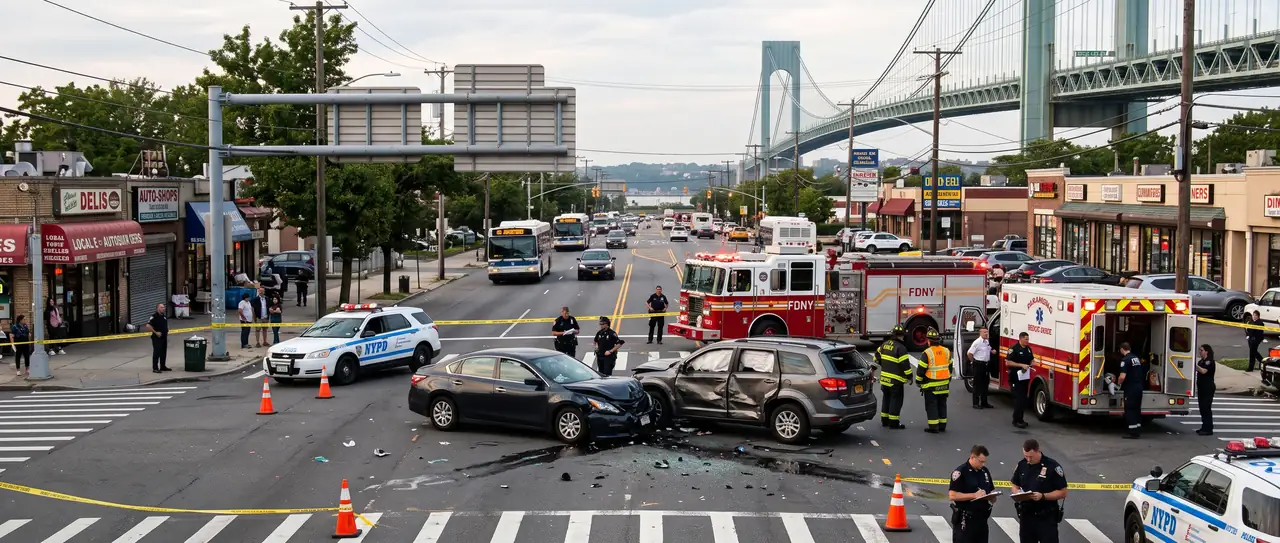
If another driver hurt you, a Staten Island car accident lawyer at Silver Law Group can start work on your claim today, and the first conversation costs you nothing. Call 212-470-4544 for a free consultation, any hour, in English, Spanish or Russian. This page is for drivers hurt anywhere from St. George to Tottenville. It explains what New York law makes you prove, which deadlines start the day of the crash, and what your claim can recover. The other driver’s insurer may have called you already. You do not owe that adjuster a statement before you speak with a lawyer.
Do You Have a Staten Island Car Accident Case?
To win a car crash claim, you have to prove four things. Each one is a separate question, and the insurer will look for a weak spot in any of them.
- Duty: the other driver had to drive with reasonable care. Every licensed driver on the road has that duty.
- Breach: the driver failed that duty by speeding, tailgating, running a light, looking at a phone or turning without yielding.
- Causation: that failure caused the crash and your injuries, not something that happened earlier or later.
- Damages: you suffered real losses, such as medical treatment, missed work and physical pain.
On Staten Island, the facts behind those elements tend to follow a few local patterns. Rear-end chains on the Staten Island Expressway happen when stop-and-go traffic bunches up near the exits. Fault in those cases often comes down to following distance and who braked first. A chain collision can also bring two or three insurers into one claim, and each will try to shift blame to the others.
Left-turn crashes on Richmond Avenue usually involve a driver cutting across oncoming traffic at a busy shopping entrance or intersection. A driver turning left must yield to oncoming traffic, so the turning driver’s insurer will claim you were speeding or ran the light. Head-on collisions on two-lane Arthur Kill Road leave little room to recover once a car crosses the center line. A head-on car crash lawyer rebuilds lane position from gouge marks, where the debris landed and each vehicle’s event data recorder before those records are lost.
Staten Island Roads Where Car Crashes Cluster
Hylan Boulevard is the deadliest street in the borough. It held five of the nine Staten Island intersections that appeared on the 2024 list of repeat-injury locations, which are the spots where people get hurt again and again rather than once. The speed camera at Hylan Boulevard and Dole Street issued 3,096 tickets in June and July 2025 alone. That is the record of a road where drivers routinely go faster than the posted limit.
Those numbers matter to your case in a practical way. When your crash happened on a corridor with documented speeding and repeat injuries, the defense has a harder time arguing that the other driver’s speed was unusual or that the collision could not have been foreseen. The location also tells your lawyer where to look for evidence. Businesses along Hylan run their own security cameras, and many of those systems record over old footage within days. Ask for that video early, or have your lawyer send the request, before the recording that shows the other car’s speed disappears.
No-Fault Benefits and the Serious Injury Threshold
Your own car insurance pays first, no matter who caused the crash. Under Insurance Law 5102(a), no-fault covers up to $50,000 in basic economic loss. That money pays for medical treatment and part of your lost earnings, but lost earnings are capped at $2,000 per month. If you earned more than that, the rest of your paycheck is not covered by no-fault.
No-fault pays nothing for pain and suffering. To sue the other driver for those losses, your injury has to meet one of the serious injury categories in Insurance Law 5102(d):
- death
- dismemberment
- significant disfigurement
- a fracture
- loss of a fetus
- permanent loss of use of a body organ, member, function or system
- permanent consequential limitation of use of a body organ or member
- significant limitation of use of a body function or system
The 2026 state budget deleted the category that once covered injuries keeping you from your usual daily activities for 90 of the first 180 days after the crash. Claims that used to fit that category now need medical proof under one of the categories above. In practice, that usually means imaging, measured range-of-motion testing and a treating doctor who will connect the limitation to the crash.
The defense will test the threshold before anything else. Insurers routinely ask a judge to dismiss the case on the ground that the injury is not serious enough. Consistent treatment records starting in the first days after the crash are the strongest answer to that argument. Gaps in your treatment are the first thing a defense doctor will point to.
Shared Fault Under New York’s 2026 Car Accident Rule
For years, New York used pure comparative fault under CPLR 1411(a). A jury set each driver’s share of the blame, and your award went down by your share. You could be 70% at fault and still collect 30% of your damages. That rule still applies to suits filed before May 26, 2026.
New CPLR 1411(b) changes the result for car accident suits filed on or after May 26, 2026. If you were more at fault than all the defendants combined, you recover nothing. Here is how the line falls:
- You were 30% at fault: you recover, and your award is reduced by 30%.
- You were exactly 50% at fault: you still recover half your damages.
- You were 51% at fault against defendants whose shares add up to 49%: you recover nothing.
The rule makes the fault percentage matter more than it used to. One percentage point can now decide whether you get anything at all. Insurers know this, which is why the adjuster’s first questions tend to steer you toward admitting you were distracted, fast or “didn’t see” the other car. A car accident attorney builds the fault case before those statements lock in. That means witness statements, the police report, scene measurements and any video, so the jury is not left to split the difference between two stories.
What Is a Staten Island Car Accident Claim Worth?
Your claim is worth the total of the losses you can prove, and proof starts in the emergency room. Once your injury meets the serious injury threshold, the claim against the at-fault driver can include:
- medical costs no-fault did not pay, including care after the $50,000 basic economic loss runs out
- excess wage loss, meaning lost pay above the $2,000 monthly no-fault cap or beyond the coverage limit
- pain and suffering, past and future, for the physical pain and the parts of daily life the injury took from you
- lost earning capacity, if the injury keeps you from returning to your old job or working the same hours
Staten Island has two Level I trauma centers: Staten Island University Hospital North on Seaview Avenue and Richmond University Medical Center on Bard Avenue. Their records are often the first independent account of your injury. They note what you complained of on arrival, what the scans showed and how you were moved through trauma care. An automobile accident attorney uses those records to tie the injury to the crash before the defense can argue it came from somewhere else.
No honest lawyer can give you a number on the first call. Value depends on how your treatment goes, whether surgery follows and what your doctors say about permanence. Settling before you know those answers usually means accepting less than the claim is worth.
Fatal Car Accidents and Wrongful Death Claims
Under EPTL 5-4.1, a wrongful death suit must be filed within two years of the date of death. The personal representative of the estate brings the claim on behalf of the family. Fatal accident lawyers usually pursue two claims together:
- a wrongful death claim for the family’s financial losses, including funeral costs and the support your loved one would have provided
- a survival claim for the conscious pain and suffering your loved one went through between the crash and death
The survival claim depends on proof that your loved one was conscious and suffering. EMS run sheets, trauma bay notes and witness accounts are how that proof is built.
The Grieving Families Act, which would have allowed families to recover for grief and lost companionship, was vetoed in December 2025. New York’s pecuniary-loss limits still apply. A wrongful death award still covers financial losses only, not the family’s grief. Those financial losses need careful documentation: earnings history, household services and the support your loved one gave dependents.
What Happens After a Staten Island Car Crash
What you do in the first ten days shapes everything that follows. Take these steps in this order where you can.
- Call 911 from the scene, even if the other driver asks you not to. The call creates a time-stamped record and brings police and EMS.
- Get the NYPD report number. Depending on where you crashed, the report comes from the 120th, 121st, 122nd or 123rd Precinct. Write down the officer’s name.
- Photograph the scene before the cars move if it is safe to do so. Get both vehicles, the plates, skid marks, traffic signals and the other driver’s license and insurance card.
- Get a medical exam the same day. Neck, back and head injuries often feel minor for the first few hours. A same-day record closes the gap the defense will try to use.
- File a report with the DMV under VTL 605 within 10 days if the damage exceeds $1,000. The police report does not take the place of your own filing.
- Do not give the other driver’s insurer a recorded statement. Refer the adjuster to your lawyer.
Filing a Car Accident Lawsuit in Richmond County
A car accident lawsuit from a Staten Island crash is usually filed in Richmond County Supreme Court, 26 Central Avenue, St. George. Supreme Court has no cap on what a jury can award. Civil Court can only award up to $50,000, so a case filed there with a serious injury would be capped before trial begins.
After filing, the case moves through set stages:
- Discovery, where both sides exchange medical records, photos, insurance policies and repair estimates.
- Depositions, where you and the other driver answer questions under oath in front of a court reporter.
- The defense medical exam, where a doctor chosen by the insurer examines you. Your lawyer prepares you for it, and that doctor’s report is written for the defense.
- Trial, which often runs fault first. The jury decides fault before it hears damages. If you lose on fault, damages never reach the jury, so the fault case has to be ready from day one.
What a Staten Island Car Accident Attorney Costs
You pay nothing upfront. Silver Law Group works on a contingency fee, which means the fee is a percentage of the money recovered for you through a settlement or a verdict. If there is no recovery, you owe no fee. The percentage is set in a written agreement you sign at the start, so you know the terms before any work begins.
This setup lets you hire a car wreck lawyer while you are out of work and waiting on no-fault checks. It also shapes how the firm works. The fee depends on the result, so the firm has a direct reason to build the case for full value instead of taking the insurer’s first offer. Ask any questions about the agreement during your free consultation and get answers before you sign.
Deadlines for Staten Island Car Accident Claims
Several deadlines start on the day of the crash, and the shortest ones come first.
- 30 days: written notice of your no-fault claim to your own insurer. Miss it and the insurer can deny benefits.
- 45 days: medical bills must reach the no-fault insurer within 45 days of treatment. Give every provider your claim number.
- 90 days: lost-wage claims must be submitted within 90 days of the work loss.
- Three years: CPLR 214 gives you three years from the crash to file a lawsuit against the at-fault driver.
The three-year deadline is the one people remember, but the no-fault deadlines are the ones that cost injured drivers money. A denied no-fault claim leaves you paying medical bills out of pocket while the lawsuit is still months or years away.
Crashes With City Vehicles or on Port Authority Bridges
If a city-owned vehicle hit you, such as an NYPD car or another municipal vehicle, the deadlines are much shorter. GML 50-e requires a Notice of Claim within 90 days of the crash. GML 50-i requires the lawsuit within one year and 90 days.
Crashes on the Goethals Bridge, Outerbridge Crossing or Bayonne Bridge can involve the Port Authority. Under Unconsolidated Laws 7107, notice must be served at least 60 days before suit, and the suit must be filed within one year. Miss either step and the claim against the Port Authority can be lost for good, even if the case is strong.
Why Staten Island Drivers Call Silver Law Group
An attorney for motor vehicle accident cases is only useful if you can reach one when you need help. Here is what you get when you call Silver Law Group:
- Consultations in English, Spanish and Russian, so you can describe the crash in the language you think in
- Availability 24/7, including the night of the crash and weekends
- An attorney who comes to your home or hospital room if you cannot travel to Midtown
- Every case prepared as if it will go to trial in Richmond County Supreme Court, because insurers set offers based on whether a firm is ready to try the case
The office is at 49 West 37th Street, 7th Floor, New York, NY 10018. Call 212-470-4544 for a free consultation about your Staten Island crash. Have your police report number and insurance card ready if you have them. If you don’t, call anyway.