

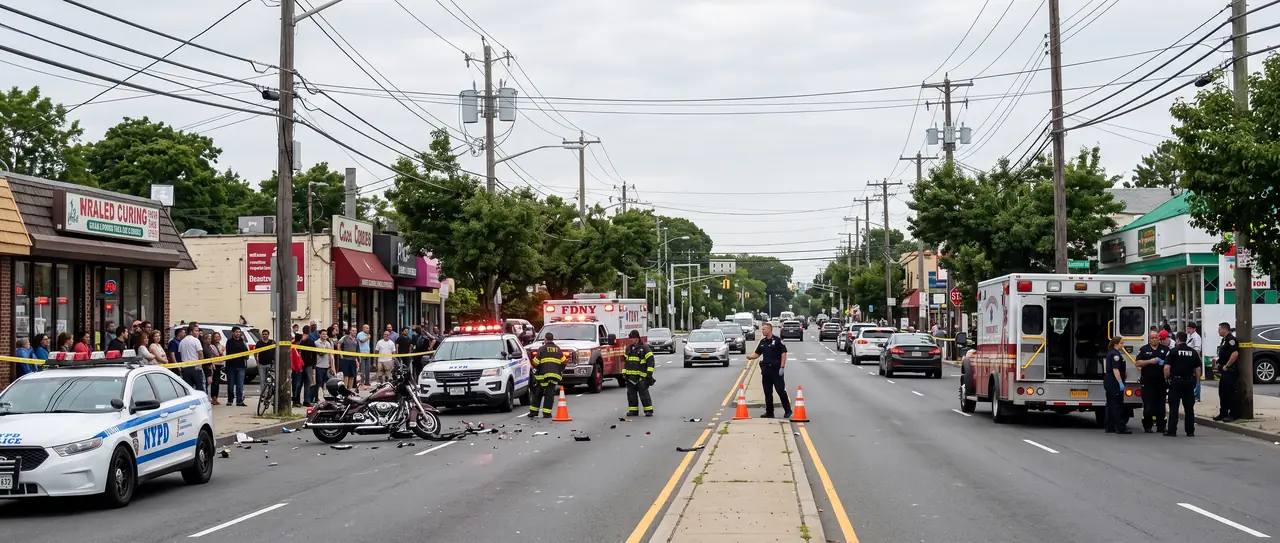
A Staten Island motorcycle accident lawyer at Silver Law Group represents riders hurt on Hylan Boulevard, the Staten Island Expressway, and the bridge merges where a driver never sees the bike until it’s too late. If a careless motorist put you on the pavement, you can pursue that driver for every dollar your injury costs, without the no-fault restrictions that bind car occupants. The consultation is free, the firm takes motorcycle cases across Staten Island on contingency, and someone answers the phone at any hour. Call 212-470-4544.
Do You Have a Motorcycle Accident Case in Staten Island?
You have a case when another driver’s negligence caused the crash, and on Staten Island that usually traces to one specific mistake a jury can point to. The left-turning driver who cuts across your path at a Richmond Avenue intersection, the car that drifts a lane change into you on the Staten Island Expressway, the door thrown open in front of you along a parked stretch of Victory Boulevard, the rear-end hit at a West Shore Expressway backup — each is a driver failing a duty they owed you, and that failure is what fixes liability.
The merges onto the Verrazzano-Narrows and Goethals Bridge are their own hazard. Drivers accelerate to blend with fast traffic, check a mirror once, and move over into a motorcycle they never registered. When that happens, the driver’s inattention, not your choice to ride, is the legal cause of your injuries.
Liability turns on proof, not on who looks sympathetic. A police report, the other driver’s statement, camera footage from a nearby business, the resting positions of both vehicles, and skid marks on the road all help show what the driver did wrong. Motorcyclists face an unfair assumption that the rider must have been speeding or weaving, so the evidence gathered in the first days matters more for you than it would for a car occupant. The stronger that record, the harder it is for an insurer to shift blame onto you later.
Why Staten Island Riders Can Sue Without the Serious Injury Threshold
Insurance Law 5102(f) leaves motorcycles out of New York’s no-fault system, and that exclusion works in your favor after a crash. Because a motorcycle is not a “motor vehicle” for no-fault purposes, you are not covered by the $50,000 in personal injury protection that pays a car occupant’s early medical bills and lost wages regardless of fault. That is the trade-off’s downside. The upside is larger.
Car occupants pay for that no-fault coverage with a restriction: to sue the at-fault driver for pain and suffering, they must first clear the “serious injury” threshold and prove a qualifying injury. You do not. As a Staten Island rider, you can bring a claim against the driver who hit you from the first dollar, for any injury, without meeting a statutory threshold first. A sprained wrist and a shattered femur both give you a direct claim against the person who caused them.
That difference changes what your case looks like from day one. Your medical bills, your lost income, and your pain and suffering all go into a single claim against the driver and the driver’s insurer, rather than being split between a no-fault carrier and a lawsuit. It also means the driver’s liability coverage is the money that matters, so identifying every insurance policy that applies to the crash is one of the first things worth doing.
How the 2026 Comparative Fault Change Affects Riders
New York changed its comparative fault rule in 2026, but the change may not touch your motorcycle claim. Under CPLR 1411(b), for cases filed on or after May 26, 2026, a plaintiff found more than 50% at fault can be barred from recovering — a departure from the state’s long-standing pure comparative negligence rule, which reduced a recovery by the plaintiff’s share of fault but never eliminated it.
The amendment is tied to claims that run through Article 51, New York’s no-fault framework. Motorcyclists sit outside Article 51 because of the 5102(f) exclusion above. The better reading, then, is that riders keep pure comparative negligence: even if a jury assigns you, say, 60% of the fault, you would still recover the remaining 40% of your damages.
This point hasn’t been tested in the courts yet, and an insurer may argue the new bar applies to you anyway. Treat it as a live question your lawyer should brief, not a settled rule to lean on.
Injuries in Staten Island Motorcycle Crashes
A rider absorbs a crash with the body, not a steel cage, so the injuries run severe. The ones that show up most often after Staten Island motorcycle crashes include:
- Traumatic brain injury, even when a helmet prevented an open wound
- Spinal cord damage that can mean partial or permanent paralysis
- Fractures to the wrists, arms, legs, and pelvis from the fall and the impact
- Degloving road rash, where sliding across pavement strips skin down to muscle or bone
- Internal bleeding, which may produce no pain for hours
Get to Staten Island University Hospital or Richmond University Medical Center the same day, even if you feel able to walk away. Brain bleeds, spinal swelling, and internal injuries often stay quiet at first and then turn dangerous. A same-day exam protects your health and builds the medical record that ties your injuries to the crash — a gap of even a few days gives the insurer room to argue you were hurt some other way.
What Your Staten Island Motorcycle Claim Is Worth
Your claim’s value is the total of what the crash took from you, in two categories the law treats differently. Economic damages are the costs with a receipt or a paycheck behind them:
- Medical bills, from the ambulance and emergency surgery through physical therapy and future care
- Lost wages for the time you couldn’t work
- Lost future earning capacity if your injuries keep you from the job you had
- Repair or replacement of your motorcycle and gear
Non-economic damages cover the harm that has no invoice: the physical pain, the loss of things you used to do, and the permanent scarring or disfigurement that road rash and surgery can leave. On a motorcycle claim these often carry real weight, because the injuries tend to be visible and lasting.
A third category applies in narrower cases. When the driver who hit you was drunk or driving with reckless disregard rather than merely careless, New York allows punitive damages meant to punish that conduct, on top of what covers your losses.
Every claim is different, and no honest lawyer can price yours from a heading on a page. What raises or lowers the number is concrete: the severity of your injuries, whether you can return to work, how clearly the driver is at fault, and how much insurance coverage exists to pay. A free consultation is where those pieces get measured against your actual facts.
What to Do After a Motorcycle Crash in Staten Island
What you do in the first hours after a crash can decide the claim months later. Work through these steps as your injuries allow:
- Call 911. A responding officer from the 120th, 121st, 122nd, or 123rd Precinct will document the scene and generate the police report that anchors your case. If you’re taken by ambulance, that’s fine — the report still gets made.
- Photograph everything you can: skid marks, the position of both vehicles, road defects or debris, traffic signals, damage to your bike, and your own injuries. Road conditions get cleared and repaired within days, so images taken now capture proof that won’t exist later.
- Get the other driver’s information and any witness names and numbers.
- Give the insurer nothing recorded. The at-fault driver’s insurance company will call quickly and ask for a recorded statement. You are not required to give one, and adjusters use those recordings to find words that shift blame onto the rider. Decline politely and point them to your lawyer.
- Stay off social media. A photo of you smiling at a family event, posted while your claim is open, becomes an exhibit an insurer uses to argue you aren’t really hurt. Assume anything you post can be found.
Then get medical care and legal advice. The sooner both start, the more of your case stays intact.
How Long You Have to File a Staten Island Motorcycle Claim
Three years is the general deadline. Under CPLR 214, you have three years from the date of a motorcycle crash to file a personal injury lawsuit against an at-fault driver, and a claim filed after that is almost always dismissed no matter how strong it is.
Two shorter clocks can override it. If a city vehicle hit you, or a road defect on a Staten Island street caused the crash, you are suing a government entity, and General Municipal Law 50-e requires a Notice of Claim within 90 days of the crash. Miss that 90-day window and you can lose the right to sue the city entirely, years before the three-year deadline would have run.
If the crash killed a rider, the family’s wrongful death claim runs on its own timeline. EPTL 5-4.1 sets a two-year limit, measured from the date of death, for the estate to bring that action.
Because these deadlines run from the crash and some of them are short, the safe move is to have a lawyer identify which clocks apply to your case within the first weeks, not the final months.
What Hiring a Motorcycle Accident Lawyer Costs
Nothing upfront, and no fee at all unless the firm wins your case. Silver Law Group takes motorcycle accident cases on a contingency fee, which means the fee is a percentage of the recovery and is paid only if there is a recovery. If the case brings nothing, you owe the firm no attorney’s fee.
The costs of building the case, including the accident investigation, crash-scene analysis, medical record retrieval, and expert witnesses, are advanced by the firm as the case goes, not billed to you along the way. That’s the point of contingency: it lets an injured rider who is out of work and facing medical bills hire a trial-ready motorcycle accident attorney without finding money first. You can weigh your options in a free consultation before you decide anything.
Why Staten Island Riders Choose Silver Law Group
Insurers settle for less when they know the lawyer across from them isn’t built to try the case. Silver Law Group prepares every motorcycle claim as if it will end in front of a Richmond County jury, and that trial-ready posture is what gives a settlement demand its weight. Cases that do go to court are heard at the Richmond County Supreme Court at 26 Central Avenue, and knowing how that courthouse handles a motorcycle case shapes how a claim is built from the start.
Consultations are handled in English, Spanish, and Russian, so you can explain what happened in the language you actually think in, without a family member translating the details of your injury.
If your injuries keep you in a hospital bed or at home, the attorney comes to you. You don’t have to travel into Midtown to start your case, though the office at 49 West 37th Street is there when you can.
And the phone is answered around the clock. A crash doesn’t wait for business hours, and the days right after are when evidence is freshest and an adjuster is most likely to call. Reaching a lawyer at 2 a.m. on a Sunday can change what your case looks like by Monday. Every case starts with a free consultation and no obligation to continue.
Talk to a Staten Island Motorcycle Accident Lawyer Today
Evidence disappears on its own schedule. Skid marks wash away, roadside cameras record over their footage, witnesses forget, and the filing clocks under CPLR 214 and GML 50-e keep running whether or not you’ve called anyone. The sooner a lawyer starts, the more of your case survives.
You might ride in St. George, Stapleton, New Springville, or Tottenville. Wherever on Staten Island a driver put you down, talk to a Staten Island motorcycle accident lawyer before you talk to the insurer again. The call is free, the line is open 24/7, and you owe nothing unless the firm recovers for you. Call 212-470-4544.