

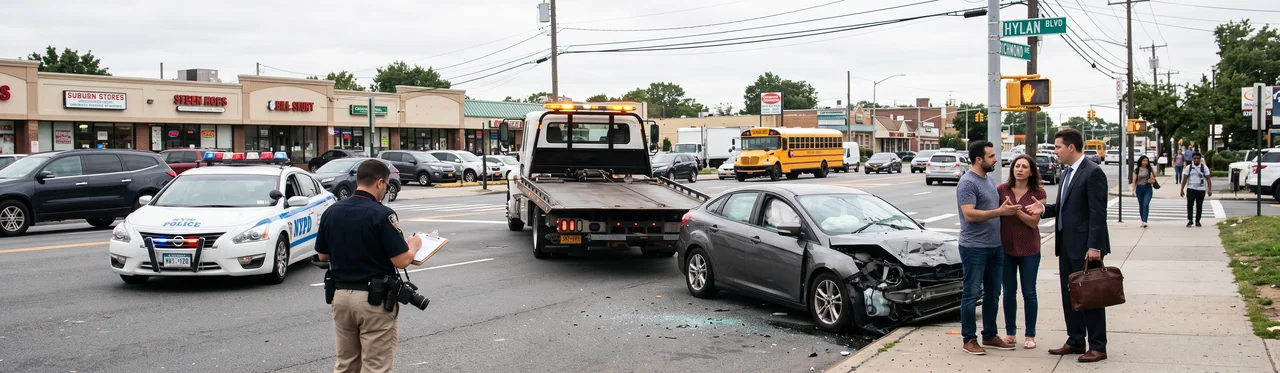
When an insurer declares your Staten Island car a total loss, the payout it offers is a number you can dispute, not a verdict you have to accept. A Staten Island total loss attorney reads the same market the carrier reads, catches the depreciation and condition adjustments used to push your check down, and forces the offer back toward what your car was actually worth the moment before the crash. The first figure an adjuster quotes is a starting point, and it is almost always low. Silver Law Group handles the property-damage side of a crash alongside any injury claim, so one office chases both checks. Every case starts with a free consultation, available 24/7 in English, Spanish, or Russian, at 212-470-4544.
When New York Declares Your Staten Island Vehicle a Total Loss
New York uses a bright-line math test. Once the estimated cost to repair your car reaches 75% of its retail value, the insurer must declare it a total loss rather than fix it. This threshold is written into state salvage rules, and it takes the decision out of your hands and the adjuster’s — the numbers decide.
That 75% figure is calculated against retail value, not what you paid or what you still owe. A ten-year-old sedan with high mileage has a low retail value, so even moderate collision damage can cross the line and total the car. A newer vehicle with the same dented quarter panel and bent frame might still get repaired, because its retail value is high enough that the repair bill stays under three-quarters of it.
The model year controls what kind of title you end up with. For a vehicle eight model years old or newer, a total-loss declaration triggers a salvage title, and that brand follows the vehicle identification number permanently. It tells every future buyer, lender, and insurer that the car was once written off. Older cars can total without the salvage brand attaching, but the write-off still ends your ownership of a drivable vehicle.
Once the car is totaled, the fight is no longer about fixing it. It is about the dollar figure the insurer assigns to your car’s value, and that figure is where a total loss lawyer earns the fee.
How Insurers Calculate Actual Cash Value and Why the First Offer Is Low
Actual cash value is what your car would have sold for on Staten Island the day before the crash, not its replacement cost and not the sticker price you remember. The insurer owes you ACV, and everything about how ACV gets built is designed by the people who have to pay it.
The starting point is comparable sales: recently sold vehicles of the same year, make, model, and trim in the local market. Staten Island prices are not Manhattan prices or upstate prices, and a fair valuation pulls from cars that actually change hands in the borough and nearby. From that market figure, the adjuster subtracts for mileage above average, for wear, for prior damage, and for anything about condition that reads as a discount.
Most carriers do not do this by hand. They feed your car into valuation software — CCC One and Mitchell are the two that dominate — and the program produces a number. These platforms are built and sold to insurers, and they lean toward low. They apply condition adjustments that assume your car was in worse shape than it was, cite comparable listings that were themselves discounted or located far from Staten Island, and quietly shave hundreds or thousands off the figure a real local sale would support.
That is why the first offer is low as a matter of routine, not accident. The number is a software output tuned in the carrier’s favor, and it counts on you accepting it before checking. You are allowed to see the valuation report the software generated, so ask for it. Every comparable it used, every deduction it applied, and every condition assumption it made is on that report, and each line is something you can challenge with a better comparable or a corrected fact about your car.
A total loss lawyer starts here, with the report, the comparables, and the deductions, because that paperwork is where the money was taken and where it can be put back.
The Five Valuation Methods New York Law Requires
State regulation limits how an insurer is allowed to reach your total-loss number. Under 11 NYCRR 216.7(c)(1), a carrier settling a total loss must base its offer on one of five methods, and each is meant to tie the payout to a real market:
- The cost of a comparable vehicle available to you, from a dealer or the used-car market, adjusted for mileage and condition.
- A quotation for a comparable vehicle obtained by the insurer from a qualified source.
- A local-market price computed by a recognized valuation source using current data for your area.
- A written statement from a qualified dealer of the cash value of a comparable car.
- A value reached through the policy’s appraisal process when you and the insurer disagree.
The point of listing these is that the insurer cannot invent a figure. It has to anchor the offer to comparable vehicles in a defined market, and if it cannot show which method produced its number, the number is exposed.
Sales tax is a separate right people forget. Under 11 NYCRR 216.6(b), a total-loss settlement has to include the applicable sales tax on the vehicle, because you will pay that tax again when you replace the car. An offer that quietly leaves tax out is short by the full New York City sales-tax rate, which on a total-loss settlement is real money the insurer owes and you would otherwise pay twice. When the software number and the regulation’s methods do not match, the regulation wins, and that mismatch is the opening a lawyer uses to move the offer.
No-Fault Won’t Pay for Your Car, So Which Coverage Does
No-fault will not buy you a new car. New York’s no-fault system, built on Insurance Law Article 51, pays for injuries, meaning your medical bills and lost wages, regardless of who caused the crash. It does not touch vehicle damage. People assume the coverage that paid their hospital bill will also cover the car, and it never does.
Three other sources can pay for the vehicle itself. The first is your own collision coverage, if you carry it. Collision pays to repair or total your car no matter who was at fault, minus your deductible, and it is usually the fastest route to a check because your own insurer processes it. You get the deductible back later if the other driver was at fault and their carrier reimburses.
The second is the at-fault driver’s property-damage liability coverage. New York requires every driver to carry at least $10,000 in property-damage liability. If the other driver totaled your car, that coverage is supposed to pay your loss up to its limit. On an older or modest car, $10,000 may cover the full value; on a newer one, the minimum policy can fall short, and the gap becomes a question of what else can be reached.
The third is uninsured-motorist property-damage coverage, which pays when the driver who hit you carried no insurance at all. It fills the hole a hit-and-run or an uninsured at-fault driver would otherwise leave in your property claim. Which coverage you use changes who you deal with, how fast you get paid, and whether a deductible comes out of your pocket, and a total loss lawyer sorts that order so no available coverage gets left unclaimed.
How to Dispute a Lowball Total-Loss Offer on Staten Island
You dispute a low offer by attacking the number where it was built, not by asking the adjuster to be nicer. Four moves do the work, and they escalate.
Start with the comparables. Pull the valuation report and check every vehicle the software used to price yours. Comparables from far outside Staten Island, cars with higher mileage or worse condition than yours, and listings that were already discounted all drag the average down. Replace them with better local matches, a same-trim car sold nearby in similar condition, and the market figure moves up.
Get an independent appraisal. A licensed appraiser inspects your car, documents its real condition and any options the software ignored, and issues a written value you can put in front of the insurer. When your appraiser’s number and the carrier’s number sit side by side, the burden shifts to the insurer to explain the gap.
Invoke the appraisal clause. Most auto policies contain an appraisal provision: when you and the insurer cannot agree on value, each side hires an appraiser, the two appraisers pick a neutral umpire, and their decision on ACV is binding. It is a contractual path around a stubborn adjuster, and simply invoking it often produces a better offer before the process finishes.
File a Regulation 64 complaint. New York’s Department of Financial Services enforces the claim-practice rules in 11 NYCRR Part 216, known as Regulation 64. If the insurer is ignoring the required valuation methods, leaving out sales tax, or stalling, you can file a complaint with DFS at dfs.ny.gov, and the carrier has to answer the regulator. These steps stack: a lawyer often runs the first two, threatens the third, and holds the DFS complaint in reserve, and the offer improves at each step because the insurer can see where the file is headed.
Diminished Value and Loss-of-Use Claims
A repaired car is worth less than a car that was never wrecked, and that loss is money you can claim. Diminished value is the gap between what your vehicle would have sold for with a clean history and what it will sell for now that the accident is on its record. Even a flawless repair does not erase the accident from the vehicle’s history report, and buyers pay less for a car that has been in a serious crash. When the other driver was at fault, their property-damage carrier can owe you that difference.
Loss of use is the second piece. While your car sits wrecked or in the shop, you still need to get around, and the at-fault carrier can be responsible for your rental car or the reasonable cost of being without your vehicle. This compensates the time you spent without it, and it is separate from the value of the car itself.
Neither claim pays automatically. You have to document the diminished value, usually with an appraisal, and keep records of rental receipts or the days you were without a car. Raised properly and early, both add real dollars to a property claim that the first offer left out.
Gap Insurance and Keeping a Salvage Vehicle
If you owe more on your car than it is worth, the total-loss check can leave you paying for a car you no longer have. The insurer pays actual cash value, but your loan balance does not care about ACV. On a financed vehicle a few years in, the payoff amount often sits above the car’s market value, and the difference is yours unless something covers it.
Gap insurance is what covers it. Guaranteed Asset Protection coverage pays the gap between what you still owe the lender and the ACV the insurer pays out. If you bought gap coverage with the car or added it to your policy, this is the moment it earns its cost — it clears the loan so a totaled car does not become a debt you keep servicing. Check your finance paperwork and your policy, because gap coverage is easy to forget you have.
Keeping the salvage car is a separate decision. You can let the insurer take the totaled vehicle, or you can keep it by accepting a reduced payout minus the salvage value. If you keep it and want to make it road-legal again, New York requires a DMV anti-theft salvage examination before it can be retitled. The examination costs $205 and verifies the vehicle and its major parts against theft records; only after it passes can you apply for a rebuilt-salvage title and register the car.
Keeping a salvage car makes sense in narrow cases, like a mechanically minor total or a car you can repair cheaply yourself. For most people the payout plus a clean replacement is the better math, but the choice is yours, and it changes what your final check looks like.
Deadlines and Where a Staten Island Total-Loss Case Is Filed
You have three years to sue over property damage in New York. CPLR 214(4) sets the statute of limitations for damage to property, including your vehicle, at three years from the date of the crash. That is longer than the injury deadlines people worry about, but it still runs, and once it passes the court will not hear the claim no matter how strong it is.
A shorter clock applies when a government vehicle caused the damage. If a New York City vehicle, such as a sanitation truck, a city bus, or a marked or unmarked municipal car, totaled your vehicle, General Municipal Law 50-e requires you to file a Notice of Claim within 90 days of the crash. Miss that 90-day window and the three-year statute barely matters, because you lose the right to sue the city long before the longer deadline is anywhere close. The 90-day rule is the one that quietly ends city cases.
Where the case is filed depends on the amount. A Staten Island total-loss lawsuit is a Richmond County matter. The Richmond County Supreme Court, at 26 Central Avenue, handles larger property-damage suits. Smaller disputes go to Staten Island’s Small Claims Court at 927 Castleton Avenue, which is built for claims under its dollar limit and lets you press a modest total-loss dispute without a full lawsuit.
Most total-loss fights settle with the insurer long before a courthouse is involved, so filing is leverage more than the usual endpoint. But the deadlines control everything behind that leverage, and a missed date, the 90-day city notice most of all, hands the insurer a defense it did nothing to earn.
What Silver Law Group Costs You: Nothing Unless We Win
You pay Silver Law Group nothing unless the firm recovers money for you. The fee is contingent: instead of billing you by the hour or asking for money up front, the firm takes an agreed percentage of what it recovers, and only if it recovers. If the claim brings in nothing, you owe no attorney’s fee. That structure exists so an injured person facing car-replacement costs and medical bills can hire a lawyer without adding another bill to the pile.
One crash usually creates two claims, the damage to your car and any injury to your body, and Silver Law Group handles both from one office. The property-damage side chases the total-loss valuation while the injury side pursues your no-fault benefits and any claim beyond them, and coordinating them under one roof keeps the two carriers from playing you against your own paperwork.
A Staten Island total loss attorney at the firm will look at your valuation report, your policy, and your loan before you sign anything with the insurer. The consultation is free and runs on your schedule, 24 hours a day, in English, Spanish, or Russian. If you cannot travel because of your injuries, the attorney can come to your home or hospital room.
Call 212-470-4544. The adjuster is working from a software number built to close low. Get your car’s real value in front of someone whose job is to raise it before you cash a check you cannot take back.