

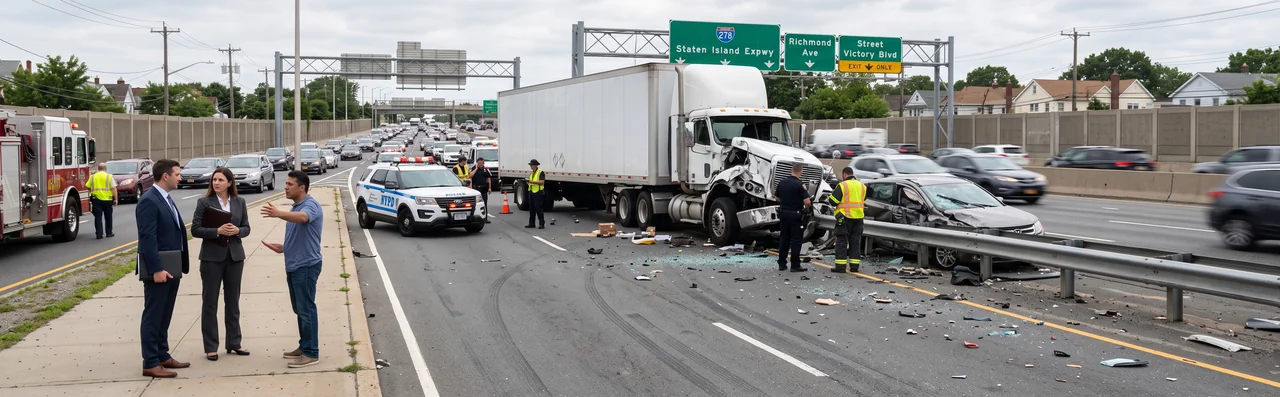
A Staten Island truck accident lawyer at Silver Law Group starts working your case while the trucking company’s insurer is already building its defense. When an 18-wheeler leaves the Verrazzano-Narrows Bridge and merges onto the Staten Island Expressway, it shares your lane at highway speed carrying far more weight than the cars around it. Container trucks rolling out of the island’s western port terminals add to that traffic through the working day. If one of them hit you, your medical bills are running now, and the adjuster who calls first works for the company that owns the truck. Silver Law Group answers 24/7 and gives free consultations in English, Spanish, and Russian. Call 212-470-4544. If you are in a hospital bed or stuck at home, the attorney comes to you rather than making you travel hurt.
Common Causes of Staten Island Truck Accidents
Most truck crashes on the island trace back to a handful of failures, and the road layout makes several of them worse. Long-haul drivers cross the Goethals Bridge at the end of shifts that federal limits say should already be over, and fatigue slows reaction time the way alcohol does. The Staten Island Expressway backs up hard at the bridge approaches, so a driver reading a dispatch screen instead of the brake lights ahead rear-ends stopped traffic at speed.
The recurring causes include:
- Driver fatigue, from drivers pushing past federal hours-of-service limits to make a delivery window
- Speeding on the West Shore Expressway, where a loaded rig builds momentum it cannot shed before it reaches congestion
- Distraction from phones, dispatch tablets, and routing screens
- Shifting or overloaded cargo that pulls a trailer sideways on the curves of the Korean War Veterans Parkway
- Brake failure and tire blowouts on rigs that skipped required maintenance
Each cause points to different evidence and often to a different party who owes you money. Fatigue lives in a logbook. A blowout lives in a maintenance file. A load that shifted lives in the cargo manifest and the record of who packed it. Sorting out which failure caused your crash is the first real work of the case, because it decides who you are actually suing.
Port, Sanitation, and Industrial Truck Traffic
The island’s freight problem is specific to its geography. Howland Hook Marine Terminal in Mariners Harbor moves shipping containers onto chassis trucks that feed the West Shore Expressway and the Goethals approaches, and Port Ivory’s container routes push the same heavy traffic through the northwest corner. Add the DSNY sanitation trucks running collection routes on Victory Boulevard, Richmond Avenue, and Hylan Boulevard, and residential streets end up carrying industrial vehicles they were never built for. A sanitation truck stopping along Hylan Boulevard is a different case from a container hauler on the West Shore, with a different owner, a different insurer, and different rules for when and how you can sue.
Who Can Be Held Liable for Your Truck Accident
More than one party usually owes you money after a truck crash, and finding all of them is where these cases turn. The driver is the obvious defendant, but under vicarious liability the trucking company answers for its employee’s negligence on the job, and the company carries the deeper insurance. A separate business may have loaded the cargo; if the load shifted because it was stacked wrong, that loader shares the blame. The garage or contractor that serviced the brakes can be liable when maintenance was skipped or done badly. When a tire or a brake component fails on its own, the parts manufacturer enters the case.
Federal law decides much of this. The FMCSA hours-of-service rules cap how long a driver can stay behind the wheel, and a logbook showing an over-hours shift is direct proof of negligence. The truck’s black box records speed, braking, and engine data in the seconds before impact. Those records and the driver’s logs get overwritten or lost fast, which is why the demand to preserve them has to go out early, before the carrier’s own people decide what survives.
Injuries and the Serious Injury Threshold
The mass of a loaded rig turns a survivable car crash into a catastrophic one, and the injuries that come out of Staten Island truck wrecks tend toward the permanent:
- Traumatic brain injury, from concussion to lasting cognitive damage
- Spinal cord injury, including partial and complete paralysis
- Crush injuries to limbs and torso
- Traumatic amputation
New York’s no-fault system pays your first medical bills no matter who caused the crash, but it also blocks most injury lawsuits unless your injury clears the serious-injury threshold in Insurance Law 5102(d). The catastrophic injuries a truck causes routinely meet that bar, which lets you step outside no-fault and sue the trucking company directly for pain and suffering. Trauma care matters to the claim as much as to your body. The records from Staten Island University Hospital or Richmond University Medical Center document how severe the injury is, and that documentation is what proves you crossed the threshold.
Compensation You Can Recover
What you can recover depends on the injury, the income you lost, and the insurance behind the truck. Commercial trucking policies carry far higher limits than the coverage on a private car, which is the main reason a serious truck case is worth pursuing all the way. Your claim can include:
- Medical bills already incurred
- Future medical care and rehabilitation for lasting injuries
- Lost wages during your recovery
- Reduced earning capacity if you cannot return to the same work
- Pain and suffering
- Compensation for permanent disability
Federal rules require interstate carriers to carry substantial liability coverage, so the money to pay a serious claim usually exists. The fight is rarely about whether there is coverage. It is about how much of it the insurer will admit it owes, and that is a fight the carrier expects to win against an unrepresented victim.
What to Do After a Staten Island Truck Accident
What you do in the first days shapes what your claim is worth later.
- Get medical care immediately, even if you feel functional, because some truck-crash injuries surface days after the adrenaline fades.
- Get the police report, which fixes the basic facts and identifies the truck and its carrier.
- Photograph the scene, the vehicles, the skid marks, and your injuries before anything is cleaned up or repaired.
- Decline any recorded statement to the trucking company’s adjuster, who is trained to get you to downplay your injury or admit fault.
- Move to preserve the black-box and driver-log data before the trucking company can lose or overwrite it.
That last step is the one victims miss, and it is often the one that decides the case. A lawyer can send a spoliation letter the same day, which legally forces the carrier to keep those records instead of letting them disappear on the normal overwrite cycle.
Deadlines to File Your Staten Island Truck Accident Claim
Miss the filing deadline and the strength of your case stops mattering. A Staten Island truck claim runs on more than one clock at once:
- Three years to file a personal injury lawsuit under CPLR 214, counted from the date of the crash
- Two years to bring a wrongful-death claim under EPTL 5-4.1 if the crash killed a family member
- 90 days to file a Notice of Claim under GML 50-e when a city vehicle is involved, such as a DSNY sanitation truck
The 90-day municipal window is short and easy to blow past, and once it closes a claim against the city is usually dead. Sharing part of the blame, on the other hand, does not end your case. Under CPLR 1411, New York uses pure comparative negligence, so if you were 20 percent at fault your recovery drops by 20 percent but you still recover. Insurers lean hard on comparative fault to shrink what they pay, which is why how the fault story gets told is worth fighting over.
Where Your Case Is Filed and Why Local Counsel Matters
A Staten Island truck accident case gets filed in Richmond County Supreme Court, at 26 Central Avenue in St. George, and that venue is not a formality. The judges, the clerks, the local jury pool, and the way Richmond County runs a motor-vehicle trial all shape how your case moves. A firm that files across the water and rarely appears in St. George is learning the building on your time. Local familiarity reaches the roads too. A lawyer who knows how traffic actually behaves at the Staten Island Expressway’s bridge approaches, or where the West Shore Expressway backs up, can take apart a driver’s account with facts a stranger to the island would never think to raise. When the case reaches a Staten Island jury, that jury drives these roads. Presenting the crash the way people who cross the Goethals Bridge and Hylan Boulevard every day already understand it counts for more than any polished out-of-area pitch.
Why Choose Silver Law Group
Silver Law Group works Staten Island truck cases on a contingency fee, which means you pay no attorney fee up front and no fee at all unless the firm recovers money for you. The fee is a percentage of the recovery, so the firm gets paid only when you do, and if the case recovers nothing you owe no attorney fee. That structure lets you take on a trucking company and its insurer without spending money you do not have while you are out of work.
Every case is prepared as if it will be tried. Insurers settle differently with a firm that is ready to put the case in front of a Richmond County jury than with one looking to close the file quickly. If you cannot come to the Midtown office at 49 West 37th Street, the attorney comes to your home or hospital room. Consultations are free, available 24/7, and offered in English, Spanish, and Russian. Call a Staten Island truck accident lawyer at 212-470-4544.