

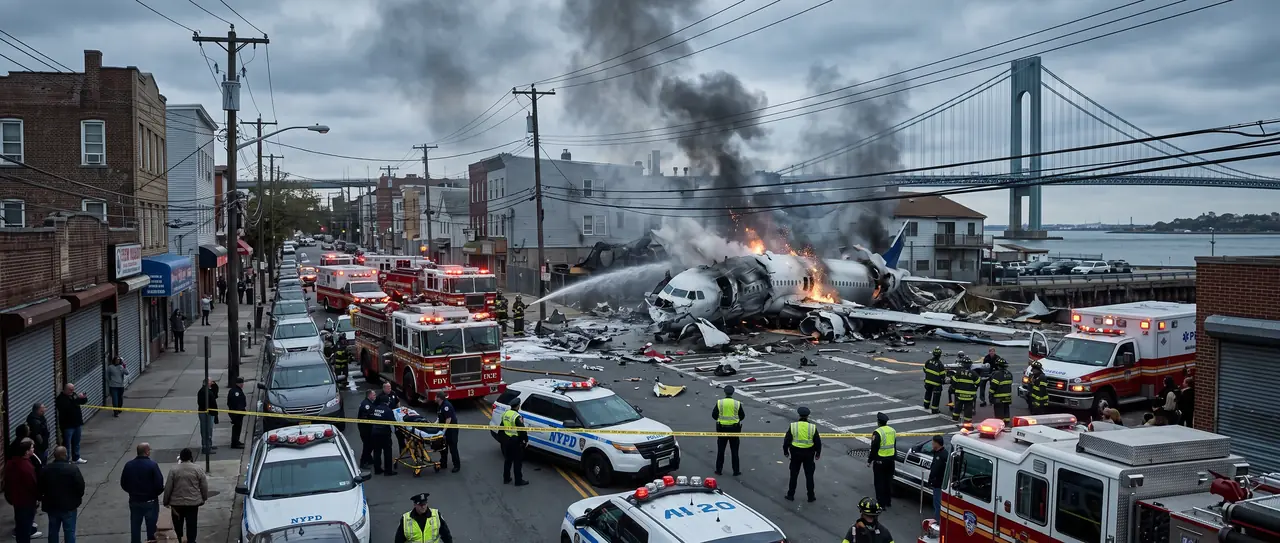
A Staten Island aviation accident lawyer represents the people a crash leaves behind: passengers hurt on a flight, crew members injured on the job, and residents struck on the ground when an aircraft comes down. Silver Law Group handles these claims for Staten Island families, from an airliner out of Newark to a charter jet or a sightseeing helicopter. The medical bills start immediately, and the airline or operator’s insurer moves fast to limit what it pays. Your consultation is free, any hour of the day, and you owe no fee unless the firm recovers for you. Call 212-470-4544 to talk with an attorney about what happened and what your claim may be worth.
Do You Have a Staten Island Aviation Accident Claim?
Four groups of people can bring an aviation accident claim in New York, and you likely fall into one of them. Passengers injured on a flight can sue the airline or operator whose negligence caused the crash. Flight crew and cabin staff hurt on the job may have both a workers’ compensation claim and a separate case against a third party, such as a manufacturer or a maintenance contractor. People on the ground, struck by wreckage or a low-flying aircraft, can sue even though they never boarded. And when someone dies, the family brings a wrongful-death claim through the estate.
What you do in the first week shapes all of it. Get examined right away, at Staten Island University Hospital or Richmond University Medical Center, even if you feel able to walk away. Crash injuries hide. Spinal damage, internal bleeding, and concussion often surface days later, and a gap between the crash and your first medical visit is the first thing a defense lawyer uses to argue you were never really hurt. The hospital record you create now becomes the backbone of your claim.
Keep everything: your boarding pass or charter booking, the names of other passengers, photographs of the aircraft and the scene, and any letter or email the operator sends you. If you cannot gather it yourself, tell the firm what exists and where. Preserving that evidence early is part of the job before it disappears.
Aircraft We Handle: Airlines, Charter and Private Planes, Helicopters
The type of aircraft in your crash decides which rules apply, who the defendant is, and which insurer you are up against. The cases the firm takes cover the full range of what flies over and around Staten Island:
- Commercial airliners — scheduled jets carrying paying passengers, governed by federal airworthiness and crew rules and backed by large aviation insurers.
- Private jets and general-aviation planes — smaller aircraft flown for business or personal travel, where a single owner or pilot is often the key defendant.
- Charter flights — on-demand operators who owe passengers a high duty of care but frequently carry thinner insurance than the airlines.
- Sightseeing helicopters — tour flights that run low and slow, with a safety record that has drawn repeated federal scrutiny in the New York area.
- Medevac helicopters — air ambulances, where a medical emergency, tight landing zones, and night flying raise the odds of a crash.
Each of these runs under a different slice of federal law: Part 121 for the airlines, Part 135 for charter and air-taxi work, Part 91 for general aviation. Each pairs with a different operator and a different insurance structure. A charter operator’s coverage rarely looks like a major airline’s, and a helicopter tour company’s exposure is different again. Working out which regime governs your crash is the first step in figuring out who pays, and it changes how an aviation accident lawyer builds the case from day one.
Aviation Crashes Over Staten Island
On December 16, 1960, a TWA Super Constellation collided with a United DC-8 over New York Harbor and came down at Miller Field in New Dorp, killing everyone aboard. It remains the sharpest reminder that Staten Island sits directly under some of the busiest airspace in the country, and the geography that put that wreckage on the ground has not changed.
Newark Liberty is the reason. When jets depart Newark on runway 22, their climb path carries them southeast over the Arthur Kill and the western shore of Staten Island at low altitude, still gaining speed and height. An engine failure or bird strike in those first minutes gives a crew almost no room, and the borough’s shoreline neighborhoods are what lie below.
Helicopters add a second layer of risk closer to the deck. Sightseeing and charter helicopters operate under visual flight rules, flying low and by eye rather than under continuous radar control, and several run out of Linden Airport just across the Arthur Kill in New Jersey. Their routes take them along the Kill and over the Staten Island waterfront, where low altitude leaves little margin when a mechanical problem or a moment of poor visibility hits. Tour helicopters in the New York region have a documented history of hard landings and crashes into the water.
This history matters to your case for a practical reason. It tells an investigator where to look: the departure corridor a plane was flying, the visual route a helicopter took, the radar and radio data federal investigators pull after any crash. A claim built on that specific record carries more weight than one that treats the crash as a generic accident. A lawyer who knows the local pattern can point investigators at the right evidence before it is gone.
What Your Staten Island Aviation Claim Is Worth
Your claim’s value is built from what the crash actually cost you, in three categories.
Economic damages cover the measurable losses: emergency care, surgery and rehabilitation, future medical treatment, lost wages, and lost earning capacity if your injuries keep you from the work you did before. Non-economic damages cover what has no receipt — pain, disfigurement, disability, and the loss of the life you had. In a wrongful-death claim, the damages shift to the survivors: the financial support the person would have provided, the loss of a parent’s guidance to their children, and the conscious pain the victim suffered before death.
Two rules make aviation cases different from an ordinary crash claim, and both work in your favor.
First, New York follows pure comparative negligence under CPLR 1411. If a jury decides you were partly at fault, say by unbuckling during a warning or ignoring a crew instruction, your recovery drops by your share of the blame but never disappears. Even a plaintiff found mostly responsible still collects the remaining percentage. Many states cut off recovery once you cross 50 percent; New York does not.
Second, aviation injuries are not trapped by the no-fault system that limits ordinary car-accident claims. New York’s no-fault law and its serious-injury threshold apply to motor vehicles, not aircraft. You do not have to clear a statutory injury bar before you can sue for pain and suffering after a plane or helicopter crash. Your right to full damages is open from the start, which is one reason these claims are worth pursuing with a lawyer rather than taking an insurer’s first offer.
Who Is Liable and How Fault Is Proven
A single crash usually has more than one party at fault, and finding all of them decides how much you can recover. The pilot may have flown into weather they should have avoided or skipped a checklist step. The airline or charter operator may have pushed an overworked crew, deferred maintenance, or dispatched a plane it knew was marginal. A mechanic or maintenance contractor may have signed off on a repair that failed. And the maker of the aircraft or a single component — an engine, a rotor, an altimeter — may be liable if a design or production defect brought the plane down.
Proving which of them is responsible turns on evidence you cannot get on your own. After a serious crash, the National Transportation Safety Board investigates the probable cause and the Federal Aviation Administration reviews whether its rules were followed. Their work produces a record — wreckage analysis, radar tracks, radio transcripts, weather data — that no private party could assemble alone, and it often points to failures the operator would never admit.
That record is only useful if the underlying evidence survives. The flight data recorder and cockpit voice recorder, the aircraft’s maintenance logs, the pilot’s training and duty-time records, and the operator’s dispatch files can all be overwritten, lost, or quietly discarded once litigation looks likely. A lawyer moves early to send preservation demands and, where needed, court orders that freeze this evidence in place. One catch shapes the whole case: the NTSB’s report on probable cause cannot be used in your civil suit to prove fault, so your lawyer has to rebuild the proof independently from the same underlying data.
When Air Traffic Control Causes a Crash
When the mistake belongs to an air traffic controller, the party you sue is the United States government, because controllers are federal employees. A controller who gives a wrong heading, clears two aircraft into the same airspace, or fails to warn a pilot about traffic or terrain can be the cause of a crash, and the Federal Tort Claims Act is the route to hold the government responsible.
That route has its own steps, and skipping them ends the case. Before you can file suit, you must submit an administrative claim to the federal agency, which for controllers is the FAA, within two years of the crash. The agency then has six months to respond. Only after it denies the claim, or lets the six months pass, can you go to court.
For a Staten Island crash, that court is the U.S. District Court for the Eastern District of New York, which covers Richmond County. An FTCA case also runs without a jury, decided by a federal judge, and the government’s lawyers defend these claims hard. The two-year administrative deadline is strict and separate from the deadlines that govern your claims against the airline or operator, so a case that mixes a private defendant with a government one runs on two clocks at once. Missing the FTCA clock forfeits the claim against the controller even if the rest of your case is on time.
What It Costs to Hire Silver Law Group
Nothing, unless the firm wins your case. Silver Law Group takes aviation accident cases on a contingency fee, which means you pay no money up front and no hourly bills while the case runs. The firm’s fee is a percentage of the recovery, collected only if there is a recovery. If the case does not succeed, you owe the firm no fee.
Aviation cases are expensive to build. They need accident-reconstruction engineers, pilots and maintenance experts, medical specialists, and the cost of obtaining records, radar data, and depositions. The firm advances those costs as the case goes, so you are not asked to fund the investigation out of pocket while you are also dealing with medical bills. Those expenses are repaid from the recovery at the end.
The first conversation costs nothing and carries no obligation. You can find out whether you have a claim, who the likely defendants are, and what the process looks like without paying for the meeting. Call 212-470-4544 to set it up.
Deadlines to File a Staten Island Aviation Claim
Every aviation claim runs on a clock, and more than one may apply to your case at the same time. Miss the deadline that governs your claim and the court will dismiss it no matter how strong the evidence.
For a personal-injury claim from a crash, New York gives you three years from the date of the crash to sue, under CPLR 214. That is the outer limit for an injured passenger, crew member, or person hurt on the ground.
A wrongful-death claim runs on a shorter clock. Under EPTL 5-4.1, the estate has two years from the date of death to file. The date of death is not always the date of the crash, and the estate has to be opened and a representative appointed before suit can be brought, which takes time you do not want to lose.
International flights follow a different rule. Under the Montreal Convention, a passenger injured or killed on a covered international flight has two years to sue, and courts apply that limit strictly. If your flight originated or ended outside the United States, this deadline can control instead of the New York ones.
FTCA claims against the government add their own two-year administrative deadline, described above. When a case involves a private operator and a federal defendant, or a domestic and an international leg, the shortest applicable clock is the one that matters. State-court cases from a Staten Island crash are filed in Richmond County Supreme Court in St. George. Because a wrongful-death or international claim can lapse a full year before the three-year injury deadline, pinning down which clocks apply is the first thing a lawyer does with a new file.
Why Silver Law Group — Free Staten Island Consultation
You can reach Silver Law Group any hour of the day. Consultations are free and available 24/7, in English, Spanish, or Russian, so the language you are most comfortable in is the one you use to explain what happened.
If your injuries or a hospital stay keep you from coming to the office, an attorney comes to you, at your home or your bedside at Staten Island University Hospital, Richmond University Medical Center, or wherever you are recovering. You do not have to travel to start your case.
The firm prepares every aviation accident case as though it will be tried. Insurers and their lawyers settle differently when the file across the table is built for a courtroom rather than a quick payout, and that preparation protects the value of your claim whether it settles or goes to a jury.
The office is at 49 West 37th Street, 7th Floor, in Midtown Manhattan, a short trip from Staten Island by the ferry or the bridges. Call 212-470-4544 now to speak with an aviation accident lawyer about your crash and your options.