

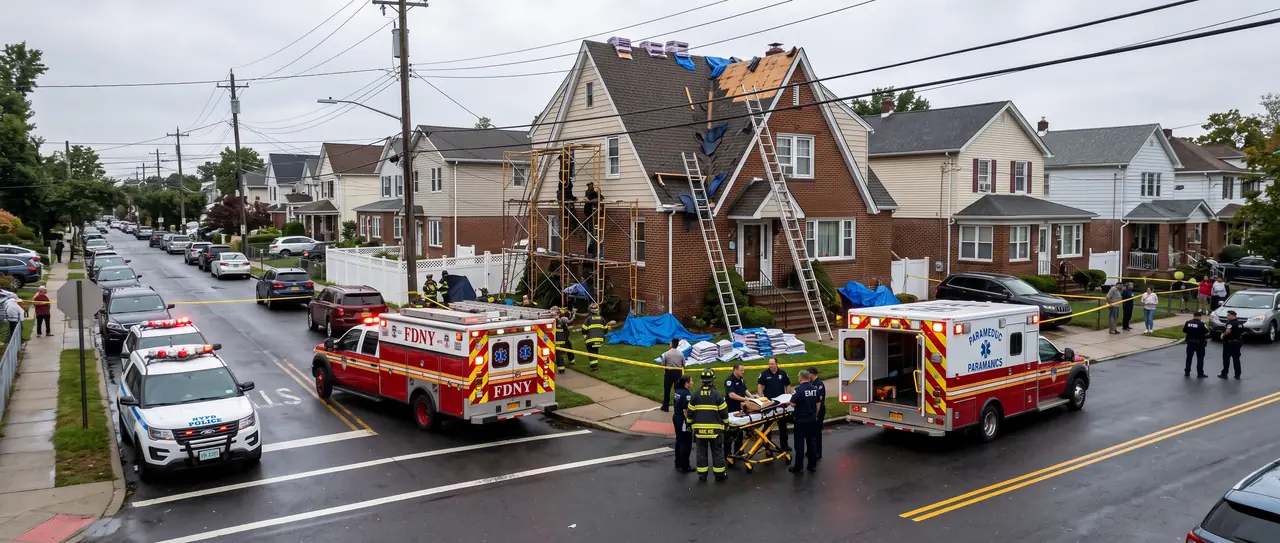
A fall from a Staten Island roof can end your ability to work in seconds. As a Staten Island roofing accident lawyer, Silver Law Group represents roofers hurt on job sites across the borough — from South Shore home builds to West Shore warehouse projects. New York’s Labor Law puts the cost of a gravity-related fall on the contractor and the property owner, not on you, and your claim can reach well past workers’ comp. Call 212-470-4544 for a free consultation, day or night. The attorney comes to your home or hospital room, and you owe no fee unless you recover.
Do You Have a Roofing Accident Case in Staten Island?
Most roofing injuries on Staten Island trace back to a few situations, and each one can support a claim against someone beyond your employer. A slide off a steep pitch is the classic one. New home builds along the South Shore mean crews working on 6-in-12 and steeper slopes, where a wet shingle or a missing anchor point turns a slip into a two-story fall. Scaffold and ladder collapses are the second: a plank that shifts, a ladder footed on soft ground, an extension ladder that was never tied off. When the equipment fails, the fall is not your mistake.
Falling debris hurts roofers who never leave the ground. A dropped bundle of shingles, a sliding sheet of plywood, or a tool knocked off the edge can fracture a skull or crush a hand on the crew below.
On the West Shore, where warehouse and industrial roofing covers large flat spans, the hazards shift toward long runs near unguarded edges, open skylights, and rooftop power lines. Contact with an energized line can cause an electrocution injury or throw a worker off the roof entirely.
If any of this describes your accident, the question is not whether you were careful. It is which party controlled the site, the equipment, or the safety plan that failed. That is what decides who pays.
How New York Labor Law Protects Injured Roofers
New York gives roofers a stronger set of protections than almost any other injured worker, because roofing is a gravity job. Three sections of the Labor Law do the work.
Labor Law 240(1) — the Scaffold Law — is the most powerful. It places absolute liability on contractors and property owners when a worker is hurt by a fall from height or by a falling object and no safety device protected against it. Absolute liability means that once you prove the height-related failure caused your injury, the owner and general contractor cannot escape by arguing you were careless. A missing guardrail, an unsecured ladder, or a harness that was never provided is enough.
Labor Law 241(6) covers the specific safety rules. It ties liability to violations of the Industrial Code at 12 NYCRR Part 23, the regulations that dictate scaffold planking, ladder footing, opening protection, and fall-arrest equipment on a roofing job. When a contractor skips one of those requirements and you get hurt, the violation itself becomes evidence of fault.
Labor Law 200 is the general duty to keep the site safe. It applies when the owner or contractor controlled the work, or knew about a dangerous condition and left it in place.
Contractors and their insurers push back the same way every time. They say the roofer moved too fast, ignored a rule, or caused his own fall. Under the Scaffold Law that argument usually fails, because a worker’s own carelessness is not a defense to a 240(1) claim. The narrow escape hatch — that the worker was the sole cause of the accident — closes the moment there is a genuine equipment or protection failure.
Who Can Be Held Liable Beyond Your Employer
Workers’ comp bars you from suing your own employer, but it does nothing to protect the other companies on the site. Those are the parties a third-party lawsuit reaches.
- General contractors who ran the site and set — or ignored — the safety plan.
- Property owners, who carry Scaffold Law liability even when they hired the work out.
- Other subcontractors whose crew dropped material, left an opening unguarded, or created the hazard that hurt you.
- Equipment manufacturers, when a ladder, harness, lift, or scaffold component failed because it was defectively made.
Naming every liable party matters because your employer’s comp coverage does not pay for pain and suffering or your full lost wages. Those damages come from the third-party case, and only the right defendants unlock them.
Workers’ Comp vs. a Third-Party Lawsuit
These are two separate claims, and most seriously injured roofers on Staten Island have both.
Workers’ compensation is no-fault. You file it against your employer’s insurer, and it pays regardless of who caused the accident, but it pays a limited menu. Comp covers your medical treatment and roughly two-thirds of your average weekly wage, up to a state cap, while you cannot work. It does not pay for pain and suffering, and it does not make up the gap between two-thirds of your wages and your full paycheck. For a roofer who was earning real money on the tools, that gap is large.
A third-party lawsuit fills it. Brought against the contractors, owners, or manufacturers responsible for the fall, it recovers your full lost earnings, past and future, plus pain and suffering, disfigurement, and the loss of your ability to do the work you trained for. This is where a serious roofing case is actually made whole.
The two claims connect through the workers’ comp lien. When the comp insurer pays your benefits and you later recover in the third-party suit, the insurer has a right to be repaid out of that recovery for what it laid out. That sounds like it cancels the benefit of suing, but it does not. The lien is negotiable, it gets reduced to account for the litigation costs and attorney’s fees that produced the recovery, and a properly handled case resolves the lien so more of the money stays with you. Handled carelessly, the lien can eat a settlement. That is one of the main reasons to have a lawyer coordinate both claims from day one.
What Your Staten Island Roofing Injury Claim Is Worth
Two categories of damages make up a New York roofing claim, and how they add up depends on your injuries and your ability to keep earning.
Economic damages are the measurable costs:
- All medical bills — emergency care, surgery, hospital stays, rehab, and future treatment.
- Lost wages for the time you could not work, and lost future earning capacity if you cannot return to roofing.
- Out-of-pocket costs tied to the injury, from medical equipment to modifications you need at home.
Non-economic damages cover what the money cannot fully measure:
- Pain and suffering, both what you have already been through and what you face going forward.
- Permanent disability and disfigurement, including scarring from burns or surgery.
- The loss of the physical ability to do your trade.
The severity of the injury drives the value. Roof falls produce the worst of them: spinal cord damage that can cause paralysis, traumatic brain injury from a head strike, and complex fractures of the legs, pelvis, and spine that need multiple surgeries. Electrocution and rooftop fires bring severe burns. The most serious of these cases are treated at Staten Island University Hospital’s Ocean Breeze campus, home to the borough’s only Level I trauma center and its regional burn center, and the record from that treatment becomes the medical backbone of your claim.
No two roofing cases are worth the same amount, and anyone who quotes you a number before reviewing your medical records and your wage history is guessing. What the value turns on is documented harm: the diagnosis, the surgeries, the permanence, and the earnings you lost.
Can You Recover If the Fall Was Partly Your Fault?
Yes. New York follows pure comparative negligence under CPLR 1411, which means your own share of fault reduces your recovery but never erases it.
Here is how it works. If a jury decides you were 20 percent responsible — say you moved onto a section of roof before it was fully anchored — your award is reduced by that 20 percent and you still collect the other 80 percent. Even a roofer found mostly at fault keeps a recovery proportional to everyone else’s share.
This matters because blame-shifting is the insurer’s default strategy. Every percentage point of your fault is a percentage point the adjuster does not have to pay, so they comb your statement for admissions and read your own words back to you.
Two things blunt that. On a Labor Law 240(1) claim, your comparative fault usually is not a defense at all. And comparative negligence is a question for the jury, not the adjuster, so whatever percentage an insurance representative assigns you has no legal force. Do not accept their number.
What to Do After a Roofing Accident
The hours and days after a fall shape your claim more than anything a lawyer does later. Take these steps.
- Get treated immediately. Go to the emergency room — Richmond University Medical Center in West Brighton runs a trauma center — even if you think you can walk it off. Internal injuries and spinal damage do not always announce themselves, and a gap in treatment becomes the insurer’s argument that you were never really hurt.
- Report the injury to your employer in writing. Workers’ comp requires written notice within 30 days, and a dated report also fixes the date and cause before anyone’s memory shifts.
- Photograph the scene. Get dated photos of the scaffold, ladder, harness, anchor points, and the spot you fell from, before the contractor cleans it up or repairs it.
- Collect witness contacts. Get names and phone numbers of coworkers and anyone else who saw the fall. Witnesses scatter to other job sites fast.
- Say nothing recorded to the insurer. An adjuster may call within days asking for a recorded statement. You are not required to give one, and you should not until you have a lawyer.
Deadlines to File a Staten Island Roofing Accident Claim
A roofing case runs on several clocks at once, and the shortest one you miss can end the claim before the others matter.
- Three years to sue for your injuries. Under CPLR 214, the statute of limitations on a personal injury lawsuit, including a Labor Law claim against a contractor or owner, is three years from the date of the fall.
- Two years for a wrongful-death claim. If a roofer is killed, EPTL 5-4.1 gives the family two years from the date of death to bring a wrongful-death suit. This runs separately from the injury deadline.
- 30 days to notify your employer. Workers’ comp requires written notice to your employer within 30 days of the accident. Miss it and you can lose your benefits.
- Two years to file with the Workers’ Compensation Board. Your formal comp claim must be filed with the Board within two years of the injury.
- 90 days for a claim against the City. If your fall happened on a city-owned building, GML 50-e requires a Notice of Claim within 90 days before you can sue a public entity. This is far shorter than the three-year rule, and it traps workers who assume they have years.
The dates are not flexible, and the evidence disappears long before they expire. Photographs get deleted, scaffolds come down, witnesses move on. The sooner the case is documented, the stronger it holds.
Why Injured Roofers Across Staten Island Call Silver Law Group
You do not pay Silver Law Group out of pocket, and you do not pay by the hour. The firm works on contingency: the fee is a percentage of what you recover, and if there is no recovery, there is no fee. The costs of building the case — expert reviews, medical records, court filings — are advanced by the firm, not billed to you while you are out of work. That structure exists so an injured roofer with no paycheck can still take on a contractor’s insurance company.
Every case starts with a free consultation, available 24 hours a day, in English, Spanish, or Russian. If you cannot travel because you are in a cast, a wheelchair, or a hospital bed, the attorney comes to you, at your home or at Staten Island University Hospital or Richmond University Medical Center.
The firm prepares every roofing case as if it will be tried. Insurers track which lawyers try cases and which only settle, and a file built for Richmond County Supreme Court in St. George carries more weight than a demand letter from a firm that always folds. Most cases still settle, but they settle for more when the other side knows you are ready to put the case in front of a Staten Island jury.
The office is at 49 West 37th Street, 7th Floor, in Midtown Manhattan. Call 212-470-4544 to start.