

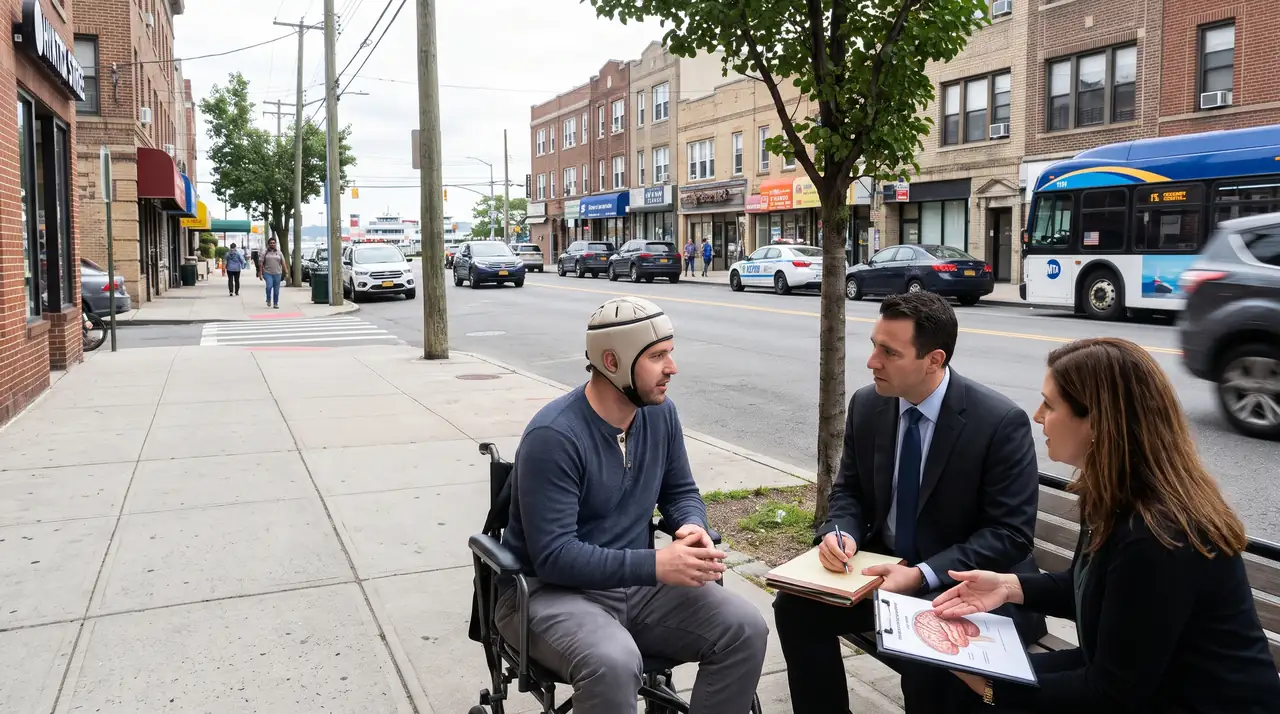
A Staten Island brain injury lawyer at Silver Law Group handles claims for traumatic brain injury, concussion, hematoma and anoxic brain injury caused by someone else’s negligence. We represent people hurt anywhere on the island, from a rear-end crash on the Staten Island Expressway to a fall on a broken stoop in St. George.
Each of these injuries leaves different evidence. An anoxic injury, where the brain is starved of oxygen after a near-drowning or a medical error, is proven differently from an impact injury. The insurer will look for the gap in your medical proof, so your case is built to close that gap from the first week.
Call 212-470-4544 for a free consultation. You pay no fee unless you recover, and an attorney can come to your home or hospital room.
Do You Have a Brain Injury Case on Staten Island?
A brain injury case needs a party you can name and four elements you can prove against that party.
- The at-fault party owed you a duty of reasonable care. Every driver owes it to others on the road, and every property owner owes it to lawful visitors.
- They breached that duty by speeding, running a light, or leaving a broken step unrepaired.
- The breach caused your brain injury, rather than an earlier condition or a later accident.
- You suffered damages, such as treatment costs, lost income, or lost ability to work and live as you did before.
The diagnosis matters because each type of injury shows up differently in the medical record.
- A concussion is a mild TBI caused by the brain moving inside the skull. It usually shows nothing on a standard CT.
- A contusion is a bruise on brain tissue, often visible on imaging near the point of impact.
- A hematoma is a pool of blood between the skull and brain or inside the brain itself, which can build pressure and may need emergency surgery.
- Diffuse axonal injury tears nerve fibers across wide areas of the brain during violent acceleration and deceleration, as in a high-speed crash, and early scans can look close to normal.
You do not have to have been knocked out. Many people with concussions never lose consciousness, and New York negligence law does not require a blackout for a claim. The question is what the medical record shows about your brain and your life since the injury.
Car and Truck Crashes on Staten Island Roads
The forces that injure a brain in a crash depend on the road, and Staten Island’s main routes produce different kinds of crashes.
- Hylan Boulevard is a NYC DOT Vision Zero priority corridor, which means the city has flagged it for its record of serious-injury crashes. Pedestrians struck on Hylan often hit their heads on the vehicle and then on the pavement.
- The Staten Island Expressway’s stop-and-go traffic produces rear-end impacts, which snap the head forward and back and move the brain inside the skull.
- The West Shore Expressway carries heavy truck traffic, and a truck’s weight turns a moderate collision into a violent one.
- Richmond Avenue’s commercial driveways and turning traffic set up side-impact crashes that throw a head into a door frame or window.
In a truck case, the investigation also reaches the trucking company, including its driver hiring, maintenance records and hours of service.
To sue a driver for pain and suffering beyond no-fault, you must prove a serious injury under Insurance Law 5102(d). Before 2026, many concussion victims qualified under the 90/180-day category, which covered an injury that kept you from substantially all your usual activities for 90 of the first 180 days. The 2026 amendment repealed that category. Your claim now has to fit one of the remaining categories, so objective medical findings of lasting limitation decide whether a car-crash TBI case can go forward.
Falls on Sidewalks, Stairs and Construction Sites
The New York State Department of Health lists falls among the leading causes of traumatic brain injury. A fall becomes a legal claim when someone else controlled the dangerous surface.
- NYC Administrative Code 7-210 makes the owner of property next to a sidewalk liable for failing to keep it reasonably safe. A cracked slab outside a store on Forest Avenue is the store property owner’s responsibility.
- The same law exempts owner-occupied one-to-three-family homes used only as residences. Staten Island has many of these houses, and when you fall in front of one, the City answers for the sidewalk instead of the homeowner. That changes your deadline, as explained below.
- Landlords and building owners are responsible for stairways, handrails and lighting in the areas they control.
- Labor Law 240(1) holds owners and contractors liable when a worker falls from a height because they did not provide proper protection, such as a secured ladder, scaffold or harness. The worker’s own carelessness generally is not a defense to a 240(1) claim.
Proving a Brain Injury That Doesn’t Show on a Scan
The defense will point to your normal emergency-room CT scan, and that scan proves less than they claim.
A CT is designed to find bleeding, skull fractures and swelling that need treatment right away. A standard MRI is more sensitive but can still miss microscopic damage to nerve fibers, which causes many lasting concussion symptoms. A clean scan rules out an emergency. It does not rule out a brain injury.
Four kinds of evidence fill that gap:
- Neuropsychological testing. Hours of standardized tests measure memory, attention, processing speed and planning, and the results are compared with norms for your age and education.
- Diffusion tensor imaging (DTI), an MRI technique that maps the brain’s white-matter pathways and can show damage a routine MRI misses
- Your treating neurologist’s records, documenting symptoms visit by visit from your first headache complaint onward
- Testimony from your spouse, parents, children or coworkers about how your personality changed: a short temper, a flat mood, forgotten conversations
The family account carries weight because those witnesses knew you before the injury. A traumatic brain injury lawyer should line up this testing before the defense medical exam, so your record speaks first.
What Is a Staten Island Brain Injury Claim Worth?
No one can honestly put a number on a brain injury claim at the first meeting. Its value depends on your prognosis, and doctors often need months to see whether your symptoms will fade or stay.
What we can tell you is which losses New York law lets you recover from the at-fault party.
- Past medical costs for the ambulance, emergency care, imaging, hospital stay, neurology visits and therapy, beyond what no-fault paid
- Future medical costs for care you will predictably need, such as follow-up imaging, medication, cognitive rehabilitation and seizure management
- Life-care-plan costs. For a moderate or severe TBI, a life-care planner works with your doctors to project attendant care, therapy, equipment and supervision over your expected lifetime. That plan becomes the evidence for this category.
- Lost earning capacity, meaning the career you would have had and not only the paychecks you already missed. A bus mechanic who can no longer follow a multi-step repair has lost more than his current wage.
- Home modification, from grab bars and stair rails to a ground-floor bedroom for someone with balance problems
- Pain and suffering: chronic headaches, light sensitivity, insomnia, depression, and losing the activities that made your life your own
Pain and suffering has no formula in New York. A jury sets it from the evidence of how your days have changed. That is why the symptom records and family testimony described above affect this category as much as any bill does. In a car crash, this part of the claim is only available if you meet the serious injury threshold.
A brain damage lawyer builds the future-cost categories with experts. Future costs that no expert has projected are easy for the insurer to discount.
How Shared Fault Changes Your Recovery
For falls and assaults, CPLR 1411(a) applies pure comparative fault. If a jury finds you 30 percent responsible for missing a broken step, your recovery is reduced by 30 percent. Even a mostly-at-fault plaintiff can still recover the share caused by the property owner.
Crash cases now run under CPLR 1411(b), and the rule is harsher. A crash victim found more at fault than all defendants combined gets nothing. A driver who was speeding on the Staten Island Expressway when another car cut across lanes could lose the entire claim if the jury puts most of the blame on the speeding. In crash cases, evidence about how the collision happened can decide the case as much as the medical proof.
First Steps After a Head Injury on Staten Island
Get examined at a trauma center the same day, even if you feel fine. Staten Island has two Level I adult trauma centers: Staten Island University Hospital North at 475 Seaview Avenue and Richmond University Medical Center at 355 Bard Avenue.
Brain injury symptoms often appear hours or days later. Go back or call 911 if you notice:
- a headache that gets worse instead of better
- repeated vomiting
- confusion, slurred speech, or trouble recognizing people
- one pupil larger than the other
- a seizure
- drowsiness you can’t shake, or trouble waking up
- weakness or numbness on one side of the body
Then protect the claim.
- File your no-fault application within 30 days of the crash. No-fault pays up to $50,000 in basic benefits for medical bills and part of your lost wages no matter who caused the accident, and a late application gives the insurer a reason to deny.
- Do not give a recorded statement to the other driver’s insurer. Someone with a fresh concussion can get times and details wrong, and the adjuster will use every mistake later.
- Keep a daily log of headaches, memory lapses, sleep problems and mood changes.
- Call 212-470-4544 before you sign anything an insurer sends you. A head injury lawyer can take over the adjuster’s calls from that day on.
How Your Case Moves Through Richmond County Supreme Court
If your case is filed in court, it goes to Richmond County Supreme Court, the courthouse at 26 Central Avenue in St. George. Most cases follow the same order.
- We investigate right away, collecting the police report, 911 audio, video from nearby businesses and traffic cameras, and witness statements before they disappear.
- Once your treatment shows how serious the injury is, we present the claim to the insurer and negotiate. Some cases settle here.
- If they don’t settle, we file suit and start discovery. Both sides exchange medical and employment records, and lawyers question parties and witnesses under oath in depositions.
- The defense schedules its own medical exams, usually with a neurologist or neuropsychologist the insurer chooses. That doctor is not treating you, and we prepare you for what the exam covers.
- Many cases go to mediation, where a neutral mediator helps both sides test whether a settlement is possible.
- Cases that do not resolve go to trial before a Richmond County jury.
Under the 2026 rule, fault is decided before serious injury in motor vehicle cases. If the jury finds the other driver was not at fault, or that you were more at fault than all defendants combined, the case ends before your medical evidence is weighed. Your TBI lawyer has to prepare the fault phase as carefully as the medical case.
What Hiring a Brain Injury Lawyer Costs
Silver Law Group works on a contingency fee. You pay no attorney’s fee unless we recover money for you through a settlement or verdict. If we do, our fee is a percentage of that recovery, agreed in writing at the start and taken from the recovery at the end, so you never pay for our time out of your own savings. Brain injury cases are expensive to prove, and the firm advances the case costs, including expert neurologists, neuropsychologists, life-care planners, medical record fees and court filing fees. Hiring a brain injury attorney on these terms means you can start the case while you are still out of work, without paying anything up front.
Deadlines for Staten Island Brain Injury Claims
One brain injury can be subject to several deadlines at once, and the shortest one matters most.
- CPLR 214 gives you three years from the date of injury to file a negligence lawsuit after a crash or fall.
- CPLR 214-a sets two and a half years for medical malpractice. That covers misdiagnosed head trauma, such as an emergency room sending you home with a bleed it missed.
- EPTL 5-4.1 gives a family two years from the date of death to file a wrongful death claim. That deadline is still in force after the December 2025 veto of the Grieving Families Act.
- GML 50-e and 50-i govern claims against the City, such as a fall on a City-maintained sidewalk or an injury on the Staten Island Ferry. You must file a Notice of Claim within 90 days and sue within one year and 90 days.
Ninety days goes by fast when you are still in neurological rehab. Call early enough to file the notice while the sidewalk defect is still there to photograph.
Why Staten Island Families Choose Silver Law Group
Here is what you can expect from us after you call:
- An attorney comes to you, at your home in Great Kills or at your bedside in SIUH North or RUMC, so you don’t have to travel across the harbor while dealing with headaches and light sensitivity.
- You can reach us 24/7, including the night of the injury, when family members have the most questions.
- Consultations are available in English, Spanish and Russian, so relatives can join the conversation in their own language.
- Every case is prepared for trial in Richmond County Supreme Court from the start, with experts brought in early instead of after the insurer’s final offer.
- Meetings are held at our office at 49 West 37th Street, 7th Floor, New York, NY 10018, in Midtown Manhattan, when coming in works better for you.
Call 212-470-4544 for a free consultation. If the injury makes phone calls hard for you, a family member can call on your behalf.