

A toxic exposure that shows up as cancer or organ damage years after the contact still gives you the right to sue in New York. The Staten Island toxic tort lawyers at Silver Law Group build those cases around the chemical that harmed you, the party that put it there, and the medical proof tying the two together. That source might be a landfill in Great Kills, an industrial site along the North Shore, or a product you handled on the job for a decade. Call 212-470-4544 for a free consultation, available 24/7 in English, Spanish, or Russian.
Do You Have a Staten Island Toxic Tort Claim?
Liability in a toxic tort case rarely stops with one company. The chemical manufacturer that made the substance, the property owner who let it sit on the land, the product maker who sold you the item that carried it, and any third party whose negligence spread it can each be named as a defendant. The business that exposed you is often not the one that created the danger, so sorting out who is responsible means tracing the substance back through several hands.
Exposure itself happens through a handful of routes, and the route shapes what evidence the claim needs:
- Inhalation — breathing fumes, dust, or airborne fibers, the route for asbestos and solvent vapors.
- Skin contact with industrial cleaners, solvents, and pesticides.
- Ingestion of a contaminant, usually through polluted water or food.
- Contaminated water, soil, or air that exposes a whole neighborhood at once.
A single case can involve more than one route. Someone living near a leaking landfill might drink contaminated well water and breathe vapors rising off the soil at the same time, which widens the list of possible sources and defendants. The Staten Island toxic tort lawyers at Silver Law Group work backward from the illness to the substance, then from the substance to every party that handled it, so no responsible defendant drops out of the case for lack of proof.
Staten Island’s Known Contamination Sites
Several Staten Island sites still drive exposure claims decades after the dumping stopped. The Brookfield Avenue Landfill in Great Kills covers 272 acres that took in household garbage, construction debris, and illegally dumped industrial and chemical waste through the 1960s and 1970s. Methane, volatile organic compounds, and other contaminants were later documented across the site, which sat beside homes for years before a state-led cleanup began.
Freshkills Park sits on what was once the largest landfill in the world. As the land is capped and converted, decades of buried waste keep generating landfill gas and leachate that require permanent management.
Great Kills Park holds a different hazard. Radium contamination was discovered there when radioactive material tied to historic dumping turned up across parts of the park, and the federal government has since fenced off affected areas as a long-term remediation site.
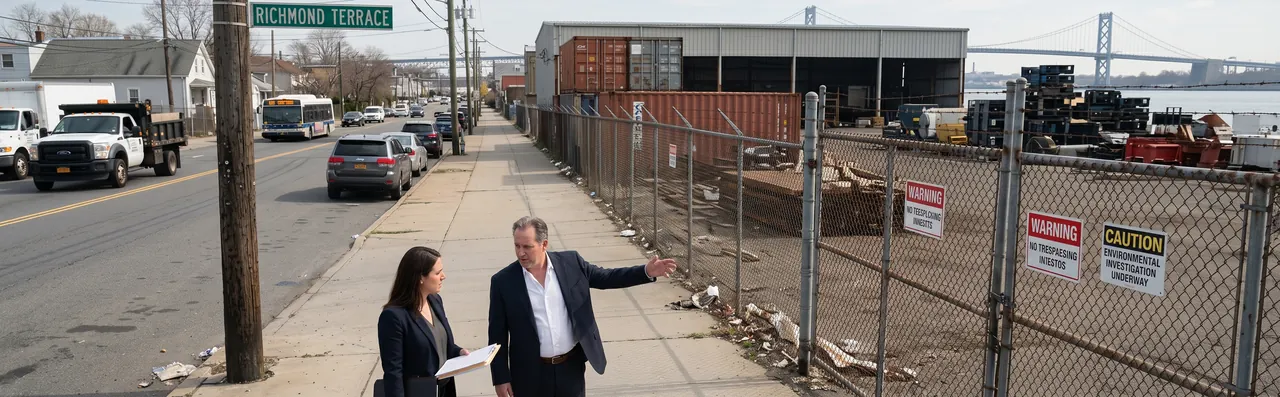
The North Shore industrial waterfront — running through Mariners Harbor, Port Richmond, and Stapleton along Richmond Terrace and the Kill Van Kull — spent a century hosting shipyards, fuel depots, and manufacturing that left contaminated soil and groundwater behind. Much of that corridor is now a state-designated Brownfield Opportunity Area. If you lived, worked, or played near any of these sites, the location itself becomes evidence a lawyer can use to connect your illness to a source.
Toxic Substances and the Illnesses They Cause
Different chemicals attack the body in different ways, and the substance often points straight to the diagnosis a lawyer will investigate.
- Asbestos — the fibers lodge in the lining of the lungs and cause mesothelioma, a cancer that can take 20 to 50 years to appear. Asbestos also drives lung cancer and asbestosis, a permanent scarring of lung tissue.
- Benzene — a solvent in fuels, paints, and industrial processes that damages bone marrow and is tied to leukemia and other blood cancers.
- Lead — lead poisoning harms the brain and nervous system, with children and demolition or construction workers most at risk from old paint and contaminated dust.
- Silica — inhaled dust from cutting stone, concrete, or masonry scars the lungs and causes silicosis, which does not reverse.
- PFAS — the “forever chemicals” that build up in the body and the water supply, linked to kidney and testicular cancer, thyroid disease, and immune problems.
- Toxic mold — heavy indoor exposure triggers chronic respiratory illness, asthma, and severe allergic reactions, often in water-damaged homes and buildings.
The latency built into many of these diseases is what makes them hard to trace. You can leave a job or move out of a contaminated area and feel fine for decades before the illness the exposure planted finally surfaces. Matching the substance to the illness is the first move in any toxic tort case, because a defendant will argue your cancer came from something else — smoking, genetics, an unrelated job. A benzene-linked leukemia and a smoking-linked lung cancer call for different proof, so your lawyer starts by tying your specific diagnosis to a specific chemical with a known biological pathway.
Proving Your Exposure Caused Your Illness
Causation is the hardest part of any toxic tort case, and it splits into two questions your lawyer has to answer with evidence. General causation asks whether the substance can cause your disease at all. Specific causation asks whether it caused yours, in your body, at the dose you absorbed. A defense lawyer attacks both, especially when 30 or 40 years separate the exposure from the diagnosis and your memory of dates and job sites has faded.
Building that proof takes a team of experts, each supplying a different piece. A toxicologist explains the biological pathway — how benzene reaches bone marrow, how asbestos fibers scar the pleura — and what dose it takes to cause harm. An industrial-hygiene expert reconstructs the exposure itself, estimating how much of the substance was in the air, water, or on your skin at a site years after the fact, using old workplace records, product data, and site histories. Your treating physicians document the diagnosis and rule out other causes.
The record has to be built backward, from a present illness to a past exposure that usually went undocumented at the time. That is why the medical file you create now matters so much. Get a firm diagnosis, tell every doctor about your exposure history, and keep the records, because they become the foundation the causation case is built on.
Workers’ Comp vs. a Third-Party Toxic Tort Lawsuit
If your exposure happened at work, workers’ compensation is usually your first source of benefits, and its ceiling is the reason it is rarely your last. Comp pays your medical bills and a portion of lost wages, but it pays nothing for pain and suffering, and the wage benefit is capped by a state formula that almost never matches what the injury actually costs you. You also give up the right to sue your own employer in exchange for those benefits, no matter how careless the employer was.
A third-party toxic tort lawsuit runs on a separate track. It targets everyone other than your employer who shares blame: the chemical manufacturer that failed to warn, the maker of the defective respirator, the property owner who let a contaminant sit, the company that supplied the toxic product. Those defendants owe you full tort damages, including the pain and suffering comp will not touch.
The two claims can move at the same time. You can collect workers’ compensation while your lawyer pursues the third-party suit, though the comp insurer will usually assert a lien to be repaid out of any tort recovery. For many Staten Island exposure victims, the third-party case is where the real value of the claim lives, because it reaches the manufacturers and site owners workers’ comp can never touch.
Compensation Available in a Toxic Tort Case
A toxic tort claim can recover the full range of damages the law allows in a personal injury case, and with a serious illness those numbers grow over a lifetime, not a few months. What you can pursue includes:
- Medical care already incurred — hospital stays, surgery, chemotherapy, medication, and the diagnostic testing that confirmed the exposure.
- Future treatment — the cost of care a progressive disease like mesothelioma or silicosis will demand for the rest of your life.
- Lost earnings — the wages you have already missed while sick or in treatment.
- Diminished earning capacity — the income you will never earn because the illness cut your working life short or forced you into lighter work.
- Pain and suffering — the physical pain, disability, and emotional toll the disease imposes, often the largest part of a serious claim.
There is no set price for any of these. The value of a toxic tort case turns on the specific diagnosis, the strength of the causation proof, and how the illness has changed your daily life and your ability to work. Silver Law Group does not publish verdict or settlement figures, and any lawyer who guarantees you a number before the medical and exposure evidence is in is guessing. What a lawyer can do is document every category above in full, so nothing you are owed gets left off the claim.
Deadlines to File a Staten Island Toxic Tort Claim
The deadline ends more toxic tort claims than any weakness in the evidence, and these cases run on a clock built for latent disease. Under CPLR 214-c, your three-year statute of limitations does not start on the day you were exposed — it starts on the day you discovered, or reasonably should have discovered, the injury. For a disease that surfaces decades after the contact, that discovery rule is what keeps the claim alive, and the three years typically run from the date of diagnosis rather than the exposure that caused it.
New York adds a second option for contamination sites. CPLR 214-f gives victims of exposure from a site placed on the state or federal Superfund list a three-year window running from the date of that designation, even if the ordinary limitations period had already expired. For claims tied to Staten Island’s mapped contamination sites, that provision can reopen a door CPLR 214-c alone would have closed.
If the exposure killed a family member, the wrongful death clock is separate and shorter. Under EPTL 5-4.1, the estate has two years from the date of death to file, regardless of when the illness was first discovered.
A different rule applies the moment a government entity is a defendant. If a city or state agency contributed to the exposure, GML 50-e requires a formal Notice of Claim within 90 days of the claim arising, long before any lawsuit is filed. Miss that 90-day notice and the case against the public defendant can be barred no matter how strong it is. Because these clocks run at different speeds and start on different dates, the safest move is to have a lawyer map every deadline that applies to your specific exposure before any of them runs out.
What Hiring Silver Law Group Costs
Nothing, unless the firm wins your case. Silver Law Group takes toxic tort cases on a contingency fee, which means you pay no money upfront and no hourly bills while the case is pending. The firm’s fee is a percentage of the recovery, and it collects that fee only if it gets you money through a settlement or verdict. If the case does not recover, you owe no attorney’s fee.
Toxic tort cases are expensive to prove. They need toxicologists, industrial-hygiene analyses, environmental testing, and deep investigation into decades-old sites and products. Silver Law Group advances those costs, so the case moves forward on the firm’s dime, not yours, while you focus on treatment. Those expenses are typically repaid out of the recovery at the end. You get a lawyer, an expert team, and a funded investigation without writing a check to start.
Why Staten Island Clients Choose Silver Law Group
Toxic tort defendants — chemical companies, manufacturers, and their insurers — spend heavily to fight these cases and settle fairly only when the other side is ready to try the case. Silver Law Group prepares every case for trial from the first day, so the firm negotiates from a position the defense has to take seriously.
The firm serves Staten Island’s exposure victims in English, Spanish, and Russian, so the language you speak at home is the language you can explain your case in. If your illness makes travel hard, the attorney comes to you, at your home or your hospital bed, instead of making you come to Midtown.
Staten Island toxic tort cases are filed at the Richmond County Supreme Court at 26 Central Avenue in St. George, and the firm handles the litigation there while you focus on your health. Every case starts with a free consultation, available 24 hours a day. Call 212-470-4544 to talk through your exposure with a Staten Island toxic tort lawyer at no cost and no obligation.