

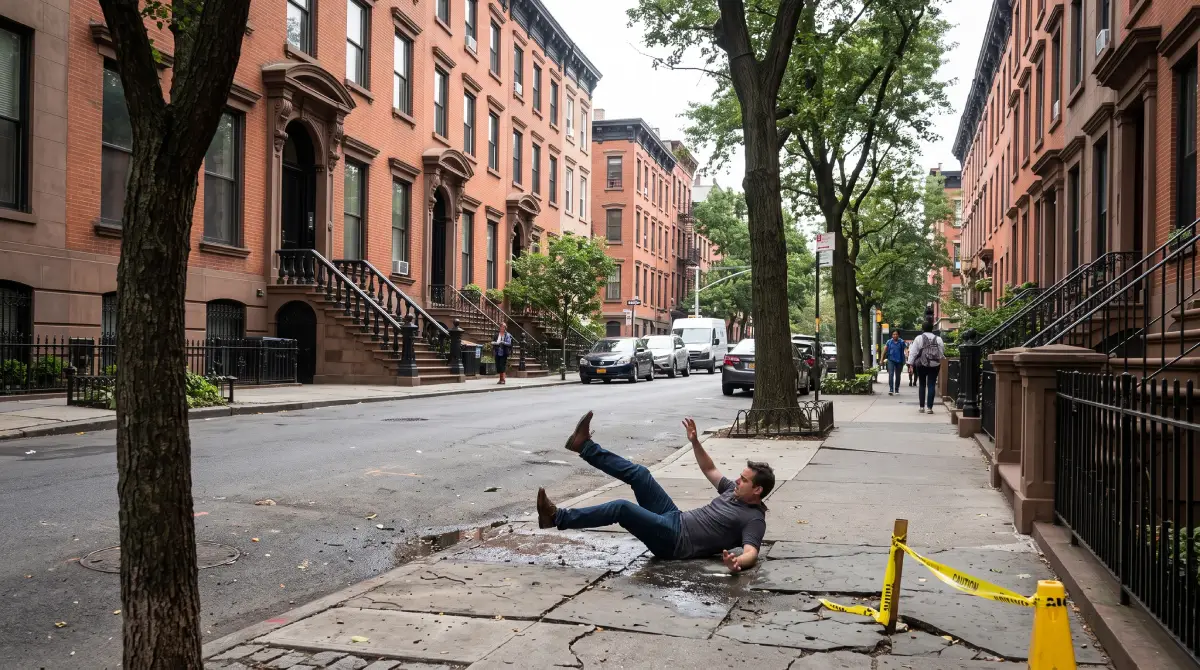
A Brooklyn slip and fall attorney can tell you within one call whether a property owner owes you money for your injury and how long you have to act. Falls put more Brooklyn residents in the emergency room than almost any other everyday accident, and the toll lands hardest on older adults: the city’s health department (DOHMH) records about 16,600 fall-related hospitalizations among New Yorkers 65 and older every year. If a hazard someone else was responsible for put you on the ground (a broken sidewalk flag, an unsalted entrance, a dark stairwell), you may have a claim against the owner who let it stay dangerous. Silver Law Group takes these calls around the clock, in English, Spanish, and Russian, at no charge. Call 212-470-4544. You pay nothing to find out where you stand, and you speak with a lawyer, not a screener.
Do You Have a Brooklyn Slip and Fall Case?
A property owner does not owe you money just because you fell on their property. New York premises liability runs on five elements, and your case needs all of them. The owner has to owe you a duty of reasonable care, which nearly every owner owes to people lawfully on the premises. The owner has to have breached that duty by letting a dangerous condition exist. That condition has to have caused your fall, and the fall has to have caused real damages: medical treatment, lost income, lasting injury.
The element that decides most Brooklyn slip and fall cases is notice. You generally cannot win by proving only that a hazard existed; you have to prove the owner knew about it or should have known about it in time to fix it. The law splits this into two kinds. Actual notice means the owner knew — a prior complaint, a work order, an employee who saw the spill. Constructive notice means the hazard was visible and existed long enough that a reasonable owner inspecting the property would have found and corrected it before you got hurt.
That distinction is why timing and evidence matter so much. A puddle that appeared 30 seconds before you slipped may not create liability; the same puddle sitting for an hour, tracked through by other shoppers, usually does. Proving how long the danger was there, through video, witnesses, and maintenance records, is often the whole fight.
Who’s Liable for a Brooklyn Sidewalk Fall
Who you sue for a sidewalk fall in Brooklyn usually depends on what sits next to the sidewalk. Since 2003, NYC Administrative Code Section 7-210 has shifted responsibility for maintaining most public sidewalks onto the owner of the abutting property. If you trip on a cracked, lifted, or broken flag in front of a store, apartment building, or commercial lot, the abutting owner (not the City) is generally the party responsible for keeping that stretch of sidewalk safe.
There is a narrow but important carve-out. Owner-occupied one-, two-, and three-family homes used only as a residence are exempt from 7-210. If you fell in front of that kind of house, liability may fall back on the City, which changes both who you file against and the deadline you face.
Snow and ice follow their own rule. Under Administrative Code Section 16-123, the duty to clear snow and ice from the sidewalk is non-delegable — an owner cannot escape it by claiming they hired someone to shovel. If a management company or contractor was supposed to salt the walk and skipped it, the owner still answers for the fall, and you may have a claim against the contractor as well.
Sorting out which owner, which code section, and whether the City belongs in the case is work a Brooklyn slip and fall lawyer does at the start, because naming the wrong defendant can cost you the claim.
Falls at Work vs. Third-Party Claims
If you fell at work, you have two separate paths, and they follow different rules. Workers’ compensation covers your medical bills and part of your lost wages no matter who was at fault, but in exchange it usually bars you from suing your own employer for the accident.
That bar stops at your employer’s door. If someone other than your employer caused the fall (the owner of the building you were sent to, a maintenance contractor, or a cleaning company that left a floor wet), you can bring a separate third-party premises claim against that party while still collecting workers’ comp. A third-party case is where pain-and-suffering damages live, which workers’ comp does not pay. Many injured workers never learn the second claim exists, and it is often worth far more than the comp benefits alone.
Common Causes and Injuries in Brooklyn Falls
Most Brooklyn fall claims trace back to a hazard the property owner could have fixed and didn’t. The settings change, but the underlying failure repeats: a condition left dangerous too long.
Common causes we see across the borough:
- Wet or freshly mopped floors with no warning sign, especially in store entrances and building lobbies
- Unsalted ice and packed snow on sidewalks and at entrances after a storm
- Broken, worn, or uneven stairs, and staircases missing a secure handrail
- Poor lighting in stairwells, parking areas, and hallways that hides a step or a spill
- Defective sidewalk flags: cracked, lifted, or sunken concrete that catches a toe
- Worn or wet subway-station steps, where crowding and constant foot traffic magnify the danger
How hard you land often decides how serious the injury is. A fall onto a hard sidewalk or a set of stairs can do lasting damage even at low speed.
Injuries these falls commonly produce:
- Fractures — hips, ankles, wrists, and elbows, with hip fractures especially dangerous for older adults
- Traumatic brain injury, including concussions and bleeding, sometimes from a head strike the victim barely registers at the scene
- Spinal damage, from herniated discs to spinal cord injuries that affect movement and sensation
- FOOSH wrist injuries — the fractures and ligament tears that happen when you throw out a hand to catch yourself
A head injury can be the most deceptive of these. Symptoms like confusion, nausea, or a worsening headache can surface hours or a day after the fall, so a normal-feeling head at the scene is not a clean bill of health.
What Your Brooklyn Slip and Fall Claim Is Worth
No lawyer can tell you a number in the first call, and anyone who does is guessing. What a Brooklyn slip and fall claim is worth depends on two things above all: how badly you were hurt and how clearly the owner was at fault. Strong liability with a minor injury is worth less than a severe injury with contested fault. Your claim is built from two kinds of damages.
Economic damages are the costs you can document:
- Medical bills, from the ER visit through surgery, imaging, and physical therapy
- Lost wages for the time you could not work, plus reduced earning capacity if the injury limits what you can do going forward
- Future care: ongoing treatment, home help, or assistive equipment a doctor says you will need
Non-economic damages cover the harm that has no receipt:
- Pain and suffering from the injury and its treatment
- Permanent scarring or disfigurement
- Lost enjoyment of daily life: activities, work, and independence the injury took from you
Severity drives both columns. A wrist fracture that heals in weeks sits at one end; a hip fracture that ends independent living, or a brain injury that changes how you think, sits at the other. Liability strength is the second lever: the clearer the owner’s notice of the hazard, the less room the insurer has to discount your claim by disputing fault. A lawyer’s job is to document both fully, because an undocumented loss is a loss the insurer will not pay for.
What to Do After a Slip and Fall in Brooklyn
What you do in the first hour after a fall shapes the claim more than almost anything a lawyer does later. Take these steps if you are physically able.
- Report the fall to the owner, manager, or a store employee, and ask them to write an incident report. Get a copy or the report number.
- Photograph the hazard immediately — the wet floor, the ice, the broken step — before anyone cleans or fixes it. The condition often disappears within minutes.
- Get the names and phone numbers of anyone who saw you fall. Witnesses move on fast, and a name today is worth more than a search later.
- Document your injuries at a Brooklyn emergency room such as Kings County Hospital or Maimonides Medical Center. Prompt treatment protects your health and ties your injuries to the fall in the record.
- Stay off social media about the accident. A photo of you smiling at a family event, posted while your claim is pending, is exactly what the insurer will use to argue you are not really hurt.
If you were too injured to do any of this at the scene, you have not lost your case. A lawyer can reconstruct much of it afterward from video, 311 records, and witness canvassing.
How Our Lawyers Prove a Brooklyn Fall Claim
Winning a Brooklyn fall claim comes down to evidence the property owner would rather you never see, and most of it has a short shelf life. Surveillance video is the clearest example. Many store and building systems record over themselves in days or weeks, so one of the first things a lawyer does is send a preservation letter demanding the owner keep the footage before it is gone. Wait too long and the recording of your fall no longer exists.
From there, the work is documentary. Prior-complaint records and maintenance logs can show the owner knew about the hazard and let it sit — the actual notice that turns a fall into a winnable case. For a sidewalk defect, 311 complaint records may show the crack was reported to the City long before you tripped. When the mechanism of the fall is in dispute, an engineering or safety expert inspects the site and measures exactly what went wrong.
Owners lean hard on the trivial-defect defense, arguing a sidewalk gap or step lip was too small to be actionable. New York does not decide that by ruler alone. Courts weigh the totality of the circumstances: the width, depth, and jaggedness of the defect together with the lighting, the foot traffic, and where it sits. A half-inch lip on a dark, busy stair is a different case than the same lip in an open, well-lit lobby, and framing that context is how a good claim survives the defense.
Comparative Fault and Blaming the Victim
The insurer’s favorite move in a fall case is to blame you. Expect the adjuster to suggest you were on your phone, wearing the wrong shoes, or not watching where you walked. Here is why that tactic has limits in New York.
Under CPLR §1411, New York follows pure comparative negligence. Your share of the fault reduces what you recover, but it never bars your claim outright. If a jury finds the owner 80% responsible for an unlit broken stair and you 20% responsible for not seeing it, you still recover 80% of your damages. Even if you were mostly at fault, you can still recover something. That is why an adjuster’s early attempt to pin the whole fall on your inattention is a negotiating position, not a legal verdict, and it is one a lawyer pushes back on with the evidence of what the owner did wrong.
Deadlines and Claims Against the City or NYCHA
Deadlines end more slip and fall cases than any defense, and the shortest one can hit in as little as 90 days. A Brooklyn fall claim can run on three separate clocks, and which ones apply depends on who you are suing.
Against a private owner such as a store, a landlord, or a business, the main deadline is CPLR §214, New York’s three-year statute of limitations for personal injury. You have three years from the date of the fall to file your lawsuit. Miss it, and the court will dismiss the case no matter how strong it was.
Falls on public property run on a much tighter schedule. If you were hurt on City property, on a City sidewalk the City is responsible for, or in New York City Housing Authority (NYCHA) housing, General Municipal Law §50-e requires you to serve a formal Notice of Claim within 90 days of the fall. This is not the lawsuit — it is a required first step, and a government body can move to throw out your entire case if you skip it or file it late. Ninety days passes quickly while you are recovering, which is why City and NYCHA falls need a lawyer early.
When a fall is fatal, the case changes form. Under EPTL §5-4.1, a wrongful death claim must be brought within two years of the date of death, and only the estate’s representative can bring it. That two-year window is separate from the injury deadlines above.
The safest assumption is that your clock is shorter than you think. A NYCHA stairwell fall and a supermarket fall look similar and are governed by very different timelines. One free call sorts out which deadlines apply to your fall before any of them run out.
Why Choose Silver Law Group After a Brooklyn Fall
You pay us nothing up front, and nothing at all unless we recover money for you. Silver Law Group works on a contingency fee: our fee is a percentage of the recovery, paid only if we win or settle your case. If there is no recovery, you owe us no attorney’s fee. That arrangement lets you hire the same caliber of lawyer the insurance company has, without writing a check while you are out of work.
The first conversation is always free, available 24 hours a day, and handled in English, Spanish, or Russian. If your injury keeps you home or in the hospital, the attorney comes to you — you do not have to travel to our Midtown office to start your case.
We prepare every fall case as if it will be tried. Insurers track which firms fold at the courthouse steps and which are ready to put a case in front of a Kings County jury; a claim built for trial from day one settles from a position of strength. Brooklyn injury lawsuits are venued at Kings County Supreme Court, 360 Adams Street, and we handle your case through to that courthouse if the insurer will not deal fairly.
Call 212-470-4544 to talk with a lawyer now.