

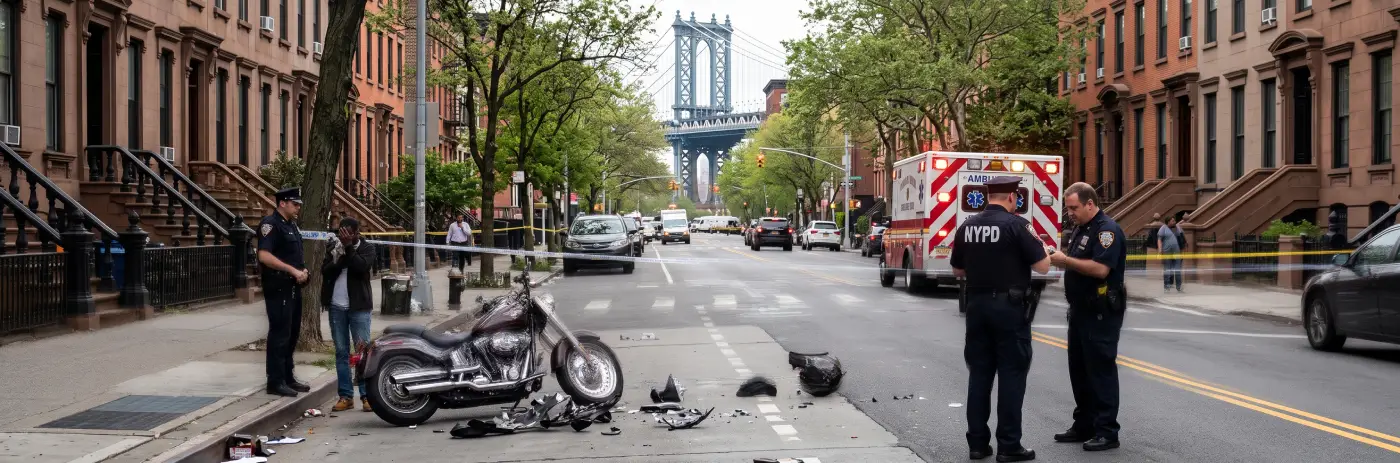
If you were hurt riding a motorcycle in Brooklyn, New York’s no-fault system does not cover you the way it covers drivers, so the claim against the at-fault driver is usually your only real path to paying for treatment and lost income. A Brooklyn motorcycle accident lawyer at Silver Law Group can pursue that claim from the first dollar of your loss, without the injury threshold that blocks most car accident cases. Every case starts with a free consultation, available 24/7 in English, Spanish, and Russian, and the attorney can come to your home or hospital room if your injuries keep you from traveling. Call 212-470-4544.
Why a Brooklyn Motorcycle Claim Is Different From a Car Accident Claim
New York treats a motorcycle differently from a car at the level of the insurance code, and that difference decides how you get paid. Under Insurance Law 5102(f), a motorcycle is not a “motor vehicle” for no-fault purposes, and Insurance Law 5103(a)(2) denies riders first-party no-fault benefits. Your own policy will not automatically pay your emergency room bill or replace your lost wages the way a driver’s Personal Injury Protection does. You carry those costs while your case moves. There is a second half to that rule, and it works in your favor. Because you are not a “covered person” under the statute, the serious injury threshold in Insurance Law 5102(d) and 5104 does not stand between you and a lawsuit. A car accident victim has to prove a fracture, significant disfigurement, or another listed category before suing for pain and suffering. You do not. You can sue the driver who hit you for any injury, from the first dollar, the moment their negligence is on the table.
Where Brooklyn Riders Get Hurt: The Borough’s Most Dangerous Roads
Brooklyn’s fastest, most crowded roads are where riders go down. The merges on the BQE and the Gowanus Expressway force quick lane changes into blind spots, and the surface arterials that feed the bridges push traffic and bikes into the same narrow space.
- The BQE and Gowanus Expressway merges, where drivers change lanes without checking for a rider alongside them
- The Belt Parkway, where highway speed meets short merge zones
- Atlantic Avenue and Flatbush Avenue, wide multi-lane corridors thick with turning traffic
- The Tillary Street and Flatbush Avenue Extension funnel feeding the Brooklyn and Manhattan Bridges
- Ocean Parkway and Fourth Avenue, long straightaways where speed and cross-street turns collide
- Bedford Avenue, where a parked driver’s door can open into a rider’s path
City data frames the risk. NYC DOT Vision Zero recorded 63 traffic fatalities in Brooklyn in 2025, down from 69 in 2024, and citywide motorcycle-user deaths fell 32% in 2025. A drop in deaths is not the same as a drop in crashes; serious injuries to riders continue across these corridors, and NYPD collision records remain the current source for how many of them involve motorcycles.
Common Causes of Brooklyn Motorcycle Accidents and Who Is Liable
Most Brooklyn motorcycle crashes trace back to another road user’s choice, and each cause points to who pays.
- Left-turn drivers who fail to yield to an oncoming rider cause the deadliest crashes; the turning driver is liable for misjudging your speed or never seeing you
- Unsafe lane changes and blind-spot merges put the merging driver at fault for moving into space a rider already held
- A driver or passenger who opens a door into traffic is responsible for that dooring impact
- In stop-and-go traffic, a rear-end hit falls on the driver behind, who is expected to leave room to stop
- Commercial and delivery-truck blind spots can bring both the driver and the trucking company into the claim
- Road defects such as potholes can make the City of New York a defendant, though the NYC Pothole Law requires that the City had prior written notice of the exact defect
That last point trips up riders who assume a pothole claim is automatic. It is not. Without proof of prior written notice on file, the road-defect claim against the City usually fails, which is why the defect and its history have to be documented fast.
Serious Injuries in Brooklyn Motorcycle Crashes
A rider has no steel cage, no airbag, and no crumple zone between their body and the road. The injuries reflect that. Traumatic brain injury happens even when you wear a helmet, because a helmet blunts force but cannot stop the brain from moving inside the skull. Spinal cord damage can end in partial or complete paralysis. Sliding across pavement strips skin down to muscle and bone, and severe road rash or degloving often needs skin grafts to close. Riders also arrive with open and lower-extremity fractures and with internal bleeding that is not visible at the scene. Brooklyn’s trauma teams see these cases constantly. Depending on where you go down, an ambulance may take you to Kings County Hospital Center, the Level 1 trauma center in East Flatbush, or to Maimonides Medical Center, NYU Langone Hospital–Brooklyn in Sunset Park, or NewYork-Presbyterian Brooklyn Methodist in Park Slope. The records those hospitals create in the first hours become the backbone of your injury claim, which matters more for a rider because there is no no-fault file building in parallel.
Compensation You Can Recover After a Brooklyn Motorcycle Accident
Because you sit outside no-fault, no injury threshold caps what you can claim. Your case can seek both hard costs and human costs. Economic damages cover money you can document:
- Past and future medical bills, from the ER through surgery and rehab
- Lost wages and lost earning capacity if your injuries keep you from working
- In-home care during recovery
- Replacement of your motorcycle and damaged gear
Non-economic damages cover what the injury took from your life:
- Pain and suffering
- Permanent scarring and disfigurement
- Loss of enjoyment of life
- Loss of consortium for a spouse
Where a driver was drunk or drove with egregious recklessness, punitive damages may also apply, on top of the compensation meant to make you whole.
How Insurance Companies Fight Brooklyn Motorcycle Riders
Adjusters treat motorcyclists as an easier target than drivers, and they lean on the assumption that a jury already sees riders as reckless. Expect the insurer to argue you share fault for speeding or lane-splitting even when you did neither, because raising your share of blame lowers what they owe. Expect them to call an injury pre-existing, to float a low offer while you are still in pain and short on cash, and to ask for a recorded statement that sounds routine but is built to catch a stray phrase they can use later. Delay is a tactic too. The longer they stall, the more your bills apply pressure, and a cheap settlement starts to look like relief. Route every call from an insurance company through a motorcycle injury lawyer, and do not give a recorded statement to anyone. What you say early can shrink your claim before you understand what it was worth.
Partial Fault and New York’s 2026 Comparative Negligence Change
New York has long followed pure comparative negligence under CPLR §1411(a). If you were partly at fault, your recovery drops by your share, but it is never wiped out; a rider found 30% responsible still recovers 70% of the damages. That rule is why insurers push so hard to pin fault on you. A 2026 change complicated the picture. Chapter 58, Part EE, effective for actions commenced on or after late May 2026, added CPLR §1411(b), which bars recovery for a plaintiff found more than 50% at fault in personal-injury actions subject to Insurance Law Article 51. Here is the part some competitors get wrong when they still print a flat “pure comparative negligence” promise: motorcyclists are excluded from Article 51. Whether the new 50% bar reaches riders at all is an open, unsettled question right now. A lawyer who tells you the answer with certainty is guessing; the honest position is that your fault share matters more than it did a year ago, and it has to be fought on the facts.
What to Do After a Motorcycle Accident in Brooklyn
The hours after a crash decide how strong your claim starts. Work this list in order.
- Call 911 and get a police report; the report anchors the official version of what happened.
- Get a medical evaluation right away, even if adrenaline is masking the pain. For a rider, that record carries extra weight because no no-fault paperwork is building behind it.
- Photograph the scene, your bike, your gear, and the roadway, including any defect or debris.
- Collect the driver’s information and every witness’s name and number, and note any nearby business or traffic camera.
- Decline recorded statements from any insurer.
- Stay off social media; a single post can be twisted into an admission.
- Contact a lawyer fast, so surveillance footage can be pulled before it is recorded over.
If the Driver Was Uninsured or Fled the Scene
A crash does not end your options just because the other driver had no insurance or never stopped. If you were hit by an uninsured, underinsured, or unidentified driver, two routes can still bring in coverage. Supplementary Uninsured/Underinsured Motorist (SUM) coverage under Insurance Law 3420(f)(2) can pay when the at-fault driver has too little insurance or none. When the driver is unidentified, as in a hit-and-run, the Motor Vehicle Accident Indemnification Corporation (MVAIC) under Insurance Law 5201 exists for exactly that gap. The firm also looks past the obvious defendant. A road-defect contractor, the City, or a motorcycle manufacturer can each carry coverage that a rider would otherwise miss, and finding that second source is often what turns a dead-end claim into a paid one.
What It Costs to Hire a Brooklyn Motorcycle Accident Lawyer
You pay nothing upfront to hire Silver Law Group, and you pay no legal fee at all unless the case brings in a recovery. The firm works on contingency, which means the attorney’s fee is a percentage of what your case recovers, not a bill you owe along the way. The firm also advances the costs of building the case, including the investigation, expert review, and court filings, and those costs come out of the recovery at the end rather than out of your pocket during the fight. If there is no recovery, you owe no fee. For a rider, that structure removes a real barrier. You already face medical bills with no no-fault to absorb them, so paying a lawyer by the hour on top of that would put representation out of reach. Contingency flips it: the firm only gets paid when you do.
Deadlines to File a Brooklyn Motorcycle Accident Claim
The clock on your case started at the crash, and more than one deadline can apply.
- The general personal-injury statute of limitations is three years under CPLR §214
- If the crash was fatal, the wrongful-death deadline is two years under EPTL §5-4.1
- If a public entity is a defendant, such as the City or the MTA, you must file a Notice of Claim within 90 days under GML §50-e, and the lawsuit itself must be filed within one year and 90 days under GML §50-i
Do not assume you have the full three years. A pothole claim against the City or a crash involving an MTA bus collapses the timeline to 90 days for the first required filing, and missing that step can end the claim before it starts.
Why Injured Brooklyn Riders Choose Silver Law Group
Silver Law Group gives injured riders free consultations 24/7 in English, Spanish, and Russian. Russian-language service matters for the riders in South Brooklyn, in Sheepshead Bay, Brighton Beach, and Bensonhurst, who would rather explain their case in their own language than through a stranger. The firm takes motorcycle cases on contingency, so cost is not what keeps you from calling. It prepares every case as if it will be tried, which is what pushes an insurer toward a fair number instead of a lowball, and it is ready to try cases in Kings County Supreme Court at 360 Adams Street when a fair number never comes. You work directly with a motorcycle personal injury attorney rather than being handed to a case manager, and if your injuries keep you home or in a hospital bed, the attorney comes to you. Call 212-470-4544.