

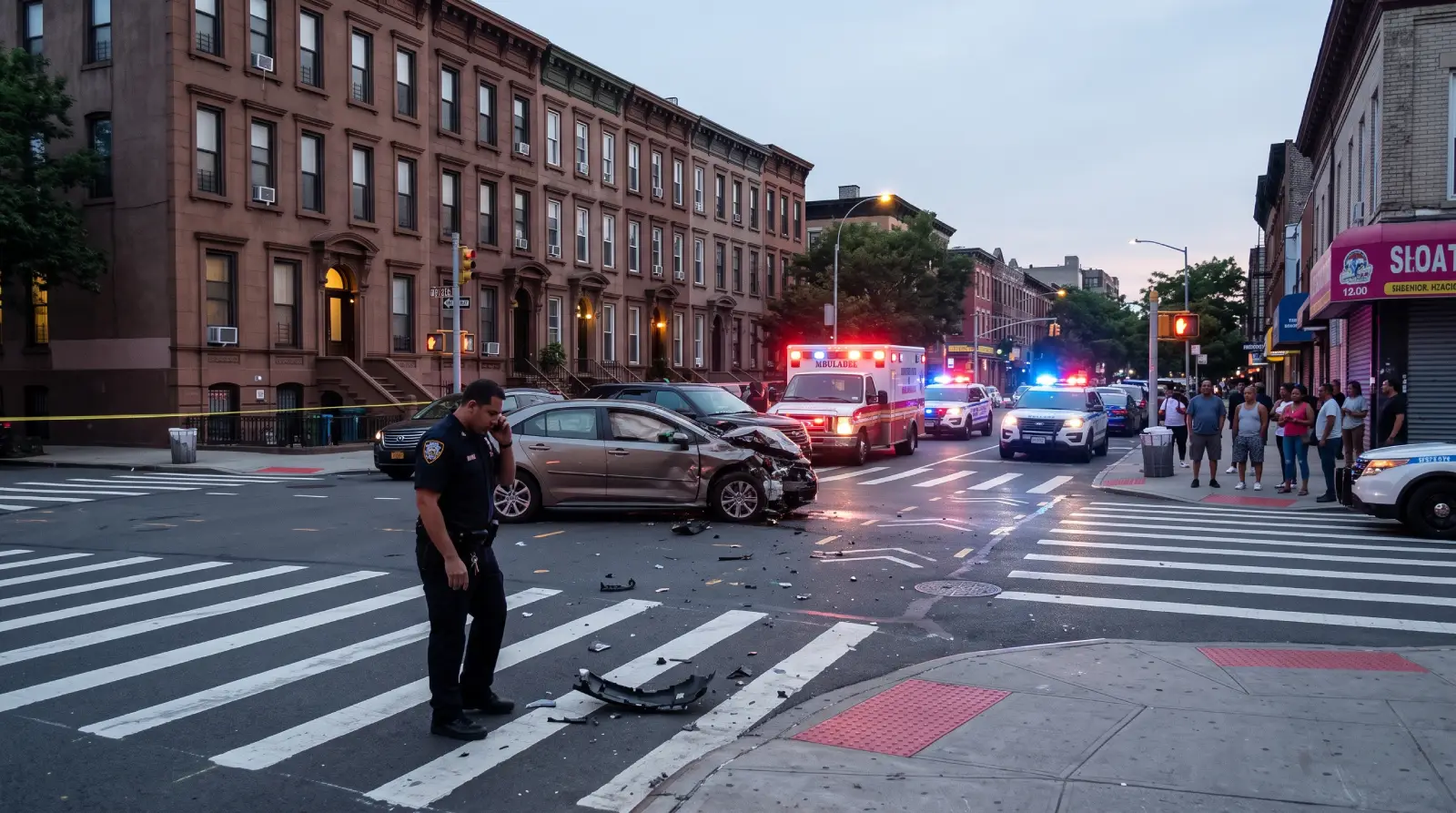
Do You Still Have a Case If the Driver Fled in Brooklyn?
A hit and run is not the end of your claim. Your right to recover usually runs through an insurance policy, not through the person who fled.
Two ideas stop most people from calling, and both are wrong. The first is that the driver got away, so there is nothing left to pursue; in reality, New York law treats an unidentified driver as an uninsured one, and that opens coverage that needs no defendant at all. The second is that the police said they could not help, which people hear as case closed; an officer declining to chase a paint scuff is not a ruling on your injury claim, and the two run on separate tracks.
Even a fragment helps. A partial plate, the car’s color, or its make and model can be enough to start an investigation and, sometimes, to name the driver later.
Who Pays When the Brooklyn Hit & Run Driver Cannot Be Found?
When the driver is gone, the question becomes which policy answers for your injuries, and there is usually more than one. The pathways, roughly in the order a lawyer works through them:
- Your own uninsured motorist (UM) coverage, which New York attaches to a hit and run automatically.
- A resident relative’s auto policy, if you live in the same household and have no policy of your own.
- MVAIC, the state fund of last resort when no auto policy covers you at all.
- No-fault (PIP) benefits, which pay medical bills and part of lost wages no matter who caused the crash.
- A commercial or government insurer, if a business truck, delivery vehicle, or City vehicle was involved.
Finding which of these applies to you, and in what order, is the real work of a hit and run case.
The MVAIC Safety Net for Uninsured and Unidentified Drivers
MVAIC, the Motor Vehicle Accident Indemnification Corporation, exists for exactly your situation: a qualified person with no other auto coverage, hurt by a driver who cannot be found. It is created under Insurance Law Article 52, and it runs on hard deadlines that end the claim if you miss them. You need an NYPD report filed within 24 hours of the crash. You must file a Notice of Intention within 90 days for an unidentified hit and run driver, or within 180 days if the driver is later identified but turns out to be uninsured. A no-fault application has to go in within 30 days, and MVAIC also asks for a notarized affidavit confirming that no one in your household carried auto coverage. What it pays is the statutory floor of $50,000 in no-fault benefits and 25/50 bodily injury coverage — a safety net, not a generous one.
Your Own and Your Household’s Uninsured Motorist (UM) Coverage
New York treats a hit and run driver as an uninsured motorist, which means your own UM coverage can pay for the harm that driver caused. That coverage follows you, not just your car, so it can apply even if you were on foot in a crosswalk or on a bike in the lane when the vehicle clipped you. The same is true of a resident relative’s policy if you have none of your own. To recover for pain and suffering through UM, your injury has to meet New York’s serious injury threshold; below that line, the claim is limited to economic losses. UM disputes are not filed in court but decided in arbitration, often through the AAA, and a SUM endorsement — supplementary uninsured/underinsured motorist coverage — can extend your protection when the at-fault limits run out.
No-Fault (PIP) Benefits and What They Cover First
No-fault, also called PIP, is the first money that moves. It pays your basic economic loss — medical treatment and a portion of lost wages, up to the standard $50,000 limit — no matter who caused the crash. It does not pay for pain and suffering, and the application has to be filed within 30 days of the crash, so it is usually the first form a lawyer gets in the door.
How We Track Down the Driver Who Fled
Finding the car is often possible, but only if the evidence is captured before it disappears. The tools that identify a fleeing Brooklyn driver include:
- NYC DOT cameras at signalized intersections
- MTA bus cameras, which record the roadway as buses pass
- storefront and doorbell footage, canvassed one block at a time
- witnesses, re-interviewed once the shock wears off and details come back
- tips from neighborhood social media groups
- physical evidence left behind, such as paint transfer, broken trim, and debris
Most of this footage is gone fast. Intersection and business cameras routinely overwrite themselves within 24 to 72 hours, so a written demand to preserve it has to reach DOT and nearby businesses within hours of the crash, not days. That single step is often the difference between naming the driver and never knowing who it was.
Common Brooklyn Hit & Run Scenarios
The kind of crash you were in shapes which coverage answers for it.
- A pedestrian struck in a crosswalk on Flatbush Avenue, Atlantic Avenue, or Eastern Parkway usually recovers through UM or MVAIC, because a person on foot rarely has the fleeing driver’s insurance to pursue.
- A cyclist clipped in the Kent Avenue bike lane in Williamsburg or on the Prospect Park loop follows the same path, with the bike’s damage and the rider’s injuries documented together.
- A high-speed sideswipe on the BQE, the Belt Parkway, or the Prospect Expressway often leaves paint and debris that can identify the car, which can turn a UM claim into a claim against a named driver’s policy.
- A hit to your parked car, with you inside or beside it, still counts, and your own UM coverage generally responds.
- A crash caused by a commercial or delivery vehicle can reach the company itself through GPS logs and DOT registration records, even when the individual driver fled and was never charged.
Injuries We See in Brooklyn Hit & Run Crashes
A person hit by a car has nothing between their body and two tons of steel, so the injuries tend to be severe:
- traumatic brain injury
- herniated spinal discs
- fractures of the pelvis and legs
- internal bleeding
- road rash deep enough to need skin grafting
- post-traumatic stress that outlasts the physical wounds
Some of the worst injuries do not announce themselves at the scene. A traumatic brain injury or internal bleeding can stay quiet for hours while it gets more dangerous, which is why a same-day exam matters even if you feel able to walk away. Brooklyn has trauma centers built for exactly this: Kings County Hospital Center on Clarkson Avenue, Maimonides Medical Center, NYU Langone Hospital–Brooklyn, and NewYork-Presbyterian Brooklyn Methodist. Getting seen the same day protects your health first and creates the medical record that ties your injuries to the crash.
What a Brooklyn Hit & Run Claim Is Worth
What you can recover depends less on a formula than on which policy is paying and how badly you were hurt. The damages available in a hit and run claim include:
- past and future medical expenses
- lost wages and reduced earning capacity going forward
- pain and suffering, which New York does not cap for non-economic harm
- loss of enjoyment of life
- property damage to your vehicle or bike
- wrongful death damages if the crash killed a family member
The ceiling on those damages is set by the pathway. A claim paid through MVAIC is bounded by that fund’s statutory minimums; a UM claim is bounded by the policy limits and any SUM coverage stacked on top; and a claim against a driver who is eventually identified is bounded by that driver’s own liability policy. Knowing which pathway you are on tells you what is realistically on the table.
What to Do After a Hit & Run in Brooklyn
The hours after a hit and run decide how strong your claim will be. Work through this in order:
- Call 911 and get an NYPD report within 24 hours. MVAIC will not consider your claim without it, and the report fixes the time, place, and fact of the crash.
- Get medical care the same day. A same-day record links your injuries to the crash and blocks the insurer’s argument that something else hurt you.
- Write down the fleeing vehicle’s color, make, and any part of the plate you saw, then photograph the scene and every camera you can spot nearby.
- Notify your own insurer promptly. UM coverage carries notice conditions, and a late report can cost you the coverage.
- File the DMV MV-104 crash report within 10 days if anyone was injured or the damage tops $1,000.
- Call a lawyer the same day, so preservation demands reach DOT and nearby businesses before the footage is written over.
Each step either creates evidence or keeps a deadline from closing on you.
How Long You Have to File a Brooklyn Hit & Run Claim
Several clocks start the moment you are hit, and they do not run at the same speed.
- Three years to file a personal injury lawsuit, under CPLR §214(5).
- Two years for a wrongful death claim if the crash was fatal, under EPTL 5-4.1.
- 90 days for the MVAIC Notice of Intention, plus the police report within 24 hours.
- 30 days for the no-fault application.
- 90 days for a Notice of Claim under GML §50-e if an NYPD, MTA, or City vehicle was involved, with the lawsuit itself filed within one year and 90 days under §50-i.
The shortest deadline controls your case, not the longest. The three-year window feels like plenty until you realize the 24-hour and 30-day requirements have already passed, which is why the first call should happen the same week, not the same year.
The Criminal Case Against the Driver vs. Your Civil Claim
Leaving the scene of an injury crash is a crime in New York under VTL §600. Depending on the harm done, it ranges from a Class B misdemeanor up to a Class E felony that carries up to four years in prison when the crash caused serious physical injury or the driver had a prior conviction. That criminal case belongs to the NYPD and the Kings County District Attorney, and it is aimed at punishing the driver, not paying you. Your civil claim is a separate matter, filed in Kings County Supreme Court at 360 Adams Street, where injury claims above $50,000 are heard, and it moves on its own schedule. It does not wait for an arrest, and it does not depend on a conviction; you can recover through insurance whether or not the driver is ever caught.
What It Costs to Hire a Brooklyn Hit & Run Lawyer
Here is the cost, in full: nothing upfront, and nothing at all unless you recover. Silver Law Group takes Brooklyn hit and run cases on contingency, which means there is no retainer to pay, no hourly bill, and no invoice arriving while you are still healing. The fee is a percentage of the recovery, and it comes out only if money comes in. If the claim does not recover, you owe no attorney’s fee. The costs of building the case — the investigators, the records, the preservation demands sent out in the first hours — are advanced as the case goes, so the decision to start does not turn on what is in your bank account today. A person who was just hit by a car should not have to pay to find out whether they have a claim, and on contingency, they do not.
Why Injured Brooklyn Residents Choose Silver Law Group
The consultation is free, it is available at any hour, and the fee stays contingent, so calling costs you nothing but the time. Silver Law Group works in English, Spanish, and Russian, which matters in a borough where a claim can start in Russian in Sheepshead Bay or Brighton Beach and in Spanish in Sunset Park or Bushwick. Hit and run claims are fought against MVAIC and UM insurers, not sympathetic parties, and a firm that prepares every case as if it will be tried is one those insurers take seriously. You also do not have to come to the office to begin: the attorney will travel to you anywhere in Brooklyn, from Greenpoint down to Coney Island, or to your hospital room if that is where you are. The office sits at 49 West 37th Street in Midtown Manhattan; the phone, answered around the clock, is 212-470-4544.