

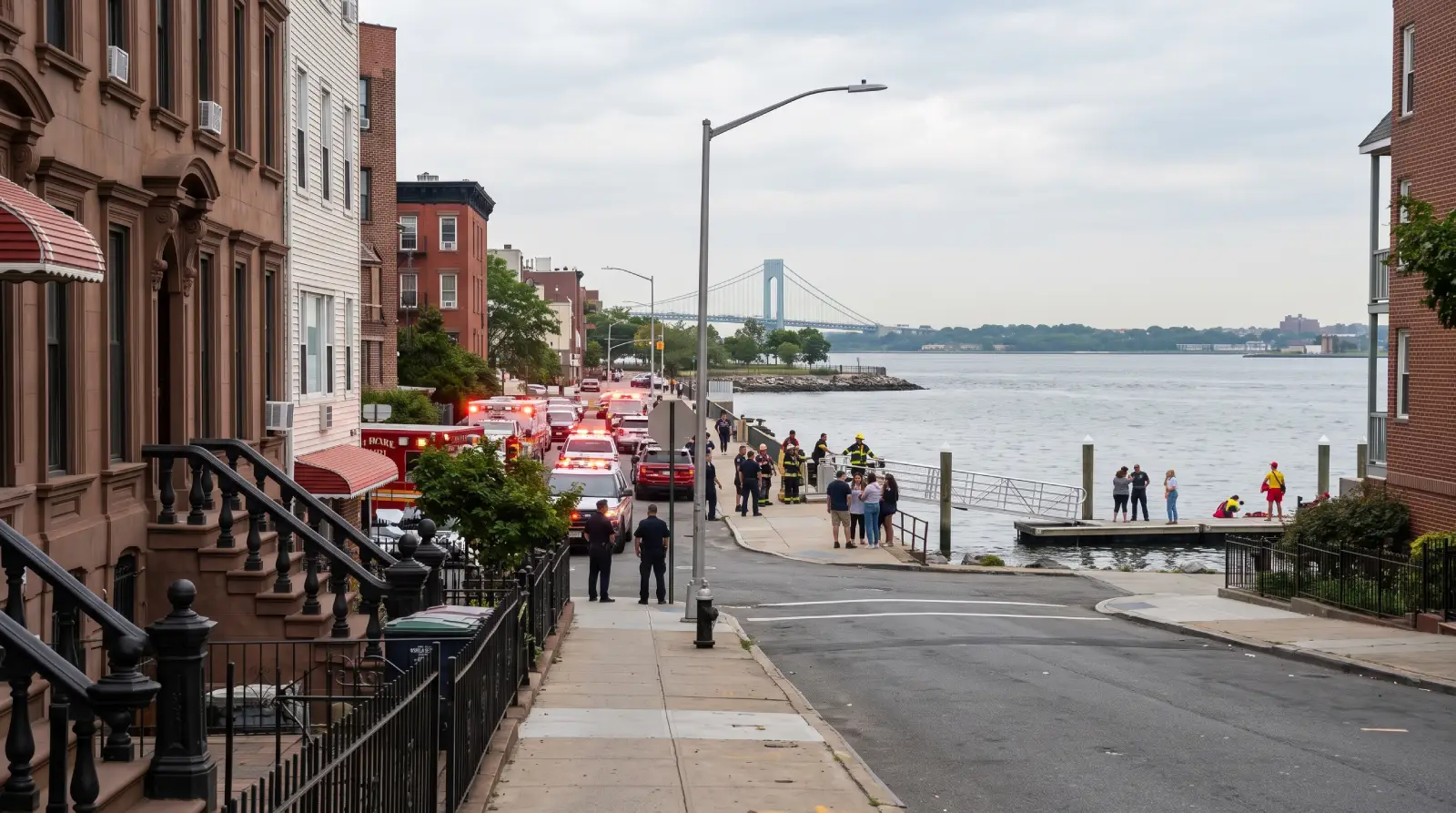
Most of these cases come down to one thing: who was responsible for keeping that water safe, and what they failed to do about it. We take them across Brooklyn — ocean beaches, city pools, hotel and apartment pools, private backyards — on a contingency basis, so you pay no legal fee unless we recover money for you. The first consultation is free, and you can have it in English, Spanish, or Russian. Someone answers at 212-470-4544 any hour of the day or night, every day of the week. When a hospital stay or your own injury keeps you from traveling, an attorney comes to you at home or at the bedside instead of asking you to come in.
Where Drownings Happen Across Brooklyn
Brooklyn’s water sits in very different categories, and the rules change with each. The ocean beaches — Coney Island, Brighton Beach, and Manhattan Beach — are city-run, guarded only during posted daytime hours, and stretch far enough that a swimmer can drift past the last lifeguard chair in minutes. The municipal outdoor pools run by NYC Parks add their own risk: crowded decks, uneven supervision on hot afternoons, and drains that can trap a small child underwater. Sheepshead Bay and the edges of Jamaica Bay bring boating and personal-watercraft drownings, where a missing life vest or an operator who had been drinking turns a routine day on the water into a recovery case. Then there is private water. Hotel and apartment-building pools carry a commercial duty to guard, fence, and maintain them. Backyard pools behind Brooklyn’s two-family homes are the setting for many child drownings, often when a gate was propped open or a fence was never installed. Even a bathtub counts, because an unsupervised toddler or an adult who suffers a medical event can drown in a few inches of water, and a negligent caregiver or facility can be liable when it happens. Each setting points to a different responsible party, which is why the first job in your case is fixing exactly where the drowning happened and who controlled that water.
Do You Have a Drowning Claim
You have a claim when someone who controlled the water owed a duty to keep it reasonably safe and broke that duty. In New York, that duty is premises liability: the owner or operator of a beach, pool, or waterfront property has to take reasonable steps to protect the people they invite in, and to guard against dangers they knew about or should have found. What counts as a breach depends on the setting. At a guarded beach or pool, too few lifeguards for the crowd, guards pulled off the water, or a swimmer left unwatched can each be negligence. At a private pool, the usual failures are a missing or broken barrier fence, an unlatched gate, and no posted depth markings. Two mechanical failures come up again and again. A defective or uncovered drain creates powerful suction that can pin a child or an adult against the bottom — suction entrapment — and hold them under while bystanders cannot pull them free. A broken drain cover, an outdated single-drain system, or a pump left running after a cover cracked all point to the owner’s maintenance failure rather than the victim’s mistake. Who you sue follows from who controlled the water. A backyard pool points to the homeowner; a hotel or gym pool points to the business that operated it. A city beach or a municipal pool points to the City of New York, which runs Brooklyn’s ocean beaches and NYC Parks pools, and suing the City carries a shorter clock and extra steps covered further down this page.
Public Beach and City Pool Drownings
City lifeguards work a fixed window — roughly 10 a.m. to 6 p.m. during the summer season — and the water is officially closed outside those hours. A drowning at 7 p.m. on Coney Island does not automatically end your case, but the City will argue the beach was closed and no guard was owed, so the facts around signage, access, and what the property invited become the fight. Closed and red-flag sections work the same way. When lifeguards raise a red flag or rope off a stretch of Brighton Beach, swimming there is prohibited, and the City leans on that to shift blame onto the swimmer. This is where comparative fault under CPLR 1411 matters. New York does not bar your recovery because the swimmer was partly at fault; instead, a jury assigns percentages, and the award is reduced by the swimmer’s share. A family found 30 percent responsible still recovers 70 percent, which is why these cases are worth pursuing even when the City claims the victim ignored a warning.
Private Pool, Hotel, and Apartment Drownings
A private pool owner owes a duty even to a child who was not invited in. Under New York’s attractive-nuisance doctrine, a swimming pool is treated as a foreseeable draw for young children who cannot appreciate the danger, so an owner who leaves a pool unfenced and accessible can be liable when a neighborhood child wanders in and drowns. The law expects a fence, a self-latching gate, and a cover, not a warning the child cannot read. Commercial pools carry a heavier duty than a backyard. A hotel, gym, or apartment complex that offers a pool has to maintain it to code, post depth markings and rules, and in many cases provide supervision. If you signed a waiver at a gym or a rental, do not assume your case is over. New York courts routinely refuse to enforce liability waivers against gross negligence, and a waiver cannot excuse a violation of a health or building code. A missing barrier or a broken drain is often exactly that kind of violation, and the signed form does not erase it.
What a Brooklyn Drowning Case Is Worth
The value of a Brooklyn drowning case is driven by two things: how clearly the owner was negligent, and how severe the harm is. A near-drowning that leaves an anoxic brain injury — the damage that follows when the brain is starved of oxygen underwater — often produces the largest claims, because the care can last a lifetime. The categories a drowning claim can include:
- Medical bills, from the emergency response and ICU stay through rehabilitation and follow-up care
- Lifetime care for an anoxic brain injury, including home health aides, therapy, adaptive equipment, and supervision that may never end
- Lost earnings, both wages already missed and the future income a permanently injured person can no longer earn
- Pain and suffering, covering the physical injury and the emotional toll on the survivor
For the most catastrophic injuries, the future-care figure is usually built by a life-care planner and an economist, so the number reflects real projected costs rather than a round guess. Silver Law Group does not publish settlement figures or verdict amounts, and no honest lawyer can quote you a number before the facts are in. Anyone who promises a specific payout at the first call is guessing. What actually moves value is provable liability and documented severity, which is why building the medical record and pinning down the negligence early matters more to your recovery than any early estimate.
Wrongful Death Claims After a Fatal Drowning
When a drowning is fatal, the claim belongs to the estate, not to the grieving family directly. New York’s wrongful death law lets the personal representative — the person appointed to administer the estate — bring the case on behalf of the family who depended on the person who died. Under EPTL §5-4.3, wrongful death damages in New York are limited to pecuniary loss, meaning economic loss rather than grief. That covers the financial support the family would have received, the value of parental guidance and household services a lost parent provided, the medical bills from the failed rescue and treatment, and funeral and burial costs. New York does not let survivors recover for their own emotional suffering in the wrongful death claim itself, which is one of the harsher features of the state’s law. A second claim often runs alongside it. A survival action belongs to the estate and recovers for what the person who drowned went through before death, the conscious pain, fear, and suffering during the drowning itself. When evidence shows the victim was aware and struggling in the water, that conscious suffering can be a substantial and separate part of the case. Fatal drowning cases also carry their own deadlines, and they are shorter than most people expect. Those dates are set out below, and missing them can end an otherwise strong claim before it starts, so the estate should be opened and a lawyer involved well before the anniversary of the death.
What to Do After a Drowning or Near-Drowning
A person pulled from the water alive still needs a doctor, even if they seem fine. Water in the lungs can cause breathing problems that surface hours after the incident, sometimes called delayed or secondary drowning, and oxygen loss during a near-drowning can cause anoxic symptoms — confusion, extreme fatigue, trouble breathing — that appear later the same day. Trouble breathing, chest pain, unusual sleepiness, or a change in behavior after a water rescue is a medical emergency. Get evaluated right away. In Brooklyn, South Brooklyn Health in Coney Island and Maimonides Medical Center in Borough Park both handle emergencies, and going the same day creates the medical record your case will rest on later. While the memory is fresh, protect the evidence:
- Photograph the scene, including the pool, the fencing or gate, the drain, missing or empty lifeguard chairs, and any warning signs or their absence
- Get the name and contact information of every witness before they leave
- Ask for the incident report; beaches, pools, hotels, and gyms usually generate one, and you are entitled to request it
- Write down what happened while it is clear, including times, staff present, and what was said
Do not give a recorded statement to the property’s insurer before you have talked to a lawyer. The adjuster will call within days, friendly and quick, and an early recorded answer is used later to argue you were at fault.
Deadlines to File a Brooklyn Drowning Claim
Drowning cases run on more than one clock, and the shortest one can be brutally short. For a personal-injury claim after a near-drowning, CPLR §214 gives you three years from the date of the incident to file a lawsuit. Miss it, and the court will dismiss the case no matter how clear the negligence. A fatal drowning is different. Under EPTL §5-4.1, the wrongful death claim must be filed within two years of the date of death, one year shorter than the injury deadline, and running from a different date. The tightest deadline applies when the City is responsible. Because NYC runs Coney Island, Brighton Beach, Manhattan Beach, and the municipal Parks pools, a drowning at any of them is a claim against the City of New York, and those claims are governed by the General Municipal Law. Under GML §50-e, you must serve a formal Notice of Claim on the City within 90 days of the incident. This is not the lawsuit — it is a separate, earlier notice, and missing it can bar the case entirely before the three-year clock ever matters. After that notice, the City has the right to a 50-h hearing, a recorded examination under oath where its lawyers question you about the incident before any lawsuit is filed. How you handle that hearing shapes the case, which is one more reason to have a lawyer involved long before the 90 days run out. If a City beach or pool was involved, treat the 90-day window as your real deadline and call as soon as you can.
What Hiring Us Costs
Hiring Silver Law Group costs nothing up front. We work on a contingency fee, which means our fee is a percentage of what we recover for you, and it comes out of the recovery, not your pocket. If we do not win or settle your case, you owe us no attorney’s fee at all. That structure exists so a family already facing medical bills and lost income can hire a trial lawyer without finding money first. We advance the costs of building the case — the medical records, the expert witnesses, the investigation of the pool or beach — and we are repaid from the recovery only if there is one. The first consultation is free, in English, Spanish, or Russian, with no obligation to hire us afterward. You can find out whether you have a case and what it involves before you decide anything, and it costs you nothing to ask.
Why Brooklyn Families Choose Silver Law Group
We prepare every drowning case as if it will be tried, not just filed. Insurers settle seriously when the other side is ready to put the negligence in front of a jury, and a case built for trial from day one carries more weight in negotiation than one built to settle cheaply. Language is a real barrier in these cases, and it should not be. We take intake and handle cases in English, Spanish, and Russian, which matters in a borough where Brighton Beach and the surrounding neighborhoods are home to a large Russian-speaking community that too often gets pushed toward a quick, underpaid settlement because no one explained the claim in a language they trust. Access matters too. Someone answers at 212-470-4544 around the clock, so you are not left waiting until Monday after a weekend drowning. When an injury or a hospital stay keeps you from coming to our Midtown office at 49 West 37th Street, an attorney comes to you — at the hospital or at home — to start the case. Call 212-470-4544 when you are ready, and the first conversation costs nothing.