

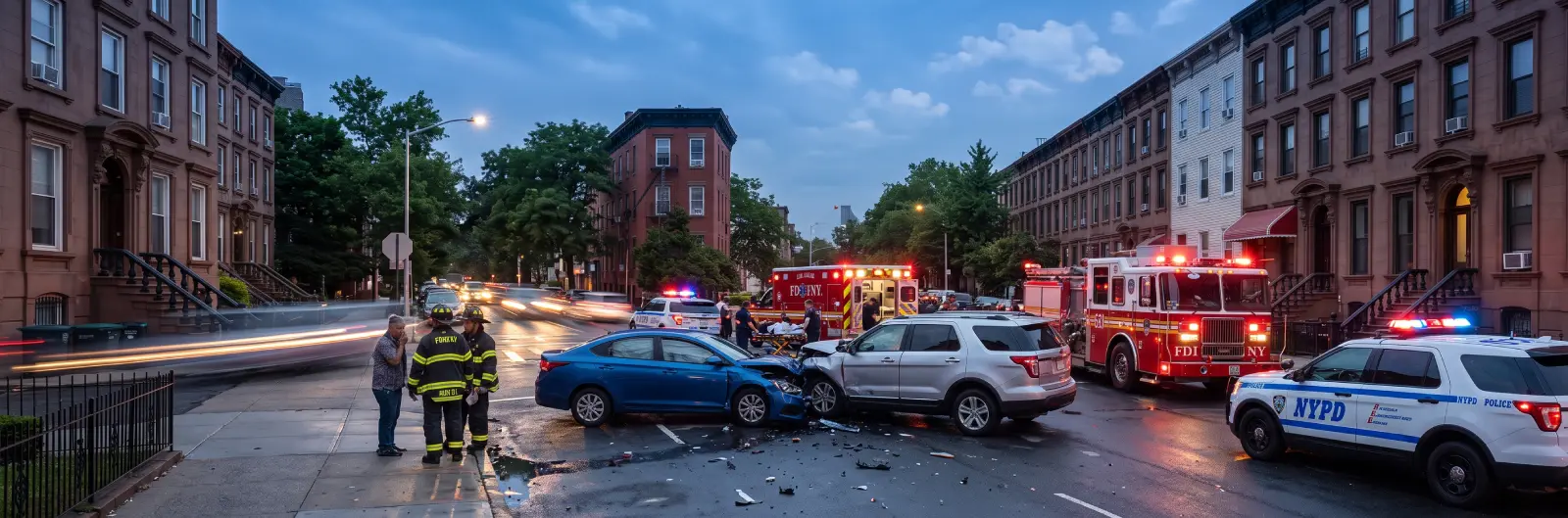
If a drunk driver hit you in Brooklyn, you may have a claim against more than the driver. A Brooklyn drunk driver accident attorney can pursue the intoxicated driver and, on a separate legal track, the bar or host who kept serving that driver after they were visibly drunk. That second track under New York’s Dram Shop Act often matters most when the driver’s own insurance runs out. Every case starts with a free consultation, and Silver Law Group answers 24/7 in English, Spanish, and Russian, works on contingency, and can meet you at your home or hospital room. Call 212-470-4544.
Do You Have a Case After a Brooklyn Drunk Driving Crash
A driver who gets behind the wheel drunk and injures you is negligent as a matter of law. New York draws the intoxication lines by blood alcohol concentration: driving while intoxicated (DWI) at 0.08% BAC or higher under VTL §1192(2), aggravated DWI at 0.18% or higher under §1192(2-a), and driving while ability impaired (DWAI) with a BAC over 0.05% but below 0.07% under §1192(1). Any of these means the driver broke a safety law written to protect you, and breaking it is evidence of negligence in your civil case. You do not need a conviction to sue. A criminal case has to prove intoxication beyond a reasonable doubt; your injury case only has to show it is more likely than not. That lower standard is why victims win civil claims even when the district attorney never charged the driver, or charged and lost. If the police let the driver walk, your right to compensation is still intact.
Who Can Be Held Liable for Your Brooklyn Drunk Driving Injuries
The impaired driver is the first defendant, but rarely the only one. New York’s Dram Shop Act, at General Obligations Law §11-101, lets you sue a bar, restaurant, or club that sold alcohol to a patron who was already visibly intoxicated and then got behind the wheel and hit you. A related section, GOL §11-100, reaches anyone who unlawfully furnished alcohol to a driver under 21 — including a private host, not just a licensed business. This matters for a practical reason. A single driver often carries the state-minimum auto policy, which a serious injury can exhaust in a day. The commercial establishment that over-served has its own liquor-liability coverage, and reaching it can be the difference between a claim that pays your medical bills and one that stalls.
Suing the Bar or Restaurant That Over-Served the Driver
A Dram Shop claim turns on two things you have to prove. First, the establishment sold alcohol to the driver while he was visibly intoxicated — slurring and unsteady on his feet — which Alcoholic Beverage Control Law §65 already makes an unlawful sale. Second, there is a reasonable connection between that illegal sale and the crash that hurt you. The proof lives in places that vanish quickly: the bar’s surveillance video, its point-of-sale records, the tab showing how many rounds the driver ran, and the bartender’s and other patrons’ memories. That is a separate pool of recovery from the driver’s insurance, and it is often the deeper one, which is exactly why it needs to be pursued before the receipts are overwritten and the footage is taped over.
Where Drunk Driving Crashes Happen in Brooklyn
Impaired crashes cluster on Brooklyn’s fast, wide roads, where late-night speed turns a drunk driver’s slowed reactions into a catastrophe instead of a fender-bender. A few corridors show up again and again:
- The Belt Parkway, the highest-crash corridor in New York City in NYC Open Data, where drivers routinely run well above the limit along the water.
- Atlantic Avenue, long nicknamed Brooklyn’s “Boulevard of Death,” with the Atlantic and Pennsylvania Avenue junction in East New York among the borough’s deadliest points.
- The Tillary Street and Flatbush Avenue intersection in Downtown Brooklyn, where traffic pours off the Brooklyn Bridge and the BQE into a tangle of turning lanes.
- Ocean Parkway and the Brooklyn-Queens Expressway, where a 2 a.m. impaired driver has room to build lethal speed.
The pattern is the road, not bad luck. A high design speed plus a driver who cannot judge distance or brake in time is what pushes these wrecks from injury to fatality.
Serious Injuries in Brooklyn Drunk Driving Accidents
High-speed impaired crashes produce the injuries that change a life permanently:
- Traumatic brain injury
- Spinal cord damage and paralysis
- Multiple fractures
- Internal organ damage
- Amputation
- Burns
- Wrongful death, when the crash is fatal.
These are not soft-tissue claims. Under Insurance Law §5102(d), New York’s no-fault system normally keeps minor injury claims inside your own insurance, but a “serious injury” — a fracture, significant disfigurement, permanent loss of a body function, or death among them — lets you step outside no-fault and sue the drunk driver directly for your full losses, including pain and suffering. The injuries above almost always clear that bar.
What Your Brooklyn Drunk Driving Claim Is Worth
Your claim covers the losses the crash forced on you: emergency and ongoing medical bills, the future care a brain or spinal injury will need for years, the wages you have already lost, your reduced earning capacity if you cannot return to the same work, and pain and suffering for the physical and emotional toll. No two claims carry the same value, because no two injuries or recoveries are the same. Being partly at fault does not end your claim. New York follows pure comparative negligence under CPLR §1411, so if you were found, say, 20% responsible, your recovery is reduced by that share rather than erased. A drunk driver’s insurer will often try to pin some blame on you to shrink what they pay, and the comparative-negligence rule limits how far that tactic can go.
Punitive Damages Against a Drunk Driver
Ordinary car crashes almost never support punitive damages. Drunk driving can, because choosing to drive intoxicated is treated as willful and wanton conduct, not a simple mistake. When a court allows them, punitive damages sit on top of the money that covers your losses and exist to punish the driver and deter the next one. They are not guaranteed, but the drunk-driving facts that make your case serious are the same facts that put punitive damages on the table.
What to Do After a Drunk Driving Accident in Brooklyn
What you do in the first hours shapes what your claim can prove later. Take these steps if you are physically able, or have someone do them for you:
- Call 911 and tell the police you think the driver was drunk. That prompts field sobriety and chemical testing at the scene, which creates the official record your civil case can lean on.
- Get examined the same day, even if you feel fine. Adrenaline hides brain injuries and internal bleeding, and a gap in treatment is the first thing an insurer uses against you. Brooklyn trauma centers like Kings County Hospital Center and Maimonides Medical Center are built for exactly these injuries.
- Photograph everything you can: the vehicles, the road, your injuries, and any beer cans, bottles, or receipts near the other car.
- Get names and numbers of witnesses before they leave. A stranger who saw the other driver weaving is worth more than any argument later.
The drunk driver’s insurer may call within a day or two. Do not give a recorded statement until you have talked to a lawyer.
The Criminal Case Against the Driver Is Not Your Injury Claim
The district attorney’s case and your case run on separate tracks and do not wait for each other. The criminal case punishes the driver with fines, license loss, or jail; your civil case puts money in your hands for what the crash cost you. One can end without touching the other, and as covered above, you can win yours even if the driver is never convicted. A criminal charge can still help your civil picture. If the driver was arrested under Leandra’s Law — VTL §1192(2-a)(b), which makes driving intoxicated with a child age 15 or younger in the car an automatic felony — that fact underscores how reckless the conduct was and can strengthen your claim, including any argument for punitive damages.
What It Costs to Hire a Brooklyn Drunk Driving Accident Lawyer
Hiring the firm costs you nothing out of pocket. Silver Law Group works on a contingency fee, which means you pay no money upfront and no hourly bills while your case is open. The fee is a set percentage taken only out of what the firm recovers for you, and if there is no recovery, there is no fee. The financial risk of bringing the case sits with the firm, not with you. The first consultation is free, so finding out whether you have a claim costs nothing either. You can make that call while you are still deciding what to do.
Deadlines to File a Drunk Driving Injury Claim in New York
Several clocks start the moment you are hurt, and they do not all run for the same length:
- Three years to file a personal injury lawsuit, under CPLR §214.
- Two years to file for wrongful death, under EPTL §5-4.1, if the crash killed someone.
- 90 days to file a Notice of Claim, under GML §50-e, if a government or MTA vehicle was involved — miss this and the longer deadline never matters.
- 30 days to give your own insurer written notice for a no-fault claim.
The legal deadlines are the outside limits, not a schedule to relax into. The bar receipts, point-of-sale data, and surveillance footage that prove a Dram Shop claim get overwritten in weeks, and the drunk driver’s own trail cools just as fast. Wait too long and the evidence that would have won your case may already be gone.
Why Choose Silver Law Group for Your Brooklyn Drunk Driving Case
Silver Law Group prepares every drunk-driving case as if it is going to trial, and insurers know the difference between a firm that files and quickly settles and one that is ready to put the case in front of a Brooklyn jury. That readiness is what gives your claim real weight when it is time to negotiate. The rest is built to make this easier while you are hurt. Consultations are free and answered 24/7, in English, Spanish, or Russian. Representation is on contingency, so you owe nothing unless the firm recovers for you. If you cannot come to the office, the attorney comes to you, at your home or your hospital bed. The firm serves Brooklyn from its Midtown Manhattan office at 49 West 37th Street, 7th Floor, and the call that starts your case is 212-470-4544.