

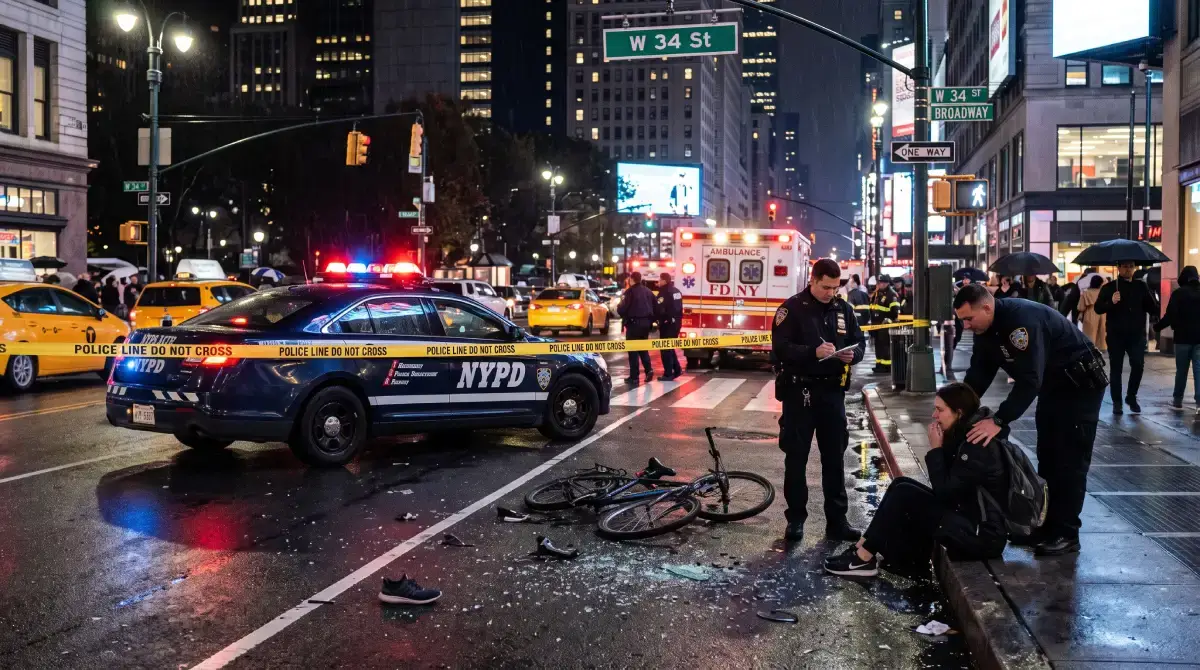
A driver who hit you and drove off does not get to decide whether you recover. If you were injured in a hit and run anywhere across New York City’s five boroughs, a hit and run lawyer at Silver Law Group can often recover compensation even when the driver is never found, through your own coverage and a state fund built for exactly this situation. There is no fee unless you recover. The consultation is free, available 24 hours a day, and handled in English, Spanish, or Russian. This page is for injured victims, not for drivers facing leaving-the-scene charges.
Do You Still Have a Case if the Driver Fled in New York
Most hit and run victims in New York can still recover, and the reason is the state’s no-fault system. New York pays first-party benefits through your own auto insurer no matter who caused the crash and no matter whether the fleeing driver is ever identified. That coverage starts your medical bills and part of your lost wages moving before anyone knows who hit you. Many people wrongly assume a driver who got away leaves them paying alone; the system is built the other way.
Beyond no-fault, there are two more ways to reach compensation when the driver stays unknown. Your uninsured motorist coverage can treat the phantom driver as an uninsured one, and a state fund called MVAIC exists for people with no auto insurance available to them at all. The sections below walk through all three paths and the one requirement that decides whether they open.
How to Recover Compensation When the Hit-and-Run Driver Is Never Found
Three sources of compensation exist for a driver who fled, and most hit and run claims run through one or more of them.
- No-fault (PIP). Your own policy, or a resident household member’s policy, pays up to $50,000 per person for medical bills and lost wages, regardless of fault. If no such policy exists, MVAIC can provide these no-fault benefits instead.
- Uninsured motorist coverage (UM/SUM). New York treats an unidentified driver as an uninsured one, so the UM coverage on your own or a household member’s auto policy can pay for your injuries. If you carry higher SUM limits, that is where a serious hit and run injury reaches real money.
- MVAIC. The Motor Vehicle Accident Indemnification Corporation is New York’s fund of last resort, for qualified state residents who have no auto insurance available through themselves or their household.
One rule sits underneath all of this and decides many hit and run cases: the physical-contact requirement. Under Insurance Law 5217, a claim against an unidentified driver only stands if the vehicle actually touched you or the car you were in. A hit and run that sideswipes your bumper or strikes you as a pedestrian meets it. A phantom car that forces you to swerve and crash without ever touching you usually does not, no matter how reckless the driver was. That single fact, contact or no contact, often decides whether the unidentified-driver paths are open to you, which is why getting any contact written into the police report matters so much.
What to Do After a Hit-and-Run in New York
What you do in the first day shapes whether the evidence, and the claim, survives.
- Call 911 and report to the police within 24 hours. This gets you a report number and preserves your eligibility for an MVAIC claim, which the 24-hour rule protects.
- Get medical care right away. Treatment records tie your injuries to the crash and start the file your claim depends on.
- Photograph everything: the scene, the damage, any paint transfer or debris, and your own injuries.
- Collect witness contact information. A witness who saw the car flee can make or break an unidentified-driver claim.
- Preserve nearby video fast. Businesses and traffic cameras often record over footage within 24 to 48 hours, so a camera that caught the plate today may be blank by the weekend.
Speed is not a nicety here. Each of these steps decays by the hour, and the driver’s head start is already working against you.
What Your Hit-and-Run Case Could Be Worth
Value comes from what you lost, not from a formula. A hit and run claim can recover your medical expenses, lost wages, pain and suffering, property damage, and, in a fatal crash, wrongful death damages for the family. Pain and suffering carries a condition: you can claim it only if your injury meets the serious-injury threshold under Insurance Law 5102(d), which covers fractures, significant disfigurement, permanent limitations, and similar defined harms. Serious injuries also bring costs that land later, from follow-up surgery to therapy you may need for years, and those belong in the claim from the start.
The honest part most sites skip is the ceiling. If your only route is MVAIC, bodily-injury recovery is capped at New York’s statutory minimums, $25,000 per person and $50,000 per accident. A claim through your own UM or SUM limits, or against a driver who is later identified and has assets, can reach well past that, which is one reason a state-minimum policy and a high-SUM policy are two very different cases. What drives the number within those limits is injury severity, the medical care ahead of you, lost earning capacity, and how clearly the evidence ties it all to the crash. No lawyer can promise you a figure, and any who does before reading your file is guessing.
Deadlines That Can End Your Hit-and-Run Claim in New York
Every hit and run claim runs on several deadlines at once, and missing the earliest can close the door for good.
- Report to police within 24 hours. Required to keep an MVAIC claim alive.
- File the no-fault application within 30 days. Insurance Law 5106 sets this window for your PIP benefits.
- File the MVAIC Notice of Intention within 90 days. This applies to hit-and-run and unidentified-vehicle claims.
- Sue within three years. CPLR 214 is the general personal injury statute of limitations.
- File a wrongful death claim within two years. EPTL 5-4.1 runs from the date of death.
- File a Notice of Claim within 90 days if a city or government vehicle was involved. GML 50-e adds this shorter step before you can sue a public entity.
These clocks do not wait for the police to find the driver. The safest move is to have every date that applies to your case checked at the start, while all of them are still open.
If the Police Identify the Driver
If the police do find the driver, your position gets stronger. Leaving the scene of an injury crash violates Vehicle and Traffic Law 600, and that violation can support negligence per se, meaning the illegal act itself stands in for proof of carelessness. Your civil injury claim runs separately from and parallel to the criminal case; you do not need a conviction to win compensation, and the criminal court can also order restitution as part of the driver’s sentence. Restitution and your civil damages are not the same money, though: restitution is ordered by the criminal court and is usually limited, while your civil case seeks the full range of what the crash cost you. Even a driver who is identified but carries no insurance can be sued directly where they have income or assets worth pursuing.
How a Hit-and-Run Lawyer Finds an Unknown Driver
Silver Law Group does not wait on the police to build your case. The firm runs its own investigation: canvassing the area for surveillance and traffic-camera footage before it is erased, tracking down and interviewing witnesses, recovering vehicle debris and paint transfer that can point to a make and model, and bringing in accident-reconstruction experts when the crash has to be pieced back together. A single clear frame of video, or a mirror housing left in the road, can turn an unknown car into a license plate. This work matters because the police clear only a fraction of these cases. Citywide, an arrest is made in only a small share of injury hit-and-run crashes, and even in fatal cases the driver is identified only about half the time. The one factor you control is time. A hit and run accident attorney brought in during the first days can still reach the footage that a driver’s flight was counting on disappearing.
What It Costs to Hire a New York Hit-and-Run Lawyer
Nothing out of pocket. Silver Law Group works on contingency, so there is nothing to pay upfront and no hourly bill along the way. The fee comes only out of a settlement or award, and if the firm recovers nothing for you, you owe no attorney’s fee. Cost is never the reason to put off the call. The case consultation is free, so you can find out where you stand before you spend a dollar.
Neighborhoods and Boroughs We Serve
Silver Law Group handles hit and run cases across all five boroughs. New York’s no-fault rules, the MVAIC process, and the injury deadlines above apply the same everywhere in the city. What changes borough to borough is the courthouse, the precinct investigating your crash, and the hospital that treated you, and that local detail affects how a case moves.
- Bronx hit and run cases
- Brooklyn hit and run cases
- Queens hit and run cases
- Manhattan hit and run cases
- Staten Island hit and run cases
The firm works from a Midtown Manhattan office, central to the courts and precincts across all five boroughs.
Why Choose Silver Law Group for Your Hit-and-Run Case
You get the terms that matter when you are hurt and unsure who will pay. A free consultation, any hour, in English, Spanish, or Russian. No fee unless the firm recovers for you. An attorney who can come to your home or hospital room when your injuries make travel hard. And a firm that prepares every case as if it will be tried, which is the posture that moves an insurer to take a phantom-driver claim seriously instead of lowballing it.
From a Midtown Manhattan base, Silver Law Group works hit and run claims across the whole city. If a driver hit you and fled anywhere in New York, the next step costs nothing: call 212-470-4544.