

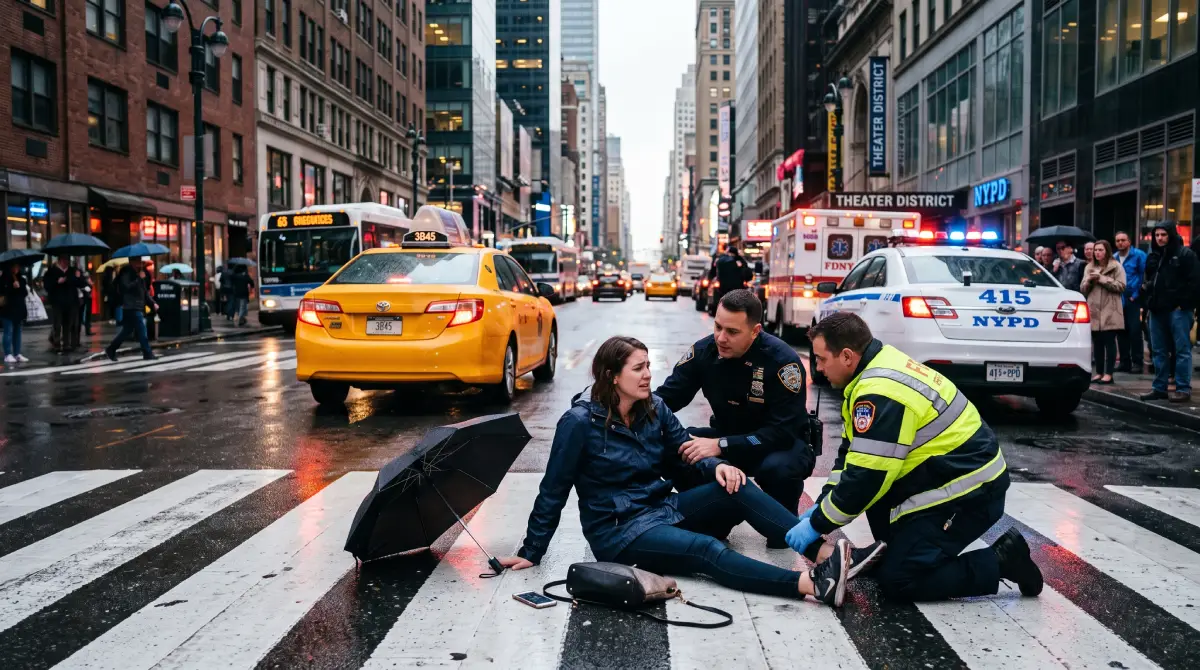
If a car struck you while you were walking, a New York pedestrian injury lawyer at Silver Law Group can pursue the driver, the insurer, and anyone else at fault while you focus on healing. We represent pedestrians hurt anywhere in New York City — the Bronx, Brooklyn, Queens, Manhattan, and Staten Island — and families who lost someone in a crash across the state. You pay nothing up front, and no fee unless we recover for you. Every case starts with a free consultation, available 24/7 in English, Spanish, and Russian; call 212-470-4544.
Do You Have a Pedestrian Accident Case in New York
New York’s no-fault system covers you even though you were on foot. When a vehicle hits a pedestrian, that vehicle’s no-fault insurance pays your first medical bills and part of your lost earnings regardless of who caused the crash, under Insurance Law §5102 and §5104. This coverage is called Personal Injury Protection, or PIP, and it works the same way in every borough. You do not have to prove the driver was careless to receive it.
PIP does not pay for pain and suffering, and it runs out. To sue the driver for that fuller harm, your injury has to cross the serious-injury threshold in Insurance Law §5102(d). That threshold includes a bone fracture, significant disfigurement, permanent loss of use of a body part or system, and an injury that keeps you from your usual daily activities for at least 90 of the 180 days after the crash. Pedestrians struck by cars routinely meet it, because a person hit by two tons of steel rarely walks away with a minor bruise. A lawyer for a pedestrian hit by a car can tell you early whether your injuries clear that line and open a claim against the driver.
Your Right of Way, the Driver’s Duty of Care, and Partial Fault
On foot, you have the right of way in more places than most drivers admit. VTL §1151 requires a driver to yield to any pedestrian in a crosswalk, marked or not, and forbids passing another vehicle that has stopped to let someone cross. Even outside a crosswalk, VTL §1146 puts a duty on every driver to use due care to avoid hitting you, and a driver who is texting or speeding does not get a pass because you stepped off mid-block under VTL §1152.
Partial fault does not end your claim. New York follows pure comparative negligence under CPLR §1411, so you can recover even if you were partly to blame, for example by crossing against the light, and your award is only reduced by your share of fault. If a jury finds you 20 percent responsible, you still collect 80 percent of your damages. The common belief that jaywalking bars recovery is wrong; it may lower what you get, but it does not close the door.
Who Can Be Held Liable for Your Pedestrian Accident
The driver is rarely the only one who has to pay. Depending on how the crash happened, your claim can reach several parties:
- The driver who hit you.
- The vehicle’s owner, who under New York law is liable for a permissive driver’s negligence even if the owner was nowhere near the scene.
- The driver’s employer, if a delivery van, box truck, or other work vehicle was involved and the driver was on the job.
- The City of New York, the MTA, or New York City Transit, when a city vehicle or public bus struck you, or a badly designed or maintained roadway helped cause the crash.
Claims against a public agency run on their own short clock, covered below.
Common Causes of Pedestrian Accidents in New York City
Most pedestrian crashes trace back to a driver doing something ordinary and careless. The patterns repeat across the city:
- Distracted driving, usually a phone in hand at the wrong second.
- Failing to yield to a pedestrian at a crosswalk.
- Left turns and other improper turns, where the driver’s attention is on oncoming traffic instead of the person in front of the car.
- Speeding, which turns a survivable impact into a fatal one.
- Driving drunk or drugged.
The scale is citywide, not confined to one neighborhood. New York City recorded 111 pedestrian deaths in 2025, according to NYC DOT, the lowest annual total since the city began keeping records and still more than two people killed on foot every week. Vision Zero has pushed the number down for years, but one turn or one distracted glance can end a life on any block in any borough.
Injuries Pedestrian Crashes Cause
A person weighs a fraction of what a car does, and has no frame, airbag, or crumple zone. That mismatch is why a struck pedestrian often suffers injuries a belted driver would survive:
- Traumatic brain injury, from the head striking the hood, windshield, or pavement.
- Spinal cord damage and paralysis.
- Multiple and crush fractures.
- Internal organ damage and internal bleeding.
- Fatal injuries, which give the surviving family a wrongful-death claim.
What Your Pedestrian Accident Case Is Worth
No honest lawyer can price your case from a headline, and this firm publishes no verdicts or settlement amounts, because every pedestrian case turns on its own facts. What a claim can recover is more concrete. You can pursue the cost of past and future medical care, from the ambulance to the surgeries and therapy still ahead. You can claim lost wages and, if your injuries limit the work you can do going forward, your diminished earning capacity. You can recover for pain and suffering — the physical pain and the loss of the life you had before the crash.
When a pedestrian is killed, the family’s claim shifts to wrongful death under EPTL §5-4.1. That covers funeral and burial costs, the loss of the support and services the person provided, and the financial hole left behind. What any of these claims is worth depends on how serious the injury is and how clear the driver’s fault is, which is why numbers on a website mean nothing until someone reviews your file.
If the Driver Fled the Scene or Had No Insurance
A driver who flees or carries no insurance does not leave you without options. Report a hit-and-run to the police within 24 hours; that report is what keeps your later claim alive. If you or a relative in your household has auto insurance, its uninsured-motorist coverage can pay for a pedestrian hurt by a driver who cannot be found or has none.
If no one in your household carries auto insurance, New York’s MVAIC, the Motor Vehicle Accident Indemnification Corporation, is the backstop built for your situation. Its deadlines are short and easy to miss: report to the police within 24 hours, and file a Notice of Intention with MVAIC within 90 days of a hit-and-run or unidentified-vehicle crash, or within 180 days when the driver is identified but uninsured. Miss the window and the fund can turn you away, so this is one of the first things to hand a pedestrian injury lawyer.
What to Do After Being Hit and How We Investigate Your Case
What you do in the first hours protects everything that follows. If you are able, or someone with you can help:
- Get medical care, even if you think you can walk it off, because some pedestrian injuries surface days later and the record ties them to the crash.
- Make sure the police are called and a report is filed.
- Get the driver’s name, license, and insurance, and the vehicle’s plate.
- Write down the names and numbers of any witnesses before they leave.
Then the work shifts to us. We move fast to pull CCTV and surveillance footage from nearby buildings and businesses, which is often recorded over within days. We can download the vehicle’s event data recorder — the “black box” that logs speed and braking in the seconds before impact — and bring in accident-reconstruction and medical experts to show how the crash happened and what it did to you. Evidence on a city street does not wait; the sooner a pedestrian injury lawyer starts, the more of it survives.
How Long You Have to File a Pedestrian Accident Claim in New York
New York runs several clocks at once, and the shortest one can quietly end your case:
- 30 days to file your no-fault (PIP) application with the insurer. Miss it and you can lose the benefits that pay your early medical bills.
- 3 years to sue the driver for your injuries, under CPLR §214.
- 2 years to bring a wrongful-death claim if a pedestrian was killed, under EPTL §5-4.1.
- 90 days to file a Notice of Claim when a city vehicle, an MTA or Transit bus, or a dangerous public roadway is involved, under GML §50-e, and then only a year and 90 days to sue the public agency under GML §50-i.
The 90-day notice is the trap most people never hear about until it is too late.
What It Costs to Hire a New York Pedestrian Injury Lawyer
Nothing. You pay no money up front to hire us, and no hourly bills arrive while your case is open. We work on a contingency fee, which means our payment is a percentage of what we recover for you — and only if we recover. We also front the costs of building the case, the expert fees, the records, the reconstruction work, so you are not writing checks while you heal. If the case brings in no settlement or verdict, you owe us no fee. That arrangement lets a pedestrian with mounting medical bills hire the same caliber of lawyer the insurance company already has, without risking money they do not have.
Why Choose Silver Law Group for Your Pedestrian Case
You want a lawyer who can take an insurance company to trial and has the resources to prove a hard case, not one who folds at the first offer. We prepare every pedestrian case as if it is going to a jury, and we fund the reconstruction and medical experts that a serious claim needs. The consultation is free, available any hour of the day, and handled in English, Spanish, or Russian. If your injuries keep you from traveling, the attorney comes to your home or hospital room. And because we work on contingency, hiring us costs you nothing unless we recover for you.
Call Silver Law Group at 212-470-4544 for a free consultation, any time, day or night.