

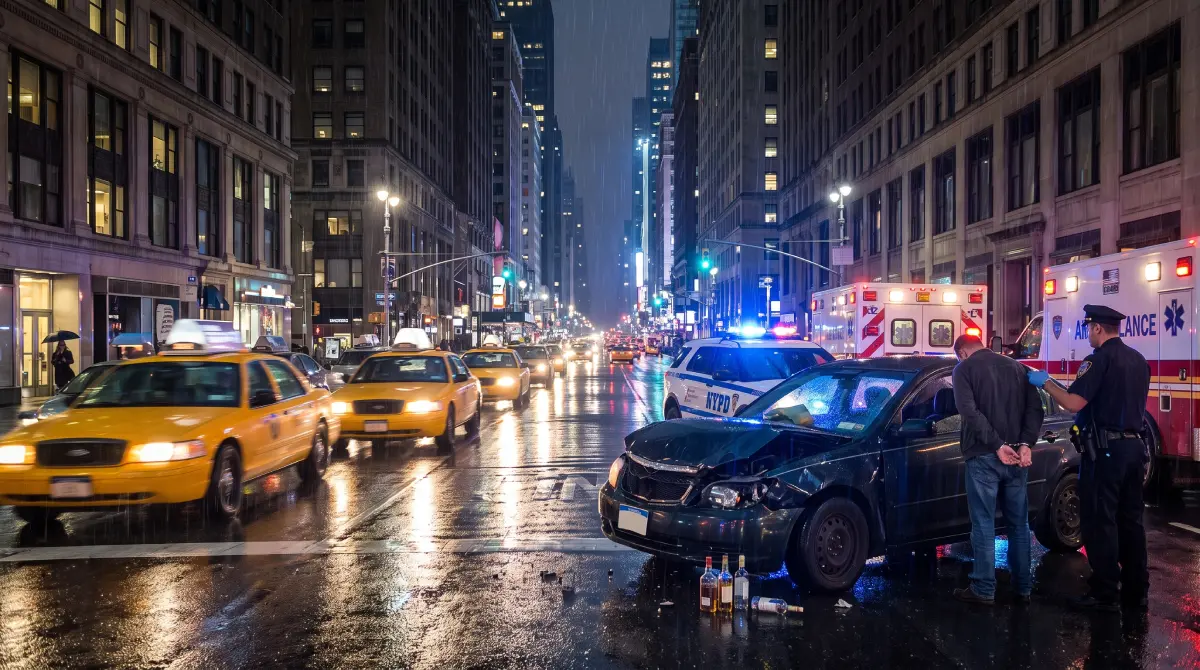
Manhattan Drunk Driver Accident Attorney
A Manhattan drunk driver accident attorney at Silver Law Group builds the civil case against the impaired driver who hit you, and against everyone who helped put them behind the wheel. This firm sues drunk drivers. It never defends them. If a drunk driver caused your crash on the FDR Drive or anywhere else in Manhattan, you can hold that driver financially responsible for what your injuries cost you.
Your first call costs nothing. Consultations are free, run 24 hours a day, and come in English, Spanish, and Russian. You owe no attorney fee unless the firm recovers money for you. Call 212-470-4544, and if you cannot travel, the attorney can come to your home or hospital room.
Do You Have a Claim After a Manhattan Drunk Driving Crash
The drunk driver is rarely the only party who owes you money. New York law lets you reach past the person behind the wheel to others whose choices helped cause the crash, and that matters because one driver’s insurance policy often falls far short of what a serious injury costs.
Depending on how your crash happened, the parties who may share liability include:
- A bar, restaurant, or club that overserved the driver. Under New York’s Dram Shop Act, General Obligations Law §11-101, a business that sells alcohol to someone already visibly drunk, or to anyone under 21, can be held responsible when that customer then injures you on the road. A stack of timestamped bar receipts can put this defendant into your case.
- The owner of the vehicle. Vehicle and Traffic Law §388 makes the registered owner of a car responsible for the negligence of anyone they let drive it. So when a drunk driver borrows or is lent a car, the owner’s insurance is in play even though the owner was nowhere near the crash.
- The driver’s employer. If the drunk driver was working at the time, making a delivery or driving a company vehicle, the employer can be liable for the harm their on-duty driver caused.
Finding every insured party early is what separates a claim boxed in by one driver’s minimum policy from one that can actually cover your hospital bills and lost income.
Proving the Driver Was Drunk
You do not need a criminal conviction to prove the driver was impaired. You need evidence, and most of it is collected in the first hours and days after the crash, which is one reason to get a drunk driver accident lawyer working early, before footage is overwritten and receipts are thrown out.
The proof that a drunk driving claim usually rests on:
- The NYPD crash report, which records the responding officer’s observations, any admissions, and whether the driver was arrested.
- A chemical BAC test result at or above 0.08, the legal limit in New York. A reading well over the limit does more than establish impairment; it supports a demand for punitive damages.
- Field sobriety test results noting how the driver performed at the scene.
- Bar and restaurant receipts showing where and how much the driver drank, which can also open a Dram Shop claim.
- Camera footage from nearby buildings and MTA cameras that may have captured the drinking, the driving, or the impact.
The outcome of the driver’s criminal case does not control yours. A prosecutor can drop the DWI charge, or a jury can acquit, and you can still win your civil claim. The criminal court must find the driver guilty beyond a reasonable doubt; your civil case only has to show it is more likely than not that the driver was impaired and caused your injuries.
Injuries That Meet New York’s Serious Injury Threshold
New York’s no-fault system blocks most crash victims from suing the driver for pain and suffering unless the injury clears a legal bar called the serious injury threshold. Insurance Law §5102(d) defines what counts. A bone fracture qualifies, and any fracture will do, from a cracked wrist to a shattered hip. Significant disfigurement counts, which covers the scarring that burns and lacerations leave behind. So does a permanent limitation of a body organ, member, or function, like a shoulder that no longer rotates or a back that will not bend the way it did.
There is also the 90/180 rule. If your injuries are not permanent but still keep you from your usual daily activities for at least 90 of the 180 days after the crash, you meet the threshold on that basis alone.
What proves any of this is the medical record. After a serious drunk driving crash in Manhattan, you may be taken to Bellevue, Mount Sinai, or NewYork-Presbyterian, and the trauma team’s imaging, operative notes, and discharge records become the backbone of your case. Get examined even if you feel able to walk away, because injuries from a high-speed impact often announce themselves days later, and a gap in treatment is the first thing the insurer will use to argue you were never really hurt.
What Your Manhattan Drunk Driving Claim Is Worth
Start with what no-fault does and does not do. New York’s no-fault coverage pays up to $50,000 in medical bills and lost earnings no matter who caused the crash, but it pays nothing for pain and suffering, and $50,000 disappears fast when you are looking at surgery and months out of work.
Once your injury clears the serious injury threshold, you can pursue the drunk driver for far more. Economic damages cover the hard numbers: medical bills above the no-fault cap, future treatment, lost wages, and the earning capacity you lose if you cannot return to the same work. Non-economic damages cover the pain, the lasting limitation, and the parts of your life the injury took from you.
If the driver carries too little insurance to cover all of that, and drunk drivers often carry only the state minimum, your own policy may hold supplementary uninsured/underinsured motorist (SUM) coverage that adds another layer of recovery. And when a drunk driver kills someone, the family can bring a wrongful death claim under EPTL 5-4.1 for the losses the death caused, from funeral costs to the support and guidance the person would have provided.
Punitive Damages Against Drunk Drivers
Most car crash cases cannot support punitive damages. Drunk driving cases often can. New York allows punitive damages when a defendant acted with reckless disregard for the safety of others, and getting behind the wheel drunk sits squarely inside that idea. These damages are not tied to your medical bills or your lost wages. They exist to punish the driver for the choice and to deter the next person tempted to make it. A high BAC reading or a prior DWI conviction sharpens the demand, because both show the driver understood the risk to everyone else on the road and drove anyway. Raising punitive damages also changes the pressure on the defense, since this is money the driver’s insurer may not cover, and that personal exposure can move a case toward a fair resolution.
What to Do After a Drunk Driver Hits You in Manhattan
What you do in the first hour shapes the case you can bring later. If you are able, work through these steps; if you are hurt too badly, focus on getting help and let the record fill in afterward.
- Call 911. A police response puts an officer on scene who can observe the driver, note signs of intoxication, and start the NYPD crash report your claim will rely on.
- Get emergency care. Accept the ambulance or go to the ER the same day. Adrenaline hides serious injuries, and same-day treatment ties your injuries to the crash.
- Photograph everything you safely can: the vehicles, the damage, the road, any open containers, and your own injuries. Images taken at the scene cannot be argued away later.
- Collect witness names and numbers. A bystander who saw the driver stumble or smelled alcohol can be the difference in proving impairment.
One warning carries more weight than the rest. The at-fault driver’s insurer will call you fast, often within a day or two, and ask for a recorded statement. Do not give one before you have a lawyer. That call is not there to help you; the adjuster is trained to get you to minimize your injuries or admit a share of blame, and your recorded words can be used to cut or deny your claim.
What Hiring a Drunk Driving Lawyer Costs
You pay nothing out of pocket to hire this firm, and you pay no attorney fee at all unless the firm wins money for you. That is what a contingency fee means. The firm’s fee is a set percentage of the recovery, taken only if there is a recovery; if the case brings in nothing, you owe no fee for the work. The first case review is free, so learning where you stand costs you only a phone call.
Litigation has real costs along the way, from court filing fees and medical records to accident reconstruction and expert witnesses, and this firm advances those expenses as the case is built, rather than sending you a bill while you are trying to heal. That way, the strength of your case decides whether a drunk driver is held to account, no matter what your bank balance looks like.
Deadlines to File Your Manhattan Claim
A drunk driving claim in New York runs on several clocks at once, and the shortest ones start ticking the day of the crash. Miss a deadline and the right behind it can vanish, no matter how strong your case is.
- Three years to sue. Under CPLR 214, you generally have three years from the crash date to file a personal injury lawsuit against the driver and other at-fault parties.
- Two years for wrongful death. If the crash killed a loved one, EPTL 5-4.1 gives the family two years from the date of death to bring a wrongful death claim, a full year shorter than the injury deadline.
- Thirty days for no-fault. To keep your no-fault benefits, you must file the NF-2 application with the insurer within 30 days of the crash, or you can lose coverage for your own medical bills and lost wages.
- Ninety days for a government vehicle. When a city or state vehicle caused the crash, General Municipal Law §50-e requires a Notice of Claim within 90 days before you can sue the public entity.
The safest move is to treat the 30-day no-fault window as your first deadline and call before it closes, because protecting that coverage early keeps your medical bills paid while the larger claim is built.
Why Injured New Yorkers Choose Silver Law Group
When a drunk driver upends your life, the firm you call should be reachable when you actually need it and ready to try your case if the insurer refuses to be fair. Silver Law Group answers 24 hours a day and handles your consultation in English, Spanish, or Russian, so the moment language stops being a barrier, your claim can move. Every case is prepared as if it will go in front of a jury, which is the posture that makes insurers take a demand seriously rather than betting you will settle cheap.
If your injuries keep you home or in a hospital bed, the attorney will come to you rather than making you find a way to the office at 49 West 37th Street in Midtown Manhattan. And the whole relationship runs on contingency, so there is no fee unless money is recovered for you.
Start with a free consultation. Call 212-470-4544, day or night, and put a Manhattan drunk driver accident attorney to work on holding the driver who hurt you responsible.