

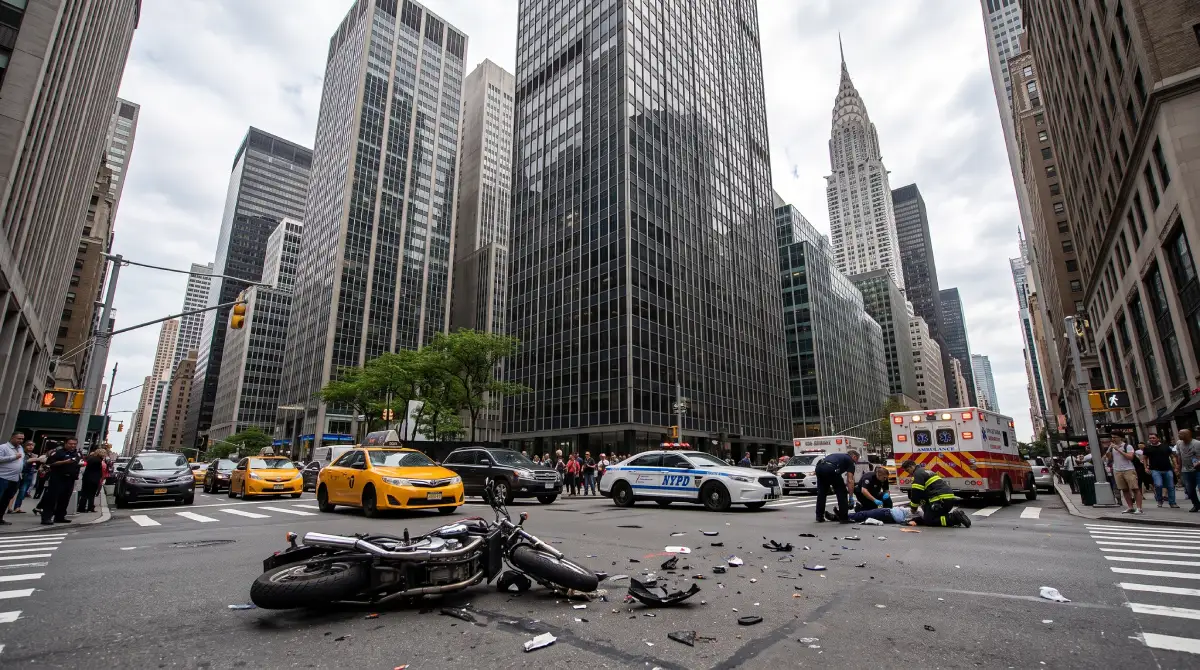
Insurance adjusters and jurors often decide the rider was at fault — speeding, weaving, riding too fast — before a single witness has spoken. A Manhattan motorcycle accident lawyer at Silver Law Group builds the record that answers that bias, using the police report, the driver’s own statements, and street or storefront video to show what happened on the road. The driver who turned across your lane is the one who broke the rule of the road, and the evidence usually proves it. Every consultation with the firm is free, the phones are answered 24 hours a day, and the attorneys handle cases in English, Spanish, and Russian. Call 212-470-4544 for a no-obligation review of your crash. If a hospital stay or your injuries keep you from traveling, the attorney comes to your room or your home.
Do You Have a Manhattan Motorcycle Accident Case
Most Manhattan motorcycle crashes come down to another driver’s negligence: a left turn taken across your path, a lane change into your line, a door thrown open, a car that ran the light. New York uses pure comparative fault under CPLR 1411, which matters more for riders than for anyone else on the road. Under that rule, your recovery is reduced by your share of the fault but never barred by it. If a jury finds you 30 percent responsible for going a few miles over the limit, you still collect 70 percent of your damages. The insurer will push your percentage as high as it can, because every point it adds is money it keeps, which is why the fault fight is the case.
Several parties can owe you money, depending on how the crash happened:
- The driver who hit you, and often the owner of the vehicle if that is someone else.
- The City of New York, when a pothole, a broken signal, or a badly designed intersection contributed.
- A parts or motorcycle manufacturer, when a defective tire, brake, or fuel system caused or worsened the wreck.
Figuring out who is on the hook early decides which insurance policies and deadlines apply to your case.
How and Where Manhattan Motorcycle Crashes Happen
Left-turn collisions are the signature Manhattan motorcycle crash. A driver heading the other way turns across Broadway or a cross street, misjudges your speed or never sees you, and cuts straight into your path. Lane-change crashes work the same way on the West Side Highway and the FDR Drive, where a driver drifts into a lane already occupied by a motorcycle sitting in a blind spot.
Dooring is a constant hazard in SoHo and the Village, where parked cars line narrow streets and a driver or passenger swings a door open into moving traffic. A rider has almost no room to react before the door is a wall.
Trucks add their own danger near the Lincoln Tunnel approaches, where large vehicles queue and merge and a motorcycle can vanish into a blind spot beside the trailer. A truck that changes lanes or turns without seeing you leaves little margin, and these crashes tend to produce the worst injuries.
Why New York’s No-Fault Law Leaves Motorcyclists Exposed
New York’s no-fault system does not cover you on a motorcycle, and that single fact reshapes your entire claim. Insurance Law Article 51 sets up Personal Injury Protection, the no-fault benefits that pay a car occupant’s medical bills and lost wages regardless of who caused the crash. Section 5102(f) defines the “motor vehicle” those benefits attach to and specifically leaves motorcycles out. A rider gets no PIP. No automatic medical coverage, no automatic wage replacement.
That exclusion cuts two ways, and the second way is a real advantage most riders never hear about. Because you are outside no-fault, you are also outside the barrier that no-fault builds around lawsuits. A car occupant in New York usually cannot sue for pain and suffering unless the injury clears the “serious injury” threshold in Insurance Law 5102(d), a list of categories like fracture, significant limitation, or permanent consequential limitation. Riders are not held to that threshold at all. You keep full common-law tort rights from the moment of the crash.
In plain terms: a car passenger with a bad sprain may be locked out of a pain-and-suffering claim because the sprain does not qualify as a serious injury. A motorcyclist with the same sprain can sue for it, because no threshold stands in the way. Your right to hold the at-fault driver responsible for every consequence of the crash — the pain, the missed work, the lasting limits on what your body can do — is broader than a car occupant’s, not narrower.
The trade-off is the medical bills. With no PIP writing checks in the early weeks, you have to cover treatment another way while the liability claim moves forward, which is the next problem to solve.
How Manhattan Riders Cover Medical Bills Without No-Fault
With no PIP to fall back on, you have a few ways to keep treatment going while your claim is pending.
- Your own health insurance usually pays for the emergency care and surgery. Expect it to assert a reimbursement lien, meaning it gets paid back out of your eventual recovery for what it spent on crash-related care. The lien is negotiable, and reducing it is part of the settlement work.
- MedPay is optional coverage some riders carry on the motorcycle policy. It pays medical costs up to the limit you bought, no fault required, and it can bridge co-pays and deductibles your health plan leaves behind.
- SUM and UM coverage — supplementary uninsured/underinsured motorist coverage — pays when the driver who hit you has no insurance or too little to cover your injuries. This comes from your own policy and is often the difference between a paper judgment and money you can actually collect.
When the at-fault driver has no insurance at all, or fled and was never identified, the Motor Vehicle Accident Indemnification Corporation may be your path to recovery. MVAIC exists for exactly that situation, the uninsured driver and the hit-and-run, but it runs on short notice deadlines, so the claim has to be started quickly. Which of these sources applies, and in what order, depends on the policies in play and who caused the crash. Sorting that out early keeps you from paying out of pocket for care another party owes.
What Your Manhattan Motorcycle Accident Claim Is Worth
What your claim is worth turns on the damage the crash did to your body and your future, not on a formula. New York law splits the value into two kinds of loss.
Economic damages are the costs you can document:
- Medical bills, from the ambulance and ER through surgery, hospital stays, and rehab.
- Future care — additional operations, physical therapy, home health, assistive equipment, and the medical needs a permanent injury creates for the rest of your life.
- Lost wages for the time the injury kept you from working.
- Lost earning capacity, when the injury changes what you are able to earn going forward, a common issue for riders with hand, leg, or spine damage that limits physical work.
Non-economic damages cover the harm that has no invoice:
- Pain and suffering, both what you have already lived through and what the injury will keep causing.
- Disfigurement and scarring, which road-rash and burn injuries frequently leave.
- Loss of enjoyment of life, when the crash takes away activities and independence you had before.
Permanence is the hinge. A fracture that heals clean is one case; the same fracture that leaves you with hardware, chronic pain, or a permanent limp is a much larger one, because the losses now run for decades instead of months. This is also why the early medical record matters so much, since the documentation you build in the first weeks is what proves, later, that the injury is lasting rather than temporary. Rushing to settle before the permanence of an injury is known almost always undervalues the claim.
What to Do After a Motorcycle Crash in Manhattan
The hours and days after a Manhattan motorcycle crash decide how strong your case is later. Work through these steps as your injuries allow.
- Call 911. A police response creates the official record, gets you medical help, and puts an officer on scene to document the driver and any witnesses before they leave.
- Make sure a report is filed and get the MV-104. This is the New York police accident report, and it captures the drivers, the vehicles, and the officer’s account of how the crash happened, a document your claim leans on from day one.
- Get real medical treatment at a hospital equipped for trauma. Bellevue, NewYork-Presbyterian, and Mount Sinai all handle serious motorcycle injuries. Tell every provider about every symptom, including the ones that seem minor, so the record is complete.
- Photograph everything you safely can: the bike, the other vehicle, the road, your gear, and your injuries. Get names and numbers from witnesses.
- Track down the cameras. Manhattan streets are watched by traffic cameras and by storefront and building security systems, and that footage is often the clearest proof of who caused the crash. Most of it overwrites itself within days, so a fast written demand to preserve it can save the single best piece of evidence you will ever have.
One thing to avoid: do not give the other driver’s insurer a recorded statement. The adjuster will call within days, sound friendly, and use anything you say to push your share of the fault up. Get advice before you talk.
Deadlines to File a Manhattan Motorcycle Accident Claim
Missing a deadline can end a valid case before it is heard, so the clocks matter as much as the facts.
The main deadline is New York’s three-year statute of limitations for personal injury, set by CPLR 214. You generally have three years from the date of the crash to file a lawsuit against the at-fault driver. Three years feels like plenty until the evidence starts disappearing and witnesses forget, which is why the work should start long before the deadline nears.
A much shorter clock applies if a City vehicle or a City condition — a broken signal, a dangerous roadway defect — played a part. General Municipal Law 50-e requires a Notice of Claim within 90 days of the crash before you can sue the City of New York at all. Miss that 90-day window and the claim against the City is usually gone, no matter how strong it is.
If a rider dies from the crash, the case becomes a wrongful death action, and EPTL 5-4.1 sets a two-year deadline running from the date of death for the estate to bring it. That clock is separate from the injury statute and easy to overlook during grief.
Manhattan motorcycle lawsuits are filed in New York County Supreme Court at 60 Centre Street, the courthouse on Foley Square where these cases are heard. Knowing which deadline governs your situation — three years, 90 days, or two — is the first thing to pin down, because the shortest one that applies controls the whole timeline.
What Hiring Us Costs and Why Injured Riders Choose Us
Hiring the firm costs you nothing up front. Silver Law Group works on a contingency fee, which means you pay no hourly bill and no retainer. The fee is a set percentage of the recovery, and it comes out only if the firm actually wins money for you — through settlement or verdict. If there is no recovery, there is no fee. The firm also fronts the costs of building the case, such as expert reports and records, and is repaid from the recovery only when there is one. That structure exists so an injured rider who cannot work can still afford the same representation as the insurance company on the other side.
Injured riders choose the firm for reasons that matter when you are hurt and stuck:
- Every case is prepared as if it will be tried. Insurers offer more when they know the lawyer is ready to go to a jury at 60 Centre Street, not just to settle cheap.
- The phones are answered 24 hours a day, so you are not left waiting through a weekend after a Friday-night crash.
- Consultations happen in English, Spanish, or Russian, at no cost.
- If you are in a hospital bed at Bellevue or unable to leave home, the attorney comes to you rather than making you travel injured.
The bias against riders is real, and the point of hiring a lawyer who handles these crashes is to put someone between you and an insurer that is counting on that bias.
Speak With a Manhattan Motorcycle Accident Lawyer Now
The two things that decide a motorcycle case — the deadline and the evidence — both work against waiting. Camera footage overwrites within days, the 90-day City notice runs fast, and witnesses scatter. The sooner the firm starts, the more of your case can still be saved.
Call 212-470-4544 now for a free, no-obligation review of your crash. The line is open 24 hours a day, the consultation is in English, Spanish, or Russian, and if your injuries keep you from coming in, the attorney will come to you. You pay nothing unless there is a recovery.