

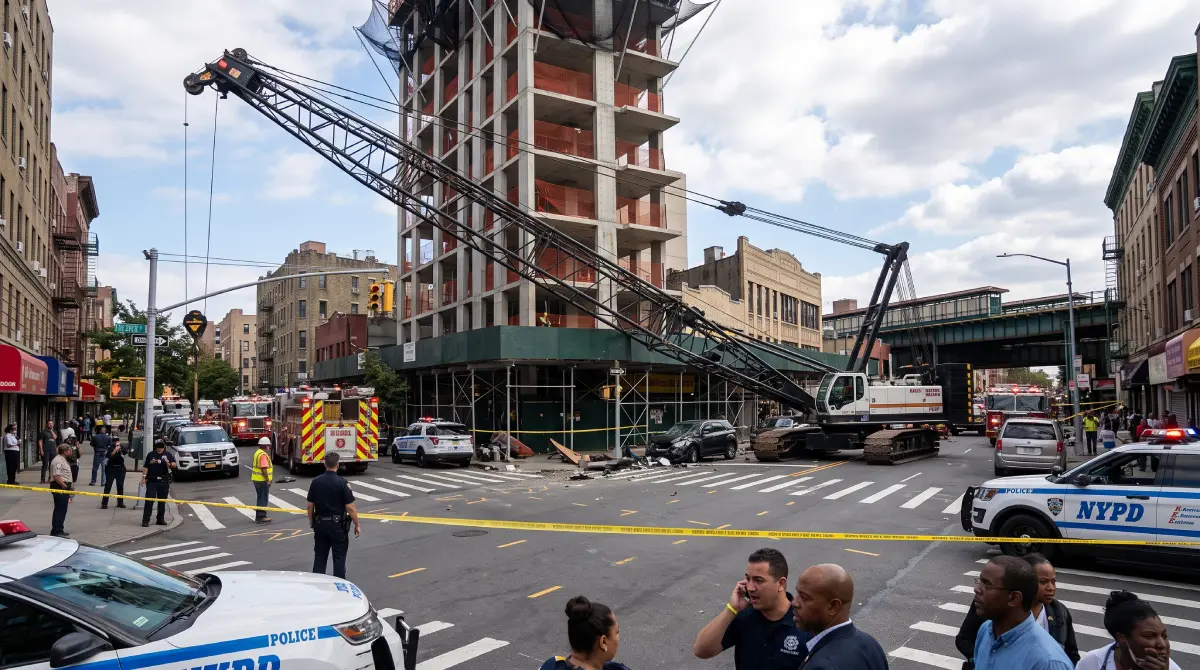
A crane collapse, dropped load, or equipment failure can end a career in seconds. If you were injured — or lost someone — in a Bronx crane accident, a Bronx crane accident attorney at Silver Law Group can review your case at no cost and tell you exactly what it may be worth. We work on contingency: Silver Law Group collects no legal fee unless we recover money for you. You owe nothing out of pocket to find out where you stand.
Who Can File a Crane Accident Claim in the Bronx
Multiple parties can have legal standing after a crane accident — not just the worker closest to the equipment.
People who may have a valid claim include:
- Construction workers injured on the job site
- Pedestrians or bystanders struck by falling debris or a collapsed crane
- Motorists hit by crane equipment or falling loads
- Tenants or occupants of nearby buildings struck by structural damage
- Family members of anyone killed in a crane accident
Construction Workers vs. Bystander Claims
Workers and bystanders follow different legal paths — and those paths affect how much compensation is available.
- Construction workers are typically covered by workers’ compensation, but that is rarely the full picture. A third-party lawsuit against the site owner, general contractor, or crane manufacturer can be filed simultaneously — and often produces a much larger recovery
- Bystanders and pedestrians are not subject to workers’ comp at all. They sue directly in civil court under general negligence principles, with no cap on damages
- Occupants of damaged buildings may have property damage and personal injury claims against the responsible party
Wrongful Death Claims After a Fatal Crane Accident
If a crane accident killed someone in your family, New York law gives surviving family members the right to pursue a wrongful death claim. Recoverable damages can include:
- Lost income the deceased would have earned over a lifetime
- Medical expenses incurred before death
- Funeral and burial costs
- Loss of companionship and parental guidance
A wrongful death claim runs parallel to, not instead of, any workers’ comp death benefits the family may be receiving.
Common Causes of Crane Accidents on Bronx Job Sites
Most crane accidents are not random. They result from specific, preventable failures by identifiable parties.
Common causes include:
- Operator error — inadequate training, fatigue, or failure to follow load charts
- Rigging defects — worn cables, improper attachment, or undersized hardware
- Overloading — lifting beyond the crane’s rated capacity
- Mechanical failure — neglected maintenance, defective parts, or worn components
- Site conditions — unstable ground, improper outrigger placement, or inadequate swing clearance
- Wind and weather violations — operating during conditions that exceed safety thresholds
- Inadequate inspection — failure to conduct required pre-shift and periodic inspections
- Communication breakdown — missing or misunderstood signals between operator and rigger
Identifying the cause is step one. Identifying who created or allowed that cause is where liability is established.
Who Is Liable for a Bronx Crane Accident
New York construction sites involve multiple layers of responsibility. Liability rarely falls on only one party.
Potentially liable parties include:
- General contractors responsible for overall site safety
- Subcontractors directly operating or rigging the crane
- Property owners who control or have authority over the site
- Crane rental companies that supplied defective or improperly maintained equipment
- Equipment manufacturers if a crane component failed due to a design or manufacturing defect
- Engineers or architects if a faulty plan contributed to the accident
- The City of New York if a municipal permit holder or city contractor was involved
One of the most important things a crane accident lawyer does early in a case is map the full chain of responsibility — because missing a liable party means leaving money on the table.
New York Labor Law Protections That Strengthen Your Case
New York’s Labor Law gives injured construction workers some of the strongest protections in the country.
Two provisions are especially relevant to crane accidents:
- Labor Law §240 (“The Scaffold Law”) — Imposes strict liability on property owners and general contractors for gravity-related injuries. If a crane dropped a load that struck you, or if you fell because of a crane malfunction, this law may apply. Strict liability means the owner or contractor cannot escape responsibility by claiming they were careful — liability attaches to the result
- Labor Law §241(6) — Requires owners and contractors to maintain a safe worksite in compliance with the Industrial Code. Violations of specific OSHA or New York Industrial Code regulations automatically support a negligence finding
These laws do not apply to bystanders — but they are powerful tools for injured workers that shift the burden of proof significantly in your favor.
Workers’ Compensation vs. Third-Party Lawsuit: Which Path Is Right for You
Workers’ comp and a personal injury lawsuit are not mutually exclusive. Most injured crane workers should pursue both.
Here is the difference:
- Workers’ compensation pays a portion of your lost wages and your medical bills. It does not compensate for pain and suffering. It does not cover the full economic value of a permanent disability
- A third-party lawsuit (against the site owner, contractor, or equipment manufacturer) can recover the full value of your injury: all medical costs, all lost wages, pain and suffering, diminished earning capacity, and long-term disability
The financial gap between the two is often enormous. A workers’ comp claim might pay $60,000 over two years. A third-party lawsuit for the same injury might settle for $1.2 million.
Filing one does not prevent you from filing the other. A crane accident attorney can manage both tracks simultaneously.
How Much Is a Bronx Crane Accident Case Worth
No honest lawyer gives you a number before reviewing your case. But here is what the law allows you to recover.
Economic damages (things with a dollar figure):
- All past and future medical expenses — surgery, hospitalization, rehab, assistive devices
- Lost wages from the time of injury through resolution
- Diminished future earning capacity if your injury prevents you from returning to the same work
- Out-of-pocket costs related to the injury
Non-economic damages (real losses without a receipt):
- Pain and suffering — physical pain, ongoing discomfort, chronic limitations
- Emotional distress and psychological harm
- Loss of enjoyment of life
- Loss of consortium (impact on your relationship with your spouse)
Severe crane injuries — crushed limbs, traumatic brain injuries, spinal cord damage, amputations — regularly produce seven-figure recoveries in New York. The strength of your case depends on the clarity of liability, the severity of your injury, and how thoroughly the evidence is preserved.
What Happens to Your Claim if a City-Permitted Crane Was Involved
New York City requires crane operators to obtain permits through the Cranes and Derricks Division of the NYC Department of Buildings. When a permitted crane is involved in an accident, that permit record becomes a critical piece of evidence.
City-involved crane accidents open additional avenues:
- DOB inspection and violation records can establish prior notice of unsafe conditions
- Permit holders carry specific regulatory obligations — violations of those obligations support your negligence claim
- Accident reports filed with the city become part of the public record and can be obtained during discovery
- If a city contractor or city agency was responsible, a Notice of Claim must be filed within 90 days of the accident — a deadline that makes early legal action critical
Missing the 90-day notice requirement against a city defendant can bar your claim entirely. Do not wait.
Steps to Take After a Bronx Crane Accident
What you do in the days after a crane accident directly affects the strength of your claim.
- Report the accident immediately — notify the site supervisor, property owner, or employer in writing. Get a copy
- Seek medical attention that day — even if you feel you can push through. Insurance companies use gaps in treatment to argue your injury was minor or unrelated
- Document everything you can — photographs of the scene, your injuries, the equipment, and any warning signs or missing barriers
- Get witness information — names and phone numbers of coworkers, bystanders, or anyone who saw what happened
- Do not give a recorded statement to any insurance adjuster before speaking with an attorney. Adjusters are trained to capture language that limits your recovery
- Preserve your work records — pay stubs, employment contracts, and any communications from your employer about the accident
- Contact a crane accident attorney as soon as possible — evidence disappears, witnesses become unavailable, and deadlines run whether or not you are ready
How Long You Have to File a Crane Accident Claim in New York
New York’s statute of limitations gives most personal injury victims 3 years from the date of the accident to file a lawsuit. Miss that deadline and your claim is gone — no matter how serious your injury or how clear the liability.
Important exceptions that shorten your window:
- Claims against New York City or a city agency — a Notice of Claim must be filed within 90 days
- Wrongful death claims — must be filed within 2 years of the date of death
- Workers’ compensation claims — have their own reporting deadlines separate from a civil lawsuit
Three years sounds like a lot of time. It is not. Investigating a crane accident — obtaining permit records, preserving physical evidence, hiring engineering experts, deposing witnesses — takes months. Cases built in a rush are cases built poorly.
Every case starts with a free consultation — in English, Spanish, or Russian — at our office or by phone.