

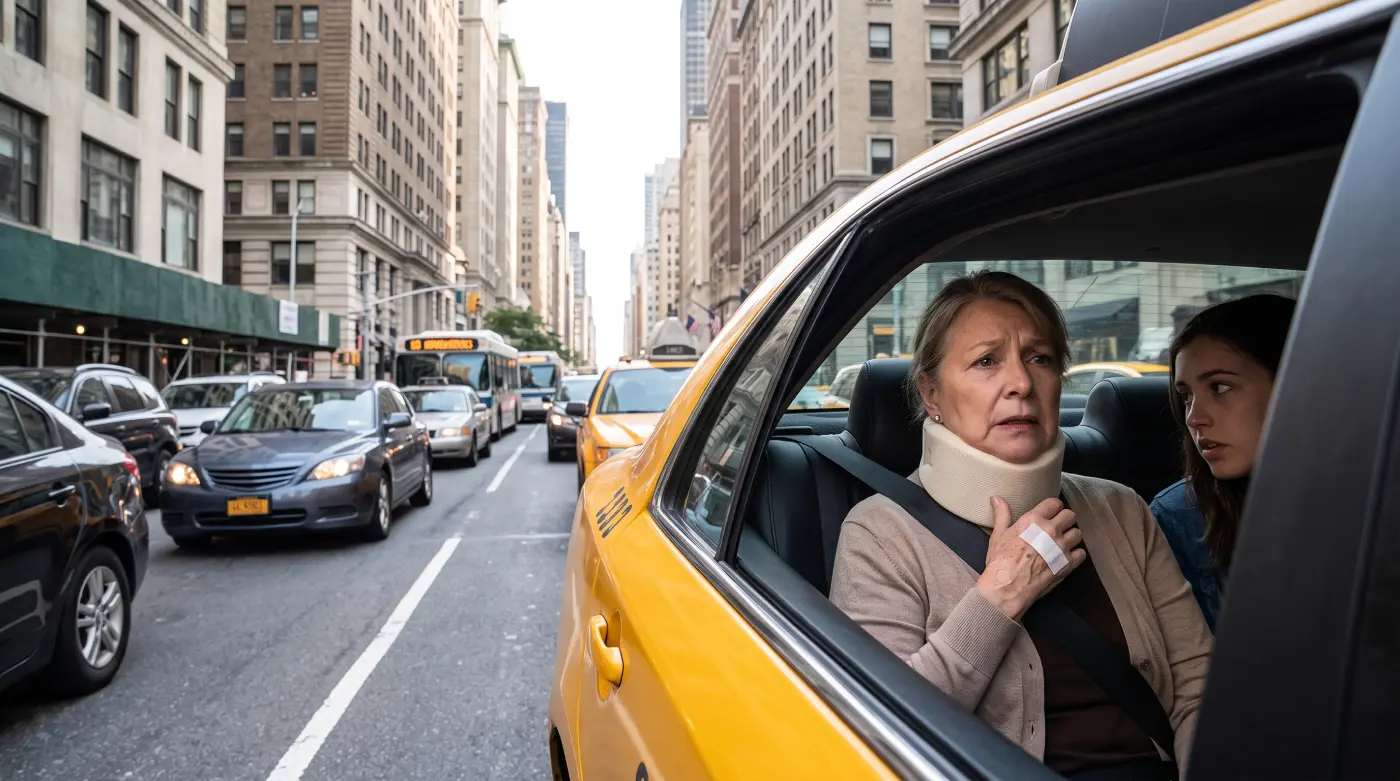
You were the passenger. Someone else was driving, someone else caused the crash, and you are the one now in pain and fielding calls from an adjuster you never chose — which is the exact situation the Manhattan passenger injury lawyers at Silver Law Group handle. When you are hurt as a passenger, you almost never share the blame, and that changes how your claim works from the start. Every case begins with a free review of what happened and what your options are, run from our Midtown office at 49 West 37th Street, 7th Floor. You pay no fee unless we recover for you. Call 212-470-4544 anytime, day or night, and talk to someone who can tell you where your claim actually stands.
Do You Have a Passenger Injury Claim?
As a passenger, you are almost always what New York’s insurance law calls a covered person who did nothing to cause the crash. You were not steering, braking, or picking the lane. That puts you in a stronger position than either driver, because the fight over who caused the collision rarely touches you; it decides which insurance company pays, not whether you get to recover at all.
The question that does matter is who you can hold responsible, and it is often more than one party. Depending on how you were hurt, your claim can reach:
- the driver of the car you were riding in, even if that driver is a friend or relative
- the driver of the other vehicle, if that driver caused or shared in the crash
- an employer, when the at-fault driver was working — a delivery van, a box truck, a company car crossing Midtown
- the owner of a taxi or rideshare vehicle, who under New York law can be liable for the driver’s negligence separately from the driver
On Manhattan streets this plays out across three settings that carry very different insurance: a yellow cab on Eighth Avenue, an Uber or Lyft running down the FDR, and an MTA bus on a crosstown route. Each one opens a different door to compensation. Sorting out which policies apply to your specific ride is the first thing a passenger injury lawyer does, because it decides how much coverage is actually available to you.
How Injured Passengers Recover Compensation
You recover on two separate tracks, and you may use both. The first is no-fault. New York’s Personal Injury Protection (PIP) pays up to $50,000 in medical bills and lost earnings to passengers in a standard car or livery vehicle, and it pays regardless of who caused the crash. You do not have to prove fault, argue about the light, or wait for an investigation — you file, and the coverage on the car you were in responds.
One gap is worth knowing. If you were riding on a motorcycle, no-fault does not cover you. Insurance Law §5102(f) writes motorcycle occupants out of the PIP system, so a passenger thrown from a bike does not get that first $50,000 and has to look straight to a liability claim instead.
The second track is the lawsuit. No-fault stops at economic losses and never pays for pain, suffering, or the human cost of a serious injury. To reach those damages, your injury has to clear the “serious injury” threshold the state sets. Once it does, the no-fault shield drops and you can sue the at-fault driver directly for what no-fault leaves on the table. Most passenger cases involving a broken bone, surgery, or lasting limitation clear that bar, which is why the medical proof you build early decides how far your claim can go.
If You Were in a Taxi, Uber, or Lyft
Ride in a TLC-licensed vehicle and the numbers change in your favor. Under Local Law 90, effective March 1, 2026, taxis and for-hire vehicles licensed by the Taxi and Limousine Commission carry $100,000 in no-fault PIP, double the $50,000 on an ordinary car. If you were hurt in a Manhattan yellow cab, an Uber, or a Lyft, that higher figure is the pool your medical bills draw from first.
Liability coverage is larger too: at least $100,000 per person and $300,000 per accident for injuries the vehicle causes. VTL §388 matters here, because it makes the vehicle’s owner responsible for the driver’s negligence, so a fleet or medallion owner can be on the hook alongside the driver behind the wheel.
Two limits deserve a flag. TLC rules set no mandated supplementary underinsured motorist (SUM) coverage on these vehicles, so if the other driver is underinsured, that particular safety net may be missing. And the $1.25 million minimum that applies to transportation network companies statewide under VTL §1693(12) does not reach New York City rides — the city is carved out, which is why the TLC’s own $100,000 figures are the ones that govern your Manhattan trip.
If You Were Hurt on an MTA Bus or Subway
A sudden stop on an MTA bus or a subway car is held to a much harder standard than a normal collision. New York courts require what they call an “extraordinary” jerk or lurch — proof that the movement was violent and unusual, not the ordinary stop-and-go a rider should expect. A driver braking hard for a jaywalker on Madison Avenue usually is not enough; the motion has to fall well outside what normal transit operation produces. That standard is why sudden-stop cases live or die on evidence rather than description.
The evidence that wins them is video, and video does not wait. Cameras on MTA buses and inside subway stations record over themselves on a cycle of roughly 30 to 90 days. If no one sends the MTA a formal demand to preserve the footage, the clip showing how hard you were thrown is gone before your case is filed. Getting that hold letter out fast is one of the first moves in any transit claim, and it is the kind of step you want handled the day you call, not weeks later.
Proving a Serious Injury Under the 2026 Law
To sue for pain and suffering, your injury has to fit one of the categories the state calls a “serious injury” under Insurance Law §5102(d). This is the gate every passenger liability claim passes through, and in 2026 the gate itself changed.
For any action filed on or after May 26, 2026, Part EE of the budget law removed the old 90/180-day category — the one that let people qualify by showing an injury kept them from their usual activities for 90 out of the first 180 days. That route is gone for new cases. What remains are the categories that turn on the injury itself:
- death
- dismemberment
- significant disfigurement
- a fracture
- loss of a fetus
- permanent loss of use of a body organ, member, function, or system
- permanent consequential limitation of use of a body organ or member
- significant limitation of use of a body function or system
A herniated disc with documented nerve involvement, a shoulder tear that needs surgery, a broken wrist — these are the injuries that clear the threshold. Soft-tissue strains that heal in a few weeks usually do not. Under Insurance Law §5104(a), fault comes first: you prove the other party was negligent, and only then does the serious-injury threshold decide which of your damages the law will pay. Building the medical record that proves a listed category is the work that makes a passenger claim worth bringing.
Why Fault Rarely Blocks a Passenger’s Case
Even when there is an argument about fault, it almost never shuts a passenger out. New York follows pure comparative negligence under CPLR §1411, which means your recovery is reduced by your share of the blame but never erased by it. Under that rule, a plaintiff who was 90% at fault could still collect on the remaining 10%.
That baseline now has an exception, and it is worth understanding why it rarely touches you. New CPLR §1411(b) bars recovery for one narrow group: plaintiffs in Article 51 no-fault motor vehicle cases who are found more at fault than the defendants combined. A driver judged more than half responsible for a crash can lose the right to sue. A passenger is almost never in that position. You were not operating the vehicle, so the percentage of fault that would trigger the bar does not attach to someone in the back seat or the passenger door. The practical result is that fault fights in passenger cases are about how a recovery gets divided among insurers, not about whether you have a claim.
What Your Passenger Injury Case Is Worth
Two things decide what a passenger claim is worth: the damages you can prove and the number of policies you can reach. Economic damages cover the measurable losses — medical bills beyond the no-fault limit, future treatment, wages you lost, and earning power you may not get back. Non-economic damages cover the part no receipt captures, meaning the pain, the limits on what you can do, and the independence a serious injury takes.
The larger lever is often coverage, and a passenger can frequently stack more than one policy. Depending on the crash, your claim may draw on:
- the policy on the vehicle you were riding in
- the policy on the at-fault driver who hit you
- your own household’s uninsured/underinsured motorist (UM/SUM) coverage, which can pay you as a passenger even though the car was not yours
That last one surprises people. If the drivers who hit you carry too little insurance, the UM/SUM coverage on your own auto policy, or a resident relative’s, can fill the gap, and using it is not the same as suing a family member. We will not put a number on your case here, because an honest value depends on your diagnosis, your treatment, and how the injury changes your work and your daily life. Finding every policy that applies is where the real value in a passenger case is won or lost.
Deadlines That Can End Your Claim
A passenger claim runs on more than one clock, and the shortest one is the easiest to miss.
The no-fault application comes first. You have 30 days from the crash to file the NF-2 application with the insurer for the vehicle you were in. File late and the company can deny your medical and wage benefits outright, no matter how badly you were hurt. This is the deadline people blow while they are still in a hospital bed, which is why it belongs in the first days, not the first month.
The lawsuit deadline is longer but firmer. Under CPLR §214, you generally have three years from the date of the crash to sue the at-fault driver for your injuries. Miss it and the court will not hear the case, whatever its merits.
The MTA deadline is its own animal. If a bus, subway, or other MTA vehicle was involved, you must serve a Notice of Claim within 90 days, then file suit within one year and 90 days of the incident — both far shorter than the ordinary three years. A crosstown bus case that would have years to breathe against a private driver can be dead in three months if that notice never goes out. When more than one of these clocks is running at once, the earliest deadline controls your whole claim.
What to Do After a Manhattan Passenger Injury
The moves you make in the first week shape everything that follows. A few matter more than the rest:
- Get the NYPD accident report. Manhattan crashes are documented by the responding precinct, and that report ties the drivers, plates, and insurers together. Before you leave the scene, write down the bus route number or the taxi’s medallion number yourself, since those details vanish once the vehicles drive off.
- See a doctor within days, not weeks. Get examined at a full-service emergency room — Bellevue on First Avenue and NewYork-Presbyterian/Weill Cornell on the Upper East Side both handle serious trauma. Same-week treatment catches injuries hiding behind adrenaline, and it creates the medical record your no-fault benefits and any lawsuit are built on.
- Say no to the recorded statement. The other driver’s insurer will call fast and ask to record you “for the file.” You are not required to give that statement, and a friendly answer early can become the quote that shrinks your claim later. Tell them your lawyer will follow up, and stop there.
Do these three and you protect both tracks of your recovery before anyone has a chance to close a door on you.
Why Injured Passengers Choose Silver Law Group
Here is how the money works, because it is the first thing most injured passengers want to know before they hire a passenger injury law firm. Silver Law Group takes passenger cases on contingency: you pay no fee up front, no fee while the case is pending, and no fee at all unless we recover money for you. Our fee comes as an agreed percentage of that recovery, so the cost of a lawyer is never a reason to wait, and if there is no recovery, you owe us no legal fee.
The rest is about access. We handle consultations in English, Spanish, and Russian, and someone answers the phone 24 hours a day, because crashes do not keep business hours. If your injury keeps you in a hospital bed or at home, the attorney comes to you rather than making you come in. And because insurers settle differently with a firm that actually tries cases, we prepare every passenger claim as if it is headed to a jury in New York County Supreme Court on Centre Street; that trial-ready posture is what gives a fair settlement its weight.
If you were hurt as a passenger anywhere in Manhattan, call 212-470-4544. The review is free, and the sooner you call, the more of your claim you can protect.