

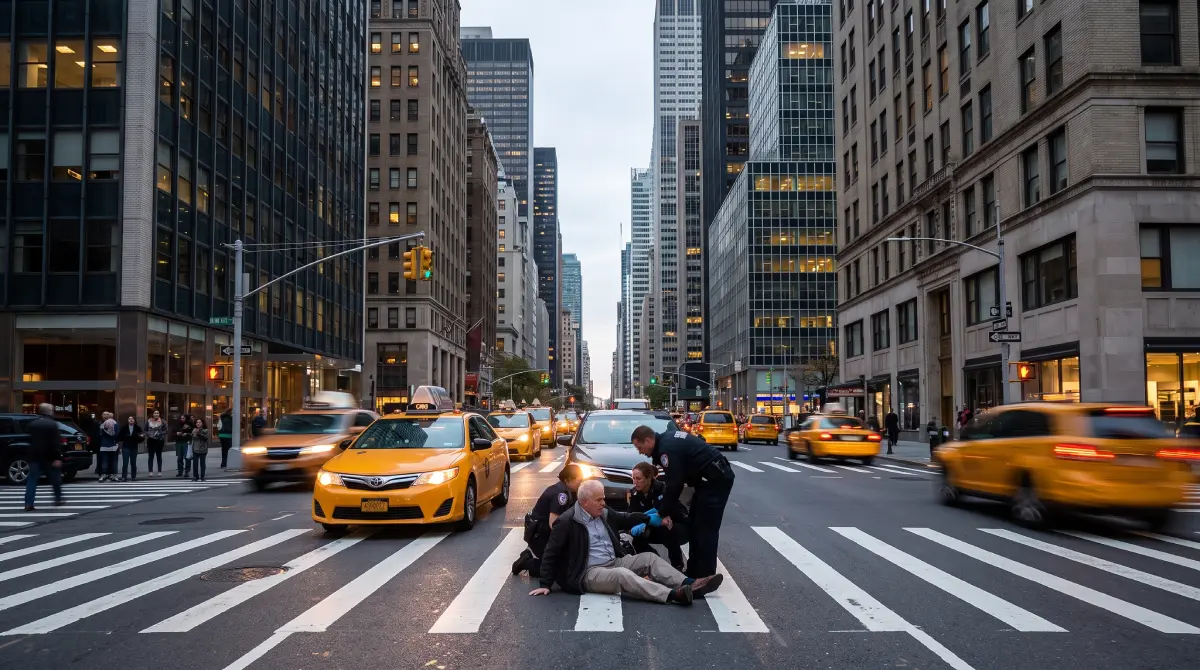
A driver turning across a Manhattan crosswalk can put you in the hospital in the time it takes to step off the curb. If that has happened to you, a Manhattan pedestrian injury lawyer at Silver Law Group can tell you in one free call whether the driver owes you money and what the next 90 days require. We answer 24/7, and the first consultation costs nothing in English, Spanish, or Russian. If you are still in a bed at Bellevue or Mount Sinai, or stuck at home unable to walk, the attorney comes to you. Our office sits in Midtown at 49 West 37th Street, seventh floor, a short distance from the corridors where most of these crashes happen. You do not pay us to start, and you owe nothing unless we recover for you. What you say to the driver’s insurer in the first week can shrink your claim before you understand what it was worth, so the sooner you know your rights, the more of them you keep. Call 212-470-4544.
Do You Have a Manhattan Pedestrian Injury Case?
Your case turns on one question: did the driver fail to use the care the law demands? New York’s Vehicle and Traffic Law §1146 puts a specific duty on every driver to use due care to avoid hitting anyone on foot, and to sound the horn when needed. Section 1151 gives you the right of way inside a crosswalk when you are crossing with the signal, or, at an unsignalized crossing, when you are already in the roadway on the driver’s half. When a driver breaks either rule and injures you, that violation is evidence of negligence you can build a claim on.
Most Manhattan pedestrians are not hit by speeding cars on open road. They are hit at the corner, by a driver turning through the crosswalk they were told to use. Left turns are the worst of these: turning vehicles account for roughly three of every four turn-related pedestrian deaths in New York City. The geometry is against you — a left-turning driver crosses the crosswalk at an angle, watching for a gap in oncoming traffic instead of the person stepping off the curb, and the car’s front pillar hides you for the half-second that matters.
That does not automatically make the driver’s insurer pay. Right of way shows you were where you were allowed to be; you still have to show the driver’s negligence caused your injuries, and the insurer will look for any reason to pin part of the blame on you. How the police report reads, whether the signal timing is on your side, and what the nearby cameras caught all decide how strong your claim starts out.
Where Manhattan Pedestrian Crashes Happen
The danger is not spread evenly across the borough. A handful of Manhattan streets carry most of the serious pedestrian crashes, and they share a trait: wide, fast, and crossed by a lot of people on foot.
- Broadway, where the diagonal path creates odd-angled intersections that hide turning cars
- 42nd Street and Canal Street, choke points thick with buses, trucks, and cross traffic
- Houston Street, a wide corridor drivers treat like a through-road
- FDR Drive and the West Side Highway, high-speed edges where exit and entrance ramps meet pedestrian paths
Since the city launched Vision Zero, the picture on these priority corridors has improved. NYC DOT reports that pedestrian deaths on Manhattan’s priority corridors have fallen about 45% since the program began, the result of redesigned crossings, leading pedestrian intervals that give you a head start into the intersection, and lower speed limits. The improvement is real, and it still leaves these streets among the most dangerous places to be on foot in the city.
Where your crash happened matters to your case, not just to the statistics. A collision on the West Side Highway raises questions about speed and roadway design; one at a Broadway corner turns on signal timing and the turning driver’s sightlines. The location tells your lawyer which records to pull first (DOT crash data, signal-timing logs, nearby surveillance) and which of them the insurer will fight hardest to keep out.
Seniors and Left-Turn Crashes
Older pedestrians pay the highest price in these crashes. New Yorkers 65 and older make up a small share of the population but a large share of pedestrian deaths, and the pattern behind those numbers is not jaywalking. They are struck with the walk signal, inside a marked crosswalk, by a driver turning across their path. A crossing timed for an average walking pace can run out before someone with a slower gait reaches the far curb, leaving them in the intersection exactly when turning cars move. If you are helping an older parent after a crash like this, the driver’s insurer may hint that your parent was too slow or should not have been crossing. The law says otherwise: a pedestrian crossing with the signal has the right of way, and a turning driver is required to yield.
Stepping Outside No-Fault: The Serious Injury Threshold
New York’s no-fault system pays your first medical bills fast, but it also caps what you can get and blocks the part of a claim that is often worth the most. Basic no-fault, called PIP, covers up to $50,000 in medical costs and lost earnings — and pays nothing for pain and suffering. To sue the driver for that, your injury has to clear the “serious injury” bar set by Insurance Law §5102(d).
The categories that most often apply to a pedestrian struck by a car include:
- A bone fracture
- Significant disfigurement, including visible scarring
- Permanent consequential limitation of use of a body part or system
- Significant limitation of use of a body function or system
One category recently disappeared. Part EE repealed the 90/180-day threshold in May 2026, closing the route that let people qualify by showing they could not do their usual activities for 90 of the 180 days after the crash. If your claim would have rested on that category, it now has to fit one of the others, which makes the medical record you build early even more important.
This is where an insurer’s first move makes sense to you in hindsight. If they can keep your injury below the serious-injury line, they never have to pay for the months of pain, the surgery you still face, or the work you cannot do. A pedestrian injury lawyer builds the case that your injury clears the threshold — with imaging, treating-physician findings, and documentation that holds up when the insurer’s own doctor examines you and disagrees.
What Your Manhattan Pedestrian Case Is Worth
No honest lawyer can put a number on your case in the first phone call, because the value depends on facts that are still unfolding — how well you heal, what care you will still need, and how the injury changes your ability to work. What a lawyer can do is tell you which losses the law lets you recover:
- Medical costs no-fault will not cover once you pass the $50,000 PIP limit or step outside the system
- Future care: surgery still ahead, physical therapy, assistive devices, home help
- Lost earnings now, and reduced earning capacity if you cannot return to the same work
- Pain and suffering, the non-economic harm that no-fault pays nothing for
One 2026 change reshapes how fault affects that recovery. Under the amended CPLR §1411, New York moved to a modified comparative fault rule for non-economic damages: if you are found more than 50% at fault for the crash, you cannot recover for pain and suffering at all. Your economic losses can still be reduced by your share of fault, but the pain-and-suffering piece, often the largest part of a serious claim, now depends on staying at or below that 50% line.
That makes the fight over blame the fight over money. Expect the insurer to argue you darted out, crossed against the light, or wore dark clothing. Physical evidence answers those claims better than your word does: the signal phase when you entered the crosswalk, the point of impact on the vehicle, the camera footage from the corner. A lawyer gathers that proof before it disappears, because a 49% finding and a 51% finding are worlds apart under the new rule.
What To Do After Being Hit in Manhattan
The hours after a crash decide how much proof you keep. If you are hurt, the medical steps come first; the legal ones follow as soon as you can manage them.
- Call 911. An ambulance gets you treated and creates the first official record that the crash happened and that you were injured.
- Get the police report started. Officers on scene document the driver and the vehicle, and often a first account of what happened — make sure they have your side, not just the driver’s.
- Photograph everything you can: the vehicle and its plate, the crosswalk and signal, your injuries, the position of the cars, the weather and light.
- Get witnesses’ names and numbers before they walk off. A stranger who saw the light turn is worth more than any argument you make later.
For serious injuries, Manhattan has some of the best trauma care in the country. Bellevue, NYU Langone, Mount Sinai, and NewYork-Presbyterian all run trauma centers equipped for the internal and head injuries that pedestrian crashes cause. Go to one, and go even if you can walk away — being checked and treated is both the right medical call and the record that anchors your claim. Tell the doctors every place that hurts, because the symptoms you skip are the ones the insurer will later say you invented.
Delayed-Onset Injuries
Some of the worst injuries do not hurt at first. A traumatic brain injury can hide behind adrenaline for hours, then surface as headaches, confusion, nausea, or trouble sleeping over the following days. Internal bleeding can build quietly and become an emergency before you connect it to the crash. This is why “I felt fine” is the phrase insurers love: if you went home instead of getting examined, they argue that whatever you feel now came from something else. A documented evaluation within a day or two protects you twice — it catches an injury that could turn dangerous, and it ties your symptoms to the crash while the link is still clear. If you skipped the ER in the moment, see a doctor as soon as the first symptom appears and tell them you were hit by a car.
Filing Deadlines for Manhattan Pedestrian Claims
A pedestrian claim in Manhattan runs on more than one clock, and the fastest one can end your case months before you think you are late. The general deadline is the friendliest: under CPLR §214, you have three years from the date of the crash to sue the driver who hit you. If someone died from their injuries, the clock is different and shorter — EPTL §5-4.1 gives the family two years from the date of death to bring a wrongful death claim.
The short deadlines come from who hit you. If the vehicle belonged to the City of New York (a sanitation truck, a city car, a police vehicle), General Municipal Law §50-e requires a formal Notice of Claim within 90 days of the crash, long before any lawsuit. Miss that window and the court can throw out an otherwise strong case. The same 90-day trap applies if a bus or other MTA or New York City Transit vehicle was involved: you must serve a notice of claim within 90 days, then file suit within one year and 90 days, not the usual three years.
Those windows are why the date on your calendar matters as much as the facts of your crash. You often will not know in the first week whether a city or transit vehicle was involved, or whether the injury will become a wrongful death claim, and each of those answers changes your true deadline. A lawyer sorts out which clock governs your case early, while there is still time to file the right notice — the paperwork that keeps every later option open.
Hit-and-Run and Uninsured Driver Claims
When the driver who hit you speeds off, or turns out to have no insurance, your claim does not die with the missing defendant. New York created the Motor Vehicle Accident Indemnification Corporation, MVAIC, for exactly this situation: a fund that pays qualifying pedestrians who were struck by a hit-and-run or uninsured driver and have no auto insurance of their own to turn to.
MVAIC comes with its own strict clock. You have to file a notice of intention to make a claim within 90 days of the crash, and for a hit-and-run you must have reported the collision to the police. That police report is not a formality — it is the proof that the vehicle existed, and without it MVAIC can deny the claim outright. This is one more reason to get officers to the scene and get the report number even when the car is already gone.
MVAIC does not pay as freely as a private insurer might, and it reads its own rules narrowly. A lawyer confirms whether you qualify, files the notice inside the 90 days, and assembles the police documentation the fund demands before the deadline forecloses it. If the at-fault driver is later identified, your lawyer can also pursue that driver directly, so the MVAIC filing protects you without closing off a claim against the person who actually hit you.
Why Silver Law Group Handles Manhattan Pedestrian Cases
You should not have to pay a lawyer out of pocket while you are out of work and buried in medical bills. Silver Law Group takes pedestrian cases on a contingency fee, which means the mechanics are simple: you pay nothing upfront, the firm advances the costs of building your case (medical records, expert reviews, investigators), and the fee is a set percentage of what we recover for you. If we recover nothing, you owe no fee and you are not billed for those costs. The risk of the case sits with the firm, not with you.
That posture matters more than it sounds. Insurers know which firms prepare every case as if it will be tried and which ones only ever settle, and they price their offers accordingly. Silver Law Group prepares your case for New York County Supreme Court at 60 Centre Street from the start, so the offer on the table reflects what a Manhattan jury might do, not what an adjuster hopes you will accept.
We answer around the clock, because a crash does not wait for business hours and neither should your questions. Consultations are free, and we handle them in English, Spanish, and Russian, so you can explain what happened in your own language without a relative translating the details of your injury. If you cannot come to Midtown, the attorney comes to your hospital room or your home. When you are ready, call 212-470-4544, and you will speak with someone who can tell you where your case stands and what the next deadline is.