

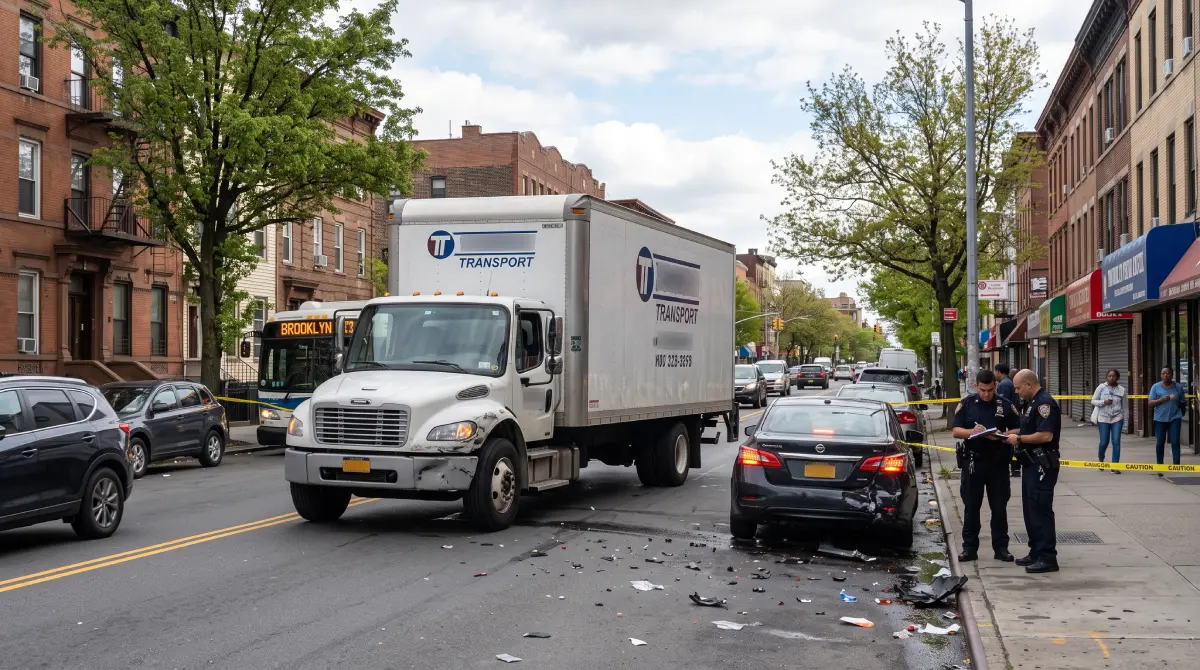
A Brooklyn truck accident lawyer earns their keep in the first week, before the carrier’s insurer has locked down the driver’s logs and framed the crash as your fault. If a tractor-trailer, box truck, or 18-wheeler hurt you anywhere in Kings County, call Silver Law Group at 212-470-4544 for a free, no-obligation case consultation. We answer 24/7, in English, Spanish, and Russian, and an attorney will come to your hospital room or your home if you cannot travel. Truck cases move on evidence that disappears fast — electronic logs get overwritten, damaged trucks get repaired, and the trucking company already has investigators working. The sooner we start, the more of that proof we can preserve for you.
Do You Have a Brooklyn Truck Accident Case?
You have a case when a truck driver or the company behind them did something careless that hurt you. That can be a driver who ran a red on Atlantic Avenue, a carrier that put an unqualified driver on the road, or cargo loaded past the truck’s rated gross vehicle weight so it couldn’t stop in time. The heavier the truck, the longer the stopping distance, which is why an overweight rig turns a survivable fender-bender into a life-changing injury.
Proving that carelessness is your burden, and the standard is negligence: the driver or carrier owed you reasonable care, broke that duty, and caused your harm. With commercial carriers, the duty runs deeper than for an ordinary driver — federal rules govern how many hours a trucker can drive, how the load is secured, and how the vehicle is maintained.
One rule surprises most people. Trucks are motor vehicles under New York’s no-fault system, so your own insurance pays initial medical bills regardless of blame. But no-fault also blocks you from suing the at-fault driver for pain and suffering unless your injury clears a legal bar called the serious injury threshold.
The Serious Injury Threshold Under Insurance Law §5102(d)
Insurance Law §5102(d) lists the injuries that let you sue for pain and suffering. A bone fracture qualifies on its own. So does significant disfigurement, such as scarring or a burn a reasonable person would view as unattractive, and permanent limitation of use of a body organ or member, like a shoulder or knee that never fully works again.
The list changed on May 26, 2026, when the 90/180-day category was deleted. Before that date, being unable to perform your usual daily activities for 90 of the first 180 days after a crash could qualify on its own. That path is gone, so your claim now has to fit one of the remaining categories.
This makes your medical record the spine of your case. Get examined even if the pain seems minor at first — spinal and soft-tissue damage from a truck impact often surfaces days later, and a documented delay is far weaker evidence than a same-week diagnosis.
Why Brooklyn Truck Crashes Happen
Brooklyn funnels heavy freight through a handful of corridors, and that is where most truck crashes cluster. The Brooklyn-Queens Expressway carries commercial traffic on a cramped, aging roadbed with tight merges. The Gowanus Expressway feeds it, backing up trucks bound for the harbor terminals. The Belt Parkway bans commercial trucks, yet drivers ignore the signs and jackknife on its curves anyway.
At street level, the danger shifts to intersections. Atlantic Avenue and Flatbush Avenue are truck routes lined with turning conflicts, cyclists, and pedestrians. Third Avenue under the Gowanus viaduct mixes local delivery trucks with expressway on-ramps. The industrial blocks of Sunset Park and the Brooklyn Navy Yard generate constant box-truck and flatbed traffic that spills onto residential streets never built for it.
Behind the location, the causes repeat. Fatigue is the big one. Federal hours-of-service rules cap a driver at 11 hours of driving within a 14-hour window, but carriers pressure drivers to push past those limits to hit delivery deadlines, and a tired trucker reacts like a drunk one.
Blind spots kill in traffic this dense. A tractor-trailer has no-zones directly in front, behind, and along both sides, and the right-side blind spot is where a truck turning onto a Brooklyn cross-street runs over a cyclist or pedestrian it never saw.
Then there is the cargo. Overloaded trailers exceed the axle and gross weight the brakes were designed for, stretching stopping distance. Poorly secured loads shift in a turn and flip the truck. Each of these traces back to a decision someone made before the truck ever reached your intersection — and that decision is what makes the crash someone’s fault.
Who Can Be Held Liable for Your Truck Accident
More than one party usually shares blame in a truck crash, and identifying all of them is what separates a full recovery from a partial one. The driver’s insurance is often too small to cover a catastrophic injury, so the companies behind the driver matter.
- The driver. Directly at fault for speeding, distraction, fatigue, or an illegal turn.
- The motor carrier. The trucking company is vicariously liable for its driver’s negligence on the job, and separately liable for hiring an unfit driver, skipping required drug tests, or pushing hours-of-service violations.
- The freight broker. A broker who hired a carrier with a known safety record can share responsibility for putting that truck on the road.
- The cargo loader or shipper. When a third party loaded the trailer, an unbalanced or overweight load that caused the crash falls on them.
- The maintenance contractor. Bad brakes, bald tires, or a failed coupling can point to whoever was paid to service the truck.
- The truck or parts manufacturer. A defective brake system or tire that failed on its own can bring a product claim.
Sorting this out runs on evidence only the trucking industry keeps. Electronic logging devices, or ELDs, record the driver’s hours and expose hours-of-service violations. The engine control module — the truck’s ECM black box — captures speed, braking, and throttle in the seconds before impact. The driver-qualification file shows whether the carrier verified the driver’s license, medical certification, and record before hiring.
That evidence is under the carrier’s control, and companies routinely let it overwrite or disappear once the retention window passes. A prompt legal hold letter demanding preservation is one of the first things your lawyer sends. Federal law requires most interstate carriers to hold at least $750,000 in liability insurance, so finding the right defendants is also how you reach coverage large enough to pay for a serious injury.
What Your Brooklyn Truck Accident Claim Is Worth
Your claim covers what the crash actually took from you. That includes:
- Medical costs — emergency care, surgery, hospital stays, and rehabilitation
- Lost earnings for the time you could not work
- Diminished earning capacity if your injury caps what you can earn going forward
- Pain and suffering, including the physical pain and the disruption to your daily life
- Future care, such as ongoing therapy, home health aides, or a later surgery
No calculator sets these numbers. The value depends on how permanent your injury is, how it changes the work you can do, and how clearly the medical record ties it to the crash.
Fault can be split, and New York uses pure comparative negligence under CPLR §1411. If the trucking company argues you were partly to blame, your recovery is reduced by your percentage of fault but never erased — 20% at fault means you still collect 80%. Insurers lean hard on this rule to shave payouts, which is why building a clean liability record early matters. A May 2026 amendment to Article 51, the no-fault law, changed how motor-vehicle injury recovery works, and it applies to crashes going forward. We check the current version of the statute against your crash date so the rule we apply is the one in force when you were hurt.
What to Do After a Brooklyn Truck Accident
What you do in the first hours shapes the claim. Work through these steps as far as your injuries allow:
- Call 911. A police report and an official crash record start your case and pin down the scene before anything moves.
- Get trauma care. Maimonides Medical Center in Borough Park, NYU Langone Hospital–Brooklyn in Sunset Park, and Kings County Hospital Center in East Flatbush all handle serious trauma. Go even if you feel able to walk away; internal and spinal injuries hide behind adrenaline.
- Photograph everything. The trucks, the license plates, the DOT numbers on the cab door, skid marks, road conditions, and your visible injuries.
- Get witness information. Names and phone numbers of anyone who saw the crash. Their accounts age fast, and the carrier’s investigator will reach them first.
- Decline recorded statements. The trucking company’s insurer may call within a day, friendly and quick. Do not give a recorded statement. A stray phrase gets clipped and replayed to blame you, and you are never required to speak with the other side’s insurer.
Then call a lawyer before the evidence you cannot photograph — the driver’s logs and the truck’s black box — gets overwritten.
How Our Fees Work
You pay us nothing upfront and nothing by the hour. Silver Law Group takes truck accident cases on contingency, which means our fee is a percentage of what we recover for you, and it comes out only if we win money in your case. If we recover nothing, you owe us no attorney’s fee. Case costs — filing fees, expert reports, records — are advanced by the firm and repaid from the recovery, not billed to you along the way. This arrangement exists so an injured person with no income can still hire a lawyer able to go up against a trucking company’s legal team. The case evaluation that starts it all is free, and there is no obligation to hire us after we review what happened.
Deadlines to File a Brooklyn Truck Accident Claim
The clock starts at the crash, and missing a deadline can end a strong case before it is heard. For a personal injury claim, CPLR §214 gives you three years from the date of the crash to file suit. Wait past that, and the court will refuse the case no matter how badly you were hurt.
If the crash killed a family member, a different clock applies. EPTL §5-4.1 sets the wrongful-death deadline at two years from the date of death, and the estate’s representative brings that claim.
Crashes involving a government truck are the trap most people fall into. If a New York City vehicle hit you — a Department of Sanitation truck, for example — you must serve a Notice of Claim under GML §50-e within 90 days of the crash, long before the three-year window would otherwise matter. GML §50-i then requires any lawsuit against the city to be filed within one year and 90 days. Skip the 90-day notice and you generally lose the right to sue the city at all.
Because these deadlines run in parallel and the shortest one governs, the safe move is to have a lawyer identify every defendant early — private carrier, city agency, or both — so no notice window slips past while you focus on recovering.
Why Injured Brooklyn Residents Choose Silver Law Group
Insurance adjusters are trained to settle your case fast and cheap, before you know what your injury will cost over a lifetime. We prepare every case as if it is going to trial, because a carrier that knows you are ready to try the case negotiates differently than one that expects you to fold. That posture is our leverage on your behalf.
We handle intake in Russian, Spanish, and English, which matters in a borough where Brighton Beach and Sheepshead Bay are home to large Russian-speaking communities who deserve to understand their own case in their own language. If your injury keeps you in a hospital bed or at home, the attorney comes to you, at any hour. Our office sits in Midtown Manhattan at 49 West 37th Street, a short trip from Brooklyn, and we are reachable around the clock. Call 212-470-4544 to start with a free consultation.