

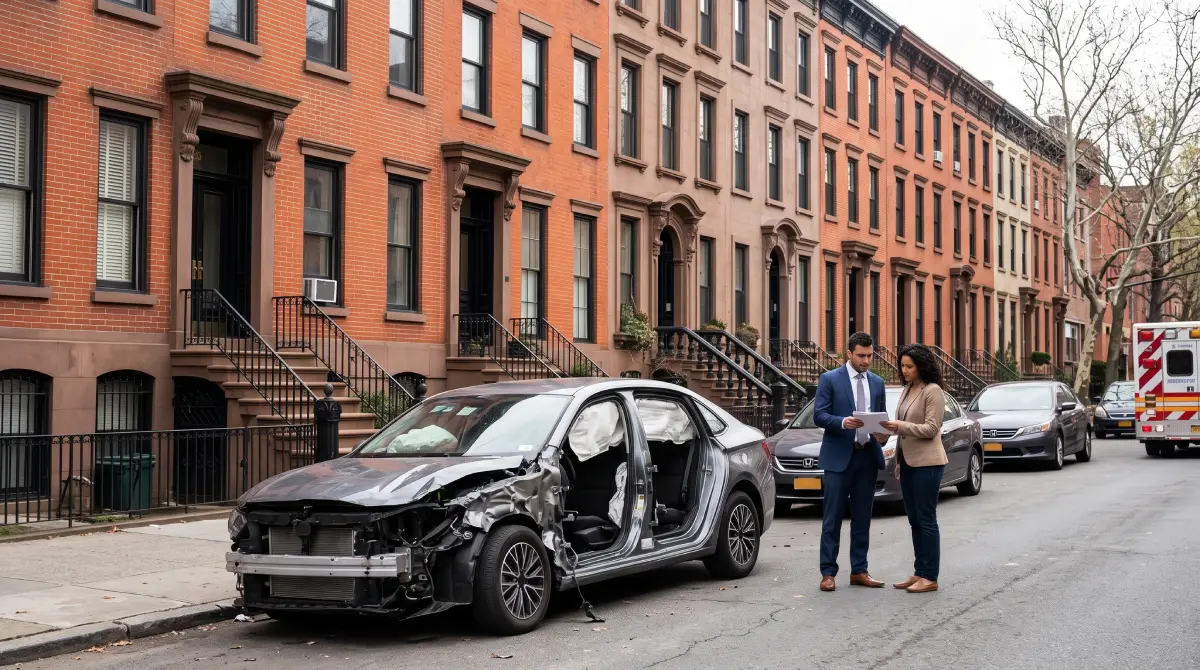
Your car was declared a total loss, and the check the insurer put in front of you doesn’t come close to replacing it. That first number is a negotiating position, and a Brooklyn total loss attorney can force the insurer to pay the full actual cash value New York law requires, not the discounted figure its software produced. Silver Law Group reviews your total loss offer for free, in English, Spanish, or Russian, and someone is reachable 24/7. Before you sign anything, find out what your car was actually worth the moment before the crash.
What a Brooklyn Total Loss Attorney Actually Does for You
A total loss lawyer takes apart the insurer’s valuation and rebuilds it from real market evidence. That work is concrete:
- Pull the insurer’s written valuation and find every mileage, condition, and “prior damage” deduction it used to cut the number.
- Assemble comparable-vehicle listings and, when the gap is large, a licensed independent appraisal that sets a defensible actual cash value.
- Push the payout up to that value, including the sales tax and fees the insurer left out.
One thing to understand up front: a car total loss claim is a property-damage claim, and it runs on a separate track from any injury claim. You can settle the totaled car in weeks while a bodily-injury case takes far longer. When the same Brooklyn crash left you hurt, Silver Law Group handles both, fighting the vehicle valuation and the injury claim together so the insurer can’t use one to pressure the other.
How Insurers Decide Your Car Is a “Total Loss” in New York
An insurer totals your car when the cost to repair it approaches or passes what the car itself is worth. There is no magic percentage written into New York law for that business decision; the company runs the math and makes the call. What New York does fix is a related number: the salvage-title branding threshold. Under 15 NYCRR 20.20, a vehicle eight model years or newer gets a branded title once the repair cost exceeds 75% of its retail value, which is why insurers lean toward totaling newer cars with heavy damage rather than repairing them.
The figure that decides your payout comes out of valuation software, usually CCC One or Mitchell. These programs generate a number from a pool of comparable sales, then apply downward condition adjustments, and they routinely land below what your car would actually sell for in the Brooklyn market. That built-in low bias is the reason the first offer and your car’s real value are two different numbers.
What Your Totaled Car Is Really Worth: Actual Cash Value Under Regulation 64
New York defines what you’re owed, and it isn’t a book value or the price on your old loan. Under Insurance Regulation 64 (11 NYCRR 216.6(b)), actual cash value is the lesser of two things: what it would cost to repair your car to its pre-loss condition, or what it would cost to replace it with a substantially identical vehicle. When the car is totaled, that second figure controls.
Actual cash value is your specific car, priced against the Brooklyn and wider New York market the moment before the crash. Its year, make, model, trim, mileage, and condition all move the number. It is not what you paid three years ago, and it is not a generic national book value. Two 2019 sedans with the same badge can be worth different amounts because one had 40,000 miles and a clean interior and the other didn’t. The insurer’s job is to price yours honestly; when it doesn’t, that gap is what a total loss lawyer closes.
Why the Insurer’s First Offer Is Almost Always Too Low
The adjuster who called you is measured on how fast and how cheaply claims close. The first offer reflects that incentive, not your car’s value, and it is only an opening position. Do not accept it, and do not sign anything releasing the claim, until the number has been checked against real listings for cars like yours. New York gives you a floor to hold the insurer to: Regulation 64 section 216.7(c) says the minimum offer has to be built from a real valuation method, such as the average of the retail values for a substantially similar vehicle taken from two current valuation manuals. If the insurer can’t show you that method, its number doesn’t meet the rule.
Sales Tax and Fees the Insurer Must Include
Sales tax is part of your payout, not a bonus. Under 11 NYCRR 216.6(b), New York requires sales tax to be included as a component of actual cash value, and it has to be added before any salvage deduction is taken out. A lot of online advice tells you to “ask” the insurer to throw in tax. You are not asking. The regulation makes it owed, so it is a demand backed by a citation, not a favor you hope the adjuster grants.
Diminished Value: When Your Repaired Brooklyn Car Loses Resale Worth
Even a car repaired perfectly is worth less once the accident shows on its Carfax, because buyers pay less for a vehicle with a wreck in its history. That gap between what your car would have sold for and what it will sell for now is diminished value, and it’s real money.
In New York, you can recover diminished value only as a third-party claim against the at-fault driver’s liability insurer. Your own collision coverage and your uninsured-motorist coverage won’t pay it. And if you were partly at fault for the Brooklyn crash, you’re not shut out: under New York’s pure comparative negligence rule (CPLR 1411), your recovery is reduced by your share of fault but never eliminated, so a driver found 30% at fault still collects the other 70%.
Rental Car and Substitute Transportation While You Wait
While the total loss is being processed, you’re generally entitled to a rental or the reasonable cost of getting around another way. Watch the cutoff date. Insurers often try to end rental coverage the day they make an offer, but you still don’t have a car until the payment actually clears. Push the coverage to the date the money arrives, not the date a number was floated.
When You Owe More Than the Car Is Worth: Gap and Liens
If your Brooklyn car is financed or leased, the insurer pays your lienholder before it pays you. Cars lose value faster than loans shrink, so it is common for the actual cash value to come in below what you still owe, leaving you writing checks on a car you no longer have. Gap insurance covers that shortfall. You may have bought it as an add-on to your auto policy, or it may be buried in the financing paperwork you signed at the dealership without anyone flagging it. Dig out those documents and check before you accept any total loss settlement, because once the claim closes, that gap is yours to cover alone.
How to Fight a Lowball Total Loss Offer in Brooklyn
A lowball offer on a car total loss claim is a starting position you can move. The dispute follows a clear order: make the insurer show its math, beat that math with your own evidence, and escalate to the state regulator and Brooklyn’s courts if it still won’t budge. Each step below builds the paper trail for the next one.
Demand the Insurer’s Written Valuation Breakdown
Ask the insurer, in writing, to show you exactly how it reached the number: which valuation software or manual it used, and every mileage and condition deduction it applied. Regulation 64 requires the offer to rest on a documented method, so the insurer has to produce this. The breakdown is where the case gets made; it shows you the specific “high mileage” or “prior wear” adjustments the adjuster used to shave the value, and those are the line items you and your lawyer attack.
Build Your Brooklyn Comparable-Vehicle Evidence
Beat the insurer’s number with the market. Pull active listings for the same year, make, model, trim, and a comparable mileage range from Brooklyn dealers and the wider New York market, the same cars a buyer would actually shop against yours. Screenshot each one with its price and mileage, and attach them to a written counteroffer. Real local listings priced above the insurer’s figure are hard to wave off, and they force the adjuster to justify a number the market contradicts.
Get an Independent Appraisal or Invoke Your Policy’s Appraisal Clause
When the disagreement is worth real money, bring in an appraiser. A licensed independent appraiser can produce a formal valuation that stands against the insurer’s software print-out. Most New York auto policies also contain an appraisal clause you can invoke: each side names its own appraiser, the two appraisers pick a neutral umpire, and the umpire resolves whatever gap is left on a binding basis. That is a faster route than a lawsuit when the fight is purely about the car’s value, and it is worth triggering once the disputed amount is large enough to justify the appraiser’s fee.
File a Free Complaint With the NY Department of Financial Services
The agency that writes and enforces Regulation 64 is the New York State Department of Financial Services (DFS), and you can file a complaint against your insurer at dfs.ny.gov. It costs nothing. A DFS complaint puts the insurer’s handling of your claim in front of its regulator, and a stalled adjuster tends to move once that scrutiny lands. This is one of the levers Silver Law Group pulls for you; a complaint written in the regulator’s language, with the specific regulation cited, carries more weight than a frustrated phone call.
Small Claims and Lawsuits in Brooklyn’s Kings County Courts
If the insurer still won’t pay, Brooklyn’s courts are the backstop. A straightforward property-damage shortfall up to $10,000 can go to the small claims part of Kings County Civil Court in Downtown Brooklyn, with no lawyer required to file, though one helps. Disputes above that limit proceed in Kings County Supreme Court. Insurers know which venue a Brooklyn claim lands in, and a credible move to file there often does more than another round of letters.
Keeping Your Totaled Car: Salvage, Buyback, and the New York Title Brand
You can often keep your totaled car instead of surrendering it; the insurer deducts the salvage value from your payout and lets you retain the vehicle. That can make sense if the car still runs or you plan to repair it yourself. But understand what the title becomes. If your Brooklyn car is eight model years or newer, it will carry a branded salvage title, and it cannot legally go back on the road until it passes a New York DMV salvage examination. And if you ever sell it, you have to disclose the damage on the title: failing to do so carries a civil penalty of up to $2,000 under Vehicle and Traffic Law 429.
What It Costs to Hire a Brooklyn Total Loss Attorney
Silver Law Group reviews your total loss offer for free. When the same crash that totaled your car also injured you, the firm handles the entire claim on contingency: you pay no attorney’s fee up front, and no fee at all unless there is a recovery. The fee comes as a percentage of what is recovered, so the lawyer only gets paid when you do.
A property-only shortfall is often a different situation, and the honest answer is that it is frequently fastest to resolve without a lawsuit. A sharp demand letter, a DFS complaint, or a small claims filing in Kings County can get it done faster and cheaper than litigation. Silver Law Group will tell you which of those actually fits your case instead of pushing a lawsuit that isn’t worth what it would cost you. If the smart move is to file a DFS complaint yourself, that is the advice you will get.
Deadlines: How Long You Have to Act in New York
You have three years from the date of the crash to sue for property damage in New York, and that window covers diminished value too, under CPLR 214(4). Three years feels like plenty until you realize how much shorter the clock runs against a government vehicle.
If the vehicle that hit you belonged to a public entity, such as a city bus, a Sanitation truck, or an MTA vehicle on Brooklyn streets, the deadlines collapse. You have to file a Notice of Claim within 90 days of the crash, and any lawsuit within one year and 90 days, under General Municipal Law 50-e and 50-i. Miss the 90-day notice and the three-year rule stops helping you.
There is a practical clock, too. Brooklyn tow-yard storage fees add up every day your totaled car sits there, so moving quickly protects money whether or not a lawsuit is ever filed.
Why Brooklyn Drivers Choose Silver Law Group
Brooklyn drivers work with Silver Law Group for reasons that hold up after the crash, not before it:
- Free consultations in English, Spanish, and Russian, with someone reachable 24/7.
- Contingency representation on injury claims, so there is no fee unless you recover.
- A trial-ready posture that insurers weigh when they decide how seriously to negotiate.
- An attorney who comes to you, at home or in the hospital, when getting to an office isn’t possible.
The firm serves drivers across all of Brooklyn from its Midtown Manhattan office at 49 West 37th Street, 7th Floor. Call 212-470-4544 to have your total loss offer looked at before you sign it.