

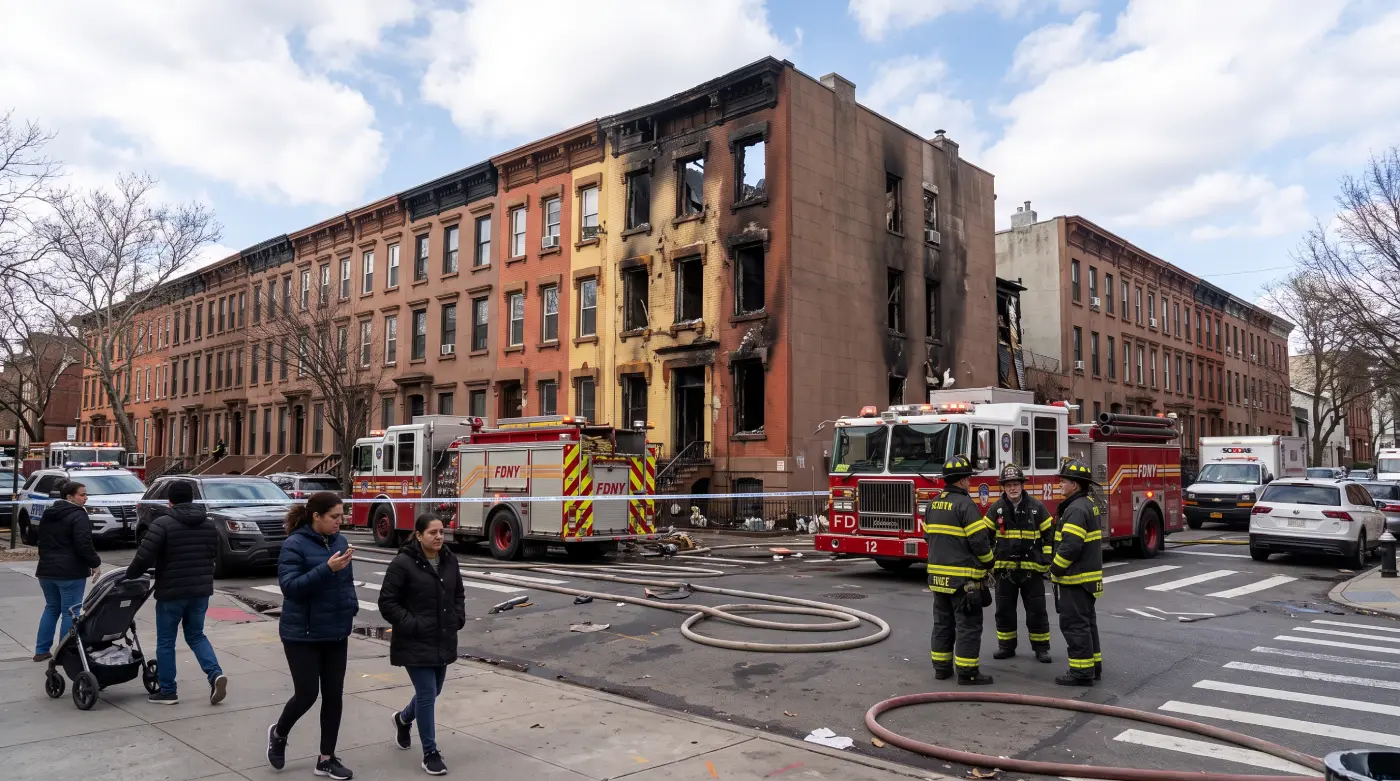
A burn takes seconds to happen and years to treat, and the bills start arriving long before any insurer admits fault. A Brooklyn burn injury lawyer at Silver Law Group builds the fire and burn case that pays for that treatment: the skin grafts, the lost income, the scars that don’t fade. Your first call costs nothing, we answer 24 hours a day, and we review your case for free in English, Spanish, or Russian. If you can’t leave a hospital bed, the attorney comes to you — call 212-470-4544.
Do You Have a Brooklyn Burn Injury Case?
A burn case turns on negligence: someone owed you a duty of care, broke it, and caused your burns. That is the legal test in New York, and proving it is the real work — the smoke detector that was never installed, the frayed wiring a landlord ignored, the grease trap a restaurant let overflow.
The party who pays depends on where and how you were burned. A Brooklyn landlord is liable when a building fire traces back to a code violation or an ignored repair. An employer or general contractor answers for a construction-site burn from exposed wiring or a flash fire.
A manufacturer is on the hook when a defective heater, battery, or appliance ignites. A negligent driver is liable when a crash sets a vehicle on fire and burns you inside it.
Vehicle-fire burns carry a rule that helps you. New York’s no-fault system normally blocks pain-and-suffering claims unless your injury meets the “serious injury” threshold in Insurance Law §5102(d). Significant disfigurement is one of the categories that clears it, and a burn that leaves visible scarring qualifies on its face. You do not have to argue about missed workdays or fracture severity — the scar itself opens the door to a full injury claim against the at-fault driver.
How Brooklyn Burn and Fire Injuries Happen
Most Brooklyn burn injuries trace back to a handful of settings, and each one points to a different party who should have prevented the fire.
- Apartment fires in old housing stock. Brooklyn’s brownstones, tenements, and multi-family walk-ups often run on decades-old wiring and gas lines. When a landlord lets that infrastructure decay, a single overloaded circuit or leaking gas connection can put a whole building at risk.
- Restaurant and commercial kitchens. Grease fires, faulty fryers, and gas flare-ups burn line cooks and dishwashers across Brooklyn’s food scene, from Bushwick to Bay Ridge. Employers and equipment makers share the blame when safety guards or suppression systems fail.
- Construction sites. Welding sparks, cutting torches, and live electrical work cause flash burns and arc-flash injuries. General contractors and site owners carry legal duties to control these hazards.
- Chemical burns. Industrial cleaners, solvents, and caustics eat through skin without any flame, hitting warehouse, cleaning, and factory workers who were never given proper protective gear.
- Electrical burns. Contact with exposed wiring or a faulty panel drives current through the body, causing deep internal damage that can look minor on the surface.
Landlords do not get to treat fire safety as optional. The NYC Housing Maintenance Code requires owners to install and maintain working smoke and carbon-monoxide alarms, keep exits and fire escapes clear, and repair electrical and heating hazards. When a Brooklyn owner ignores those duties and a tenant is burned, that failure becomes the spine of the negligence claim.
E-Bike and Lithium-Ion Battery Fires
Lithium-ion batteries have become one of the fastest-growing fire hazards in the city. Since 2022, the FDNY has reported more than 800 lithium-ion battery fires, over 30 deaths, and more than 400 injuries citywide. Many of them start with an e-bike or e-scooter battery charging inside an apartment, where a single cell failure can flash into a fire that fills a room in under a minute.
A burn from one of these fires can support two kinds of claim. A product liability claim targets the maker or seller of a defective battery, charger, or bike — the cell built wrong, the charger with no thermal cutoff, the retailer who sold uncertified equipment. A premises liability claim targets a landlord or business that allowed unsafe charging in a hallway, stairwell, or shared space and blocked the exit you needed to escape. Delivery workers who charge several batteries at home to keep working carry the highest risk, and the companies profiting from that work are increasingly part of the fault picture.
Burn Types and Why Severity Drives Your Case
The depth of a burn decides both your medical future and the size of your claim. Doctors grade burns by how far they reach into the tissue.
- First-degree burns damage only the outer skin layer. They redden and hurt but usually heal without scarring.
- Second-degree burns reach the layer beneath, blistering and often leaving marks that take months to fade.
- Third-degree burns destroy the full thickness of skin, killing nerve endings and requiring grafts. These rarely heal without surgery.
- Fourth-degree burns extend past the skin into muscle, tendon, or bone, and can cost a limb.
Depth is only half the picture. Burn units also measure total body surface area (TBSA) — the percentage of your body the burn covers. A deep burn over a large TBSA drives up the risk of infection, the number of surgeries, and the length of recovery, and all of that feeds directly into what your case is worth.
Smoke inhalation can be as dangerous as the flame. Superheated air and toxic gases scar the airway and lungs, and symptoms sometimes surface a day or two after the fire. Anyone caught in an enclosed fire should be checked even with no visible burns.
Severe burns in Brooklyn are typically stabilized at Kings County Hospital, the borough’s Level 1 trauma center, then transferred to the William Randolph Hearst Burn Center at NewYork-Presbyterian/Weill Cornell, one of the region’s main burn units. The transfer records from that path often document exactly how serious your injury was.
Compensation in a Brooklyn Burn Injury Claim
A burn claim covers far more than your first hospital stay. New York lets you recover for every loss the fire caused, past and future.
- Medical bills already incurred — the emergency care, surgeries, and hospital stays behind you.
- Future medical care, including the grafts, reconstructive surgery, and physical therapy burn recovery often demands for years.
- Lost income from the work you missed, plus reduced earning power if the burn keeps you from your job or trade.
- Scarring and permanent disfigurement, valued on their own because visible burns change how you live.
- Pain and suffering, covering the physical agony of the burn and the emotional weight that follows it.
New York places no cap on these damages. Unlike states that limit pain-and-suffering awards, New York lets a jury value your injury on its facts, which matters most in severe burn cases where the lifelong cost is real.
Shared fault does not end your claim either. Under CPLR §1411, New York follows pure comparative negligence: if you are found partly responsible for the fire, your recovery is reduced by your share of fault but never erased. Say a jury finds you 20 percent at fault for a cooking fire and the landlord 80 percent for a dead smoke detector — you still recover 80 percent of your damages. Insurers lean on comparative fault to shrink what they pay, which is why the way your case is built and documented from day one carries weight.
What to Do After a Burn Injury in Brooklyn
What you do in the first days after a burn shapes the claim later. Work through these steps as soon as you’re able.
- Get medical care right away, and follow up even for burns that look minor. Burns deepen over the first 48 hours, and smoke exposure can hide.
- Photograph everything — your burns at each stage of healing, the scene, the source of the fire, and any product involved before it’s thrown out or repaired.
- Report the fire in writing to your landlord, employer, or building management, so there is a dated record that it happened and that they knew.
- Keep the product that burned you. A defective battery, heater, or appliance is physical evidence; box it and do not let anyone take it.
- Decline recorded statements from any insurance adjuster until you have a lawyer. Adjusters call within days, sound friendly, and use your own words to cut what they owe.
The evidence you save in week one is often the evidence that proves fault months later, long after the scene has been cleaned up.
What a Brooklyn Burn Injury Lawyer Costs
Nothing upfront. Silver Law Group takes Brooklyn burn cases on a contingency fee, which means you pay no hourly rate and no retainer to start. The firm’s fee is a percentage of what it recovers for you, agreed in writing before any work begins, and it comes out of the settlement or verdict, not your pocket. If your case recovers nothing, you owe no attorney’s fee at all.
That structure exists so a burn victim buried in medical bills can still afford serious representation against a landlord’s or manufacturer’s insurer. The free case review that starts it carries no obligation and can happen by phone, at our Midtown office, or at your bedside.
Deadlines to File a Brooklyn Burn Injury Claim
Miss the filing deadline and your claim is gone, no matter how strong it was. New York sets different clocks depending on the case.
- Three years for personal injury. Under CPLR §214, you generally have three years from the date of the burn to file a lawsuit for your injuries.
- Two years for wrongful death. If a fire kills a family member, EPTL §5-4.1 gives the estate two years from the date of death to bring a wrongful death claim — a shorter window than the injury deadline.
- Tolled until 18 for children. Under CPLR §208, a child’s injury deadline is paused during infancy, so the three-year clock generally does not start until they turn 18.
A Brooklyn burn lawsuit is filed in Kings County Supreme Court at 360 Adams Street in Downtown Brooklyn, the trial court where injury cases in the borough are heard. Deadlines aside, waiting hurts your case in practical ways: witnesses move, buildings get repaired, and the burned product gets discarded. The sooner the evidence is locked down, the stronger your claim stands when it reaches that courthouse.
Claims Against NYCHA and Public Buildings
Burns in public housing follow a much faster clock. If your fire happened in a NYCHA development or any city-owned building, you must file a formal Notice of Claim within 90 days of the injury under General Municipal Law §50-e, long before any lawsuit. This is not the three-year deadline; it is a short notice requirement that comes first.
Miss the 90 days and you can lose the right to sue the city entirely, even if the burn was clearly its fault — a broken alarm in a NYCHA building, an unrepaired hazard the housing authority knew about. The clock starts the day of the fire, not the day you decide to act.
Why Brooklyn Burn Survivors Choose Silver Law Group
Insurance companies settle for less when they know a firm won’t take a case to trial. Silver Law Group’s Brooklyn burn injury attorneys prepare every case as if it will be tried, which changes the number an insurer is willing to put on the table before it ever gets that far. That readiness is what protects the value of your claim.
The firm is built for people in the middle of a crisis. Consultations are free, available 24 hours a day, and handled in English, Spanish, or Russian, so a language barrier never keeps you from understanding your own case. If you are in a burn unit at Weill Cornell or recovering at home in Brooklyn, the attorney comes to you rather than making you travel while you heal.
You keep the office informed, and the office does the fighting: the investigation, the experts, the pressure on the insurer. The free consultation puts no obligation on you, and the fee only comes out of a recovery, so there is no risk in learning where you stand. Call 212-470-4544.