

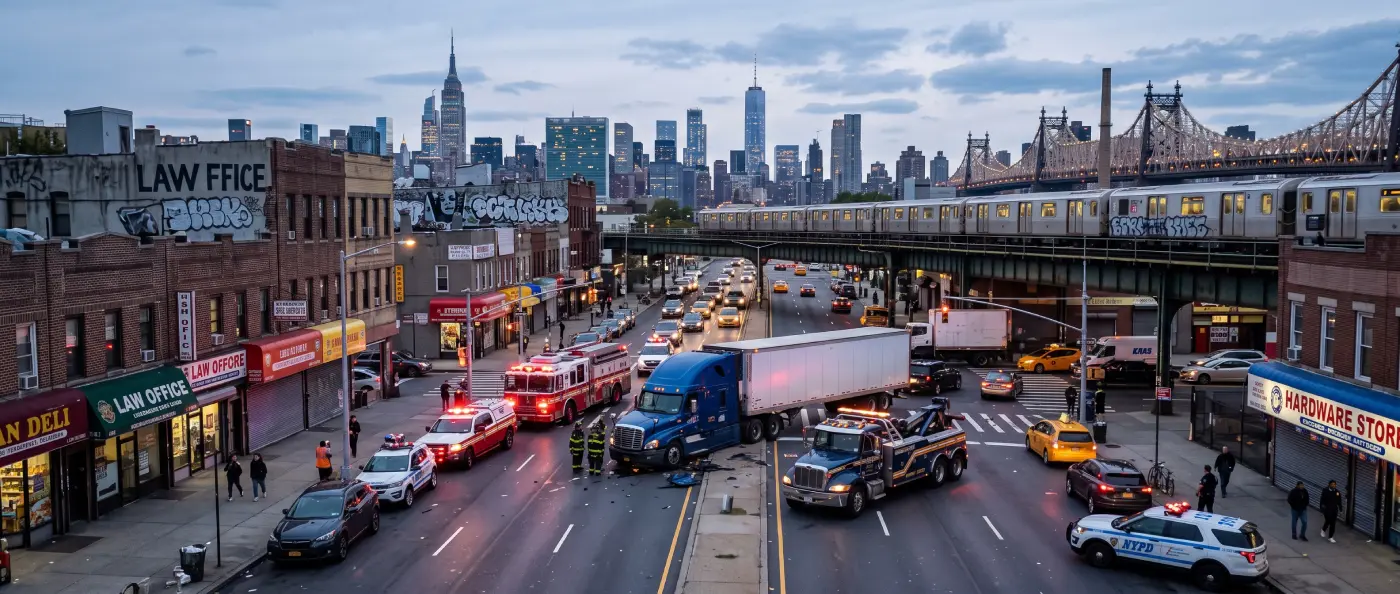
A Queens truck accident lawyer handles a different kind of case than a two-car fender bender, because the vehicle that hit you was probably owned by a company, driven by an employee on a schedule, and insured under a policy written for commercial risk. This page is for people hurt by tractor-trailers, 18-wheelers, box trucks, delivery vans, dump trucks and sanitation trucks anywhere in the borough: on the Long Island Expressway and the Brooklyn-Queens Expressway, on the Van Wyck and Whitestone Expressways, on Queens Boulevard, Northern Boulevard, Woodhaven Boulevard, Rockaway Boulevard and Atlantic Avenue. Silver Law Group offers a free consultation in English, Spanish and Russian, answers the phone 24 hours a day, and charges no fee unless we recover money for you.
Do You Have a Truck Accident Case in Queens?
You have a case when the truck driver, the motor carrier that put the truck on the road, or another party in the chain owed you a duty of care, broke it, and caused your injury. That is the legal test. What it looks like in practice depends on where in Queens the crash happened.
Most viable claims in this borough come out of three patterns. The first is dense delivery traffic in Jackson Heights, Elmhurst, Flushing and Long Island City, where drivers on a tight route make wide turns across bike lanes and double-park in a way that forces other traffic around them. The second is freight movement through the Maspeth and Long Island City industrial corridors, where heavy trucks share narrow streets with cars and people on foot all day. The third is JFK air-cargo trucking, which loads the Van Wyck Expressway and North Conduit Avenue with drivers working against flight schedules.
Types of Queens Truck Crashes That Produce Claims
Crash type is not a formality. It decides which records prove your case, which is why the first questions a lawyer asks are about how the truck moved and what it was carrying.
- Tractor-trailer and 18-wheeler collisions, where the tractor and the trailer may belong to different companies
- Jackknife and rollover crashes, which point at speed, braking and load distribution
- Underride crashes, where a car goes beneath the trailer and guard equipment becomes the issue
- Wide-turn and blind-spot crashes at Queens intersections
- Rear-end crashes by loaded trucks, where stopping distance and brake maintenance records matter most
- Delivery and box truck crashes involving Amazon, FedEx and UPS operations
- Garbage and private carting truck crashes
- Dump and construction truck crashes
- Truck-versus-pedestrian and truck-versus-cyclist crashes
If a City Truck Hit You: Sanitation, DOT and School Bus Vehicles
Claims against New York City vehicles run on a separate and much faster track. If a DSNY sanitation truck, a city DOT vehicle or a city-operated bus hit you, General Municipal Law §50-e requires a Notice of Claim within 90 days of the crash, and General Municipal Law §50-i limits the lawsuit itself to one year and 90 days.
Read those numbers against the ordinary three-year deadline for a private truck case and the gap is obvious. Ninety days is the most common way a valid Queens claim is lost. People spend that window in physical therapy, on hold with an insurer, or waiting to feel well enough to deal with it, and by the time they call a lawyer the door has closed.
Who Can Be Held Liable for a Queens Truck Accident
The driver is rarely the only defendant, and often not the most important one. Each party below controls a different set of records and a different insurance policy:
- The motor carrier, under respondeat superior, for the conduct of a driver acting within the scope of employment
- The freight broker that arranged the load and selected the carrier
- The shipper or cargo loader, where an unsecured or badly balanced load caused the crash
- The third-party maintenance contractor responsible for brakes, tires and inspections
- The truck or component manufacturer, where a part failed
Delivery giants complicate this. Many classify their drivers as independent contractors rather than employees, which is a direct attempt to keep the crash off the parent company’s policy. That fight over the employment relationship has to be won before the carrier’s coverage is reachable at all, and it is fought with route assignments, app data, uniform and equipment requirements, and evidence of who controlled the driver’s day.
When the Truck Was Never Supposed to Be on That Street
New York City DOT divides truck traffic into two networks. The Local Truck Route Network is for trucks with an origin or destination inside Queens, such as a delivery or a pickup. The Through Truck Route Network is for trucks only passing through the borough with no local business, and Queens Boulevard is a designated through truck route.
The restrictions carry real weight. Under NYC Traffic Rule Title 34, Chapter 4, commercial vehicles are barred from the Belt Parkway, the Cross Island Parkway and the Jackie Robinson Parkway. On the Grand Central Parkway between the Triborough (RFK) Bridge and the western leg of the BQE, only single-unit vehicles with no more than three axles and ten tires are permitted.
A truck that was off its lawful route, or on a parkway where it had no right to be, is direct evidence of negligence. It also tends to explain the crash: a driver on a banned parkway is usually there because it was faster, and speed on an unfamiliar route is how people get hurt.
If the Trucking Company Blames You: New York’s 2026 Comparative Fault Change
Expect the carrier’s adjuster to argue you caused part of the crash. Since May 26, 2026, that argument can end your case entirely.
Part EE of Chapter 58 of the Laws of 2026 added a new CPLR §1411(b), which applies to actions commenced on or after that date. In motor vehicle personal injury actions subject to Insurance Law Article 51, recovery is now barred completely when the claimant’s culpable conduct is greater than that of the defendant, or greater than the combined culpable conduct of the defendants. CPLR §1411(a), the pure comparative negligence rule New York has used for decades, still governs everything else: at 50 percent fault or less in a covered motor vehicle case, your damages are reduced by your share rather than erased.
The practical result is that a few percentage points now decide whether you recover anything. Pushing your fault past the halfway mark is the single most valuable move available to the trucking company’s insurer, and it is the central battle in a Queens truck case.
What a Queens Truck Accident Claim Is Worth
Value is built from four categories, documented one piece at a time:
- Medical expenses, including the cost of care you will still need years from now
- Lost wages, and lost earning capacity if you cannot return to the work you did before
- Pain and suffering
- Property damage
No honest lawyer quotes you a number before the medical picture is complete. A surgeon who tells you in month eight that you need a fusion changes the value of the case more than any argument a lawyer makes. Anyone who names a figure at the first meeting is guessing, and usually guessing low to get you to sign.
The Serious Injury Threshold and What Changed in 2026
Insurance Law §5102(d) is the gate. Clear it and you can recover for pain and suffering; fail to clear it and your claim is limited to economic loss.
Part EE deleted the 90/180-day category from that definition effective May 26, 2026, removing the option that once let people qualify by showing they could not perform their usual daily activities for 90 of the 180 days after the crash. The surviving categories include fracture, significant disfigurement, permanent loss of use of a body organ or member, permanent consequential limitation of use of a body organ or member, and significant limitation of use of a body function or system.
Part EE also amended Insurance Law §5104(a) so the trier of fact must decide fault first, and only then decide whether the injury is serious. Fault has moved to the front of the trial.
No-Fault Benefits Versus the Lawsuit
No-fault and your lawsuit are two separate things, and people lose money by assuming the first one covers everything. No-fault pays your medical bills and part of your lost earnings regardless of who caused the crash. The lawsuit against the trucking company is what pays for pain and suffering.
Basic economic loss under no-fault is capped at $50,000 per person. Lost earnings are paid at 80 percent of what you were making, up to $2,000 per month, for up to three years. Under 11 NYCRR 65-1.1, written notice of claim must reach the no-fault insurer within 30 days of the crash. Miss that window and the insurer can deny benefits outright, which leaves your treatment unpaid at exactly the moment you need it most.
Why Truck Insurance Reaches Further Than Car Insurance
Federal law sets the floor. Under 49 CFR 387.9, an interstate carrier hauling general freight must carry at least $750,000 in liability coverage, and certain hazardous materials operations must carry up to $5,000,000. New York’s minimum for a personal auto policy is $25,000.
Carriers also sit under layered excess policies, where a primary insurer covers the first tier and one or more excess insurers sit above it. Identifying every insurer in that tower is what determines whether a spinal injury or an amputation is actually paid for, or paid out to a limit that ran out years before your care did.
What to Do After a Truck Accident in Queens
Do these in order, as soon as you are physically able:
- Call 911 and make sure an NYPD report is generated at the scene.
- Photograph the truck’s DOT number, the carrier name on the door, and the license plate on both the tractor and the trailer.
- Get names and phone numbers from witnesses before they leave.
- Refuse any recorded statement to the carrier’s adjuster. You are not required to give one, and it exists to lock in words you will not be able to take back.
- Call a lawyer before the trucking company’s rapid-response investigators finish building their version of the crash. Many carriers dispatch a team to the scene within hours.
The Evidence That Disappears First
Federal rules let the carrier destroy the proof. Under 49 CFR 395.8(k)(1), a motor carrier must keep records of duty status and their supporting documents for only six months. After that, lawful destruction.
Electronic logging device data, dispatch and routing records, cargo manifests, weight tickets and maintenance logs all sit on short retention cycles. So does the video: surveillance from businesses along Northern Boulevard or Queens Boulevard and MTA camera footage typically overwrite within days or weeks, not months. A spoliation letter sent early is what freezes all of it in place, and it only works if it goes out before the deletion happens.
Getting Treated and Documented in Queens
Go to an emergency department the same day, even if you think you can walk it off. Queens has three Level I trauma centers:
- NYC Health + Hospitals/Elmhurst, 79-01 Broadway, Elmhurst
- Jamaica Hospital Medical Center, 8900 Van Wyck Expressway, Jamaica
- NewYork-Presbyterian Queens, 56-45 Main Street, Flushing
An emergency-department record created close in time to the crash is what defeats the insurer’s later argument that your back problem came from your job, your age, or a gym session two weeks afterward. Every week you wait is a week the defense gets to point at.
What It Costs to Hire a Queens Truck Accident Lawyer
Nothing upfront. The consultation is free and carries no obligation to hire us. If we take your case, our fee is a percentage of what we recover for you, paid out of the recovery at the end rather than billed to you along the way. If there is no recovery, there is no fee.
If your injuries make travel difficult, we come to you at home or in the hospital. That is not a courtesy limited to serious cases; it is how the first meeting happens whenever getting to Midtown would cost you a day of pain.
How Long You Have to File a Truck Accident Claim in New York
Four clocks run at once after a Queens truck accident, and they run at different speeds:
- 30 days — written no-fault notice to the insurer under 11 NYCRR 65-1.1
- 90 days — Notice of Claim under GML §50-e if a city truck was involved, with GML §50-i capping that lawsuit at one year and 90 days
- Two years — wrongful death actions under EPTL §5-4.1, measured from the date of death
- Three years — most personal injury lawsuits under CPLR §214, measured from the date of the crash
One more timing point matters after 2026. The Part EE amendments apply based on when the action is commenced, not when the crash happened, so a crash from an earlier year filed today is governed by the new rules.
Where a Queens Truck Accident Lawsuit Is Filed
Queens truck cases are litigated in Queens County Supreme Court:
- Civil Term, 88-11 Sutphin Boulevard, Jamaica
- Long Island City Courthouse, 25-10 Court Square
Filing here rather than in the carrier’s home county puts the case in front of a jury drawn from the borough where the crash happened, people who drive the Van Wyck and cross Queens Boulevard on foot and do not need a diagram to understand what a wide right turn does to a cyclist. Most cases settle before trial. They settle at a fair number only when the carrier and its defense counsel believe the firm across from them is prepared to try the case.
Why Queens Truck Accident Victims Choose Silver Law Group
- Free case review with no obligation and no pressure to sign
- Consultations in English, Spanish and Russian, in a borough where a majority of households speak a language other than English at home
- Someone available 24 hours a day, 7 days a week, including the night of the crash
- Contingency representation, so the firm is paid only from a recovery
- An attorney who travels to your home or hospital room when you cannot travel
- A trial-ready posture toward carriers and their defense counsel from the first filing
Talk to a Queens Truck Accident Lawyer Today
Call 212-470-4544 for a free consultation. Our office is at 49 West 37th Street, 7th Floor, New York, NY 10018, a short drive or subway ride from Queens, and we will come to you if that is easier.
The reason to call now is not pressure. It is that the carrier can lawfully destroy its duty-status records six months after the crash, and your no-fault benefits can be denied if written notice does not reach the insurer within 30 days. Both of those clocks started the day the truck hit you.