

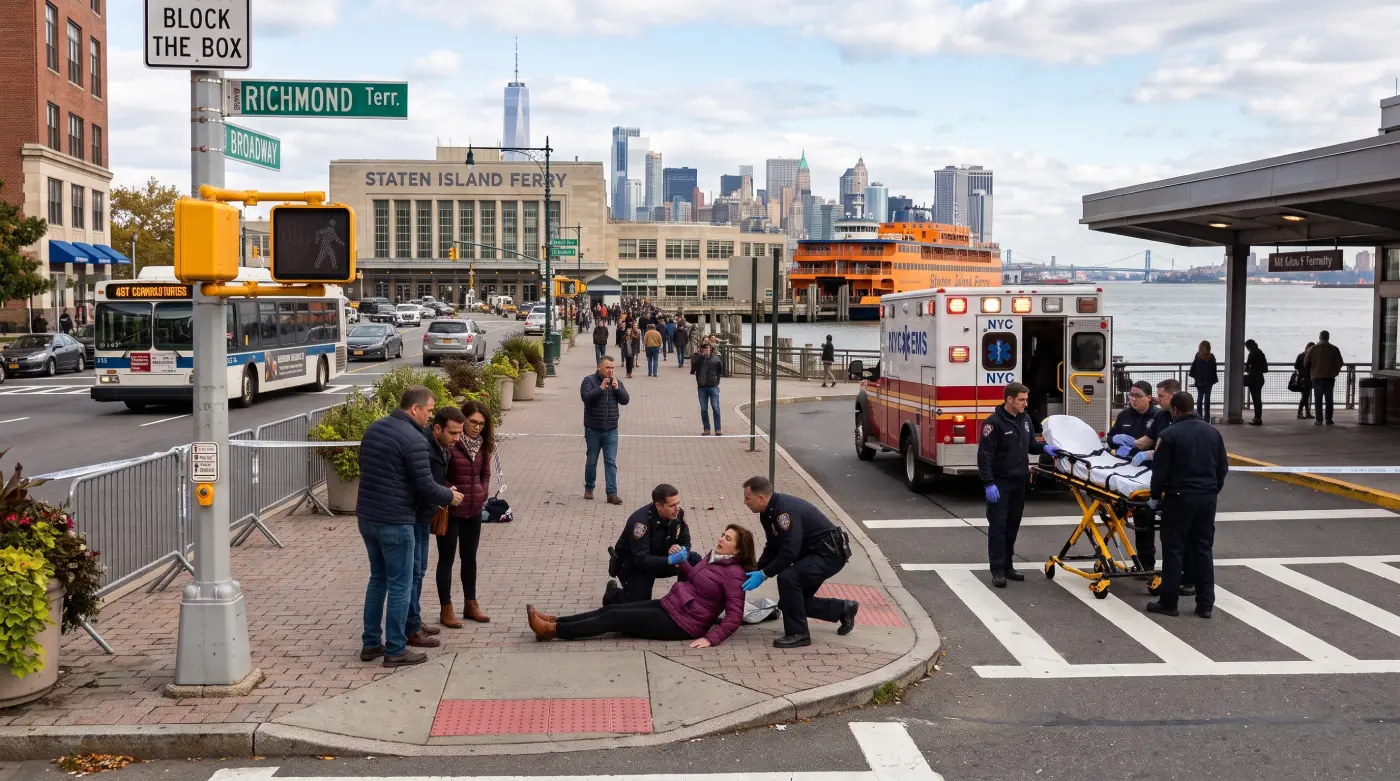
A driver who hits you owes you more than an apology. If a car struck you on Staten Island, you can recover money for medical care, lost wages, and lasting pain, and a Staten Island pedestrian accident lawyer can hold the driver’s insurer to that debt. New York starts the money moving before any lawsuit is filed, through no-fault benefits that pay hospital bills no matter who caused the crash. It also protects your right to sue the driver for what no-fault leaves out. The sooner the evidence is locked down — the police report, the vehicle, the camera on the corner — the harder your claim is to fight later. Every case here starts with a free consultation, open 24 hours a day in English, Spanish, and Russian. Call 212-470-4544. If you cannot travel, the attorney comes to your home or hospital room.
Do You Have a Pedestrian Injury Case?
New York City law puts the burden on the driver, not on you. Under Section 19-190 of the NYC Administrative Code, a driver who fails to yield to a pedestrian with the right of way commits a misdemeanor when that failure causes injury or death, and the same violation becomes strong evidence in your civil claim.
You do not lose your case by being hit somewhere other than a painted crosswalk. Drivers owe a duty of care everywhere, and a claim can survive even when you were crossing mid-block, stepping off a median, or moving against the signal. What the driver did — speed, distraction, failing to look before a turn — usually matters more than the exact spot where you were standing.
That is why the insurer’s first questions try to pin the blame on you. An adjuster will ask whether you looked both ways, whether you were on your phone, whether you “came out of nowhere.” Those questions are built to shrink your recovery, not to help you. A pedestrian who was partly careless can still have a full case, because New York does not treat shared fault as an all-or-nothing bar. The driver’s insurer knows this and hopes you do not.
Before you answer any of it, get the facts documented and get a lawyer looking at the same evidence the insurer is already gathering.
When You Are Partly at Fault
Shared fault reduces your recovery; it rarely erases it. New York has long used pure comparative fault, cutting your damages by your percentage of blame but still paying the rest. For pedestrian and cyclist cases filed on or after May 26, 2026, CPLR 1411(b) changes the ceiling: recovery is barred only when your share of fault is greater than the driver’s. A smaller share still reduces your damages proportionally rather than ending the case.
The practical effect is direct. If a jury finds you 30 percent responsible for stepping off the curb early, you keep 70 percent of your damages. If it finds you 55 percent responsible, the new rule blocks recovery entirely. That single percentage point can decide the case, which is why how fault gets investigated and argued is not a detail to leave to the other side’s insurer.
Who Pays Your Medical Bills After Being Hit
The car that hit you pays first. New York’s no-fault system requires the striking vehicle’s insurer to cover up to $50,000 in medical bills and lost earnings, even though you were on foot and owned no policy on the crash. You do not need your own car or car insurance to collect these benefits.
Two deadlines protect that $50,000, and both move fast:
- File the no-fault application (form NF-2) with the striking vehicle’s insurer within 30 days of the accident.
- Submit medical bills within 45 days of treatment.
Miss the 30-day window and the insurer can deny the whole benefit, leaving you to fight for coverage you were entitled to.
What happens when there is no insurer to bill? A hit-and-run driver or an uninsured vehicle does not leave you with nothing. The Motor Vehicle Accident Indemnification Corporation (MVAIC) exists for exactly that gap, standing in as the payer of no-fault benefits when the striking driver cannot be identified or carried no coverage. MVAIC has its own short notice deadlines and eligibility rules, and the paperwork is unforgiving, so it is worth having a lawyer file it correctly the first time. The $50,000 covers a lot in an emergency, but a serious pedestrian injury can burn through it quickly, and that is where the claim against the driver becomes the real source of recovery.
Proving a Serious Injury for Pain-and-Suffering Damages
No-fault pays your bills, but it does not pay for pain. To recover for pain and suffering, you have to clear the serious-injury threshold in Insurance Law 5102(d).
The statute lists specific categories that qualify. The most common in pedestrian cases include:
- Bone fracture of any kind
- Significant disfigurement, including permanent scarring
- Permanent loss of use of a body part, organ, or system
- Permanent consequential limitation or significant limitation of a body function or system
- Traumatic brain injury
One change matters for recent cases: the “90/180-day” category — which had let people qualify by showing a substantially disabling injury for 90 of the first 180 days — was eliminated in 2026. Claims that once leaned on that provision now have to fit one of the remaining categories, usually with imaging, treatment records, and a physician’s findings tying the limitation to the crash. Building that proof early, while the injury is documented and fresh, is what keeps this door open.
What Your Staten Island Pedestrian Case Is Worth
No honest lawyer quotes a number at the first call, because the value comes from your specific injury, not a formula. What a Staten Island pedestrian accident lawyer does instead is build the case in two parts and prove each one.
Economic damages are the measurable losses: emergency and follow-up medical care, surgery, physical therapy, the future care a permanent injury will demand, and the wages you lost while unable to work, including reduced earning power if you cannot return to the same job. These are documented with bills, records, and expert projections.
Non-economic damages cover the human cost that no receipt captures — the pain, the lost sleep, the activities you can no longer do, the way an injury reshapes daily life. The drivers of that number are severity, permanence, and disability. A fracture that heals cleanly is worth less than one that leaves you limping for good; a scar on your forearm carries different weight than one across your face. The more lasting and limiting the injury, the higher the case value climbs, which is why the medical proof discussed above does double duty: it clears the serious-injury threshold and it sets the ceiling on what you can recover.
Where Pedestrian Accidents Happen on Staten Island
The danger clusters on a handful of corridors, and Hylan Boulevard sits at the top of the list as the borough’s deadliest street for people on foot. Its long stretches, wide lanes, and heavy traffic give drivers room to speed and leave pedestrians exposed at every crossing.
Other recurring trouble spots include:
- Manor Road at Victory Boulevard, a busy junction where turning traffic and crossing pedestrians collide.
- Bay Street, where commercial traffic and foot traffic share tight, congested blocks along the North Shore.
Staten Island pedestrian fatalities rose in 2025, cutting against progress elsewhere in the city and underscoring that these crashes are getting more severe, not less. When they happen, the borough’s two Level I trauma centers are where the badly hurt go: Staten Island University Hospital (SIUH) and Richmond University Medical Center (RUMC). A Level I designation means round-the-clock surgical capability for the worst injuries, and the records those hospitals create in the first hours become the backbone of your claim.
What to Do After a Pedestrian Accident
What you do in the first hour shapes the case for the next year. Work through these steps in order:
- Call 911. Get police and an ambulance on scene. The police report fixes the driver’s identity, the vehicle, and the location while memories are fresh.
- Photograph everything. The vehicle, its plate, the roadway, the signals, your injuries, and the exact spot where you were hit. Photos taken that day cannot be argued away later.
- Get prompt trauma care. See a doctor the same day even if you feel able to walk. Internal injuries and brain trauma can hide for hours, and a gap in treatment is the first thing an insurer uses against you.
- Say nothing to the driver’s insurer. An adjuster may call within days asking for a recorded statement. Decline it. Speak to a lawyer first, then let counsel handle every conversation with the insurance company.
Deadlines to File a Staten Island Pedestrian Claim
The clock starts the day of the crash, and different claims run on different timers. Miss the deadline and the right disappears, no matter how strong the case.
- Three years to sue the driver. CPLR 214 gives you three years from the accident date to file a personal injury lawsuit.
- Two years for wrongful death. If a pedestrian is killed, EPTL 5-4.1 sets a two-year deadline for the estate to bring a wrongful-death claim, which is shorter than the injury deadline and easy to overlook while a family is grieving.
- 90 days for a government vehicle. If an MTA bus, city truck, or other public vehicle hit you, GML 50-e requires a Notice of Claim within 90 days, long before any lawsuit. This is the deadline that catches people off guard, because most assume they have years.
- Tolling for children. When the injured pedestrian is a minor, the statute of limitations generally pauses until age 18, giving the child time that an adult would not have.
Why Choose Silver Law Group
You pay nothing unless we win. Silver Law Group works on a contingency fee, which means there is no retainer, no hourly bill, and no legal fee at all unless we recover money for you; the fee is a percentage of that recovery, and if there is no recovery, you owe no attorney’s fee. That structure lets an injured pedestrian hire a trial-ready firm without spending a dollar up front.
The firm prepares every case as if it will go before a jury in Richmond County Supreme Court, which is where a contested Staten Island pedestrian case is tried. Consultations and case handling are available in English, Spanish, and Russian, and when injuries keep you home or in the hospital, the attorney comes to you. Reach the office at 49 West 37th Street, 7th Floor in Manhattan, or call 212-470-4544 for a free consultation, any hour of the day.