

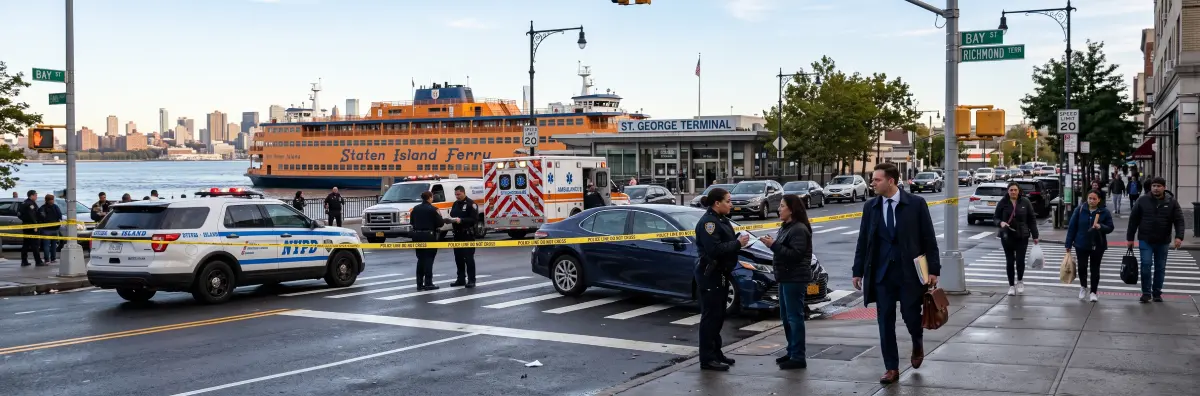
A driver hit you and drove off, and now the bills are landing on you for a crash no one has claimed. You can still recover money, and a Staten Island hit & run lawyer at Silver Law Group can tell you which insurance has to pay when the other driver is gone. New York gives hit-and-run victims more than one path to a recovery: the no-fault coverage on the car you were in, the uninsured motorist coverage on your own policy, a state fund for people with no policy at all, and sometimes the driver once police put a name to the plate. Silver Law Group handles these claims on contingency for injured people across Staten Island. Call 212-470-4544 for a free consultation, available 24/7 in English, Spanish, and Russian; if you are hurt, the attorney can come to your home or hospital room.
Do You Still Have a Case If the Driver Fled or Is Unknown?
Yes. Your right to recover does not depend on catching the person who hit you. New York’s no-fault and uninsured-motorist system was built partly for this exact situation, where a car flees a wreck on Hylan Boulevard or merges off the Staten Island Expressway before anyone reads the plate.
Most of the money in an early hit-and-run claim comes from insurance you can already reach, not from the missing driver’s pocket. Your own auto policy carries uninsured motorist coverage, and a hit-and-run driver counts as uninsured under it. No-fault benefits pay your first medical bills no matter who caused the crash. If you have no policy of your own, a state fund called MVAIC can stand in for the driver who left.
Identifying the driver still matters, because a named defendant gives your case leverage that a phantom vehicle does not. That is often possible weeks later. A partial plate, a paint transfer on your fender, a camera on Richmond Avenue, or a witness who followed the car can turn an unknown driver into a named one long after the police report is closed.
What New York Counts as Leaving the Scene
Vehicle and Traffic Law §600 requires any driver in a crash to stop, give their name, address, license, and insurance information, and report the collision to police when someone is hurt. Driving off before doing that is the legal definition of a hit-and-run, and the statute treats it in two tiers.
Leaving after property damage alone is a traffic infraction. Leaving after a personal injury is a crime: a misdemeanor when the injury is not serious, and a felony when it is. The line the statute draws between damage and injury is the same line that decides how hard the district attorney pursues the driver once police find them.
The criminal case and your case run on separate tracks, but they help each other. The same act that gets a driver charged under VTL §600 is strong evidence of fault in your civil claim, and a conviction or a police finding that the driver left the scene supports the argument that they, not you, caused the crash.
How You Get Compensated When the Driver Fled
Money after a hit-and-run comes in a set order, and which source pays depends on whether you own a car, whether you were driving, and whether police ever find the other driver.
- No-fault (PIP): the first $50,000 in medical bills and lost wages, paid by the policy on the car you occupied, regardless of fault. This covers drivers, passengers, and usually pedestrians the vehicle struck.
- Uninsured motorist (UM): your own policy’s UM coverage pays for pain and suffering once no-fault runs out and there is no driver to sue, treating the one who fled as uninsured.
- MVAIC: if you own no car and are not covered by a relative’s policy, the Motor Vehicle Accident Indemnification Corporation fills the gap the missing driver left.
- Suing an identified driver: if police name the driver, you can sue and reach their liability coverage directly, and turn to your own SUM coverage if their limits fall short.
Which layer applies turns on the person. A driver or passenger with their own policy uses that policy’s no-fault and UM coverage. A passenger in someone else’s car uses that car’s no-fault first. A pedestrian struck by a car that fled has no vehicle to bill, so the claim runs to a household policy or, absent one, to MVAIC. A hit & run lawyer sorts which door is open before an adjuster steers you to the wrong one.
Filing an MVAIC Claim With No Insurance of Your Own
MVAIC exists for the people the insurance system would otherwise leave with nothing: a pedestrian hit by a fleeing car who owns no vehicle, or someone in a car with no valid coverage. It operates under Insurance Law Article 52, and its deadlines are strict enough that missing one ends the claim before it starts.
To qualify, you must be a New York resident, not covered by any applicable auto policy, and injured by a vehicle that was unidentified or uninsured. Three steps control eligibility:
- Report to police within 24 hours. A hit-and-run reported later than that can defeat the claim, because MVAIC treats a late report as a reason to doubt the crash happened as described.
- File a notarized Notice of Intention to Make Claim within 90 days of the accident. This is the formal document that puts MVAIC on notice; it is separate from the police report.
- Submit the no-fault application so medical and wage benefits begin.
Once you qualify, MVAIC pays basic economic loss up to $50,000 in no-fault benefits, and bodily injury coverage of $25,000 per person and $50,000 per accident for pain and suffering. Those 25/50 limits are the ceiling on the non-medical part of an MVAIC recovery, which is why a firm value of your injury matters early.
Uninsured and Underinsured Motorist (UM/SUM) Coverage
If you or a relative you live with owns a car, that policy almost certainly carries uninsured motorist coverage, and a driver who fled counts as uninsured under it. This is the coverage that pays for pain and suffering after no-fault is spent and no defendant exists to sue.
A UM claim is a case within a case. You are claiming against your own insurer, but you still have to prove the phantom driver existed and was at fault, usually in arbitration, exactly as you would against a named driver. Insurers sometimes deny that a phantom vehicle was ever there, especially when your car was never touched, and that denial can force a declaratory-judgment action just to establish that the coverage applies.
If the driver is later identified but carries low limits, supplementary underinsured motorist (SUM) coverage makes up the difference between their liability limit and your own higher one.
How We Identify a Fleeing Staten Island Driver
Naming the driver widens your recovery and often takes fast work, because the evidence disappears on its own timeline. We move on several fronts at once:
- FOIL requests to NYC DOT for traffic-camera and red-light-camera footage near the crash, including corridors like the Staten Island Expressway and Hylan Boulevard.
- Private surveillance from gas stations, storefronts, and homes with doorbell cameras, much of which overwrites within days.
- Canvassing for witnesses who stopped, plus drivers whose dash cams may have caught the plate.
- Debris and paint analysis. A broken mirror, a bumper fragment, or a paint transfer can fix the make, model, and color of the car that hit you.
- Licensed investigators who run partial plates and check body shops for matching front-end damage.
The point of the work is not the plate for its own sake. A named driver means a second insurance policy to reach and a defendant a jury can hold responsible.
What Your Staten Island Hit-and-Run Case Is Worth
Value in a New York injury case is not a figure you can look up, because two legal gates come first. To recover for pain and suffering, rather than only medical bills and lost wages, your injury has to cross the serious-injury threshold in Insurance Law §5102(d). The categories that meet it include:
- death
- dismemberment or significant disfigurement
- a fracture
- loss of a fetus
- permanent loss of use of a body organ, member, function, or system
- a permanent consequential limitation or a significant limitation of use
The 90/180 category, which once let a non-permanent injury qualify if it kept you from your usual activities for 90 of the first 180 days, was repealed in 2026. That route to the threshold is closed, so your injury now has to fit one of the categories above.
The second gate is fault. Under CPLR §1411(b), as amended in 2026, New York applies modified comparative fault: if you are found more than 50% responsible, you recover nothing, and at 50% or less your recovery is cut by your share. In a hit-and-run this matters because an insurer may argue you stepped off the curb into traffic or crossed against the light to push your percentage up.
Once both gates are cleared, the value is built from real losses: past and future medical costs, lost earnings and reduced earning capacity, and pain and suffering. Documenting each is the work that decides the number.
What to Do After a Hit-and-Run in Staten Island
The hours after the crash shape the claim more than any step you take later. Work through this in order:
- Get medical care the same day. Staten Island University Hospital at 475 Seaview Avenue and Richmond University Medical Center at 355 Bard Avenue both have emergency departments. A concussion, internal injury, or soft-tissue tear can surface days later, and the record you create now anchors the whole case.
- Write down everything about the car before you forget it: partial plate, color, make, the direction it fled, the damage you saw.
- Call 911 and get a police report, and do it within 24 hours if MVAIC might apply to you.
- Tell your own insurer promptly. The no-fault application has a 30-day clock, and UM claims carry their own notice requirements.
- Say nothing on a recorded line. If an adjuster calls, do not give a recorded statement before you talk to a lawyer.
Deadlines That Can Bar Your Claim
A hit-and-run runs on several clocks at once, and the shortest one is not the one most people worry about. Each of these can end a claim on its own:
- 30 days: the no-fault application to the insurer. Miss it and you can lose medical and wage benefits even with a real injury.
- 90 days: the MVAIC Notice of Intention, if you are relying on the fund, and the GML §50-e Notice of Claim if a city vehicle such as an MTA bus or a Sanitation truck was involved. A late Notice of Claim usually bars the case against the public agency entirely.
- 3 years: the CPLR §214 statute of limitations to file a personal injury suit.
- 2 years: the EPTL §5-4.1 deadline for a wrongful death claim, running from the date of death, if the crash killed a member of your family.
The three-year suit deadline is the one people assume governs everything. The 30-day and 90-day windows expire first, and they are the ones that quietly cost victims their benefits.
Why Choose Silver Law Group as Your Staten Island Hit & Run Lawyer
You pay nothing up front, and no legal fee at all unless we recover money for you. Silver Law Group works on contingency: our fee is a percentage of what we collect, taken only out of the recovery, so if there is none, you owe us nothing for our time. The costs of building the case, from records to the investigators who track down the driver, are advanced by the firm.
If your case does not settle, we prepare it to be tried rather than pushed toward whatever the insurer offers, and Staten Island injury suits are filed at Richmond County Supreme Court, 26 Central Avenue. When you are too hurt to travel, the attorney comes to your home or hospital room.
From our office at 49 West 37th Street in Midtown Manhattan, Silver Law Group represents injured Staten Islanders throughout the borough. Consultations are free, available 24/7, and handled in English, Spanish, or Russian. Call 212-470-4544.