

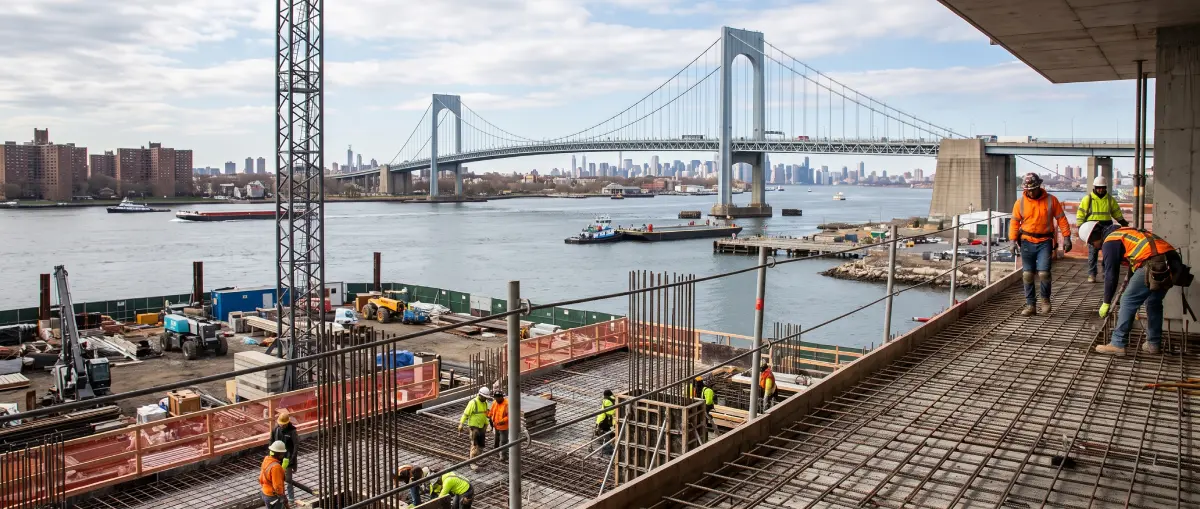
If you were hurt on a jobsite in Long Island City, Astoria, Flushing or Jamaica, two separate claims can run at the same time, and a Queens construction worker lawyer handles both. One is workers’ compensation against your employer’s carrier, which pays for your medical treatment and part of your wages no matter who caused the accident. The other is a Labor Law lawsuit against the property owner and the general contractor, which reaches the pain, the permanent injury and the full earnings that compensation never touches. Filing one does not give up the other. Call 212-470-4544 for a free consultation, any hour of the day or night, in English, Spanish or Russian.
How Dangerous Queens Construction Work Has Become
The New York City Department of Buildings recorded 44 construction accidents involving injury or death in Queens in its year-end 2025 summary: 42 injuries and 4 deaths. Those four fatalities were the most of any borough that year, out of 10 citywide. Falls accounted for 163 of the 320 construction incidents citywide, so roughly half of everything that goes wrong on a New York site involves a worker coming down from a height.
The borough’s building boom explains the numbers. Work is concentrated in:
- Long Island City, where high-rise residential towers keep crews on hoists, exterior scaffolds and unfinished floor slabs
- The Astoria waterfront and its residential builds
- The Willets Point redevelopment, including Etihad Park and the Willets Point Commons housing
- Flushing commercial and hospital construction
- Jamaica’s transit-area development around the AirTrain and LIRR corridor
- The Port Authority’s $19 billion JFK rebuild and the LaGuardia program, both of which run active airside and terminal work
Do You Have a Case Under New York Labor Law
Most injured workers call with one question: does the law actually cover what happened to me? For a Queens construction worker, the answer is usually yes, and there is almost always a claim beyond workers’ compensation. Which statute fits your accident decides how hard your case is to win, so the three provisions below are worth reading in order.
Labor Law §240, the Scaffold Law
Labor Law §240(1) puts absolute liability on the property owner and the general contractor for elevation-related injuries. That covers falls from ladders, scaffolds, hoists and roofs, falls through unprotected floor openings and elevator shafts, and being struck by an object that should have been secured or hoisted properly. Absolute liability means something specific: your own carelessness is not a defense. If the ladder was unsecured and you were hurt, it does not matter that you were rushing, that you skipped a step, or that your foreman told you to do it that way. The one narrow exception is the owner of a one- or two-family home who does not direct or control the work, which rules out very few Queens jobsites but does come up on small residential jobs in places like Middle Village and Bayside.
Labor Law §241(6) and the Industrial Code
Section 241(6) handles the hazards that are not about gravity. It covers construction, demolition and excavation work, and it operates by importing specific safety rules from the Industrial Code at 12 NYCRR Part 23. A general complaint that the site was unsafe is not enough; your lawyer has to name the rule that was broken. The provisions that come up most on Queens sites are:
- §23-1.7, general hazards including falling objects, slipping and tripping hazards
- §23-1.21, ladders and ladder footing
- §23-5, scaffolding erection, planking and guardrails
- §23-4, excavation and trench protection
- §23-1.13, electrical hazards and energized circuits
Unlike a §240 claim, comparative fault is a live defense under §241(6). If the defense convinces a jury you were 30 percent responsible, your recovery drops by 30 percent.
Labor Law §200 and Ordinary Negligence
Labor Law §200 is the catch-all. It codifies the common-law duty to provide a safe place to work, and it applies to conditions that no Industrial Code rule happens to address. The tradeoff is proof: you have to show the owner or contractor either had notice of the dangerous condition or controlled the way the work was performed. A well-built case pleads §240, §241(6) and §200 together, so that if a judge throws out one theory on summary judgment, the claim stays alive on the others.
Non-Union, 1099, Cash-Paid and Undocumented Workers
Labor Law protection does not depend on union membership, W-2 status, or immigration status. In Balbuena v. IDR Realty LLC, 6 N.Y.3d 338 (2006), the New York Court of Appeals held that undocumented workers keep their full tort and Labor Law rights, including lost wages.
Workers on Queens sites get told the opposite all the time. Getting paid in cash, working off the books, being called a subcontractor on paper, having no papers at all: none of that hands the owner or the general contractor a defense. It is a story told to keep injured men from calling a construction worker attorney, and it is false. What being paid in cash does affect is how your lost earnings get proven, which is a documentation problem your lawyer solves with pay records, coworker testimony and industry wage data.
Who Can Be Held Liable for Your Queens Construction Injury
A third-party claim can reach anyone with a duty on that site except the company that signs your paycheck. The defendants worth identifying early:
- The property owner, who is liable under §240 and §241(6) whether or not anyone from the owner’s side ever set foot on the site.
- The general contractor, on the same statutory footing as the owner.
- Subcontractors that controlled the work area or created the hazard.
- Manufacturers of defective equipment, and the rental companies that supplied and maintained it.
- Staffing agencies and labor brokers that placed you on the job.
Your direct employer is off the list. Workers’ compensation is the exclusive remedy against the employer, which is exactly why the third-party case matters so much. On a large Queens site with a general contractor and eight or ten subs sharing one address, contracts and insurance certificates decide who answers for what, and those documents start disappearing after a serious accident. Naming every potential defendant before the three-year clock runs is what keeps a case from collapsing when one company turns out to be uninsured or dissolved.
When the Owner Is a Public Agency
A large share of Queens construction is publicly owned or publicly funded. That includes the Port Authority of New York and New Jersey at JFK and LaGuardia, the MTA and New York City Transit, the New York City School Construction Authority, NYCHA developments such as Queensbridge, Astoria and Ravenswood Houses, and NYCEDC-led projects including Willets Point.
If one of those entities owns the site, every deadline compresses, in some cases to 90 days and in one case to a lawsuit filed within a year. The specifics are set out in the deadlines section below, and they are the reason to call before you finish physical therapy rather than after.
Workers’ Compensation and a Lawsuit Run Side by Side
Workers’ compensation pays for your medical treatment and roughly two-thirds of your average weekly wage while you are out, regardless of who was at fault. What it does not pay for is pain and suffering, loss of the life you had before the injury, or the gap between two-thirds and what you actually earned with overtime. For a Queens laborer who can no longer lift, climb or kneel, that gap runs for the rest of a working life.
The Labor Law lawsuit against the owner and general contractor covers what comp leaves out. Pursuing it does not forfeit your compensation benefits, and receiving benefits does not weaken the lawsuit; the two proceed on separate tracks, before different tribunals, with different rules. One point to plan for from the start: the compensation carrier will assert a lien against any third-party recovery, claiming back the medical and wage benefits it paid. That lien is negotiable, and reducing it before the client is paid is part of the job, not an afterthought at the closing statement.
What a Queens Construction Injury Case Is Worth
No honest lawyer quotes a number before reading the file. What can be explained is what moves value, and the first factor outweighs the rest: whether Labor Law §240 applies. A gravity case with absolute liability removes the comparative fault argument entirely, which changes how a carrier evaluates the file from the first reserve setting.
After that, value turns on medical reality and earning capacity. Surgery, hardware, fusion levels and the likelihood of future operations matter. So does whether you can return to the trades at all, because a 38-year-old ironworker with a permanent lifting restriction has lost decades of income, not months. The last factor is the one under your lawyer’s control: the strength of the damages workup, meaning treating-physician narratives, life-care planning for future medical needs, and an economist’s projection of lost earnings and benefits. Cases with thin damages proof settle for thin numbers no matter how clear the liability.
What to Do After a Construction Accident in Queens
- Get treated the same day. Serious jobsite injuries in the borough go to Queens Level I trauma centers: NYC Health + Hospitals/Elmhurst at 79-01 Broadway, Jamaica Hospital Medical Center at 8900 Van Wyck Expressway, and NewYork-Presbyterian Queens at 56-45 Main Street in Flushing. A gap between the accident date and the first medical record is the first thing a defense attorney will point to.
- Give your employer written notice within 30 days. Workers’ Compensation Law §18 requires it. Telling a foreman verbally is not the same thing, and foremen forget conversations.
- Photograph the hazard before the site is cleaned up. The missing guardrail, the unsecured ladder, the open shaft, the frayed cord. Sites get corrected within hours of a serious injury.
- Get the names and cell numbers of the men who saw it. Crews rotate off Queens jobs constantly, and a witness you cannot find in a year is a witness you do not have.
- Ask for a copy of the incident report, in writing, and keep the request.
- Sign nothing and give no recorded statement to any insurer or safety consultant, including your employer’s.
- Stay off social media until the case ends. A single photo of you at a barbecue becomes an exhibit.
What It Costs to Hire a Queens Construction Worker Lawyer
Nothing upfront, and nothing at all unless you recover. There is no hourly billing and no retainer. The fee is a percentage of the recovery, taken out of the money at the end, so it comes from the settlement or verdict rather than from your pocket while you are out of work. If the case produces no recovery, you owe no fee.
The consultation is free and can happen in English, Spanish or Russian. If you are in a hospital bed at Elmhurst or Jamaica Hospital, or laid up at home in Corona or Ridgewood, an attorney comes to you. Nobody hurt badly enough to need a construction worker injury lawyer should have to get on a train to hire one.
How Long You Have to File a Queens Construction Claim
Each claim runs on its own clock, and the shortest one governs whether the rest ever matter.
- Private owner or contractor: three years from the accident under CPLR §214.
- Workers’ compensation notice: written notice to your employer within 30 days under Workers’ Compensation Law §18.
- Workers’ compensation claim: two years to file the C-3 form with the Board under Workers’ Compensation Law §28.
- Wrongful death: two years from the date of death under EPTL §5-4.1 if the worker was killed.
- City of New York, NYCHA, School Construction Authority: a Notice of Claim within 90 days under General Municipal Law §50-e, with the lawsuit filed within one year and 90 days.
- New York City Transit: the same 90-day notice of claim requirement under Public Authorities Law §1212.
- Port Authority (JFK and LaGuardia): under McKinney’s Unconsolidated Laws §7107, the notice of claim must be served at least 60 days before suit, and the lawsuit must be started within one year of the accident, not three.
That last one catches people. A worker hurt on the JFK rebuild who waits two years, on the assumption that three years is the rule, has already lost the case.
Where a Queens Construction Case Is Litigated
Labor Law lawsuits arising from accidents in the borough are filed in Queens County Supreme Court at 88-11 Sutphin Boulevard in Jamaica, with the Long Island City Courthouse at 25-10 Court Square also part of the county’s court system. Venue is not a technicality here. A Queens jury is drawn from Corona, Astoria, Ozone Park and Jamaica, from the same neighborhoods where the men on your crew live, and jurors who know what a 12-hour shift on a concrete deck does to a body understand a damages claim differently than jurors somewhere else.
Carriers price cases according to what they think will happen at trial. A file handled by a firm that prepares every case for a jury and is willing to pick one gets a different number than a file the carrier expects to settle cheaply on the courthouse steps. That difference is decided long before trial, in how the depositions are taken and whether the summary judgment motion on Labor Law §240 gets filed and won.
Why Injured Queens Workers Call Silver Law Group
Free consultations, available 24 hours a day, in English, Spanish and Russian, for the Spanish-speaking crews on jobs across the borough and for the Russian-speaking communities of Rego Park and Forest Hills. An attorney travels to the hospital, the home or the jobsite instead of asking an injured worker to travel. The contingency arrangement costs you nothing unless there is a recovery. Every case is built for trial in Queens County Supreme Court, which is what gives a settlement demand weight.
The office is at 49 West 37th Street, 7th Floor, New York, NY 10018, and the direct line is 212-470-4544.