

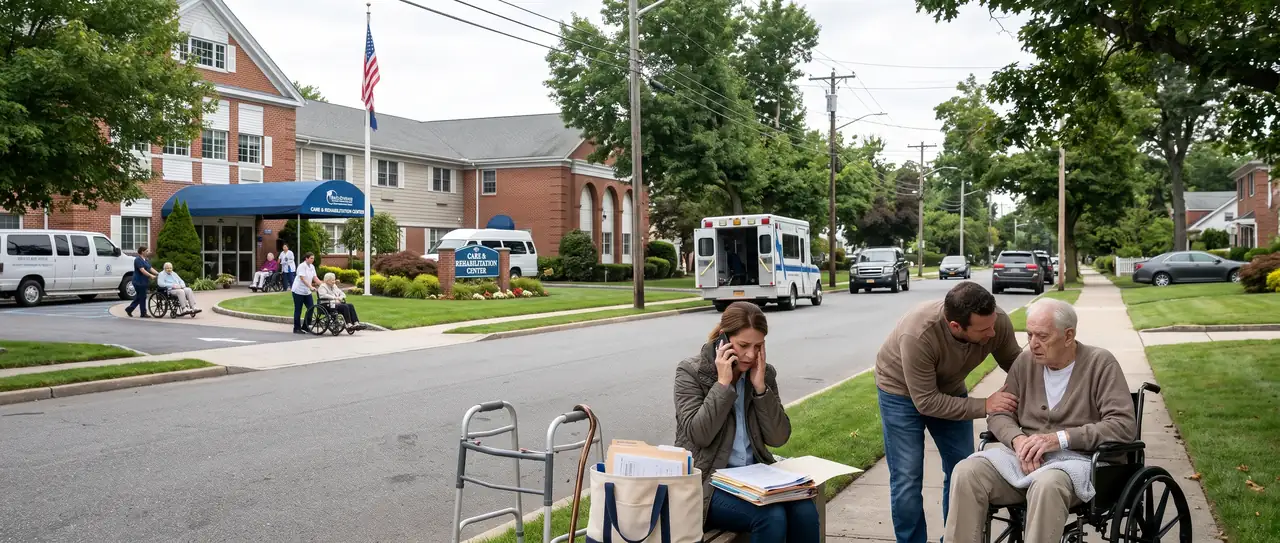
Families from Huntington to the East End call Silver Law Group when a parent or spouse leaves a facility with bedsores, a broken hip, or an infection nobody can explain. A Suffolk nursing home negligence attorney at our firm will review what happened for free and tell you whether New York law gives your family a claim.
New York gives nursing home residents rights most families never hear about. One statute lets a resident sue the facility directly. Another sets minimum daily care hours for every resident. A third rule cancels any waiver of the right to sue hidden in the admission paperwork. You pay no fee unless you recover. Call 212-470-4544 at any hour, and an attorney can meet you at home, at the hospital, or at the facility itself.
Signs Your Loved One Is Being Neglected in a Suffolk Nursing Home
Neglect usually builds for weeks before anyone outside the building sees it. Watch for these signs, and write down the date each time you notice one:
- Bedsores (pressure ulcers) on the heels, hips, tailbone, or back of the head. They form when staff do not turn or reposition a resident, so a deep sore points straight at the care plan.
- Falls with no clear explanation, or a second and third fall after the first one should have led to a new plan.
- Dehydration. Dry lips, sudden confusion, dark urine, and urinary tract infections that keep coming back.
- Sepsis, which can follow an untreated bedsore or UTI. By the time the facility calls 911, the resident may need intensive care.
- Medication errors, including missed doses, another patient’s pills, or sedatives given to keep a resident quiet.
- Withdrawal. A talkative parent who goes silent, flinches when touched, or seems afraid of one aide is telling you something.
In Suffolk, the full picture often comes out at the hospital. When a resident is sent to Stony Brook University Hospital, Good Samaritan in West Islip, or Peconic Bay Medical Center in Riverhead, emergency staff record the wound stage, the lab values, and any infection on arrival. Those doctors have no reason to protect the nursing home. Their notes often contradict the facility’s chart.
Ask the hospital for copies of the admission records before your parent is discharged. Photograph every wound with the date visible.
Elder Abuse Beyond Neglect
Neglect means care that should have happened and did not. Abuse means someone harmed the resident on purpose. It can be physical, like hitting or rough handling during transfers, or sexual. It can be emotional, through threats, insults, and isolation meant to frighten a senior into silence. It can also be financial, such as an aide using a senior’s debit card or pushing them to sign over property. The person who commits abuse may face criminal charges, and the employer that hired and supervised them can face civil liability.
Abuse also happens outside facilities. Home health aides often work alone in a senior’s house with little oversight. If your parent lives at home or with relatives in Suffolk and you suspect abuse, call Suffolk County Adult Protective Services at 631-854-3232. An elder abuse lawyer in New York can then pursue civil claims against the aide and the home care agency that sent them.
New York Laws That Protect Nursing Home Residents
Three parts of New York’s Public Health Law do most of the work in a Suffolk nursing home case.
Public Health Law 2801-d gives every resident a private right of action. Suppose a nursing home denies a resident any right or benefit created by contract, by state or federal statute, or by regulation, and the resident is injured as a result. The resident, or the estate, can then sue the facility directly. This claim is separate from ordinary negligence and can be filed alongside it, so a broken care rule like a skipped turning schedule can be the basis of the case.
Section 2801-d(7) cancels any waiver of that right, whether oral or written. If the admission packet your parent signed says the family gives up the right to sue, that clause has no effect on a 2801-d claim.
Public Health Law 2895-b sets minimum staffing for every nursing home in the state:
- at least 3.5 hours of total care per resident each day
- at least 2.2 of those hours from certified nurse aides
- at least 1.1 hours from licensed nurses
Staffing records are among the first documents we request. If a facility ran below these numbers on the days your parent fell or developed a sore, the shortage helps explain why the care plan was never followed.
Who Can Be Held Liable for Nursing Home Negligence
A nursing home negligence case rarely has just one defendant. Depending on the facts, liability can reach:
- the operator that holds the state license
- corporate owners and parent companies, including the management companies that control budgets and staffing
- the administrator and director of nursing, who set policy and supervise staff
- individual nurses and aides who caused the injury or ignored it
- staffing agencies that sent workers who were unqualified, unscreened, or never trained on your parent’s care plan
Ownership matters because money decisions are often made above the facility. In 2014, the New York Attorney General charged nine employees of Medford Multicare Center for Living and sued the home’s owners for fraud. That case shows why a claim should look past the aide on the floor to the people who own and fund the building. Naming every responsible party also matters when it is time to collect, because a single company that operates a facility may hold few assets.
What a Suffolk Nursing Home Neglect Claim Is Worth
Nobody can put an honest number on your case during a phone call, and this firm does not publish figures. What we can explain is how New York measures the claim.
Under Public Health Law 2801-d(2), a resident injured by a violation of their rights recovers compensatory damages. The statute also sets a minimum: at least 25% of the facility’s daily per-patient rate for each day the injury lasts. A bedsore that took four months to heal counts every one of those days, so we document when each injury started and when it ended.
The recovery can also include:
- medical costs, including hospital stays, wound care, and rehabilitation
- the pain and suffering your parent went through
- punitive damages when the facility acted willfully or with reckless disregard for the resident’s rights. These punish the facility rather than repay a loss.
- attorneys’ fees, which section 2801-d(6) lets the court award to a resident who wins, shifting that cost onto the facility
When neglect causes a death, the estate brings a wrongful death claim. That claim covers the family’s financial losses, medical bills, and funeral costs. The estate can also bring a separate claim for the pain your parent suffered before dying.
Four things affect value the most. They are how long the neglect lasted, how serious the injury was, whether the facility’s records are incomplete or altered, and whether staffing fell below the 2895-b minimums on the days that matter.
What Happens After You Call Our Suffolk Nursing Home Lawyers
Once you call 212-470-4544, the work usually happens in this order. It is the same order any careful nursing home negligence attorney in New York should follow, and you can hold us to it.
- A free consultation, by phone or in person, where an attorney hears what you have seen and tells you which claims may apply.
- Preservation letters and records requests to the nursing home and the hospital. They cover the chart, incident reports, staffing schedules, and medication records.
- A complaint to the New York State Department of Health at 1-888-201-4563. The DOH line takes complaints about events within the past year. If inspectors confirm a violation, that finding becomes part of the public record.
- A referral to the Long Term Care Ombudsman program run by Family Service League in Suffolk, 631-470-6755, if your parent still lives at the facility and needs an advocate inside it.
- A review of the facility’s inspection history on profiles.health.ny.gov, where the state posts citations. Repeated citations for the same failure help prove the facility knew about the problem.
- A lawsuit in Suffolk County Supreme Court in Riverhead if the facility and its insurer will not pay a fair amount, with the case prepared for a jury from the start.
If the care your parent receives changes after a complaint, tell us that day. Any change becomes part of the record.
If Your Parent Signed an Arbitration Agreement
Admission packets often include an arbitration agreement. It moves any dispute out of court and away from a Suffolk jury. Federal rules for nursing homes that take Medicare or Medicaid, at 42 CFR 483.70(n), limit what these agreements can do. A facility cannot require a resident to sign one to be admitted or to keep receiving care. The resident also has 30 days after signing to cancel the agreement.
Signing does not mean the case is over. Send us the full admission packet. An attorney will read it for free, check whether the 30-day window is still open, and look at whether the agreement followed the federal rule.
What It Costs to Hire Silver Law Group
Silver Law Group handles nursing home cases on a contingency fee. You pay nothing upfront: no retainer and no hourly bills. Our fee comes out of the money recovered for your family, as a percentage written into an agreement before any work starts. If there is no recovery, you owe no fee. That puts the risk of the case on our firm, and it gives us the same reason you have to build the strongest file possible. The first consultation is free, and talking to us does not commit you to hiring us.
Deadlines for Suffolk Nursing Home Claims
Three different deadlines can apply to the same nursing home injury. If your claim falls under the shortest one, that one controls.
- Three years under CPLR 214(2) for claims under Public Health Law 2801-d, because that right comes from a statute.
- Two and a half years under CPLR 214-a for claims about medical treatment, such as a doctor’s clinical judgment. Facilities often argue that a neglect claim is really malpractice to move it under this shorter deadline.
- Two years from the date of death under EPTL 5-4.1 for wrongful death.
The wrongful death deadline has a hidden step. Only the personal representative of the estate can file, so the Suffolk County Surrogate’s Court must appoint someone first. That appointment can take weeks or months, and the time counts against the two years. Open the estate early, even before you decide whether to sue.
Do not plan around these deadlines down to the last day. The start date can be disputed, especially when neglect went on for months.
Claims Against the Long Island State Veterans Home
The Long Island State Veterans Home in Stony Brook is a state facility run by Stony Brook University. A claim against it goes to the New York Court of Claims, not Suffolk Supreme Court. Court of Claims Act 10(3) requires you to file a claim or serve a notice of intention to file within 90 days after the claim arises. Missing that window can end the case before it starts.
Facilities owned by a county, town, or other local government follow a similar rule. General Municipal Law 50-e requires a notice of claim within 90 days. If you are not sure who owns your parent’s facility, call us and we will check, because ownership decides which deadline applies.
Why Suffolk Families Choose Silver Law Group
This is what working with our firm looks like in practice:
- Consultations in English, Spanish, and Russian, so every family member can describe what they saw in their own language.
- Phones answered 24/7. Families often call after a 2 a.m. fall or a midnight transfer to the emergency room, and someone picks up.
- An attorney who comes to you, whether that means a nursing home in Riverhead, a hospital room at Stony Brook, or your kitchen table in Huntington.
- Every case prepared as if it will go to trial. Insurers value a claim partly by whether the lawyer on the other side will actually try it.
The last point shapes how we work from day one. We request staffing logs and inspection records early and track each injury day under 2801-d(2), so the case is ready for court even if it settles before trial.
Our office is at 49 West 37th Street, 7th Floor, New York, NY 10018, in Midtown Manhattan, and we travel across Suffolk County to meet clients. If you believe a nursing home is neglecting someone you love, call 212-470-4544 today for a free case review.