

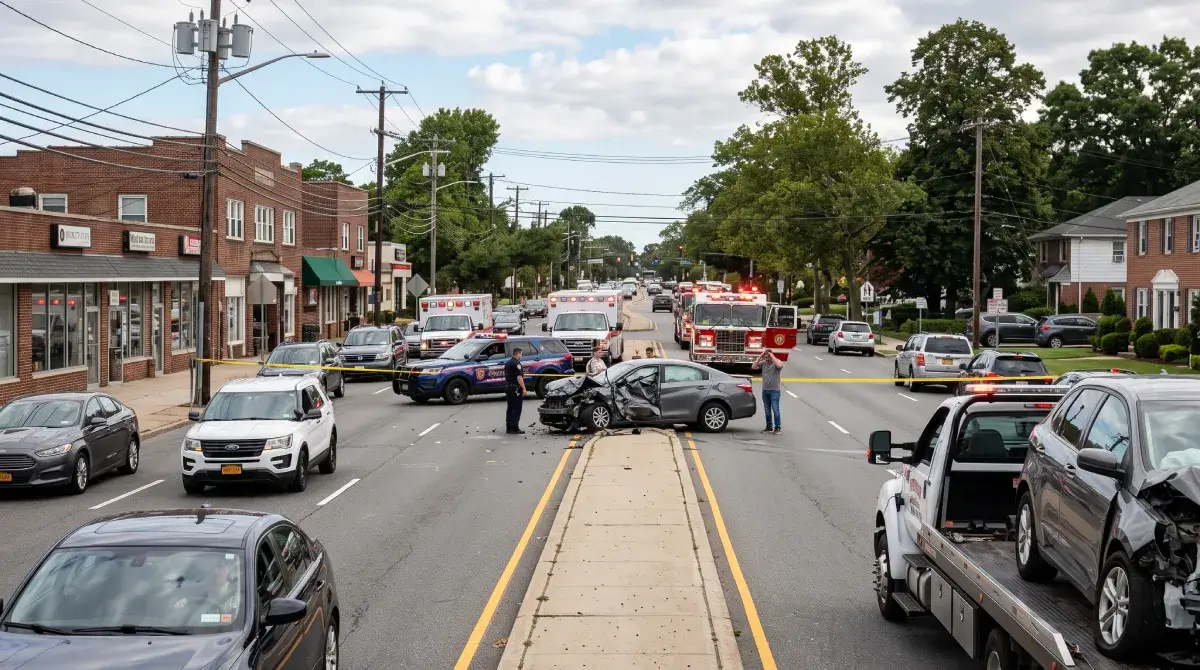
Your insurer just called your Suffolk County car a total loss, and the check they’re offering feels low. A Suffolk County total loss attorney reads that offer against what the law actually requires the insurer to pay, then pushes back on the parts they got wrong. New York ties the total-loss decision to hard numbers: the actual cash value of your car, the salvage rules, and the valuation manuals the insurer has to average. Each of those numbers is a place an adjuster can shave your payout. Silver Law Group reviews your total loss offer for free, in English, Spanish, and Russian, and someone answers 24/7. Before you sign the release, find out what your car was actually worth.
When an Insurer Declares Your Suffolk Vehicle a Total Loss
An insurer declares a total loss when the cost to repair your car climbs close to, or past, its actual cash value — the amount the car was worth the moment before the crash. Once repair estimates cross that line, the company stops paying to fix the car and instead pays you its value, then takes the wreck. New York Insurance Law §3412 is the statute behind that process. It governs how total losses are handled, how salvage is treated once the insurer takes ownership of the damaged vehicle, and how stolen cars that are later recovered or written off are settled.
For you, the practical point is where that line sits. A car with high mileage or an older model year carries a lower actual cash value, so it takes less damage to total it. A collision that would be repaired on a newer car gets your car written off instead. The insurer’s incentive runs one way: the lower they set your car’s value, the smaller the check and the cheaper the salvage they keep. That is why the total-loss number is worth reading closely rather than signing. The salvage title, the sales tax you’re owed, and whether you can buy the car back all flow from the value the insurer assigns under §3412, and that value is the first thing a total loss lawyer checks.
Salvage Titles and the MV-907A Certificate
Once your car is totaled, its title changes. Under 15 NYCRR §20.20, New York brands a vehicle as salvage when the damage reaches 75% of its pre-damage retail value, and that rule applies to cars eight model years old or newer. When the threshold is met, the DMV issues an MV-907A salvage certificate in place of a clean title, and that brand follows the car for the rest of its life.
If you keep the wreck and want to put it back on the road, the car has to clear a salvage examination that costs $205 before it can be retitled. That inspection, and the branded title behind it, is why a bought-back salvage car is worth far less than the same car with a clean history, a gap that matters if you plan to sell it later.
How Actual Cash Value Is Calculated and Undervalued
Actual cash value, or ACV, is what your car would have sold for on the open market the moment before the crash — not what you paid for it, and not what a dealer would charge to replace it. It reflects your specific car: its mileage, trim, options, condition, and the prices similar cars were actually selling for in the Suffolk market. Get the ACV right and the rest of the settlement follows. Get it wrong and every dollar after it is wrong too.
New York does not let the insurer pick a number out of the air. Under 11 NYCRR §216.7, the company has to base your car’s value on an average of two approved valuation manuals, so the figure has to trace back to recognized pricing sources rather than one adjuster’s guess. Insurers still find room to push the number down. They apply steep condition deductions for wear you would dispute, leave off options your car had, or lean on comparable vehicles that are older, higher-mileage, or listed in cheaper markets than eastern Long Island.
The settlement also owes you sales tax. Because you will pay tax again when you replace the totaled car, the ACV settlement has to include the sales tax on your vehicle’s value, and an offer that quietly leaves it out is short by a real amount. When you read an offer, three lines decide whether it is fair:
- The base value and the exact comparable cars used to reach it
- Every condition or mileage deduction, and whether it can be documented
- Whether sales tax was added on top of the value, not folded into it
A total loss lawyer rebuilds the ACV from better comparables and puts the missing tax and options back on the table before you agree to anything.
Diminished Value on a Repaired Suffolk Vehicle
If your car was badly damaged but repaired instead of totaled, it is now worth less than an identical car with no crash on its record, and that lost value is its own claim. New York calls it diminished value, and where you can collect it depends on who was at fault. You cannot recover diminished value from your own collision coverage as a first-party claim. You can recover it in tort against the at-fault driver’s liability insurer, because that driver’s negligence is what put the accident on your car’s history.
Proving the number is the work. A diminished value claim stands on an independent appraisal that measures your car’s pre-accident value against its repaired value, backed by the Carfax or accident-history report that any future buyer will pull up to knock down their offer. The insurer will not volunteer this money. You have to document the gap and demand it, which is where an appraisal and a total loss lawyer’s demand letter carry the claim.
Disputing a Lowball Total Loss Offer
A first total loss offer is a starting number, not a final one, and you can push it up with evidence the adjuster cannot wave off. The strongest evidence is proof that cars like yours actually sell for more near you.
- Comparable Suffolk-market listings. Pull current listings for your year, make, model, trim, and mileage from AutoTrader, Cars.com, and CarGurus, filtered to the Suffolk and Long Island market. Local asking prices for the same car undercut a value the insurer built from cheaper regions.
- A written demand. Put your counter-value in writing with the comparables attached, and ask the insurer to respond in writing. A documented demand forces the adjuster to justify their number instead of holding the phone line.
- A DFS complaint. New York’s Department of Financial Services takes consumer complaints against insurers for free. Filing one puts your dispute in front of the regulator that licenses the company, and insurers tend to sharpen a lowball number once a complaint is on file.
Each tool works better stacked on the last. Comparables give you the number, the written demand puts it on record, and the DFS complaint adds pressure the adjuster answers to. A total loss lawyer runs all three at once and keeps the paper trail a later appraisal or lawsuit will lean on.
The Insurance Law §3411(k) Appraisal Process
When you and the insurer cannot agree on your car’s value, New York Insurance Law §3411(k) gives you a way out of the standoff that does not require a lawsuit. It is the appraisal clause, and it works like a private valuation panel. You name your own independent appraiser, and the insurer names theirs. The two appraisers then pick a third neutral party, the umpire. From there, any two of the three who agree on a value set the binding figure, so your appraiser and the umpire can outvote the insurer’s appraiser and lock in a fair number.
Appraisal has trade-offs. You pay your own appraiser, and the decision binds you as well as the insurer, so it is worth invoking when your comparables are strong and the gap is large enough to justify the cost. A total loss lawyer weighs whether appraisal or a straight lawsuit gives you the better return before triggering the clause, since once you demand appraisal the outcome sticks.
Gap Coverage When You Owe More Than the Car
A fair total loss payout can still leave you in the hole. If you owe more on your auto loan than the car is worth, the ACV check goes to your lender first, and when that check is smaller than your loan balance, you are left owing the difference on a car you no longer have. That gap between the payout and the balance is negative equity, and it is common on newer cars financed with little money down.
Gap insurance exists for exactly this. If you bought it, gap coverage pays the shortfall between the insurer’s ACV settlement and what you still owe the lienholder, so the loan closes out instead of following you. One detail trips people up: because there is a lender on the title, the total loss settlement is usually issued jointly to you and the lienholder, and the lender is paid off the top before any balance reaches you. Knowing who gets paid first, and in what order, tells you whether an offer actually clears your loan or leaves you writing checks on a car that is gone.
Steps to Take After Your Car Is Totaled
The days right after a total loss decide how much leverage you keep. A few concrete moves protect both the value of the car and any injury claim riding alongside it.
- Photograph the car before it goes anywhere. Once the insurer takes the salvage, the wreck is gone as evidence, so shoot the damage from every angle, plus the odometer, interior, and tires, while you still have access.
- Clear out your personal property. Registration, insurance cards, garage remotes, chargers, and anything in the trunk leave with the car unless you pull them first. Salvage yards are not obligated to return what you left behind.
- Keep every offer and conversation in writing. Ask the adjuster to send valuations and deductions by email, and save them. That paper trail is what a written demand, a DFS complaint, or an appraisal is built from.
- Read any release before you sign it, and refuse a broad one. Insurers sometimes fold a wide injury-claim waiver into a property-damage release, so settling for the car can quietly sign away your right to pursue a claim for your injuries.
Handle the property claim and the injury claim as two separate things, because signing the wrong paper collapses them into one.
What Hiring a Total Loss Attorney Costs
Cost is the reason many Suffolk drivers put off calling a lawyer, so here is the plain version. Silver Law Group works on a contingency fee, which means you pay no legal fee up front and no fee at all unless there is a recovery on your injury claim. The fee comes as a percentage of that recovery, so it only exists if money comes in for you, and if the claim recovers nothing, you owe no attorney’s fee. Your out-of-pocket risk to have a lawyer look at your case is zero.
The total loss offer itself is reviewed free at your consultation. Bring the insurer’s valuation, the deductions they applied, and any comparables you have found, and the review costs you nothing whether or not you go further. That lets you learn what your car was actually worth, and whether the offer is low, before you decide anything. The consultation is free, someone is available 24/7, and it runs in English, Spanish, or Russian.
Deadlines That Can Bar Your Suffolk Claim
Total loss claims run on clocks, and missing one can cost you the claim no matter how strong it is.
- Three years to sue for property damage. CPLR §214(4) gives you three years from the crash to file a lawsuit over the damage to your car. Wait past it and the court will not hear the property claim at all.
- Ten days to report to the DMV. New York requires an MV-104 accident report filed with the DMV within ten days whenever the crash caused more than $1,000 in damage — which a total loss always does. Skipping it can put your license and registration at risk.
- The insurer’s own clock. Under 11 NYCRR §216.6, the company has to acknowledge and act on your claim within set business-day windows, ten days and fifteen days under the rule. When they blow those windows, that delay is itself documentation you can use.
The three-year suit deadline is the one people misjudge, because it feels far off while the claim is fresh. Calendar it the week your car is totaled, not the month you finally give up negotiating.
Where Suffolk Total Loss Disputes Are Heard
If negotiation and appraisal do not get you a fair number, the dispute goes to court, and where it lands depends on how much you are claiming. For smaller total loss disputes, Suffolk County District Court hears small claims cases, with a cap of $5,000 in controversy. The district court sits across the county’s five western towns: Babylon, Brookhaven, Huntington, Islip, and Smithtown, so you file where the case belongs rather than driving the length of Long Island.
When the amount at stake climbs past the small claims cap, or when a total loss dispute is tied to a larger injury case, the claim belongs in State Supreme Court, which sits in Riverhead for Suffolk County. Consolidating the property fight with the injury claim there keeps one court handling the whole matter instead of splitting it. Which forum fits your case is a judgment call about the dollars in dispute and whether an injury claim is riding with it, and a total loss lawyer makes that call before filing anything.
Why Suffolk Drivers Choose Silver Law Group
A totaled car rarely comes alone. If you were hurt in the same crash, you are dealing with the property fight and an injury claim at once, and you may not be in shape to travel to an office to sort it out. Silver Law Group’s attorney comes to you, at your home or your hospital room, so starting the case does not depend on you being able to drive somewhere.
Someone answers 24/7, not only during business hours, because insurers call when it suits them and a recorded-statement request should not wait until Monday. The consultation is free, it runs in English, Spanish, or Russian, and the total loss review is part of it. The fee stays contingent, so hiring the firm adds no cost you pay out of pocket. The office is in Midtown Manhattan at 49 West 37th Street, 7th Floor, and the same number reaches the firm from anywhere in Suffolk County. Before you accept the insurer’s total loss number, call 212-470-4544 and find out what your car was worth.