

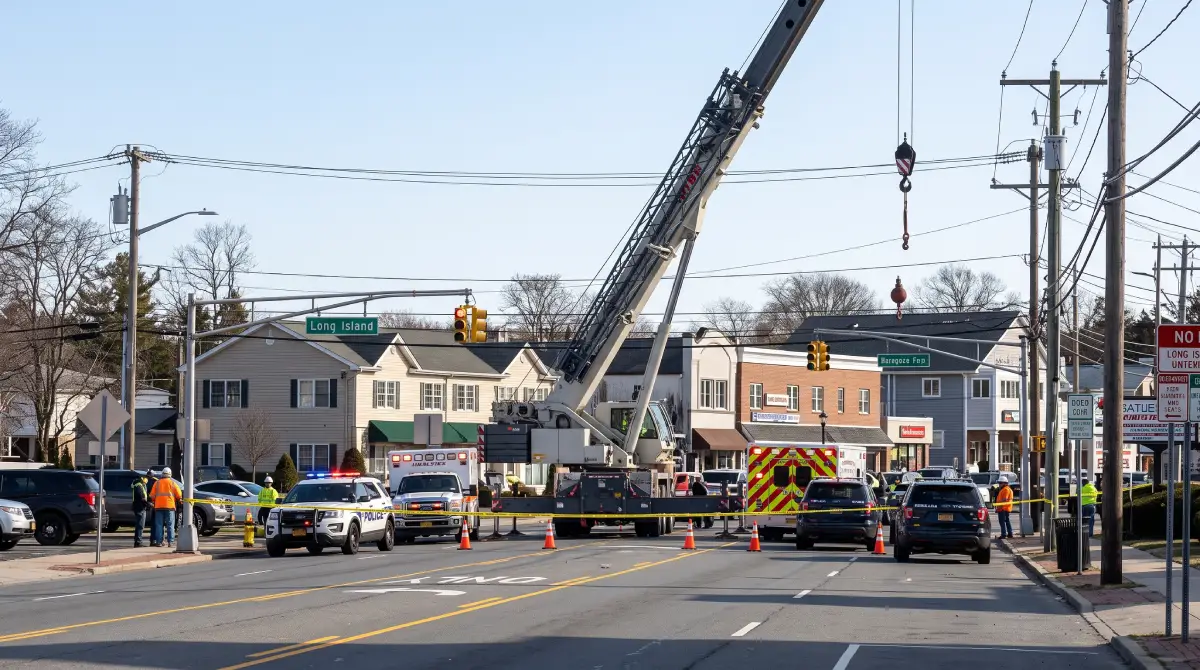
A crane accident on a Suffolk County job site can end a career in seconds: a dropped load, a collapsed boom, a swing that catches a worker who never saw it coming. If you were hurt, a Suffolk County crane accident attorney at Silver Law Group can tell you within one free call whether you have a Labor Law claim worth far more than workers’ comp alone. We represent the people these accidents hit hardest — the operators and riggers on the crane, the ground crew working below it, and the passersby struck by falling steel or a machine that tipped past the fence line. Call 212-470-4544 any hour. The consultation is free and available in English, Spanish, and Russian, and you owe nothing unless we recover for you.
Do You Have a Suffolk Crane Accident Claim?
The people a crane injures are rarely the operator alone. Suffolk County runs on heavy construction: the mid-rise and commercial work near Islip, the warehouse and retail builds across Brookhaven, the road and utility jobs in Huntington, and the custom homes rising on the East End’s South and North Forks. A single failure on any of these sites can reach everyone inside the swing radius at once.
You may have a claim if you are one of several groups:
- Crane operators and the riggers who hook, signal, and land the load
- Ground crew, carpenters, ironworkers, and laborers working below or beside the machine
- Workers for a different contractor on the same site who had nothing to do with the crane
- Pedestrians, drivers, or neighbors struck when a load, boom, or the crane itself comes down outside the fence
Construction workers hurt on the job are protected by New York’s Labor Law, which puts the responsibility for gravity-related and code-violation injuries on the owners and contractors who ran the site. Bystanders and non-construction victims bring an ordinary negligence claim against whoever operated or maintained the crane carelessly. Both paths can run at the same time against different defendants, and both start with the same question a lawyer answers for free: who controlled the work, and what did they fail to do? If you are not sure whether you qualify, the fastest way to find out is a call, not a guess based on what an adjuster told you at the hospital.
Common Crane Failures on Suffolk Job Sites
Most crane injuries trace back to a short list of failures, and each one points to a different defendant.
- Overloading collapse — a load past the crane’s rated capacity buckles the structure or tips the machine
- Boom failure — a lattice or hydraulic boom cracks, folds, or separates mid-lift
- Dropped loads — frayed slings, worn cables, or a failed hook release send steel or concrete down onto the crew
- Power-line electrocution — a boom swung too close to overhead lines energizes the whole rig and anyone touching it
- Overturning on unstable ground — outriggers set on soft fill or unmatted soil let the crane roll
- Swing-radius strikes — the counterweight or cab catches a worker pinned between the machine and a fixed object
- Hydraulic or brake failure — a load drifts or drops because a maintenance step was skipped
Some of these are operator error. Others come from a rental company that sent out a machine with a known defect, a general contractor who let the ground go uninspected, or a manufacturer whose part failed under normal use. The failure mode usually tells your lawyer where the fault sits before the first document is even requested.
Who Can Be Held Liable for Your Injuries
New York gives construction workers something almost no other state does: a set of laws that put the cost of a fall or a dropped load on the people who ran the site, not on the injured worker. Three sections of the Labor Law do the heavy lifting.
Labor Law §240, the Scaffold Law, imposes strict liability for gravity-related injuries, meaning a worker who falls from height or is struck by a load that was inadequately hoisted or secured. Strict liability matters because it removes the usual fight over whether you were careful. If the elevation-related protection you needed was missing and that failure hurt you, the owner and general contractor are liable even if you made a mistake of your own.
Labor Law §241(6) covers injuries tied to a specific violation of the State Industrial Code — an improperly secured load, an unbarricaded swing radius, a rigging practice that broke a written rule. Labor Law §200 codifies the general duty to keep the site reasonably safe, and it reaches parties who actually controlled how the work was done.
The defendants in a crane case are usually several at once: the property owner, the general contractor, any subcontractor whose crew created the hazard, the crane rental or leasing company that supplied the machine and sometimes the operator, and the manufacturer if a part failed. The New York State Department of Labor requires certified operators for the machines used on these sites, and federal OSHA rule 1926.1400 governs crane assembly, inspection, and operation. When an operator was uncertified or an OSHA inspection step was skipped, that violation becomes direct evidence of negligence your lawyer can put in front of a jury. Sorting out which defendant carried which duty is the core of the case, and it is why a crane claim should never be filed as a simple workers’ comp matter and left there.
Protections for Undocumented Construction Workers
Your immigration status does not cost you your Labor Law rights. In Balbuena v. IDR Realty, New York’s highest court held that an undocumented worker injured on a construction site can recover damages and that the Labor Law’s protections apply regardless of work authorization. Being paid off the books does not change this either. An owner or contractor cannot use your status to pressure you into dropping a claim, and you do not have to disclose it to bring one. Immigration enforcement is not part of a personal injury case, and the defense cannot turn it into one to scare you off. If fear of status has kept you from calling after a crane injury, that fear is being used against you, and a consultation costs nothing.
Compensation Available After a Crane Accident
A Labor Law claim reaches money workers’ compensation never touches. What you can recover depends on the severity of the injury and the strength of the liability proof, but the categories are well established.
- Medical costs, current and future — surgery, hospitalization, rehabilitation, prosthetics, home care, and the follow-up a crush or fall injury demands for years
- Full lost wages — your real lost income, well beyond the partial fraction comp pays
- Lost earning capacity — the wages you will never earn if the injury keeps you from returning to the trade at all
- Pain and suffering — the physical pain, disability, and mental toll of the accident, often the largest part of a serious crane case and unavailable through comp
- Loss of consortium — a claim your spouse can bring for the companionship and support the injury took from your household
When a crane collapse kills a worker, the family’s claim shifts to different categories: funeral and burial costs, the financial support the worker would have provided, and the loss to dependent children and a spouse. A lawyer values these from the worker’s earnings, age, and the people who relied on that income.
Separating these categories is practical, not academic. An adjuster who calls in the first week will frame your losses as narrowly as possible, usually as medical bills and a few weeks of missed pay. The real value of a crane case sits in the categories they leave out.
Workers’ Compensation vs. Third-Party Lawsuit
Almost every injured construction worker has two separate claims, and treating them as one is the most expensive mistake you can make.
Workers’ compensation is the floor. If you were hurt on the job, comp pays your medical treatment and a portion of your lost wages no matter who was at fault. You do not have to prove anyone did anything wrong, and you get it fast. The trade-off is steep: comp is no-fault in both directions, so you generally cannot sue your own employer, and it pays nothing for pain and suffering. For a broken wrist that heals, comp may be enough. For a spinal injury or amputation from a crane collapse, it covers a fraction of what the injury actually costs you.
The third-party Labor Law lawsuit is the ceiling. It runs against everyone except your direct employer — the owner, the general contractor, the crane rental company, the manufacturer — and it reaches the full menu of damages, including the pain and suffering and complete lost wages comp will never pay.
You pursue both at the same time. The comp claim keeps your treatment paid and some income flowing while the Labor Law case builds. When the third-party case resolves, the comp carrier is typically repaid part of what it advanced out of that recovery, and a lawyer negotiates that lien down so more of the money stays with you. Handled together, the two claims cover far more than either could alone, which is exactly why a crane injury should not be filed as a comp claim and abandoned there.
What to Do After a Suffolk County Crane Accident
What you do in the first days after a crane injury shapes what the claim is worth later. Work through these in order.
- Get emergency care immediately. For a serious crush, fall, or head injury, Stony Brook University Hospital is Suffolk County’s only Level I trauma center, the highest designation for treating life-threatening injury. Go there or let EMS take you, because a complete medical record starting on day one is the backbone of your case.
- Report the accident. Tell your supervisor and make sure it is written into the site log. You have 30 days to notify your employer in writing for workers’ comp, but do it the same week.
- Photograph everything you can safely reach — the crane, the load, the rigging, the ground conditions, your injuries, and the wider site. Photos taken before the scene is cleaned up are evidence that disappears within hours.
- Preserve the rigging and equipment. Slings, cables, hooks, and the failed part are physical proof. Tell your lawyer fast so a letter can go out demanding the equipment be kept and not repaired or scrapped.
- Get the names of everyone who saw it — coworkers, the signal person, other trades on site. Witnesses scatter to different jobs quickly.
- Say nothing recorded to any insurer. An adjuster may call within days asking for a quick statement. Decline it. A recorded statement given while you are medicated and rattled exists to shrink your claim, and you are not required to give one.
The single most useful call you can make from the hospital is to a lawyer, before you sign anything or explain anything to an insurance company.
Deadlines to File a Suffolk Crane Accident Claim
A crane case runs on several clocks at once, and the shortest one that applies to you controls everything. Miss it and the strongest liability proof in the world stops mattering.
For most crane injury lawsuits, New York’s statute of limitations under CPLR 214 gives you three years from the date of the accident to sue. Three years feels like plenty until you realize evidence degrades, witnesses vanish, and equipment gets scrapped in a fraction of that time. The deadline to file is not the deadline to start building.
If a crane collapse killed a family member, the wrongful death claim under EPTL 5-4.1 must be filed within two years of the death. That is a full year shorter than the personal injury deadline, and it catches families who assumed they had three years.
Public and municipal projects carry a much tighter track. If the job was owned by a government entity such as a state, county, town, or public authority, a Notice of Claim under General Municipal Law 50-e must be served within 90 days of the accident, and the lawsuit itself must follow within one year and 90 days. Ninety days is short, and a missed Notice of Claim usually ends the case against a public defendant before it begins.
Separately, the workers’ compensation system requires written notice to your employer within 30 days. That is the fastest clock of all, and it is easy to blow while you are focused on surgery and recovery. Because one crane accident can trigger all of these at once, the safe move is to have a lawyer sort out which deadlines apply to your site within days, not months.
Why Suffolk Crane Victims Choose Silver Law Group
A crane injury usually arrives with a stack of bills and no paycheck, so the way a firm charges matters as much as how it litigates.
At Silver Law Group, you pay no fee up front and no fee at all unless we recover money for you. Our fee is a percentage of the recovery, taken only from what we win. If the case brings in nothing, you owe us nothing for our time, and the costs of building the case are carried while it runs rather than billed to you monthly. That is what contingency means in practice: the financial risk of the lawsuit is ours, not yours, which lets an injured worker take on an owner, a general contractor, and their insurers without spending a dollar out of pocket.
The consultation that starts it all is free and available in English, Spanish, and Russian, so the conversation happens in the language you actually think in. We answer 24/7, because a crane accident does not wait for business hours. If you cannot come to our Midtown Manhattan office at 49 West 37th Street because you are in a hospital bed or laid up at home in Suffolk, the attorney comes to you. Every case is prepared as if it will be tried, because insurers settle seriously only when the other side is ready for a courtroom. If you were hurt in a crane accident, call 212-470-4544 for a free consultation and find out what your claim is actually worth.