

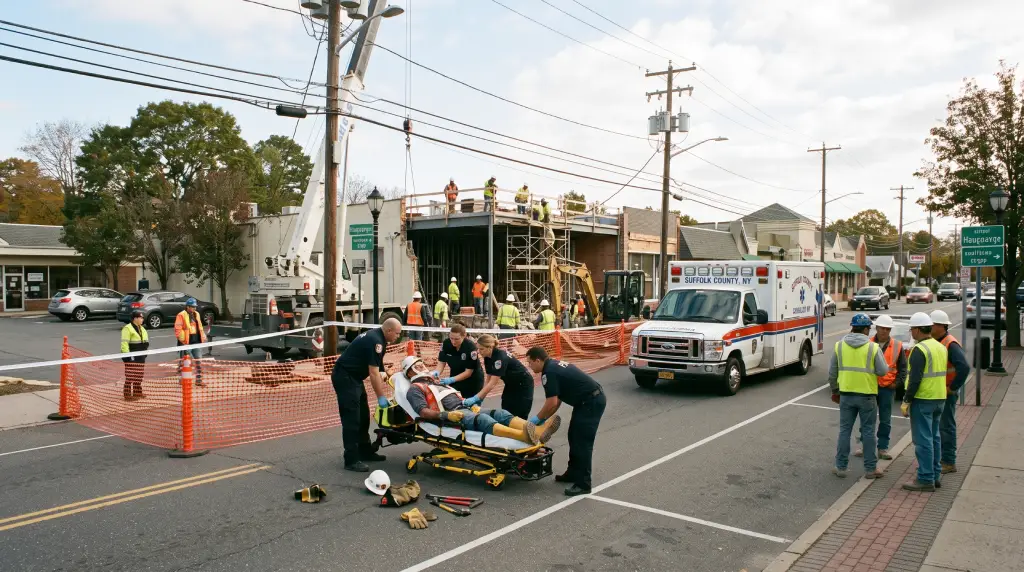
If you were hurt on a Suffolk County construction site, a Suffolk County construction worker injury lawyer can tell you within one free call whether you have a claim worth more than workers’ compensation. Silver Law Group takes these cases on contingency: you pay no attorney’s fee unless we recover money for you, our fee is a percentage of what we win, and if we recover nothing you owe us nothing. We answer 24/7, and consultations are available in English, Spanish, and Russian. If you can’t leave the hospital or your home, the attorney comes to you. Call 212-470-4544 now — the sooner we see the site and the equipment, the more of the evidence survives.
Do You Have a Suffolk Construction Injury Case?
Not every job-site injury turns into a lawsuit, but the ones caused by an unsafe condition usually do, and those are the cases that pay far beyond a workers’ comp check. On the Suffolk sites strung along the Long Island Expressway and Route 110, the injuries that most often support a claim share a pattern: a hazard the owner or general contractor was supposed to guard against, and didn’t.
Common examples:
- A fall from a scaffold or ladder that had no guardrail, sat on uneven ground, or wobbled because no one secured it.
- A struck-by injury from a dropped tool, a swinging load, or falling debris that should have been tied off or netted.
- Electrocution from a live line or ungrounded equipment near your work area.
- A trench collapse where the walls were never shored or sloped.
Each of these points at someone other than your employer: the property owner, the general contractor, a subcontractor whose crew created the danger. That is what opens the door to a third-party case on top of the comp benefits you’re already owed. If you’re not sure who was responsible for the condition that hurt you, that’s the first thing we sort out, and it costs you nothing to ask.
New York Labor Law Protections for Injured Workers
New York gives construction workers something workers in most other fields don’t have: a set of statutes that put the duty for your safety on the people who control the site, not just your direct boss. Property owners and general contractors carry these duties by law, and they can’t sign them away or push them down to a subcontractor. That’s why an injured worker here can reach past the limits of workers’ compensation and sue the parties who let the hazard exist. Three sections of the Labor Law do the heavy lifting, and which one fits your accident decides how hard your case is to prove.
Labor Law 240: The Scaffold Law
The most dangerous force on any construction site is gravity, and Labor Law 240 is the statute built around it. It applies when you fall from a height, or when something falls onto you from above, and the injury traces back to a missing or defective safety device. A scaffold with no guardrail, a ladder that wasn’t tied off, a hoist that failed, a load left unsecured — if the right protection wasn’t there and you got hurt because of it, the owner and general contractor face absolute liability.
Absolute liability is the strongest tool an injured worker has. Once you prove the safety violation caused your fall, the defendant cannot pin the blame on your own carelessness. The standard insurance defense, that you should have watched your step, mostly disappears under 240. The section has limits. It reaches elevation-related risks, not every trip on level ground, and the height involved has to be the kind of hazard the statute was written for. But for a scaffold fall, a ladder collapse, or a falling-object injury on a Suffolk site, 240 is often what separates a full recovery from a workers’ comp claim alone.
Labor Law 241(6) and the Industrial Code
Where the Scaffold Law targets falls from height, Labor Law 241(6) reaches the rest of the site, and it works only when a specific safety rule was broken. It ties an owner’s or general contractor’s liability to a concrete provision of the New York Industrial Code, the detailed regulations that govern how construction work must be done. A general command to work safely isn’t enough. Your lawyer has to point to a particular rule that was violated: an unguarded floor opening, debris that should have been cleared, a missing barricade, the wrong equipment for the job.
The power of 241(6) is that these duties are non-delegable. An owner or general contractor cannot avoid responsibility by saying the violation was really the subcontractor’s fault. The law holds them accountable for the condition of the site regardless of who created it. Unlike a 240 claim, a 241(6) case can weigh your own conduct as comparative fault, so a share of blame may reduce what you recover without erasing the claim. For many Suffolk workers, 241(6) is the section that fits when the injury wasn’t a fall from height.
Labor Law 200 and the Homeowner Exception
Some construction injuries don’t come from a height or a code violation but from a plainly dangerous condition the site’s controllers ignored. That’s the territory of Labor Law 200, the general-duty section, and it’s harder to win. To recover under 200, you have to prove ordinary negligence: that the owner or contractor knew, or should have known, about the danger and failed to fix it. A 200 claim usually runs alongside the stronger sections rather than on its own.
There’s an exception built into the Labor Law, and it matters on Long Island, where single-family and two-family homes are everywhere. Owners of one- and two-family houses are exempt from the 240 and 241 duties as long as they didn’t direct or control how the work was done. A homeowner who hired a contractor and stayed out of the way generally can’t be held liable under those sections. But if that same homeowner told you how to do the job, supplied the defective ladder, or ran the site themselves, the exemption falls away and the claim comes back. Whether the exception applies is often the whole fight in a Suffolk home-renovation injury.
Workers’ Compensation vs. a Third-Party Lawsuit
On a serious Suffolk construction injury, you don’t choose between workers’ comp and a lawsuit — you pursue both, because they pay for different things.
Workers’ compensation is no-fault. You get it even if the accident was partly your doing, and you get it fast, but it’s capped: it covers your medical treatment and roughly two-thirds of your average wages, and it pays nothing for pain and suffering. It comes from your employer’s insurer, and it’s usually the only thing you can collect from your employer directly.
A third-party lawsuit is where the real money is. It’s a claim against a party other than your employer: the property owner, the general contractor, or a negligent subcontractor. It recovers your full damages, including all your lost earnings, your future medical costs, and the pain, disability, and disfigurement that comp ignores.
Running both together takes some care because of the comp lien. The workers’ comp insurer that paid your benefits has a right to be repaid out of your third-party recovery, so those benefits aren’t lost, but they have to be accounted for when the case resolves. Handled right, you keep the comp checks coming while the lawsuit builds, and the lien gets negotiated down at the end. Handled wrong, the lien can eat into money that should be yours, which is one of the clearest reasons to have a construction injury lawyer manage both tracks from the start.
Who Is Covered, Including Undocumented Workers
The Labor Law protects the worker on the site, not a job title on a payroll form. Carpenters, laborers, ironworkers, roofers, electricians, demolition crews, and day laborers are all covered when they’re hurt doing construction, whether they’re union or non-union, on the books or paid cash, employed directly or through a temp agency. What matters is that you were doing covered work when the hazard hurt you.
Immigration status doesn’t change that. In Balbuena v. IDR Realty, New York’s highest court confirmed that an undocumented worker can bring a Labor Law claim and recover lost wages, and that being undocumented is not a defense an owner or contractor can use to bar or shrink the recovery. Employers and their insurers sometimes hint otherwise to scare injured workers into silence. It doesn’t hold up. If you were hurt on a Suffolk construction site, you have the same right to a claim as any other worker, and we handle these cases in Spanish and Russian as readily as in English.
Compensation After a Suffolk Construction Accident
A third-party construction case is built to make you whole for everything the injury takes from you, in two broad categories.
Economic damages are the costs you can document. They include:
- Medical bills already run up, from surgery and hospital stays to imaging and medication.
- The future treatment your injury will need, from follow-up procedures and physical therapy to assistive devices and home care.
- Wages you’ve lost while you couldn’t work.
- Lost earning capacity, when the injury keeps you from your trade or forces you into lower-paying work for good.
That last item is often the largest part of a serious case. A roofer who can no longer climb, or an electrician who’s lost the use of a hand, faces a lifetime of reduced income, and the law counts every year of it.
Non-economic damages cover what you can’t put a receipt on — the pain you’ve lived through, the disability you carry forward, and disfigurement from burns, scarring, or amputation. These are real losses, and a jury is allowed to compensate them, which is exactly what workers’ comp refuses to do.
When a construction accident is fatal, the family’s claim shifts to wrongful death: the medical and funeral costs, and the financial support the worker would have provided. No figure replaces the person, but the law lets the family recover the losses the death leaves behind.
What to Do After a Suffolk Job-Site Injury
The hours and days after a job-site injury shape how strong your claim will be. A few steps protect it.
- Report the injury to your supervisor and make sure it’s written down. A verbal mention that never makes the log becomes a fight later.
- Get real medical treatment right away. For major trauma, Stony Brook University Hospital is Suffolk’s Level I trauma center; for anything else, see a doctor the same week and tell them exactly how it happened.
- Photograph the scene and the equipment before it’s cleaned up or repaired. The unguarded scaffold, the frayed cable, the open trench — that evidence disappears fast once the site keeps moving.
- Get the names and numbers of anyone who saw it. Coworkers move between sites and become hard to find; a phone number today saves you weeks later.
- Don’t give a recorded statement to any insurance adjuster before you’ve talked to a lawyer. The call will come quickly, and its purpose is to get you to say something that shrinks your claim.
If the site’s already been cleared, or you’re reading this from a hospital bed, don’t assume it’s too late. Call us and we’ll move on the evidence that’s left.
Filing Deadlines for Suffolk Construction Claims
Every construction claim runs on a clock, and missing the deadline usually ends the case no matter how strong it was. New York sets a different clock for each type of claim:
- CPLR 214 gives you three years from the accident to file a personal injury suit, long enough that the evidence has usually started vanishing by the time people think about the deadline.
- EPTL 5-4.1 gives a grieving family only two years from the date of death to bring a wrongful-death claim, shorter than the injury clock and easy to miss.
- On a public project such as work for a town, county, or school district, GML 50-e requires a Notice of Claim within 90 days before a lawsuit can even start. Miss that window and the case can be gone.
Suffolk County construction suits are filed in the Supreme Court at 1 Court Street in Riverhead. You don’t need to know the filing rules yourself; you need to start early enough that we can build the case before any of these deadlines close. The safest move after a serious injury is to have the dates calculated now, while all of them are still open.
Why Injured Suffolk Workers Choose Silver Law Group
Insurance companies settle for less when they know the firm across the table won’t actually try the case. Silver Law Group prepares every construction claim as if it’s going to a Suffolk jury, and that trial-ready posture is what moves an insurer to pay full value instead of a token offer.
The cost side is simple: the free consultation costs you nothing, and the case runs on contingency, so there’s no fee unless we recover for you. There’s no retainer and no hourly bill while your case is pending.
We answer the phone 24 hours a day, because a construction injury doesn’t wait for business hours, and if you can’t come to the office, the attorney will come to your hospital room or your home. Consultations and case updates happen in English, Spanish, or Russian, so nothing about your claim gets lost in translation.
The firm’s office is at 49 West 37th Street in Midtown Manhattan, and we handle Suffolk County construction cases from there. Call 212-470-4544 to talk through what happened and what your claim is worth. The first conversation is free, and the sooner you make it, the more of your case we can protect.