

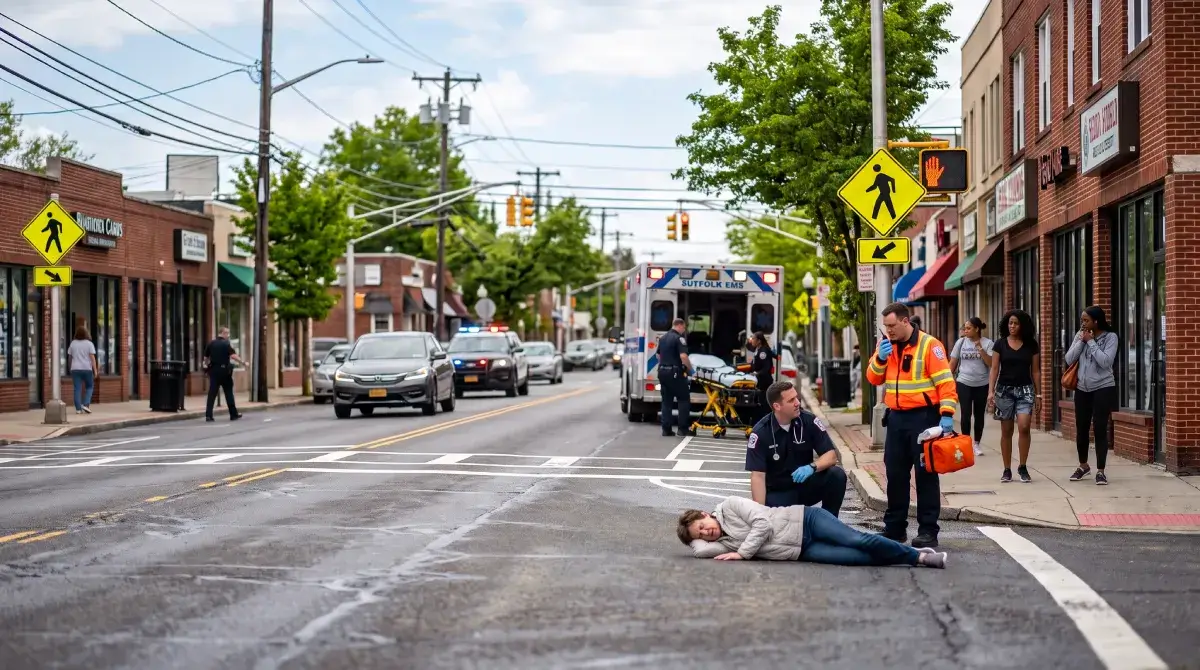
If a car hit you while you were walking in Suffolk County, call 212-470-4544 now for a free consultation. Silver Law Group works as a Suffolk County pedestrian injury lawyer for people struck by drivers across Long Island, and the phone is answered 24 hours a day, in English, Spanish, or Russian.
You are probably in pain, worried about money, and already getting calls from the driver’s insurance company. Do not give them a recorded statement before you talk to a lawyer who handles pedestrian cases. A lawyer can deal with the adjuster, gather the medical records, and protect the deadlines already running against you. The first call costs nothing — call 212-470-4544.
Do You Have a Case? Proving the Driver Was at Fault
New York law puts the burden on the driver to watch for people on foot. A driver who fails to yield to a pedestrian in a crosswalk has broken a duty the traffic law spells out, and that failure is usually the core of your case. In a marked crosswalk with a walk signal, the right of way is yours. The rule does not vanish at unmarked crosswalks either: every intersection has a crosswalk whether it is painted or not, and drivers must yield to people crossing there.
Fault is rarely all-or-nothing, and the insurers for Suffolk drivers know it. They will argue you stepped out too fast, wore dark clothing, or crossed mid-block. What many injured pedestrians do not know is that New York uses pure comparative negligence under CPLR 1411. Your recovery is reduced by your share of the blame, but it is never wiped out by it.
If a jury finds you 30 percent at fault, you still collect 70 percent of your damages. Even a pedestrian who was jaywalking can recover a reduced amount; the driver who hit you does not get a free pass because you crossed against the light.
What decides your share is evidence: the police report, the signal timing, footage from nearby businesses, and what the driver said at the scene. The sooner that evidence is preserved, the harder it is for the insurer to pin the crash on you.
When You Can Sue the Driver Beyond No-Fault
No-fault insurance pays your medical bills and part of your lost wages, but it does not pay a dime for pain and suffering. To bring that kind of claim against the driver, your injury has to clear the “serious injury” bar set by Insurance Law 5102(d). Cross it and you can pursue the driver directly; fall short and you are limited to basic no-fault benefits.
The statute lists the injuries that qualify. The ones that come up most in pedestrian cases include:
- A bone fracture, usually the most clear-cut way to meet the threshold.
- Significant disfigurement, such as scarring from the road or from surgery.
- Permanent limitation of a body organ or member, like a joint or limb that no longer works the way it did.
Pedestrians clear this bar more often than people inside cars, because a person on foot takes the full force of the impact. Fractures and head injuries are common. Once your injury qualifies, you can pursue the driver for the pain, the lasting limits on your daily life, and the future care no-fault will not cover.
What Your Suffolk Pedestrian Injury Claim Is Worth
No two pedestrian claims carry the same value, because value tracks the harm the crash did to you and what you can prove. A claim covers the losses the collision caused you, not a fixed sum. In New York, an injured pedestrian can recover:
- Medical bills, from the ambulance and emergency care through surgery, hospital stays, and rehab.
- Future medical care, including follow-up operations, physical therapy, and long-term treatment a doctor says you will still need.
- Lost wages for the time you could not work while healing.
- Lost earning capacity, if your injuries keep you from the job or the hours you had before.
- Pain and suffering, meaning the physical pain and the limits the injury puts on your life going forward.
Two things move these numbers. The first is severity: a fracture that heals is one thing, and a permanent limp or nerve damage that never fully resolves is another that the law lets you recover for over the years to come. The second is evidence.
A claim backed by clear medical records, a consistent treatment history, and proof the driver was at fault holds up. Gaps in treatment or a thin record give the insurer room to call your injuries minor. This is why the medical file you build in the first weeks matters so much; it becomes the backbone of what your case can recover.
Losing a Loved One in a Fatal Pedestrian Crash
When a pedestrian dies from the crash, the claim does not end; it passes to the family through a wrongful-death case brought by the person’s estate. New York law is specific about who benefits: the distributees, meaning close family such as a spouse, children, or parents who relied on the person who died.
What the family can recover is not the same as a personal injury claim. It covers funeral and burial costs, the income and support the family lost, and the value of the guidance and nurturing that children no longer receive. New York does not treat the family’s grief itself as a separate money loss, which is why these cases turn on documenting the support the household actually depended on. If you lost someone this way in Suffolk County, a lawyer can bring the claim on the estate’s behalf while you tend to your family.
Who Pays Your Medical Bills After Being Hit
Here is what surprises most people: as a pedestrian, you do not need to own a car or carry auto insurance to have your medical bills covered. When a vehicle strikes you, that vehicle’s no-fault coverage (also called PIP, or personal injury protection) pays your medical bills and a portion of your lost wages, and it pays no matter who caused the crash. You could be blameless or partly at fault, and no-fault still applies.
There is a hard deadline attached. You must file the no-fault application, the NF-2 form, within 30 days of the accident. Miss that window and the insurer can deny benefits it would otherwise owe you. A lawyer files it correctly and on time so a paperwork slip does not cost you your coverage.
Sometimes the driver had no insurance, or fled the scene and was never identified. You are not left with nothing. New York’s Motor Vehicle Accident Indemnification Corporation, MVAIC, exists for this exact situation and provides no-fault benefits to pedestrians hit by uninsured or hit-and-run drivers. MVAIC has its own strict notice deadlines, which is another reason to get a lawyer involved early.
What to Do After a Suffolk Pedestrian Accident
The hours right after the crash shape everything that follows. Here is what protects your health and your claim, in order:
- Call 911. A police report and an ambulance response create the first official record of what happened, and that record is hard for an insurer to dispute later.
- Get real medical care, fast. For a serious injury, ask to be taken to Stony Brook University Hospital — it is Long Island’s only Level 1 Trauma Center, staffed and equipped for the worst pedestrian injuries. Even if you feel able to walk away, get examined; internal injuries and concussions do not always show at the scene.
- Photograph everything you can: the car and its plate, the crosswalk and signals, skid marks, your injuries, and the road conditions. Photos taken that day cannot be argued away.
- Get the names and numbers of witnesses before they leave. A stranger who saw the driver run the light may be the person who wins your case, and once the scene clears, they are gone.
Do all of this before you talk to the driver’s insurance company, and before you accept any quick offer. Insurers move fast because early, low settlements are cheaper for them, and the more evidence you lock down now, the less room they have to shift blame onto you.
If a Government or Suffolk Transit Vehicle Hit You
If the vehicle that hit you belonged to a government body (a town, Suffolk County itself, or a Suffolk County Transit bus), the ordinary three-year clock does not apply, and the shorter deadlines are brutal. Under General Municipal Law 50-e, you must serve a formal Notice of Claim within 90 days of the accident. Miss it and your case can be barred before it starts, no matter how badly you were hurt. On top of that, a suit against a municipality generally has to be filed within one year and 90 days, far sooner than the deadline for a claim against a private driver. These cases also demand exact filing against the right public entity. If a public vehicle was involved, tell a lawyer immediately — the 90-day window can close while you are still in treatment.
Where Pedestrian Accidents Happen in Suffolk County
Suffolk County is one of the deadliest places in New York to cross the street on foot, and the danger clusters on a handful of wide, fast suburban highways where crosswalks are far apart. If you were struck on one of these roads, the setting itself is part of the story; these corridors force pedestrians and fast traffic into the same space with little between them.
- Route 27, the Sunrise and Montauk Highway. This is the worst of them: 22 pedestrians were killed along Route 27 between 2016 and 2020, on a multi-lane highway people on foot regularly have to cross with long gaps between safe crossings.
- Route 25, Middle Country Road. Eighteen pedestrian deaths over the same years, on a road where shopping plazas, bus stops, and through-traffic pull walkers across lanes built for cars.
- Route 110 in Huntington Station. A dense commercial stretch where turning cars and steady foot traffic overlap all day.
- Bay Shore around Exit 44, where highway-speed traffic meets local crossings and repeatedly puts walkers in harm’s way.
What these roads share is design: they were built to move cars quickly, and the person on foot came second. Poor lighting, missing sidewalks, and crossings spaced too far apart turn an ordinary walk into a gamble. Where and how you were hit matters to your claim, because a road’s design and conditions can point to responsibility beyond the driver. A lawyer who knows these Suffolk corridors can read the scene for that kind of evidence.
Deadlines to File Your Suffolk Pedestrian Claim
A missed deadline ends a case no matter how strong it is, so the calendar is the first thing a lawyer checks. Two deadlines control most Suffolk pedestrian claims:
- Three years to sue for your injuries. Under CPLR 214, you generally have three years from the date of the crash to file a personal injury lawsuit against the driver.
- Two years for a wrongful-death claim. If the pedestrian died, EPTL 5-4.1 gives the family two years from the date of death to bring the case.
Those are the outer limits, not targets to aim for. Waiting until a deadline nears means witnesses scatter, memories fade, and nearby camera footage gets recorded over. And if a government vehicle was involved, the 90-day Notice of Claim under GML 50-e overrides the three-year clock entirely, a much shorter fuse that catches people off guard.
When it is time to file, a Suffolk pedestrian injury suit is brought in Suffolk County Supreme Court at 1 Court Street in Riverhead. A lawyer handles that filing and the deadlines behind it, so the one thing that could quietly end your case, running out of time, never does.
Why Injured Suffolk Pedestrians Choose Silver Law Group
Money should not decide whether you can afford a lawyer after you have been hurt. Silver Law Group takes pedestrian cases on a contingency fee: you pay no attorney fee up front, and no fee at all unless we recover money for you. Our fee is a percentage of what we win, and if we recover nothing, you owe us nothing for our work. That puts our interest and yours on the same side, because we only get paid when you do.
A serious injury can make it impossible to get to a law office, so the attorney comes to you, at home or at your hospital bed, to start the case. The first consultation is free, answered 24 hours a day, and available in English, Spanish, or Russian.
We prepare every case as if it will be tried. Insurance companies keep track of which firms take a low offer and which will put a case in front of a jury, and a file built for trial from the first week is what moves an adjuster toward a fair number. Our office is in Midtown Manhattan at 49 West 37th Street, and we handle claims for pedestrians hurt throughout Suffolk County.
If a car hit you while you were on foot, call 212-470-4544 now. The consultation is free, and the sooner you call, the more of your case a lawyer can protect.