

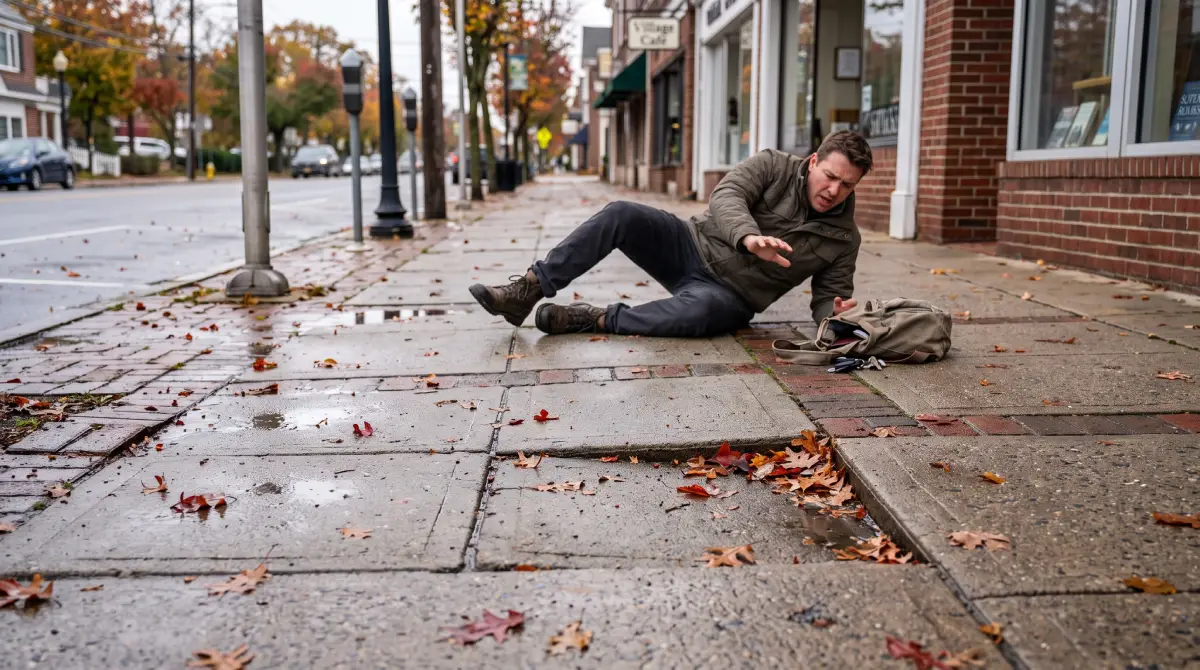
A fall on someone else’s property in Suffolk County can leave you with a broken hip, a pile of medical bills, and an insurance adjuster already asking for a recorded statement. Silver Law Group represents fall victims across Suffolk County, and a Suffolk County slip and fall attorney can tell you in one phone call whether the property owner owed you a duty they broke. You do not owe us anything unless we recover money for you. The consultation is free, the phone is answered 24 hours a day, and you can speak with us in English, Spanish, or Russian. If the injury keeps you home or in a hospital bed, the attorney comes to you. Call 212-470-4544.
Do You Have a Suffolk County Slip and Fall Case?
A property owner is not automatically liable because you fell on their property. Liability turns on two questions: what duty the owner owed you, and whether the owner knew or should have known about the hazard in time to fix it.
The duty depends on why you were there. An invitee (a customer at a store, a shopper at Smith Haven Mall, anyone the owner brought in for business) is owed the highest duty: reasonable care to keep the property safe and to warn of dangers the owner knows about. A licensee, on the land with permission but for their own reasons, such as a social guest, is owed less; the owner must warn of known hazards but has no duty to inspect for hidden ones. A trespasser is owed the least, mainly a duty not to injure them through willful or reckless conduct, though a separate rule protects children drawn to an obvious danger like an unfenced pool.
Duty alone does not decide the case. You also have to show the owner had notice of the hazard. Actual notice means the owner knew: an employee saw the spill, or a tenant reported the broken step weeks earlier. Constructive notice means the hazard sat there long enough, and openly enough, that an owner inspecting the property should have found it. A puddle that formed 30 seconds before you slipped usually is not constructive notice. A puddle that sat in a store aisle for two hours, tracked through by other shoppers, often is.
Notice is still not the end. Once an owner learns of a hazard, the law allows a reasonable time to fix it, and what counts as reasonable depends on the danger. A live wire gets minutes. A worn stair tread might get days. Your case is won or lost on which of these the owner ignored.
Where Falls Happen in Suffolk County
Falls cluster where crowds and hard surfaces meet. In Suffolk County that means the tile concourses of Smith Haven Mall, the outdoor walkways at Tanger Outlets Riverhead where rain and cold turn pavers slick, and the entrances and food court of the Walt Whitman Shops. LIRR platforms carry their own hazards: gaps at the platform edge, ice on exposed concrete, worn tactile strips. The wide parking lots off Sunrise Highway freeze over fast in January, funnel runoff into low spots, and go dark when lot lighting fails. Where you fell shapes who is responsible: a mall owner, a store tenant, the MTA, or a lot maintenance contractor. Each answers to a different notice standard, and public entities carry a different filing deadline.
Snow, Ice, and the Storm-in-Progress Rule
You slipped on ice during a snowstorm, and the property owner may owe you nothing. New York’s storm-in-progress rule says an owner has no duty to clear snow or ice while a storm is still falling. The law does not force a store or landlord to send someone out every ten minutes into active snowfall; they get to wait until the weather settles.
The rule cuts the other way once the storm ends. After the snow stops, the owner gets a reasonable time to clear the walk, salt the steps, and treat the ice, and then the duty is real. How long is reasonable depends on the storm’s size, when it ended, and the type of property. A supermarket lot off Sunrise Highway still sheeted in ice a full day after the last flake is a different case from a driveway cleared by mid-morning.
Two facts often decide these claims. The first is old ice versus new ice. If you slipped on a ridge that had refrozen from a storm three days earlier, the storm-in-progress defense does not apply, because that hazard predates any active weather. The second is whether the owner made things worse. A plow job that pushed snow into a pile that later melted and refroze across a walkway can create liability the bare weather never would have.
This is where Suffolk winters get technical. Pinning down the weather timeline, hour by hour, around the moment you fell often separates a claim the insurer pays from one it denies.
Falls on Public Property: Notice of Claim and Prior Written Notice
Fall on a public sidewalk, a county road, a town park, or a school walkway, and the ordinary three-year deadline is a trap, because a much shorter clock starts first. Before you can sue a Suffolk County municipality (the county, a town such as Brookhaven or Islip, a village, or a school district), you must serve a Notice of Claim under General Municipal Law 50-e within 90 days of the fall.
The Notice of Claim is a formal document that tells the municipality what happened, where, and how you were hurt. Miss the 90 days and your claim is usually dead before it starts, with only narrow exceptions a court may or may not grant. This deadline is the single most common reason a valid public-property fall never gets heard.
A second barrier applies to many town sidewalk and road defects: the prior-written-notice rule. Under Town Law 65-a, a town is not liable for a defect in a walk, road, or lot unless it already received written notice of that exact defect and then failed to fix it. Actual knowledge is not enough. A town employee walking past the broken curb every morning does not count; someone has to have filed a written complaint about that specific spot. Many Suffolk County sidewalk claims live or die on whether that complaint sits in the town’s records.
The third hurdle is the trivial-defect defense, and it comes straight out of Suffolk County. Under the rule from Trincere v. County of Suffolk, not every small height difference in a walkway is actionable; a defect can be too minor to hold anyone liable. There is no magic measurement. Courts weigh the width and depth of the defect, the lighting, the weather, and where it sat, so a half-inch lip at the center of a busy mall entrance reads differently than the same lip on a quiet residential walk.
A claim against a private store and a claim against the county run on different rules and different clocks. Getting that call right in the first weeks is what protects your right to sue at all.
What Is Your Slip and Fall Claim Worth?
No lawyer can hand you a number in the first meeting, and any who does is guessing. What your claim is worth depends on your injuries, how they change your work and your life, and how much fault the owner shares. New York law lets you recover several distinct kinds of loss:
- Medical bills, past and future: the ER visit, the surgery, months of physical therapy, and the care a serious fracture or brain injury still needs years later.
- The wages you lost while you healed, plus the earning power you lose for good if the injury keeps you out of your old trade.
- Future care a doctor can project, such as home health aides, assistive equipment, and repeat procedures.
- Pain and suffering, which New York treats as a real, recoverable loss even though no receipt exists for it.
What can shrink that recovery is your own share of the fault, and New York’s rule here is unusually kind to injured people. Under CPLR 1411, the state follows pure comparative negligence: your recovery drops by your percentage of fault, but it is never wiped out. If a jury finds you 30 percent responsible for looking at your phone when you tripped, you still collect 70 percent. Even a person found 90 percent at fault can recover the last 10 percent, a rule many other states do not allow.
Insurers know this, which is why the adjuster’s first move is to build your fault percentage: the recorded statement, the question about your shoes, the note that you were carrying bags. Every point of fault they pin on you comes off what they pay. Saying little and letting your lawyer speak is how you keep that number down.
What to Do After a Fall in Suffolk County
What you do in the first hour, and the first week, decides whether your claim survives. The steps below are ordered by how fast the evidence disappears.
- Report the fall to a manager or the owner before you leave, and ask that it be written down. A store or landlord that learns of your fall the day it happened cannot later claim it never occurred.
- Photograph the hazard right away, from several angles and with something for scale. Within hours the floor gets mopped or the ice gets salted, and the proof is gone.
- Get a copy of the incident report, or at least the name of the person who filled it out. Many stores write one and never offer you a copy.
- See a doctor the same day, even if you think you can walk it off. Stony Brook University Hospital and Southside Hospital both run emergency departments, and the record you create that day ties your injury to the fall and blocks the insurer’s claim that you were hurt somewhere else.
- Collect witness names and phone numbers on the spot. A stranger who saw you fall will be impossible to find next week, and an independent witness carries more weight than you do.
Deadlines to File a Suffolk County Slip and Fall Claim
Every slip and fall claim in Suffolk County runs on a clock, and which clock depends on who you are suing and whether anyone died.
- Three years to sue a private owner. CPLR 214 gives you three years from the date of the fall to file a personal injury suit against a store, landlord, or private property owner.
- Two years if the fall was fatal. Under EPTL 5-4.1, a wrongful death claim must be filed within two years of the death, a separate and shorter deadline from the injury claim.
- One year and 90 days against a municipality. GML 50-i caps suits against the county, a town, or a school district at one year and 90 days from the fall, on top of the 90-day Notice of Claim you already had to serve.
These clocks do not wait for you to feel better or finish treatment, and the shortest one governs. If your fall happened on county property, the 90-day Notice of Claim comes first, the one-year-90-day suit deadline comes next, and missing either ends the case no matter how badly you were hurt. A slip and fall lawyer who reads the location right in week one is what keeps all of these deadlines open.
Why Silver Law Group and No Fee Unless We Win
You are hurt, you are worried about money, and hiring a lawyer sounds like one more bill you cannot pay. Here is how the fee actually works. Silver Law Group takes slip and fall cases on contingency: you pay no legal fee up front, and no fee at all unless we recover money for you. Our fee is a set percentage of what we recover, agreed to in writing before we start, and it comes out of the recovery rather than your pocket. Recover nothing, and you owe us no fee. That arrangement lets you hire a Suffolk County slip and fall attorney the day after your fall, while the insurance company already has adjusters and lawyers working against you.
We prepare every case as if it will be tried, and Suffolk County cases are tried at the Supreme Court in Riverhead. Insurers settle fairly when they see a file built for trial and a firm with no reason to fear one.
If the injury keeps you from reaching our Midtown Manhattan office at 49 West 37th Street, the attorney will come to you, at your home or your hospital room. Consultations are free, the phone is answered 24 hours a day, and you can speak with us in English, Spanish, or Russian. Call 212-470-4544.