

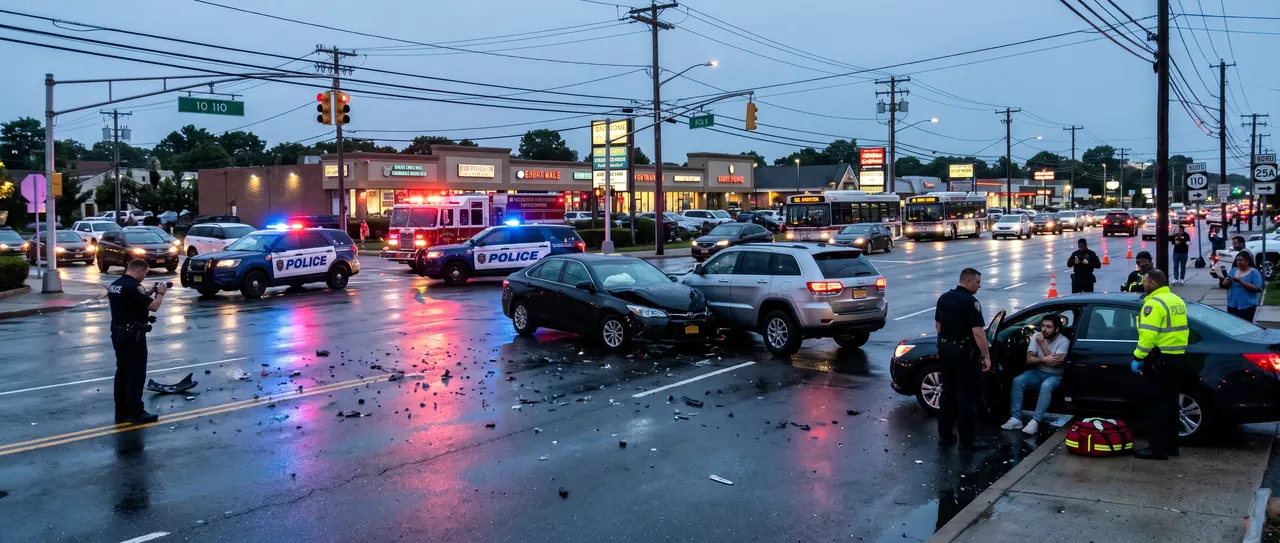
A Suffolk car accident lawyer from Silver Law Group will take your call at any hour, and the first consultation is free. You can speak with us in English, Spanish or Russian. The attorney handling your case will come to your home or hospital room anywhere from Huntington to Montauk. You should not have to drive to Manhattan with a broken collarbone to get answers. In that first conversation you find out whether your injury meets New York’s serious-injury threshold, who is likely to be found at fault, and which of your deadlines is closest. Nothing you sign that day costs you money upfront. The other driver’s insurer may already be calling you. Call 212-470-4544 before you say anything to that adjuster.
Do You Have a Suffolk County Car Accident Case?
Your right to sue the other driver for pain and suffering depends on Insurance Law 5102(d). New York’s no-fault system pays your medical bills and part of your lost wages no matter who caused the crash. It also blocks a lawsuit for pain and suffering unless your injury fits one of these serious-injury categories:
- death
- dismemberment
- significant disfigurement, such as facial scarring
- a fracture
- loss of a fetus
- permanent loss of use of a body organ, member, function or system
- permanent consequential limitation of use of a body organ or member
- significant limitation of use of a body function or system
- a medically documented injury that kept you from performing substantially all of your usual daily activities for at least 90 of the 180 days right after the crash
A fracture is the easiest category to prove. An X-ray or CT scan showing a broken wrist, rib or vertebra meets the threshold by itself, so nobody argues over how severe it is.
Herniated discs, torn rotator cuffs and knee ligament tears usually fall under the two limitation categories, and insurers fight those hardest. To win that fight, a car accident attorney needs measured range-of-motion losses, MRI findings, and a treating doctor who will state in writing that the crash caused the limitation.
The 90-of-180-days category covers injuries that heal but cost you months of your life first. The proof is your doctor’s notes keeping you out of work, along with your own record of what you could not do at home.
Fault is decided separately. Under CPLR 1411, New York follows pure comparative fault. If a jury finds you 20 percent responsible for the crash, your damages go down by 20 percent. Sharing some of the blame reduces your recovery but never bars it.
Head-On, Rear-End and Intersection Crashes on Suffolk Roads
The way your car was hit determines what evidence proves the other driver’s fault.
- A head-on crash on William Floyd Parkway or Nicolls Road almost always means one car crossed into the opposing lanes. The proof is physical: gouge marks and debris on the wrong side of the road, where both cars came to rest, and the event data recorder that logs speed and steering in the seconds before impact. A head on car crash lawyer moves to preserve both vehicles before an insurer sends them to salvage.
- Rear-end collisions in stop-and-go traffic on the Long Island Expressway or Sunrise Highway start with the law on your side. New York courts treat a rear-end hit on a stopped or slowing car as evidence that the rear driver was negligent. That driver then has to give a non-negligent explanation, and “the car ahead stopped short” seldom works.
- Left-turn crashes at intersections along Route 110, Route 347 and County Road 39 come down to right-of-way. The turning driver must yield to oncoming traffic, so the dispute is about signal timing, speed and sight lines. Traffic-camera footage, video from nearby businesses and independent witnesses decide these cases.
On every one of these roads, the video and the vehicles are the first evidence to disappear. Business cameras record over themselves, and wrecked cars get crushed. Preservation letters should go out in the first two weeks, not after the lawsuit is filed.
What Your Suffolk Car Accident Claim Is Worth
Your compensation comes from two sources, and no-fault always pays first, whoever caused the crash:
- up to $50,000 in basic economic loss per person, covering medical bills, rehabilitation and lost earnings
- 80 percent of your lost earnings, capped at $2,000 a month and counted against that $50,000
No-fault pays nothing for pain. A serious hospital stay can use up the $50,000 fast. Once your injury meets the serious-injury threshold, an automobile accident attorney can pursue the at-fault driver’s liability policy for what no-fault leaves out:
- Pain and suffering, past and future, including what you could do before the crash and cannot do now, from lifting your child to sleeping through the night.
- Future medical care your doctors expect, such as a later surgery, injections or years of physical therapy, documented in a written life-care plan.
- Lost earning capacity, meaning the gap between what you would have earned over your working life and what your injury now allows. Vocational and economic experts measure it.
- Economic losses above the $50,000 no-fault limit, including wages beyond the $2,000 monthly cap.
Your claim’s value depends on the injury, the treatment record and the other driver’s policy limits. Any number someone quotes before reading your MRI is a guess.
Treatment Records From Suffolk Trauma Centers
The insurer’s first defense is usually causation. It will argue that your neck or knee was injured before the crash, or by something that happened after it. Your emergency room chart is the earliest answer. Triage nurses record how you were hurt (“restrained driver, struck on passenger side at intersection”), what hurt, and when you arrived. Imaging taken that day shows the condition of your spine and bones within hours of the impact.
For Suffolk crashes, those records usually come from one of these hospitals:
- Stony Brook University Hospital, a Level I trauma center for both adults and children
- Good Samaritan in West Islip
- South Shore University Hospital in Bay Shore
- Peconic Bay Medical Center in Riverhead
Request the full chart, including the EMS run sheet and the radiology images, not just the discharge summary. After that, the defense looks for gaps in treatment, so keep every follow-up appointment.
Fatal Car Accident Claims for Suffolk Families
A State Comptroller report found that Suffolk County had 164 crash deaths in 2022, the most of any county in New York. The same report found that Suffolk led the state in fatal crashes involving distracted driving and in fatal crashes involving speeding.
If you lost a family member in one of those crashes, the legal claim does not belong to you personally. Under EPTL 5-4.1, a wrongful death action is brought by the personal representative of the estate. That is the executor named in a will, or an administrator the Surrogate’s Court appoints if there is no will. Any recovery then passes to the surviving family members who lost financial support.
The steps happen in this order:
- Petition the Surrogate’s Court for letters testamentary or letters of administration, which give the representative legal authority to sue.
- Preserve both vehicles, the police file and any event data recorder download before the insurer moves the wrecks.
- File the lawsuit within two years of the date of death.
Fatal accident lawyers handle the estate paperwork and the crash investigation at the same time. The Surrogate’s Court appointment takes time, and the two-year clock keeps running while you wait.
What Happens After a Car Crash in Suffolk County
Every injury crash in Suffolk produces two reports: one that you file with the DMV and one that the police write.
- File DMV form MV-104 within 10 days if anyone was injured or property damage exceeds $1,000. As the driver, you have to file it even if police came to the scene.
- Get a copy of the police report. For crashes handled by the Suffolk County Police Department, request it from Central Records at 30 Yaphank Avenue in Yaphank, or order it online through BuyCrash.
- If the crash happened in Southampton, Riverhead or Southold, ask that town’s police department for the report. Those departments write and keep their own reports.
- Notify your own insurer and start your no-fault application. Its 30-day deadline is covered below.
- See a doctor within days, and keep every follow-up visit.
The police report lists the other driver’s insurer, the policy number, the witnesses and the officer’s diagram of the collision. A car crash lawyer uses that information to put the insurer on notice and reach witnesses while they still remember the crash. Read the report carefully as soon as you get it. A wrong lane direction or the wrong car marked as turning is easier to fix now than at a deposition.
How a Suffolk Car Accident Lawsuit Moves Through Court
A case can settle at any step below, but the steps always come in this order.
- Your attorney files a summons and complaint in Suffolk County Supreme Court and serves the at-fault driver, whose insurer assigns a defense lawyer.
- In discovery, both sides exchange medical records, photographs, insurance information and a bill of particulars listing your injuries.
- The defense sends you to a medical exam with a doctor the insurer picks and pays. We prepare you for it, because that doctor’s report is written for the defense.
- You and the other driver each give a deposition, answering questions under oath in front of a court reporter.
- At mediation, a neutral mediator tests whether a fair settlement is possible.
- Cases that do not settle go to trial before a jury at the Alan D. Oshrin Supreme Court Building, 1 Court Street, Riverhead.
At mediation, the defense is asking itself whether your lawyer will really try the case in Riverhead. Your file should answer that question long before anyone sits down at the table.
What a Suffolk Car Accident Lawyer Costs
You pay nothing upfront. Silver Law Group takes car accident cases on a contingency fee, which means the fee is a percentage of the compensation recovered for you through a settlement or verdict. The fee comes out of that recovery at the end of the case. If nothing is recovered, you owe no attorney fee. You do not pay anything to start the case, to file the lawsuit or to take it to trial. The percentage is written into the retainer agreement you sign before work begins, so you know the terms on the first day. Because the firm gets paid only when you do, a low offer gets measured against what a Riverhead jury might award, not against how fast the file could close.
Deadlines for Suffolk Car Accident Claims
The shortest deadline in a Suffolk car crash claim is 30 days, and it runs even if you do not feel hurt yet.
- Within 30 days of the crash, give the insurer written notice of your no-fault claim, as 11 NYCRR 65-1.1 requires. If you file late, the carrier can deny your medical and wage benefits.
- Medical providers have 45 days to submit bills to the no-fault carrier, so tell every doctor and therapist that your treatment is for crash injuries.
- CPLR 214 gives you three years from the crash to sue the at-fault driver.
- If a Suffolk County vehicle, such as a county police car, hit you, you must file a Notice of Claim within 90 days under General Municipal Law 50-e and sue within one year and 90 days under GML 50-i.
- Claims against New York State, including crashes caused by a state vehicle or a dangerous condition on a state road, require a claim or notice of intention within 90 days under Court of Claims Act §10.
The government deadlines trip people up because the crash looks like any other at first. A county car may be unmarked. A defect in a state highway may not be identified as a cause until an engineer inspects the scene. A car wreck lawyer checks who owns every vehicle and every road in the first week, while the 90-day windows are still open. For fatal crashes, the two-year wrongful death deadline also applies.
Why Suffolk Crash Victims Choose Silver Law Group
Three practices shape how Silver Law Group handles your case.
- Every case is prepared for trial from the first day. We preserve evidence, interview witnesses and line up medical experts as if a Suffolk jury will hear the case, because the insurer’s offer depends on how ready your side is.
- You reach your attorney directly. You will not be routed through a call center or passed between rotating case managers.
- The firm handles every contact with the insurers, both yours and the other driver’s, so adjusters stop calling you once our letter of representation arrives.
The attorney travels to you anywhere in Suffolk County, and consultations are available in English, Spanish and Russian, day or night. Car accident attorneys at Silver Law Group work out of our Midtown Manhattan office at 49 West 37th Street, 7th Floor, New York, NY 10018. Call 212-470-4544 now.