

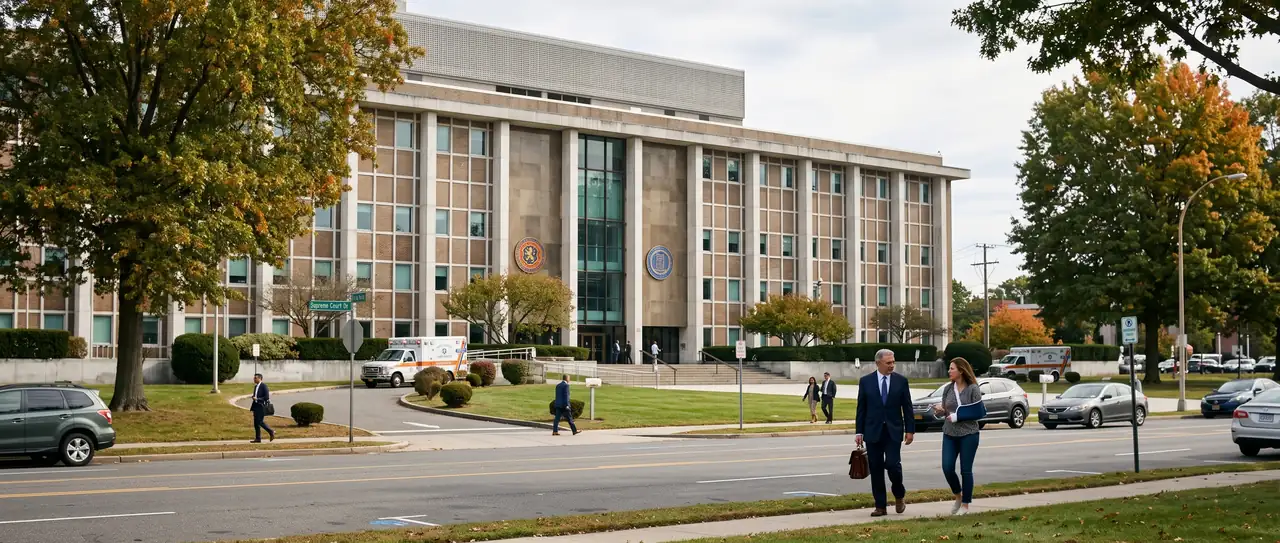
If a doctor, nurse or hospital in Nassau County missed something they should have caught, a Nassau medical malpractice lawyer at Silver Law Group can read your records and tell you whether you have a claim. Your first consultation is free, in English, Spanish or Russian, and you can call 212-470-4544 at any hour, 24/7.
Call before you sign any hospital form or sit down with a risk manager. In New York, most malpractice claims must be filed within two and a half years. A claim against Nassau University Medical Center needs a formal notice within 90 days.
You pay no fee unless you recover. If you or your family member is still in a hospital bed in Manhasset or recovering at home in Hicksville, an attorney will come to you.
Do You Have a Nassau Medical Malpractice Case?
New York law asks four questions, and your claim needs a yes to each one.
- A doctor-patient relationship existed. The provider agreed to diagnose or treat you, and that agreement creates the duty of care.
- The care departed from accepted medical practice, meaning a reasonably careful provider in the same specialty would have done something different.
- That departure caused your injury. The harm has to come from the error, not from the illness you already had.
- You suffered damages, such as another surgery, lost work, permanent impairment or pain you would not otherwise have had.
A bad result alone does not prove malpractice. Surgery can fail and cancer can spread even when every step was done right. The legal question is whether the doctor’s choices fell below the standard of care, and a physician expert has to be willing to say so under oath.
Hospitals answer for the staff they employ. If a hospital-employed nurse ignores a falling blood pressure or a resident misreads an order, the hospital is responsible along with that person. That is why an attorney for hospital negligence checks who employed each provider early in the case, using employment records as well as the chart.
Misdiagnosis, Surgical Errors and Birth Injuries in Nassau
Most malpractice claims in Nassau County fit one of a handful of patterns:
- Delayed cancer diagnosis, such as a suspicious mammogram read as normal, a lung nodule with no follow-up scan, or rectal bleeding put down to hemorrhoids. Lost months can mean a later stage and fewer treatment options.
- Missed stroke, when slurred speech or sudden dizziness is sent home as a migraine or vertigo and the window for clot-dissolving treatment closes.
- Wrong-site surgery, meaning the wrong knee, the wrong level of the spine or the wrong patient.
- Anesthesia errors: overdose, poor airway monitoring, or an allergy history nobody read.
- Medication errors, including the wrong drug, a tenfold dosing mistake, or a dangerous interaction that the prescriber or pharmacy missed.
- Birth injuries from a delayed C-section during fetal distress, mishandled shoulder dystocia, or a newborn’s infection or jaundice left untreated.
- Informed-consent failures, where the surgeon never explained a known serious risk or a reasonable alternative that would have changed your decision.
- ER discharge errors. Chest pain gets sent home without cardiac testing, a feverish infant leaves without a workup, or abdominal pain later turns out to be a ruptured appendix or sepsis.
Each pattern needs a different kind of expert. Doctor malpractice attorneys match your file to a reviewing physician in the right specialty, such as radiology, obstetrics or emergency medicine, before deciding whether the claim can go forward.
Nassau Hospitals Where Malpractice Claims Arise
The hospital where you were treated decides whose records get requested first and which defendants are likely to appear in your lawsuit. Nassau claims often come from these hospitals:
- NYU Langone Hospital–Long Island, Mineola
- North Shore University Hospital, Manhasset
- Long Island Jewish Medical Center, New Hyde Park
- Mount Sinai South Nassau, Oceanside
- St. Francis Hospital, Roslyn
- Mercy Hospital, Rockville Centre
Large hospitals run their own risk-management departments, and they start building a file as soon as something goes wrong. Many doctors who treat patients inside these buildings belong to separate practice groups rather than working for the hospital. One surgery can therefore lead to two or three defendants, each with its own insurer and lawyer.
Hospital malpractice lawyers work out who employed whom from credentialing files, staffing schedules and billing records. The name on the building doesn’t settle that question.
What a Nassau Medical Malpractice Claim Is Worth
New York has no cap on medical malpractice damages. A jury in Mineola can award whatever the evidence supports, so the value of your claim depends on proof rather than a legal limit. Your damages can include:
- Medical costs, past and future: corrective surgery, rehabilitation, home nursing, medication and equipment
- Lost earnings, plus reduced earning capacity if the injury keeps you from going back to the same work
- Pain and suffering, including the loss of activities and independence you had before the error
How a large award is paid out follows a separate rule. Under CPLR 5031, future damages are not always handed over as a single check. The statute requires future economic damages, such as lifetime care and lost earnings, to be paid out over time through an annuity. Future pain and suffering above $500,000 is also partly deferred.
For that pain-and-suffering portion, the greater of 35% or $500,000 is paid up front. The rest comes in yearly installments over the period the jury sets or eight years, whichever is shorter.
This affects every settlement talk, because the insurer compares its offer with what a structured judgment would cost it. Nobody can honestly price your case before the records are collected and a physician expert has reviewed them.
Wrongful Death Caused by Medical Negligence
If medical negligence caused your family member’s death, the estate’s personal representative has two years from the date of death to file a wrongful death action under EPTL 5-4.1.
New York still limits what the family can recover to economic losses. That covers the income and support your loved one would have provided, the value of household services, and medical and funeral costs. It does not cover grief or the loss of companionship. In December 2025, Governor Hochul vetoed the Grieving Families Act for the fourth time, so that limit still applies.
Because the economic loss is the whole case, your attorney needs early proof of earnings, benefits and the household work your family member did.
Attorneys for malpractice suits against large hospitals expect delay. The defense can request more records, ask for adjournments and change experts. Keeping the file trial-ready from step one is how you push the case toward a decision.
What to Do If You Suspect Malpractice in Nassau
What you do in the next few weeks determines what evidence survives.
- Request your complete chart and imaging in writing from every facility involved. Ask for the actual images on disc, not only the radiologist’s report.
- Keep a dated timeline of each visit, each symptom, who you spoke to and what they told you. Patient-portal messages and texts to family members help fix the dates.
- Get follow-up care at a different facility. A new doctor gives you independent treatment and an independent record, and you stop relying on the people who may become defendants.
- Turn down risk-management interviews unless you have a lawyer. After a bad outcome, hospitals send patient-relations staff or risk managers to talk with families. Their notes go into the hospital’s file, not yours. Decline politely and give them your attorney’s number.
Do not sign a release or accept a bill write-off in exchange for “closing the matter” until a lawyer has read it.
What a Medical Malpractice Attorney Costs in Nassau
You pay nothing up front, and you pay no attorney fee if there is no recovery. Silver Law Group takes malpractice cases on a contingency fee. The fee is a percentage of the settlement or verdict, paid from that money when the case ends, so you never write a check to start. If the case recovers nothing, you owe the firm no fee.
Medical malpractice has an extra protection that other injury cases don’t. Judiciary Law 474-a limits what any attorney for medical malpractice can charge, on a sliding scale:
- 30% of the first $250,000
- 25% of the next $250,000
- 20% of the next $500,000
- 15% of the next $250,000
- 10% of any amount above $1.25 million
The percentages are taken from the net recovery, meaning after case expenses such as expert fees and filing costs come out. You are not charged a fee on money that paid for experts.
The percentage gets smaller as the recovery grows. That protects you most in the catastrophic cases, such as birth injuries, missed cancers and brain damage, where lifetime care drives the value. During the free consultation you can ask how the scale would apply to your case.
Deadlines to File a Nassau Medical Malpractice Lawsuit
CPLR 214-a gives you two and a half years to sue for medical malpractice. The clock usually starts on the date of the negligent act, not the date you found out about it. Four rules can move that date:
- Continuous treatment. If the same provider kept treating you for the same condition, the 2.5 years run from your last treatment. Once you stop seeing that provider, the clock starts.
- Foreign objects. If a sponge, clamp or other object was left inside you, you have one year from when you discovered it, or from when you learned facts that would reasonably have led you to discover it, whichever is earlier.
- Lavern’s Law. For a missed cancer or malignant tumor, the 2.5 years start when you knew or reasonably should have known about the negligent act and the harm it caused. The outer limit is seven years from the act.
- Children. CPLR 208 pauses the clock while the patient is a minor. In malpractice cases, though, that pause cannot go beyond ten years from the act. For a birth injury, that means filing by about the child’s tenth birthday at the latest.
These rules can overlap, and the earliest deadline that applies to you is the one that counts. Collecting records and getting an expert review takes months, so a case that comes in near the two-year mark is already short on time.
Once the deadline passes, the court will dismiss the case no matter how clear the error was.
Claims Against Nassau University Medical Center
Nassau University Medical Center in East Meadow is not a private hospital. It is run by Nassau Health Care Corporation, a public benefit corporation. Public Authorities Law 3415(1) requires you to serve a notice of claim under General Municipal Law 50-e before you can sue.
That notice is due within 90 days of the malpractice. It must state who you are, what happened, when and where it happened, and the injuries you are claiming. Ninety days is a small fraction of the 2.5 years you would have against a private hospital in Mineola or Manhasset.
Families often lose weeks just finding out that NUMC is a public hospital with its own rules. Lawyers for hospital negligence who handle NUMC claims prepare and serve the notice first, then collect the full chart and expert review afterward.
Why Nassau Families Choose Silver Law Group
Every malpractice file at Silver Law Group is prepared as though it will be tried before a jury at 100 Supreme Court Drive. That means expert opinions, deposition outlines and medical timelines are built in the first months, not in a rush just before trial. The defense sees that preparation at every deposition.
You don’t have to travel into the city to start. Attorneys visit clients at home or at the bedside anywhere from Elmont to Massapequa, which matters when the injured person can’t sit in a car or a parent can’t leave a child in the NICU.
The firm’s office is at 49 West 37th Street, 7th Floor, in Midtown Manhattan, and 212-470-4544 is answered 24/7. Consultations are available in English, Spanish and Russian, so a grandparent can describe the symptoms in the language they think in.
As attorneys for medical negligence, the firm gives you a straight read of your records. You’ll learn whether a physician expert sees a departure from accepted practice, how strong the link to your injury is, and which deadline applies to you.
Talk to a Nassau Medical Malpractice Attorney Today
Call 212-470-4544 or submit the free case review form, and an attorney will review what happened at no cost to you. Records are easier to collect and witnesses remember more while the care is recent. Staff leave, memories fade and the 90-day NUMC notice runs out quickly. The 2.5-year CPLR 214-a deadline keeps running while you decide, so make the call this week.