

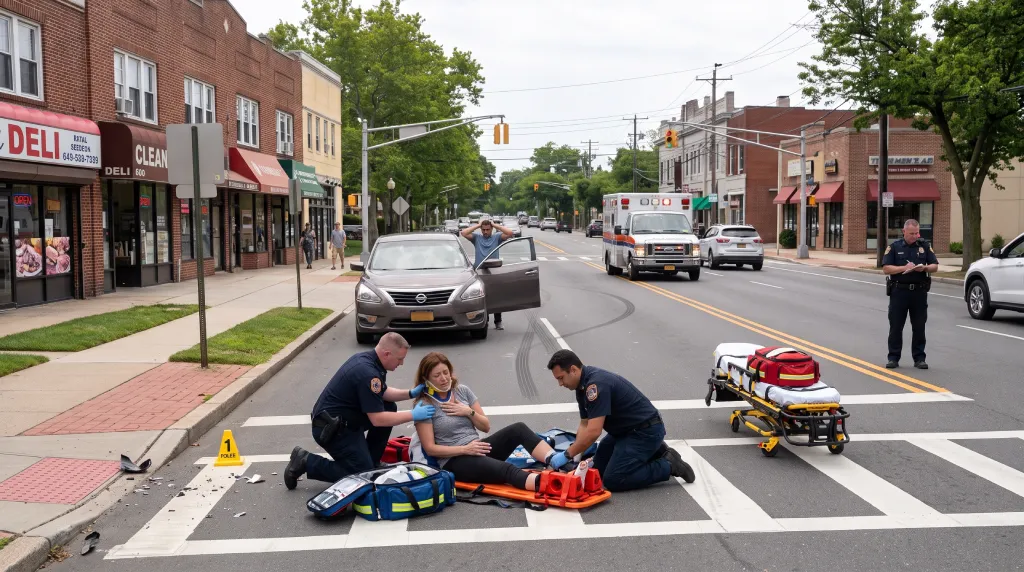
If a car struck you while you were walking anywhere in Nassau County, a Nassau County pedestrian injury lawyer at Silver Law Group can tell you on one free call whether you have a claim worth pursuing. We represent injured pedestrians across the county, from the crosswalks of Hempstead and Mineola to Long Beach and the North Shore. The consultation costs nothing and stays confidential, in English, Spanish, or Russian, and someone answers 24/7 at 212-470-4544. You concentrate on healing; we deal with the driver’s insurer.
Do You Have a Pedestrian Injury Case in Nassau County?
New York drivers owe you the road when you are on foot, and your case is built on the moment one of them ignored that. Vehicle and Traffic Law 1151 gives a pedestrian inside a crosswalk the right of way and forces the driver to stop and yield instead of edging through. Section 1146 reaches wider, applying on every street rather than only at marked crosswalks, and requires each driver to use due care to avoid striking anyone walking. When a driver breaks either duty, that broken duty is the negligence a pedestrian accident lawyer uses to hold them responsible. Most Nassau pedestrian crashes come down to one of a few driver failures:
- Failing to yield to a walker who already had the crosswalk
- Looking at a phone instead of the road
- Carrying too much speed to stop in time
- Turning across a crosswalk without checking for people in it
- Backing up in a lot or driveway without looking behind
You do not have to prove the driver meant to hurt you. You have to show the driver failed to act as a careful person would, and that the failure put you in the hospital. That is a lower bar than many injured people expect, and it is often captured on a nearby camera before anyone thinks to look for it.
New York’s Serious Injury Threshold After the 2026 Reforms
To recover money for your pain, as opposed to just your medical bills, New York makes you clear a bar called the serious injury threshold. Insurance Law 5102(d) defines it, and after the 2026 reforms the definition is narrower than it was for years. Your injury now has to fall into one of these categories:
- A bone fracture
- Significant disfigurement
- Dismemberment
- Permanent loss or limitation of use of a body organ, member, or system
- Significant limitation of use of a body function or system
- Death
The change that matters most for pedestrians is what was taken out. The old law had a category lawyers called the 90/180 rule: if a non-permanent injury kept you from your usual daily activities for at least 90 of the 180 days after the crash, you qualified. For any lawsuit filed on or after May 26, 2026, that route is gone. A soft-tissue back injury that once opened the door to a pain-and-suffering claim may no longer clear the threshold on its own. This is why the medical record you build in the first weeks decides so much. A fracture on an X-ray, documented nerve damage, a surgeon’s note about permanent limitation are the findings that now carry your claim. If your injury looks temporary on paper, the driver’s insurer will argue you cannot sue for pain at all. A pedestrian injury lawyer reads your records against the surviving 5102(d) categories early, so nothing that qualifies gets missed and treatment gaps do not sink you.
How Shared Fault Now Affects Your Recovery
Being partly to blame no longer means what it used to. For decades New York followed pure comparative negligence, where even a pedestrian who was 90% at fault could still collect that last 10% from the driver. The 2026 budget rewrote that rule for motor vehicle cases, and pedestrians struck by cars are covered by it. A new provision, CPLR 1411(b), draws a hard line. If a jury finds you more at fault for the crash than the driver, you recover nothing.
If your share of fault is 50% or less, the old math still applies and your damages are simply reduced by your percentage. Cross the halfway line and the claim collapses; stay at or under it and you are only discounted, not denied. That single line changes how these cases are fought. Insurance Law 5104(a) now has fault decided first, before a jury ever weighs your injuries or your losses. The driver’s insurer knows this, so its whole strategy becomes pushing your fault past 50 percent: you stepped out early, you wore dark clothing, you were looking at your phone. This is the reform that makes early legal help worth the call.
The facts that keep your fault down, like the signal timing, the driver’s speed, a witness who saw you in the crosswalk, the point of impact on the car, start disappearing within days. A crosswalk accident attorney who gets on the case quickly can lock down that evidence while it still exists, before the fault fight is decided on the insurer’s version of events.
What Your Nassau Pedestrian Claim Is Worth
What your case is worth depends on two kinds of losses, and New York lets you claim both. The first kind is money you can add up on paper.
- Emergency and hospital bills, surgery, and follow-up care
- The cost of future treatment, therapy, or assistive devices your doctors project
- Wages you lost while you could not work, plus reduced earning power if the injury is lasting
The second kind has no receipt, and once the serious injury threshold is met, it is often the larger part of the claim.
- Physical pain and the ordeal of recovery
- Permanent disability or scarring
- Disfigurement that changes how you look or move
- The loss of activities you can no longer enjoy
We do not put a headline number on your case before we know your medical picture, because an honest value comes from your diagnosis, your prognosis, and how the injury reshapes your work and your days. As your treatment develops, the future-care and lost-earning pieces often grow past the first hospital bill, which is exactly why settling early with the insurer usually costs a pedestrian money.
No-Fault Benefits and Hit-and-Run Coverage
Here is the part that surprises most people we talk to: when a car hits you as a pedestrian, the driver’s no-fault insurance pays your early medical bills and lost wages, even though the driver hit you. New York’s no-fault system follows the vehicle, not the fault. The striking car’s policy carries at least $50,000 in personal injury protection, and that PIP coverage is available to you as the struck pedestrian regardless of who caused the crash. The catch is the clock.
You have to file the no-fault application with the striking vehicle’s insurer within 30 days of the crash. Miss that window and the insurer can deny the benefits you were entitled to, which means your own medical bills start landing on you while you are still recovering. This is one of the first things we file for an injured pedestrian, because it is fast, it is easy to blow, and it keeps your care funded while the injury claim plays out. The driver who speeds off, or who turns out to carry no insurance at all, leaves no-fault with nothing to follow.
That is what MVAIC is for, the Motor Vehicle Accident Indemnification Corporation. A hit-and-run pedestrian, or one struck by an uninsured driver, can pursue no-fault benefits and a bodily injury claim through MVAIC instead. The requirements are strict and time-sensitive: a hit-and-run has to be reported to police promptly, and a notice of intention filed within 90 days. A lawyer for a pedestrian hit by a car who cannot find the driver moves on MVAIC early, so a missed report or late notice does not close the only door you have left.
What to Do After Being Hit by a Car in Nassau County
The hours after a pedestrian crash shape the claim you can bring later. If you are able to act, or someone with you is, work through these steps.
- Call the Nassau County Police so an officer responds and writes a report. That report fixes the location, the driver, and the vehicle in an official record on day one.
- Get trauma care right away. Nassau University Medical Center in East Meadow and NYU Langone in Mineola both handle serious injuries, and being seen immediately ties your injuries to the crash before an insurer can claim they came from something else.
- Photograph the scene if you safely can: the crosswalk, the signals, the car’s position, the plate, and your own visible injuries. Ask any witness for a name and number.
- Say nothing recorded to the driver’s insurer. An adjuster may call within a day sounding helpful, but a recorded statement exists to trap you into admitting fault, which under the new 50% rule can end your claim outright.
Do not worry if you could not do all of this from a stretcher. Much of it can be rebuilt afterward, from the police report pulled to the camera footage requested to the medical timeline reconstructed. The one thing worth guarding from the start is your own words to the insurance company.
Dangerous Nassau Roads and How We Prove Fault
Nassau’s deadliest stretches for people on foot are not a secret, and Silver Law Group knows how crashes happen on them. Hempstead Turnpike, carried by Route 24, has for years ranked among the most dangerous pedestrian roads in the entire state, a wide high-speed arterial with long gaps between safe crossings. Sunrise Highway, Jericho Turnpike, Merrick Road, and Northern Boulevard run the same pattern of multiple lanes, high speeds, and intersections where a turning driver and a person in the crosswalk meet at exactly the wrong moment. Knowing the road is only the start. Proving the driver was at fault, and keeping your own fault under the 50% line that now controls your recovery, takes evidence gathered fast. On a Nassau pedestrian case we go after:
- Surveillance and traffic-camera video from nearby businesses, gas stations, and intersections, most of it overwritten within days
- Accident reconstruction that reads skid marks, the point of impact, and vehicle damage to show speed and where you were standing
- The driver’s cell phone records, when distraction is in question, obtained through the litigation process
Each piece answers a question the insurer will raise about you. Video shows you were in the crosswalk with the signal. Reconstruction shows the driver had time to stop. Phone records show where the driver’s attention actually was. Built together, on a road we already understand, that evidence moves a pedestrian accident claim from the driver’s word against yours to a documented account the insurer has to answer.
Filing Deadlines and Where Your Case Is Heard
Every pedestrian claim in New York runs on deadlines, and missing one usually ends the case no matter how strong it was. Three of them matter to you. For a standard injury claim against a private driver, CPLR 214 gives you three years from the date of the crash to file suit. That sounds long until treatment, insurer delays, and evidence loss eat into it. If a pedestrian died from the crash, the family’s wrongful death claim runs on a shorter clock. EPTL 5-4.1 sets two years from the date of death, not the date of the accident, and the two deadlines are separate, so a family can be inside one and outside the other.
The tightest deadline of all applies when a government vehicle is involved. If a NICE bus, a Nassau County vehicle, or a town truck struck you, General Municipal Law 50-e requires a formal Notice of Claim within 90 days of the crash, long before you would ever file a lawsuit. Miss the 90 days and you can lose the right to sue the public agency entirely, even with three years technically left on the general clock. When it is time to file, a Nassau pedestrian case is heard in Nassau County Supreme Court in Mineola. That is where your suit is filed and, if the insurer refuses a fair resolution, where it is tried. We prepare every case as if it is going there, because an insurer that sees a file built for trial has reason to deal seriously before one becomes necessary.
Why Injured Pedestrians Choose Silver Law Group
You should not have to pay a lawyer out of pocket while you are hurt and out of work, and with Silver Law Group you do not. We work on contingency: you owe no attorney’s fee up front and no fee at all unless we recover money for you, and our fee then comes as a percentage of that recovery. If the case brings in nothing, you pay us nothing. That is how an injured pedestrian on a reduced paycheck can still afford serious representation. What you get alongside that arrangement:
- Consultations and case updates in English, Spanish, or Russian
- A phone answered 24/7, not a voicemail box
- Every case prepared for trial, which is what makes insurers negotiate
- Home and hospital visits when your injuries keep you from traveling to us
Our office is in Midtown Manhattan at 49 West 37th Street, and we come out to Nassau clients rather than making you travel while you heal. If a car hit you while you were walking, call 212-470-4544 for a free consultation and find out where you stand before you talk to the insurer again.