

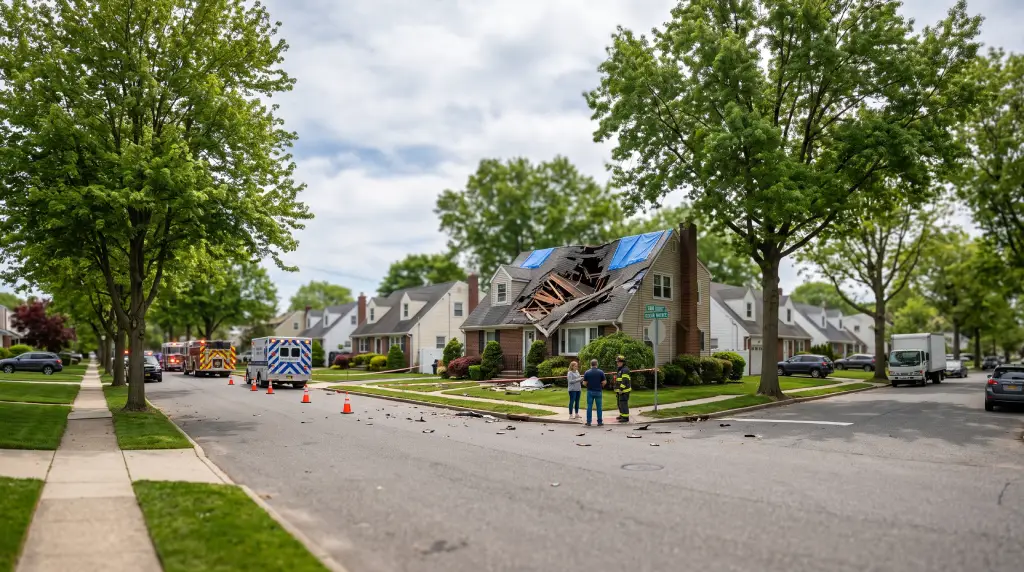
A Nassau County roof collapse injury lawyer at Silver Law Group represents people crushed or pinned when a roof or ceiling gives way, and the families of those who did not survive it. If a rotted beam or a water-logged ceiling put you in the hospital, you have the right to hold the owner, contractor, or roofing company that let it happen accountable. Your first consultation is free, comes with no obligation, and you can reach a lawyer any hour of the day or night. You pay nothing unless we recover money for you. If your injuries keep you home or in a bed at North Shore in Manhasset or NYU Langone in Mineola, the attorney comes to you. Call 212-470-4544.
Do You Have a Roof Collapse Injury Case?
You have a case when someone responsible for that roof or ceiling failed to keep it safe, and that failure is what hurt you. New York negligence law asks four things: that the owner or contractor owed you a duty of reasonable care, that they breached it, that the breach caused the collapse, and that you were injured. A sound roof does not fall on its own.
The causes trace back to a decision someone made or ignored. Snow load beyond what the structure was built to carry, water damage that rotted the joists and decking through years of unrepaired leaks, aging construction no one bothered to inspect, or defective roofing work that was wrong the day it was finished — each one points to a party who could have stopped the collapse and did not.
Nassau County has seen how fast these failures happen. A building at the Jericho Water District on Stillwell Lane in Woodbury collapsed in August 2023, and structural failure like that is not limited to old or neglected buildings. If your collapse traces to any of these causes, it was preventable, and someone chose not to prevent it.
Who Is Liable for a Nassau Roof or Ceiling Collapse?
More than one party is usually on the hook for a Nassau roof or ceiling collapse, and naming all of them early is what protects your recovery.
- Building owners and landlords, who are responsible for keeping the structure safe
- General contractors and roofing companies whose work caused the defect or hid it
- Developers and architects who approved a flawed design or the wrong load rating
- Property managers charged with inspection and upkeep
These claims rarely land on a single defendant. A landlord may blame the roofing company that patched the roof two winters ago; that contractor may point to the architect who specified the wrong materials. When fault is shared, each party stays responsible for its own share, which is why suing only the obvious defendant can leave real money uncollected. If you are weighing how to sue a roofing company whose work failed, the same investigation that names them usually names the owner and manager who let the work go unchecked.
Injured Construction Workers and Roofers
If you were working on or under that roof when it came down, New York gives you protections that ordinary negligence law does not. Labor Law §240, the Scaffold Law, puts absolute liability on owners and general contractors when an elevation-related risk injures a construction worker. Absolute liability means that once the height hazard caused your injury, the owner and GC cannot blame your own carelessness to escape paying. Labor Law §241(6) reaches further, letting you build a claim on specific Industrial Code violations like inadequate shoring or unsafe planking, and Labor Law §200 codifies the general duty to run a safe worksite.
Here is the part injured roofers miss. Workers’ compensation bars you from suing your own employer, and it pays only a fraction of what a full injury claim is worth. But comp does not touch anyone else. The property owner, the general contractor, and the roofing company you did not work for can each be sued directly in a third-party claim that runs alongside your comp case. That third-party claim is where lost earning capacity and pain and suffering come back into reach.
Injured Tenants, Shoppers, and Visitors
If you were a tenant, a customer, or a guest when the ceiling came down, your claim runs on premises liability. The owner owed you a duty to keep the property reasonably safe, and the case turns almost entirely on one question: did they know, or should they have known, about the danger before it hurt you?
That question splits into two kinds of notice. Actual notice means the owner already knew, because a tenant reported the leak or an inspector flagged the sag. Constructive notice means the condition existed long enough and openly enough that a reasonable owner should have found it, even a leak no tenant ever formally reported. A brown water stain spreading across a ceiling for months, a visible bow in the drywall, a soft spot the super was told about and never fixed — each of these is proof the owner should have known and did nothing.
Proving that notice is the work. The maintenance logs, the prior complaints, and the photos a neighbor took of the sagging plaster weeks before are what turn a bad accident into a claim the owner has to answer for.
Common Roof and Ceiling Collapse Injuries
A collapsing roof drops concentrated weight onto whoever is beneath it, and the injuries are rarely minor.
- Traumatic brain injuries from a direct blow or from being thrown
- Spinal cord damage that can mean partial or permanent paralysis
- Crush injuries to the limbs and torso when debris pins the body
- Fractures, often several at once, from the impact
- Internal organ damage and bleeding that never shows on the surface
The dangerous injuries are the ones you cannot feel yet. A brain bleed, internal bleeding, or a spinal injury can stay quiet for hours while it gets worse. Get a full trauma evaluation the same day, even if you walked away and feel only bruised, because that emergency record is also the first documented proof the collapse hurt you.
What Is Your Nassau Roof Collapse Claim Worth?
What your claim is worth depends on what the collapse cost you — the care you have needed and will need, and the income the injury takes from you.
- Medical costs already incurred, from the ER and surgery to imaging and the hospital stay
- Future care, including additional surgery, rehabilitation, home health aides, and equipment
- Lost wages for the time you could not work
- Diminished earning capacity when the injury permanently changes what you can earn
- Pain and suffering for the physical and emotional toll
The future-facing losses are usually the largest and the easiest to undervalue. A spinal injury that ends a physical trade, or a brain injury that limits the hours you can work, follows you for decades, and pricing that correctly takes medical and vocational proof, not a quick offer from an adjuster.
New York does not shut you out if you were partly to blame. Under CPLR §1411, the state follows pure comparative negligence: your recovery is reduced by your share of fault but is never barred, even if you were found more at fault than the defendant. If a jury decides you were 20 percent responsible, you still collect 80 percent of your damages. This matters when a property owner argues you ignored an obvious hazard, because that argument can shave your recovery but it cannot erase it.
What to Do After a Roof Collapse in Nassau County
The hours after a collapse decide how strong your claim will be, and most of what matters you can do from your phone or ask someone to do for you.
- Photograph everything: the fallen structure, the debris field, and the water stains or rot at the point where it broke, before anyone cleans up.
- Preserve the debris. The failed beam, the rotted decking, and the section of roof that gave way are physical evidence, so ask that they not be discarded.
- Get the names and numbers of everyone who saw it, because witnesses scatter fast.
- Get trauma care the same day. In Nassau County, North Shore University Hospital in Manhasset and NYU Langone in Mineola both run trauma services.
- Report it. If you were hurt on the job, make sure the collapse is reported to OSHA, since the investigation that follows can document the safety failures behind your claim.
Do these in whatever order your injuries allow. Your health comes first, and the evidence can be gathered by a family member or your lawyer if you cannot do it yourself.
If a Roof Collapse Killed Someone You Love
When a collapse kills, New York does not let just anyone file. The claim belongs to the estate, brought by the personal representative the Surrogate’s Court appoints, usually a spouse, an adult child, or a parent. Two separate claims run in a wrongful-death case, and they cover different losses.
The wrongful-death claim itself, under EPTL §5-4.3, is measured by pecuniary loss, meaning the financial support, services, and guidance the person would have provided. New York’s law here is narrow: it compensates the economic value the family lost, not the family’s grief. That limit is one of the harder truths families hear, and it shapes how the case has to be built.
The survival claim, under EPTL §11-3.2, belongs to the person who died. It recovers what they endured between the collapse and their death, including the conscious pain and suffering in those minutes or hours. Where death was not instant, this claim carries real weight. Together, these two actions are how a Nassau family holds a negligent owner or contractor responsible for a death a safe roof would have prevented.
Deadlines to File a Nassau Roof Collapse Lawsuit
A roof collapse case runs on more than one clock, and the shortest one can end your claim before you knew it was ticking.
For a personal injury, CPLR §214 gives you three years from the date of the collapse to sue. That sounds like plenty until you see how much of it disappears into treatment and recovery.
If someone died, the wrongful-death clock is shorter: EPTL §5-4.1 gives the estate two years from the date of death, and it runs separately from the three-year injury deadline. The real trap is the public building. If the collapse happened in a government-owned structure such as a school, a library, or a county facility, General Municipal Law §50-e requires a Notice of Claim within 90 days of the injury, long before any lawsuit is filed. Miss that 90-day window and the three-year deadline stops mattering, because the court will not hear a late claim against a public entity. A defendant like the Jericho Water District is exactly the kind of public body this rule reaches.
When you do file, a Nassau County roof collapse case is brought in Nassau County Supreme Court in Mineola, the trial court that hears these injury suits. Every one of these deadlines has narrow exceptions, and a few have none, so the safe move is to have a lawyer calculate your dates the week you are hurt, not the month before they run.
Why Nassau Families Choose Silver Law Group
The fee works one way. You pay nothing up front, nothing while the case runs, and no attorney’s fee at all unless we recover money for you. Our fee is an agreed percentage of that recovery, and if there is no recovery, you owe no fee. The costs of building the case, including the experts, the filing fees, and the investigators, are fronted by the firm rather than billed to you as you go. That matters when you are out of work and an adjuster is already pushing you to settle cheap.
The first conversation is free and puts you under no obligation. We hold consultations in English, Spanish, and Russian, so you can explain what happened in the language you actually think in, and someone is reachable 24/7 because collapses do not wait for business hours.
We prepare every case as if it will be tried, which is what makes an insurer treat a settlement offer seriously. If your injuries keep you home or in a hospital bed in Manhasset or Mineola, the attorney comes to you. Our office is at 49 West 37th Street in Midtown Manhattan, a short drive from Nassau County. Call 212-470-4544.