

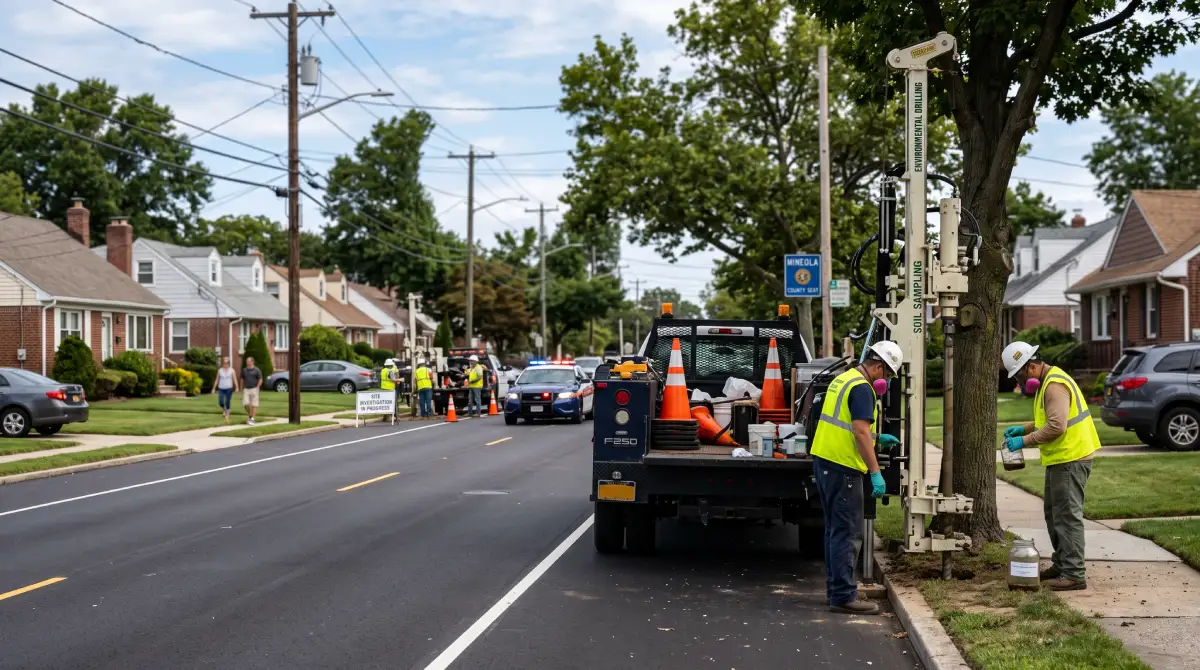
If a chemical, contaminated water, or a toxic substance at work made you sick, the Nassau County toxic tort lawyers at Silver Law Group can tell you whether you have a case worth bringing. These are not ordinary injury claims. The harm often surfaces years after the exposure, and proving where it came from takes far more than a diagnosis. We focus on chemical injury and environmental exposure for Nassau residents, from the Bethpage plume corridor to the older housing in Hempstead. Every consultation is free, available 24 hours a day, and handled in English, Spanish, or Russian. Call 212-470-4544 and talk with someone who works these cases directly, not an intake screener.
Do You Have a Nassau County Toxic Exposure Case?
You may have a claim when a substance you never chose to be near damaged your health and someone else controlled that exposure. Toxic tort litigation covers a wide range of substances, but the ones behind most Nassau claims sort by where the exposure happened:
- Workplace exposure to asbestos in old insulation and building materials, benzene in fuels and solvents, and silica dust released when workers cut stone, brick, or concrete.
- Lead paint in homes built before 1978, still common across Nassau’s older housing, along with toxic mold that grows after long-term water damage goes unaddressed.
- Pesticides, industrial cleaners, and consumer products that release benzene or other solvents during normal use.
- Contaminated groundwater carrying TCE and PFAS into private wells and public supply.
You do not need to have handled the chemical yourself. Family members have developed asbestos disease from dust carried home on work clothes, and residents have been exposed simply by drinking tap water above a contaminated aquifer.
Two things tend to be true across all of these. The illness rarely appears right away, so people connect it to a chemical only after a serious diagnosis. And the responsible party is usually a company with its own lawyers and insurer, which is why an early call to a toxic exposure attorney matters more here than in a straightforward crash claim.
The Bethpage Plume and Nassau’s Contamination Sites
Nassau County sits on top of one of the most documented groundwater contamination sites in New York. For decades, the U.S. Navy and Grumman ran aerospace and defense operations in Bethpage, and the solvents used there seeped into the ground. The result is the Bethpage plume, a mass of contaminated groundwater that New York designated a state Superfund site in 1983 and that has kept spreading through the aquifer system beneath the county.
The primary contaminant of concern is trichloroethylene (TCE), an industrial solvent classified as a human carcinogen. It has been detected in the Magothy Aquifer, the deep water source that supplies much of central Nassau, beneath Bethpage and reaching toward Oyster Bay. Because the plume moves underground over time, the boundary of who was exposed is not fixed; wells that tested clean years ago can later show contamination as it migrates.
That history matters for your claim in a specific way. When a court or agency formally identifies a contamination site, New York opens a filing window tied to that designation, which can revive claims that would otherwise look too old. A diagnosis you connect to Bethpage water does not automatically fall outside the deadline just because the exposure started long ago.
The plume is the best-known problem, but not the only one. Nassau’s older housing, concentrated in areas like Hempstead, still carries lead paint in homes built before the 1978 federal ban, and lead remains a live risk for children in those units. Former industrial and dry-cleaning sites across the county have left their own solvent and chemical residues in soil and groundwater. If your illness traces to any of these, the source and its history are often already part of the public record, which is where a toxic tort case usually begins.
Illnesses Linked to Toxic Exposure
The diseases that bring people to a toxic tort attorney are serious, and most share one feature: a long gap between exposure and diagnosis.
- Mesothelioma, a cancer of the lung and abdominal lining caused almost exclusively by asbestos, often diagnosed 20 to 50 years after exposure.
- Lung cancer and kidney cancer, both linked to solvents like TCE and to airborne industrial contaminants.
- Leukemia and other blood cancers connected to benzene.
- Chronic respiratory disease, including permanent scarring of the lungs from silica and asbestos dust.
- Neurological damage from heavy metals and solvents, ranging from memory and coordination problems to lasting injury.
- Reproductive harm and birth defects tied to exposure during or before pregnancy.
The latency is the hard part. Someone exposed to benzene in the 1990s may not develop leukemia until now, and by then the job, the product, or the company may be long gone. That delay is exactly why these cases turn on reconstructing an exposure history rather than pointing to a single recent event.
Proving Causation — Why These Cases Are Different
Winning a toxic tort claim comes down to causation, and New York breaks that into two separate questions you have to answer. The first is general causation: can this substance cause this disease at all? The second is specific causation: did your exposure, at the level and duration you experienced, cause your illness in particular? A crash case rarely needs either question spelled out. A chemical case fails without both.
Proving them takes evidence most people cannot assemble alone. Expert toxicologists testify to the dose and biological mechanism that link the substance to the disease. Environmental testing of water, soil, air, or a product establishes what you were actually exposed to and at what concentration. Your medical records document the diagnosis and rule out other explanations a defense lawyer will otherwise raise.
The piece that ties it together is exposure reconstruction, building a timeline of when, where, and how much you came into contact with the substance, often going back decades. That can mean tracking employment records, product histories, building materials, or the movement of a groundwater plume beneath a specific address.
Defendants in these cases are usually corporations that have handled exposure claims before, and their standard move is to argue your illness came from something else, such as smoking, genetics, or an unrelated job. The reconstruction and expert testimony are what close off those arguments. Starting early helps for a concrete reason: witnesses, records, and testing sites are easier to reach the sooner the work begins, and some evidence disappears with time.
Who Can Be Held Liable
More than one party is often responsible for a toxic exposure, and identifying all of them changes what you can recover. Depending on how you were exposed, liability can fall on:
- Manufacturers that made or sold a hazardous chemical or a product containing one, sometimes while knowing the risk.
- Employers whose worksites exposed workers to asbestos, benzene, silica, or solvents.
- Property owners and landlords who failed to address lead paint, mold, or contamination on premises they controlled.
- Product makers whose consumer goods released toxic substances in ordinary use.
If you were exposed at work, the split between two systems decides your options. Workers’ compensation is no-fault: you can collect medical coverage and partial wage benefits from your employer without proving anyone did anything wrong, but you generally cannot sue that employer directly. A third-party toxic tort suit runs against outside parties such as the chemical manufacturer, a product maker, or a contractor on the site, and it is not capped the way comp benefits are, which is where the fuller recovery in these cases usually comes from. Many injured workers have both a comp claim and a third-party case running at once, and coordinating them protects what you keep from each.
Workplace Chemical Exposure Claims
Construction and industrial sites produce some of Nassau’s most serious chemical exposures, and New York’s Labor Law gives those workers a route the comp system does not. Labor Law §200 codifies the general duty to keep a worksite reasonably safe, which can reach exposure to toxic dust and fumes when the site owner or general contractor controlled the conditions. Labor Law §241 imposes specific safety obligations during construction, excavation, and demolition, the exact work that stirs up asbestos, silica, and solvent vapors.
The everyday hazards are concrete. Benzene shows up in fuels, adhesives, and degreasers. Silica dust comes off any operation that cuts or grinds concrete, stone, or masonry, and it scars the lungs permanently. Solvents used for cleaning and stripping carry both cancer and neurological risk. Because a general contractor or property owner can be a third party rather than your employer, a Labor Law claim can proceed alongside your workers’ compensation, keeping the larger recovery on the table.
Compensation You Can Recover
What you can recover in a toxic tort case depends on the illness and how it changes your life, but the categories are broader than what workers’ comp alone will pay:
- Medical costs already incurred, from diagnosis through treatment.
- Future care, which in cancer and chronic respiratory cases can mean years of monitoring, medication, and treatment.
- Lost earnings for the time you could not work.
- Diminished earning capacity, when the illness limits or ends your ability to do your job.
- Pain and suffering, covering the physical toll and its effect on daily life.
When a toxic exposure proves fatal, the family’s claim changes shape. Under New York’s wrongful death statute, surviving family members can recover separately for their own losses, including the financial support the person provided. Those damages belong to the family and are pursued apart from any claim the person could have brought while alive.
We do not attach dollar figures to a case before the evidence is in. The value comes from the medical proof, the exposure history, and the earning loss, and putting a number on it earlier than that would be a guess rather than an answer.
How Long You Have to File in Nassau County
Toxic tort deadlines work differently from ordinary injury deadlines, and the difference usually helps you. Because these illnesses hide for years, New York does not start your clock on the day of exposure.
Under CPLR 214-c, the standard toxic exposure rule, you have three years from the date you discovered the injury, or reasonably should have discovered it, not three years from the exposure itself. For a disease diagnosed decades after the contact, that discovery rule is often the only thing that keeps the claim alive. It also means the three years can start running at diagnosis, so waiting once you connect an illness to a chemical is a real risk.
Contamination sites like Bethpage get an additional rule. CPLR 214-f gives people harmed by a designated Superfund site a filing window measured as the greater of the ordinary 214-c period or three years from the date the site was classified. It exists precisely so that people exposed to a plume identified years after their exposure are not shut out by a deadline that ran before anyone knew the source. If your claim ties to the Bethpage plume, this is the provision that may keep it timely.
When toxic exposure causes a death, a separate and shorter clock applies. Under EPTL 5-4.1, the family’s wrongful death claim must be filed within two years of the death. That runs independently of the injured person’s own discovery deadline, so a family can face the two-year limit even while other timelines look longer.
Which deadline controls your case depends on the disease, the date of diagnosis, and whether a designated site is involved. That determination is worth making early, because once a deadline passes, the strength of the underlying claim stops mattering.
What It Costs and How to Start
Cost is the first worry for most people we hear from, and the answer is built to remove it. Silver Law Group takes toxic tort cases on a contingency fee, which means you pay no attorney fee up front and no fee at all unless we recover money for you. The fee is a percentage of the recovery, agreed to in writing before we start, and it comes out of the result rather than your pocket. If the case does not recover, you owe no attorney fee. That structure lets you bring a claim against a manufacturer or a well-funded defendant without risking money you do not have while you are already facing medical bills and lost income.
Starting is straightforward. The consultation is free, available any time of day, and offered in English, Spanish, and Russian. If your illness makes travel hard, the attorney comes to you anywhere in Nassau County, at your home or a hospital, so you are not commuting into Manhattan while you are sick. Our office is at 49 West 37th Street in Midtown, but the case begins wherever you are. Call 212-470-4544 to find out whether you have a claim and what your deadline is.