

A Nassau County construction worker injury lawyer can pursue money that workers’ compensation by itself will never pay you: full lost wages, pain and suffering, and the lifetime cost of a permanent disability. Comp covers your medical care and roughly two-thirds of your paycheck, but it stops there, and it never touches the property owner, contractor, or equipment maker whose negligence put you in the hospital. Silver Law Group handles these third-party cases on contingency, so there is no fee unless you recover. The consultation is free, open 24 hours a day, and available in English, Spanish, and Russian. If a spinal or head injury keeps you off your feet, the attorney comes to your home or your hospital bed anywhere in Nassau County to go through what happened.
Do You Have a Nassau County Construction Injury Claim
Workers’ compensation is not the end of the road. If someone other than your direct employer caused the accident, you can bring a third-party lawsuit at the same time you collect comp benefits, and that lawsuit is where the real money for a serious injury lives.
The question is who else was at fault. On most Nassau job sites, several companies share control of the site without sharing a payroll, and each is a separate target for liability:
- The property owner, who under New York law owes construction workers safety duties that cannot be delegated away
- The general contractor running the site and setting the schedule that pushed a crew onto an unsafe scaffold
- Subcontractors whose crew left an open trench, a live wire, or a load rigged to fall
- The manufacturer of a defective saw, hoist, lift, or ladder that failed under normal use
Your own employer is usually off-limits for a lawsuit because comp is the trade-off for that immunity. But the owner and the general contractor almost never are, and identifying every company with a stake in the site is the first thing your lawyer does. Miss one, and you leave the part of your claim that pays for a ruined back or a lost hand on the table.
How New York Labor Law Protects Nassau Construction Workers
New York gives construction workers protections that no other injured person in the state gets, and they come from three sections of the Labor Law.
Labor Law 240, the “scaffold law,” is the strongest. It imposes strict liability on owners and contractors for gravity-related injuries: a fall from a height, or an object that falls and strikes a worker below, when proper protection was not provided. Strict liability means you do not have to prove the owner was careless. If a scaffold had no guardrail, or a ladder was not secured, and you fell, the defendant is liable for that failure. This is the provision insurers fight hardest, because it takes their favorite defense off the table.
Labor Law 241(6) reaches accidents that are not about falling. It ties liability to specific violations of the Industrial Code, New York’s detailed safety rulebook covering things like trench shoring, debris removal, and machine guarding. Your lawyer has to point to the exact regulation the site broke, which is why the specifics of how you were hurt matter so much.
Labor Law 200 is the general duty to keep a worksite reasonably safe. It applies more broadly than the other two but requires proof that the owner or contractor knew about the hazard, or controlled the work closely enough that they should have. Together these three statutes are the backbone of nearly every Nassau construction case, and the facts of your accident decide which one carries your claim.
When the Homeowner Exemption Applies
There is one carve-out. Owners of one- and two-family homes are exempt from Labor Law 240 and 241 liability, on the theory that a private homeowner is not a professional builder and cannot police a contractor the way a developer can.
The exemption is narrow. It disappears the moment the homeowner directs or controls how the work is done. A homeowner who points to where the deck goes and then stays out of it keeps the exemption; one who tells your crew which ladder to use, sets the method, or supervises the job loses it and becomes liable like any other owner. Whether the homeowner crossed that line is a fact question, and it often decides a case involving a two-family house in Hempstead or Levittown.
Common Nassau Construction Accidents and Injuries
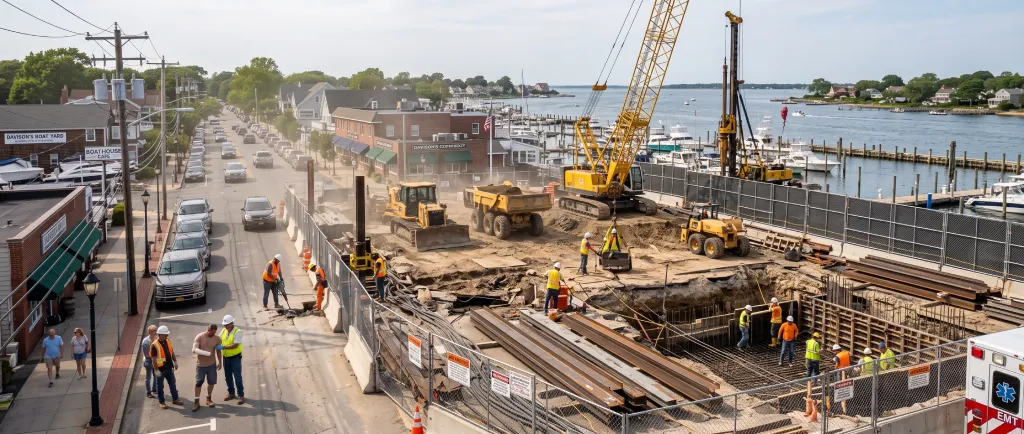
The redevelopment work along Sunrise Highway and the commercial corridors off Old Country Road puts crews on scaffolds, in trenches, and under crane loads every day. The accidents that follow fall into a handful of patterns:
- Falls from scaffolds, ladders, and unguarded roof edges
- Falling objects: dropped tools, swinging loads, collapsing material stacks
- Trench and excavation collapses that bury a worker in seconds
- Crane failures and tip-overs on tight urban lots
- Electrocution from live wires and un-grounded equipment
The injuries these produce are life-altering. A fall or a fallen object can fracture a spine and leave you paralyzed, or cause a traumatic brain injury that changes how you think and work for good. Electrical contact and fires cause deep burns that need repeated surgery. Machinery amputates fingers, hands, and arms. Fractures that would heal cleanly in a younger job often end a career for a worker who has spent thirty years in the trades. The common thread is that each of these injuries carries costs, in future earnings and future care, that reach far past anything comp will ever pay.
Workers’ Compensation Versus a Third-Party Lawsuit
These two claims run on different rules, and you can have both.
Workers’ compensation is no-fault. You get benefits no matter who caused the accident, even if it was partly your own mistake, and you get them without suing anyone. The trade-off is what comp pays: your medical treatment, and about two-thirds of your average weekly wage up to a state cap. It pays nothing for pain and suffering, nothing for the full value of the paycheck you lost, and nothing extra for a permanent disability beyond a scheduled formula. For a catastrophic injury, comp alone leaves a family well short of whole.
A third-party lawsuit is the opposite. You must prove someone was at fault, but if you do, you recover the full range of damages: every dollar of lost past and future earnings, the complete cost of your medical care, and money for the pain, the disability, and the life you cannot get back.
One rule connects them. When you win a third-party case, your workers’ comp carrier holds a lien and is entitled to be paid back out of your recovery for the benefits it already paid you. That sounds like it shrinks your award, but the lien is negotiable, and reducing it is part of the settlement work your lawyer does. Handled right, pursuing both claims leaves you with far more than comp alone, which is the entire point of bringing the lawsuit.
What Your Nassau Construction Claim Can Recover
A third-party claim is measured by what the injury actually cost you and will keep costing you. That includes:
- Lost earnings, past and future, including the raises and career you would have had if you could still do the work
- The full cost of medical care: surgery, hospital stays, rehabilitation, medication, and the long-term treatment a spinal or brain injury requires
- Pain and suffering, for the physical pain and the toll on your daily life
- Permanent disability, compensating a lasting loss of function that ends or limits your ability to work in the trades
- Wrongful-death damages, when a worker is killed, for the surviving spouse and children who lost that income and support
The size of these numbers is why the third-party case matters. A career-ending back injury at fifty is not a bill you can add up in a month; it is decades of earnings and care, and the claim exists to make the company that caused it pay for all of it.
Steps to Take After a Nassau Construction Accident
What you do in the first days shapes what your claim is worth later. Take these steps in order:
- Report the injury to your employer in writing as soon as you can. This starts your workers’ comp claim and creates a dated record of the accident.
- Get to a trauma center. Nassau University Medical Center on Hempstead Turnpike in East Meadow and NYU Langone Hospital–Long Island in Mineola both handle serious construction trauma. Go even if you think you can walk it off; internal and spinal injuries often hide behind adrenaline for a day.
- Photograph everything you safely can: the scaffold, the ladder, the trench, the machine, the debris, and the wider scene before the site is cleaned up and the evidence disappears.
- Get names and numbers from coworkers who saw what happened.
One thing to refuse: a recorded statement to any insurance adjuster who calls, whether it is the comp carrier or the contractor’s insurer. Adjusters call early and sound helpful, and a stray sentence about “feeling okay” or “not looking where I was going” gets used to cut your claim. Tell them your lawyer will be in touch, and say nothing else.
Deadlines to File a Nassau Construction Claim
Your case runs on more than one clock, and the shortest one that applies to you controls.
- CPLR 214 gives you three years from the date of the accident to file a personal injury lawsuit. Miss it and the third-party claim is gone, no matter how strong.
- EPTL 5-4.1 gives the family of a worker who was killed two years from the date of death to bring a wrongful-death suit.
- Workers’ compensation has its own front-end deadlines: you generally must notify your employer within 30 days of the injury, and file the comp claim within two years.
- If the accident happened on a public-works site owned by a city, county, or public authority, GML 50-e requires a Notice of Claim within 90 days before you can sue that entity. This is the trap that catches the most workers, because 90 days passes fast while you are still in treatment.
The safe move is to have a lawyer sort out which deadlines apply to your specific site early, while every option is still open.
Why Injured Nassau Workers Choose Silver Law Group
Many firms handle only the workers’ comp side and stop there. That leaves the larger claim, the third-party lawsuit that actually pays for a permanent injury, unfiled. Silver Law Group builds the third-party case from day one and prepares it to be tried, not just settled cheaply because the file was never worked up.
Trial-ready matters here. Insurers track which firms take construction cases to a Nassau County jury and which always fold. Cases prepared for trial in Nassau County Supreme Court in Mineola carry more weight in settlement talks, because the other side knows the file will hold up in front of a judge if they lowball it.
Here is how the fee works. You pay nothing up front and nothing out of pocket. The firm advances the costs of building your case: the investigators, the medical records, the expert witnesses who explain how the scaffold failed or what your future care will cost. The fee is a percentage of what you recover, taken only if you recover. If the case brings in nothing, you owe nothing and you are not billed for the expenses. That structure means a hurt worker with no income can afford the same caliber of representation as the company on the other side.
Every case starts with a free consultation, available 24 hours a day in English, Spanish, and Russian. If your injuries keep you home or in the hospital, the attorney comes to you anywhere in Nassau County. Call 212-470-4544, or reach the Midtown office at 49 West 37th Street, 7th Floor, New York, NY 10018.