

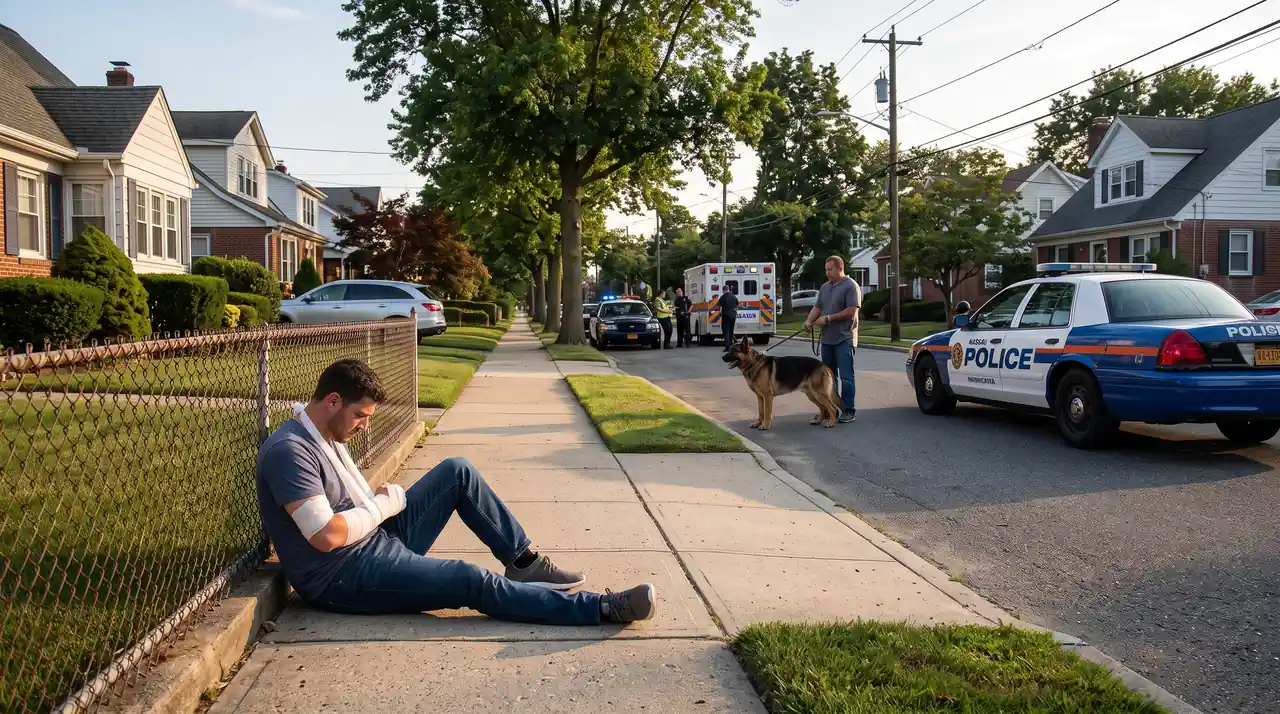
A dog bite in Nassau County can leave you with puncture wounds, nerve damage, and bills that arrive before the wound closes. A Nassau County dog bite lawyer can tell you in one call whether the owner is legally responsible and what your claim covers. Silver Law Group represents dog attack victims across the county, and every case starts with a free consultation — call 212-470-4544, any hour, day or night.
You pay nothing unless we win money for you. New York law gives you a real claim against a careless owner and their insurer, but the clock starts the day you are bitten, and the shortest deadline can arrive fast. If an adjuster has already called you, say little and call us first, because what you tell them in the first week can shrink your claim.
Do You Have a Dog Bite Case in Nassau County?
New York holds a dog owner strictly liable for a bite when the dog had known vicious propensities and the owner knew about them. That rule comes from Agriculture and Markets Law § 123, and strict liability means you do not have to prove the owner was careless — only that the dog had shown dangerous tendencies and the owner was aware.
The word “vicious” is broader than most people expect. A dog does not need a bite history to count. Growling at visitors, snarling, baring teeth, lunging on the leash, straining against a chain, or a documented tendency to chase people can all show the propensity the law asks about. If the owner had seen any of that and kept the dog anyway, the earlier warning signs become the core of your case.
Proof usually comes from the people around the dog. Neighbors who crossed the street to avoid it, a mail carrier who filed a complaint, a prior animal-control report, a “Beware of Dog” sign the owner posted, or a vet record noting aggression — each one helps show that the owner knew.
Under strict liability, once you show the dog’s known propensity, the owner is on the hook for your injury costs even if they insist the dog “never did this before.” That is why we start by mapping the dog’s history in your neighborhood, not just the moment it bit you.
When the Dog Never Bit Before
For almost twenty years, an owner whose dog had no history of aggression was nearly impossible to sue. A 2006 decision, Bard v. Jahnke, blocked ordinary negligence claims against dog owners and left strict liability as the only route, which meant a first-time bite often left the victim with nothing.
That changed on April 17, 2025. In Flanders v. Goodfellow, New York’s highest court overruled Bard and held that you can now sue a dog owner for ordinary negligence, the same way you would sue a driver who ran a light. You no longer need to prove the dog bit or menaced anyone before.
For you, this widens who you can hold responsible. If an owner let a dog off-leash near a crowded sidewalk, failed to fix a broken gate, or ignored a fence they knew a large dog could clear, that carelessness can support your claim on its own. A Nassau County dog bite case that would have been dead on arrival two years ago may be fully viable today.
Who Pays: Owners, Landlords, and Homeowner’s Insurance
The dog’s owner is the obvious defendant, but the money that actually pays your claim usually comes from an insurance policy, not the owner’s bank account. In most Nassau County cases, that policy is the owner’s homeowner’s or renter’s insurance, which typically covers dog-bite injuries up to the policy limit. That is the fund a Nassau County dog bite lawyer goes after first.
Two other parties can share the bill:
- A landlord, when they knew a tenant’s dog had vicious propensities before signing or renewing the lease and let the dangerous dog stay anyway. Their knowledge at that moment is the hinge of the claim.
- A property owner or business, if the attack happened on premises they controlled and they ignored a known risk.
Renters matter here too. If the owner rents and carries renter’s insurance, that policy can respond even though the tenant owns no home. And if the owner has no coverage at all, we look at their personal assets and any umbrella policy before deciding how to proceed. Sorting out which policy applies, and which one has the higher limit, is often the difference between a claim that pays your full costs and one that stalls.
What a Nassau County Dog Bite Claim Is Worth
Your claim is built from specific losses, not a single lump guess. New York lets you recover both the money you have spent or lost and the harm that never shows up on a receipt. In a Nassau County dog bite claim, the pieces usually include:
- Medical bills — emergency care, wound repair, antibiotics, rabies and tetanus treatment, and any follow-up surgery.
- Lost wages for the days or weeks you could not work while healing.
- Future earning loss, if nerve damage or a disabling injury changes what work you can do going forward.
- Pain and suffering, which covers the physical pain and the fear, sleep loss, and anxiety many bite victims carry afterward.
- Scarring and disfigurement, valued separately because a permanent mark, especially on the face or hands, follows you for life.
- Punitive damages, available only when the owner’s conduct was reckless — for instance, keeping a dog they knew had already mauled someone.
You can prove the economic pieces with paper: pay stubs, bills, and a doctor’s report on future costs. The human pieces take a different kind of proof, which is why we document how the injury changed your daily routine, your work, and your sleep from the first week on. Two bites that look similar on an X-ray can be worth very different amounts once that full picture is in front of an insurer or a jury.
Child Victims and Facial Scarring
Children are bitten differently than adults. Because a small child’s face sits at a dog’s mouth level, kids take a disproportionate share of head, face, and neck wounds, and those are the injuries that scar most visibly. A bite that would catch an adult on the forearm can catch a five-year-old across the cheek or lip.
That changes the shape of the claim. Facial and neck injuries often need reconstructive surgery, sometimes staged across years as the child grows, and a scar that seems small at age six can widen and stretch by adulthood. New York accounts for this with higher non-economic value — the disfigurement, the surgeries ahead, and the emotional weight a visible scar puts on a child are all compensable.
Because a minor’s injury clock does not start until they turn 18, a parent has more time to act — but early medical documentation still shapes the case.
What to Do After a Dog Bite in Nassau County
What you do in the first days after a bite shapes both your health and your claim. Work through these steps in order:
- Get medical care the same day. A dog’s mouth carries bacteria that can infect fast, and deep punctures need professional cleaning. For a serious bite, the emergency rooms at Nassau University Medical Center in East Meadow and NYU Langone Hospital–Long Island in Mineola can handle wound repair and start rabies and tetanus treatment.
- Report the bite to the Nassau County Department of Health. A report creates an official record, triggers a check on the dog’s rabies status, and documents the attack while it is fresh.
- Photograph everything. Take clear pictures of every wound before and after cleaning, your torn clothing, and the location — then keep photographing the injuries as they heal, since scarring evidence builds over weeks.
- Get the owner’s information. Ask for their name, address, phone number, and their homeowner’s or renter’s insurance carrier, the same as you would after a car crash.
- Collect witness details. Anyone who saw the attack, or who knew the dog was dangerous before, can be the difference in proving the owner’s knowledge.
Do this before you talk to any insurance adjuster. The record you build in the first week is the strongest evidence your Nassau County dog bite lawyer will have to work with.
Does the Attack Location Change Your Claim?
Where the dog attacked you changes who you can sue and which insurance responds. A bite in the owner’s own fenced yard usually points straight at their homeowner’s policy. An attack in an apartment or its hallway can pull in the tenant’s renter’s insurance and, if the landlord knew the dog was dangerous, the building owner too.
A sidewalk or street attack often involves a loose or off-leash dog, and after Flanders v. Goodfellow that owner’s carelessness with a gate, leash, or chain can carry the case on its own. Public-park bites are their own category. If the dog belonged to a government body, or the handling of a known dangerous dog is part of the story, a separate 90-day notice deadline kicks in that does not apply to a private owner.
Most Nassau County dog bite lawsuits are filed and heard at the Nassau County Supreme Court, 100 Supreme Court Drive in Mineola, the venue for cases out of Hempstead, Levittown, Massapequa, and the rest of the county. Knowing that court and how local juries weigh dog-bite injuries is part of preparing a claim that holds up if the insurer refuses to pay a fair amount.
How Long You Have to File in Nassau County
A dog bite claim in Nassau County runs on more than one deadline, and the shortest one that applies to you controls whether you have a case at all. Miss it, and the strongest evidence in the world will not save the claim.
- Three years to sue for injury. Under CPLR 214, you generally have three years from the date of the bite to file a personal injury lawsuit. Most dog bite cases fall under this deadline.
- Two years for a wrongful death. If a dog attack kills a family member, EPTL 5-4.1 gives the estate two years from the date of death to bring a wrongful death claim — a full year shorter than the injury deadline.
- Ninety days for a notice of claim. When a government body is involved, such as a dog owned by a public agency or a bite tied to how a county-run shelter handled a known dangerous animal, General Municipal Law 50-e requires a formal notice of claim within 90 days before you can sue at all.
Children get more time. Because a minor’s injury clock is tolled during childhood, the three-year period does not start until the child turns 18. Even so, waiting hurts the case, because witnesses move away and the dog itself can vanish before it is identified. The safe move is to call a Nassau County dog bite lawyer well before any clock runs out.
Why Nassau County Victims Choose Silver Law Group
You choose a dog bite lawyer when you are hurt, behind on bills, and unsure whether hiring one costs money you do not have. Here is how it actually works with us.
You pay no fee to hire us and no fee while your case runs. We work on contingency, which means our fee is a percentage of the money we recover for you, paid only if we win or settle your case. If we recover nothing, you owe us no attorney’s fee. That keeps the risk on us, not on you, and it is why the first conversation is always free.
A few more things injured Nassau County families count on:
- Free consultations in English, Spanish, and Russian, so you can explain what happened in your own language.
- Someone reachable 24/7, because a dog attack does not wait for business hours.
- A trial-ready case from day one — insurers offer more when they can see a firm is prepared to go to court, not just settle.
- Attorneys who come to you at home or in the hospital when you cannot travel to our Midtown office.
From our office at 49 West 37th Street in Manhattan, we handle dog bite cases across Nassau County. Call 212-470-4544 to talk through yours today.