

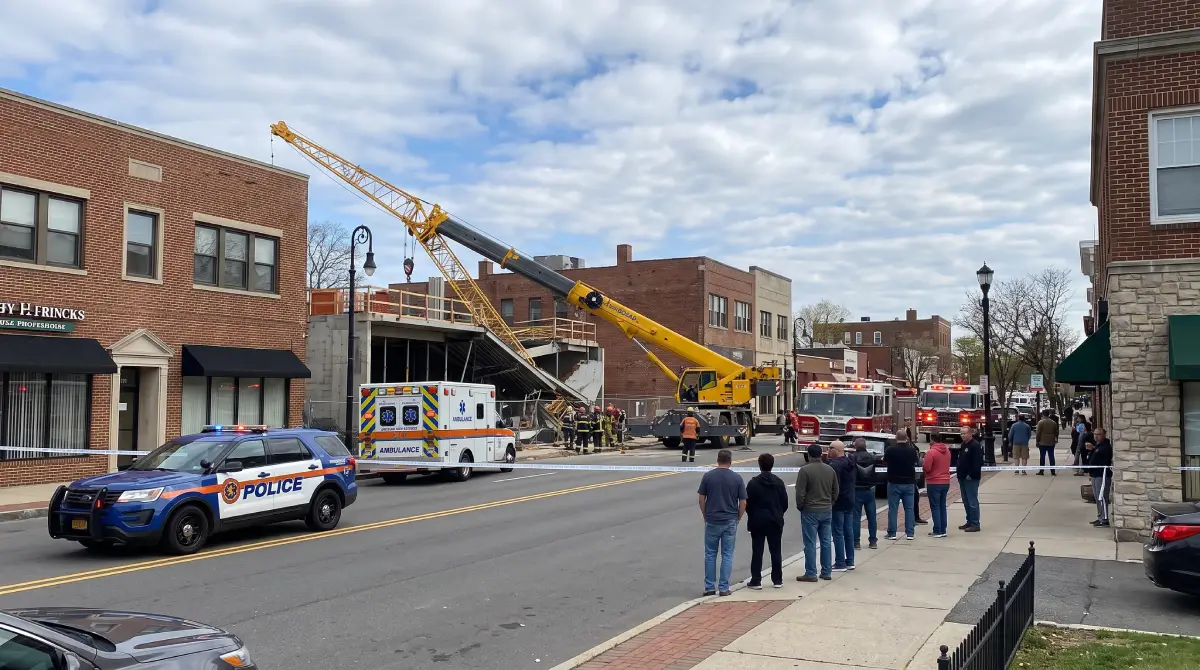
If a crane failed on a Nassau County jobsite and you were hurt, a Nassau County crane accident attorney at Silver Law Group can tell you in one free call whether you have a claim worth pursuing. We represent the ironworkers and laborers who were on the ground when a load came down, and the bystanders who happened to be near the site when a boom swung wide. Our consultations cost nothing and run in English, Spanish, and Russian, so the language you speak at home is the language your case is handled in. You do not have to come to our Midtown Manhattan office to start. If your injuries keep you in a hospital bed in Mineola or at home in Hempstead, the attorney comes to you. Call 212-470-4544 now; the line is answered 24 hours a day.
Do You Have a Crane Accident Case in Nassau County
Workers’ compensation pays your medical bills after a crane accident, but it will not let you sue your employer, and it pays nothing for pain and suffering. That money comes from a separate lawsuit against a company other than your boss, and on a crane job several companies usually share the fault.
The parties a Nassau crane accident lawyer typically looks at include:
- The property owner who controlled the site
- The general contractor answerable for overall jobsite safety
- A subcontractor whose crew created the hazard
- The crane rental company that supplied a defective or badly maintained machine
- The equipment manufacturer, when a design flaw or failed part triggered the collapse
- The rigging crew that hooked and secured the load
Your third-party lawsuit runs alongside your workers’ comp claim, not in place of it. Comp keeps paying while the lawsuit goes after everything comp leaves on the table. This matters most for the workers with the worst injuries, because the losses that never heal — a career you can’t return to, a spine that won’t hold up — are the ones a comp claim was never built to cover. Figuring out who owned, ran, and inspected the crane usually takes an engineer and the site records, which is where having a lawyer early changes the outcome.
New York Labor Law 240, 241, and 200
Three sections of the New York Labor Law give construction workers protection that ordinary negligence law does not, and crane accidents land squarely inside all three.
Labor Law 240, often called the Scaffold Law, covers gravity. If a crane load that should have been secured drops on you, or you fall from height because a required safety device was missing, the owner and general contractor face strict liability. Strict liability means you do not have to prove they were careless; the violation itself is the case. Your own mistakes generally cannot be used to wipe out a 240 claim, which is why insurers fight so hard to argue the accident falls outside it.
Labor Law 241(6) attaches to the Industrial Code, the state’s detailed jobsite rules on crane operation, rigging, and load handling. When a defendant breaks one of those specific rules and you get hurt because of it, that violation supports your claim directly.
Labor Law 200 is the general duty to keep the workplace reasonably safe. It reaches an owner or contractor who controlled the work or knew about the danger and let it stand. Read together, these sections shift the burden onto the companies that ran the site, not the worker who was doing his job.
Common Nassau Crane Accidents and Injuries
Cranes fail in a handful of predictable ways, and each one tends to produce its own pattern of injury on jobsites along Hempstead Turnpike and the Long Island Expressway corridor.
- Collapse of the crane structure or its footing
- Boom failure, where the arm buckles or breaks under load
- Dropped loads from a snapped line, failed rigging, or an overloaded hook
- Power-line electrocution when a boom contacts overhead lines
- Overturning on soft or uneven ground
- Swing-radius strikes that catch workers standing in the machine’s rotation path
The harm from these events is rarely minor. A dropped load or a swing strike delivers crush injuries and shatters bones. A fall or a collapse drives spinal damage that can end in paralysis. Loads and machinery sever limbs, leaving amputations that change how you work for good. And any blow to the head, or a fall onto it, can cause a traumatic brain injury whose full cost shows up months later. These are the cases where lifetime medical care, not a quick check, is what the claim has to account for.
What Your Nassau Crane Accident Claim Is Worth
No lawyer can name a number before the medical picture is clear, because the value of a crane accident case tracks the severity of the injury and the care you will need for the rest of your life. What a full claim accounts for:
- Past medical bills already run up from surgery, hospitalization, and rehab
- Future medical costs, including the care a permanent injury demands for years
- Full lost wages for the time you could not work
- Diminished earning capacity, when you can never return to the trade you trained for
- Pain and suffering, the physical and emotional toll the injury takes
- Loss of consortium, a claim your spouse can bring for the loss of your companionship and support
Workers’ comp reaches only the first parts of that list, and even then only partially. The third-party lawsuit is what puts pain and suffering and a lifetime of diminished earnings back into reach. Building those numbers takes medical experts and often a vocational analysis, which the firm arranges as part of the case.
Workers’ Compensation vs. Third-Party Lawsuit
Workers’ comp is a no-fault system, so you collect regardless of who caused the accident. It pays for your medical treatment and replaces part of your lost wages while you are out. In exchange for that certainty, the law takes away your right to sue your own employer, and it gives you nothing for pain and suffering, no matter how badly you were hurt.
A third-party lawsuit is the other half. It targets the other companies on the job — the owner, the contractor, the crane rental outfit, the manufacturer — and it reaches the damages comp ignores, above all pain and suffering and the full value of what you can no longer earn. You can pursue both at once. The comp benefits keep your household afloat while the lawsuit does the heavier work.
Bystanders sit in a different spot. If you were a pedestrian, a driver, or a passerby struck by a crane accident and you never worked on that site, workers’ comp does not touch your case at all. You file directly against the responsible parties, with none of the comp restrictions on pain and suffering that limit an injured worker’s own employer claim. In practice that often makes a bystander’s path to full damages more direct than a worker’s.
What to Do After a Nassau Crane Accident
The first hours shape the case more than most people expect. If you can, work through these steps:
- Get emergency care. Go to Nassau University Medical Center in East Meadow or NYU Langone Hospital—Long Island in Mineola, both equipped for serious trauma. Do this even if you feel functional; brain and internal injuries hide.
- Report the accident. Tell your supervisor and make sure a written incident report is created on the day it happened.
- Photograph the site. Capture the crane, the rigging, the load, and the ground conditions before anything is moved or cleaned up.
- Get names. Write down coworkers and witnesses who saw what happened.
- Refuse recorded statements. An insurer or the site’s carrier may call within days asking you to go on the record. You are not required to, and a recorded answer given in pain is used to shrink your claim later. Say no and call a lawyer first.
What Hiring Us Costs
Nothing up front, and no fee at all unless we win money for you. Silver Law Group works on a contingency fee, which means our payment is a percentage of the recovery we obtain and comes only out of that recovery. If the case brings in nothing, you owe us no attorney’s fee. The case review that starts everything is free. We also front the costs of building the case — the site investigation, the records, the expert engineers who reconstruct how the crane failed — so you are never asked to fund your own claim out of pocket while you are already out of work.
Deadlines to File a Nassau Crane Accident Claim
A crane accident case can run on several clocks at once, and the shortest one you miss is the one that ends your claim. The deadlines to watch:
- Three years to sue for injury. Under CPLR 214, you generally have three years from the accident to bring a personal injury lawsuit in New York.
- Two years for wrongful death. If the accident killed a loved one, EPTL 5-4.1 gives the estate two years from the date of death to file.
- 90 days for a government defendant. When a public entity is involved — a public project, a municipal property — GML 50-e requires a formal Notice of Claim within 90 days, and the lawsuit itself must follow within one year and 90 days. Miss the notice window and the claim is usually barred no matter how strong it is.
- 30 days to notify your employer. For workers’ comp, you have to give your employer written notice of the injury within 30 days.
These run in parallel, not in sequence. The safest move is to have a lawyer identify which deadlines apply to your specific accident early, because the municipal 90-day window can expire long before you have finished treatment.
Why Injured Nassau Workers Choose Silver Law Group
The insurance company on the other side has one goal, which is to delay your claim until the pressure of unpaid bills makes you take less than the case is worth. We prepare every file as if it is going to trial, because a case built to be tried is the one insurers take seriously and the one that holds its value if they refuse to be fair. You work directly with the attorney on your case, not a rotating desk of assistants, and you can reach us any hour, any day. The first step is a free case review. Call 212-470-4544 now, or tell us where you are and the attorney will come to you.