

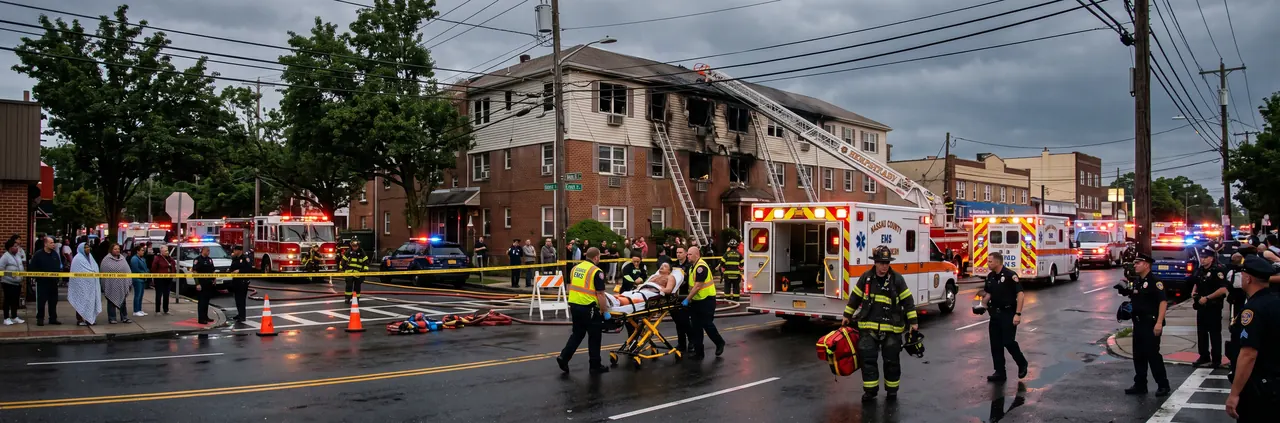
A serious burn doesn’t stay on your skin. A Nassau County burn & fire injury lawyer at Silver Law Group can start protecting your claim today, because fire evidence vanishes fast: burned wiring gets hauled away, the fire marshal releases the scene, and the defective heater that started it ends up in a dumpster within days. If you were hurt in a fire, crash, or explosion anywhere in Nassau County, call 212-470-4544 now, while that proof still exists. The consultation is free, the phone is answered 24 hours a day, and we work in English, Spanish, and Russian.
Do You Have a Nassau County Burn Injury Claim?
You have a claim when someone else’s carelessness caused the fire or the burn. A New York burn case runs on negligence: another person or company owed you a duty of reasonable care, broke it, and your injury is the result. Who that other party is depends on how you were burned.
- A driver whose fuel line or crash sparked a vehicle fire
- A landlord who ignored a broken smoke detector, bad wiring, or a blocked exit
- A contractor whose welding or gas work set off a blaze
- A manufacturer whose space heater, lithium battery, or appliance was built to fail
- A utility that mishandled a gas line or power connection
More than one of them can be liable at once. A landlord and an appliance maker can share the blame for the same apartment fire, which matters because it gives you more than one source of recovery.
Partial fault does not end your case. Under CPLR 1411, New York uses pure comparative negligence: if you were partly to blame — say you left a candle burning — your recovery is reduced by your share of fault, not erased. Even a person found 90% at fault can still recover the other 10%. An insurer will try to pin as much blame on you as possible for exactly this reason, so what you say in the first phone call matters.
Common Causes of Burn and Fire Injuries in Nassau County
Most Nassau burn injuries trace back to a few recurring situations, and where they happen shapes who pays.
Vehicle fires are the most violent. A high-speed collision on the Long Island Expressway can rupture a fuel line and turn a survivable crash into a burn case in seconds. The same pattern shows up on the Northern State and Southern State Parkways, where merges and heavy traffic produce hard rear-end impacts, and on Sunrise Highway, where cross-traffic collisions crush fuel systems. When a car catches fire after a crash, two questions decide the claim: did another driver cause the collision, and did a defect in the car make the fire worse than it should have been.
Rental housing is the second big source. Fires in Nassau apartments and two-family homes often start with problems a tenant never sees: aluminum or knob-and-tube wiring behind the walls, an overloaded circuit, a furnace the landlord never serviced. When a landlord ignores those conditions, the fire that follows is a liability case, not just bad luck.
Gas explosions do the most damage at once. A leaking line or a botched appliance hookup can level part of a house and burn everyone inside. These cases usually involve the gas utility, a contractor, or both.
Then there are the products people trust and shouldn’t:
- Space heaters and stoves that ignite nearby material
- Lithium-ion batteries in e-bikes, scooters, and phones that overheat and catch fire while charging
- Appliances with defective wiring or missing thermal cutoffs
A defective-product burn is often the strongest claim of all, because the manufacturer is liable even if no one was careless in how the product was used.
Construction and Workplace Burn Injuries
Burns on a job site follow different rules than burns anywhere else, and the difference is worth real money to an injured worker.
New York’s Labor Law gives construction workers protections most employees don’t have. Section 240 covers elevation-related work and the equipment failures that come with it. Section 241 sets specific safety requirements for construction, demolition, and excavation sites, including the handling of flammable materials and gas lines. Section 200 is the general duty to keep a site reasonably safe. A welding flash burn, an arc-flash electrical burn, a flash fire from a ruptured gas line, or a chemical burn from mishandled solvents can each fall under these sections when a contractor or property owner broke the rule.
The choice of claim decides what you can actually recover. If you file only a workers’ compensation claim, you get medical coverage and a portion of your lost wages, but nothing for the pain of a skin graft, the permanent scar, or the work you can’t go back to. Workers’ comp also bars you from suing your own employer in most cases.
A third-party claim runs alongside comp and reaches the parties comp can’t touch: the general contractor, the property owner, the equipment manufacturer, a subcontractor from another company. That claim can pay for pain and suffering and full lost earnings, the damages workers’ comp leaves on the table. Many injured workers pursue both at once, and the third-party case is usually where the real recovery is.
Burn Degrees and New York’s Serious Injury Threshold
How badly you were burned drives both your medical future and your legal options. Doctors classify burns by depth.
- First-degree burns damage only the outer skin. They redden and hurt, then heal on their own.
- Second-degree burns reach the layer underneath, blister, and can scar.
- Third-degree burns destroy the full thickness of skin, often killing nerve endings so the deepest areas feel numb. These need grafts.
- Fourth-degree burns go past the skin into muscle, tendon, or bone, and can cost a limb.
Depth also decides one specific legal question for anyone burned in a car or truck fire. New York’s no-fault system normally blocks you from suing the at-fault driver for pain and suffering unless your injury clears the “serious injury” threshold in Insurance Law 5102(d). Permanent scarring and significant disfigurement are named categories in that statute. A burn that leaves a lasting scar, especially on the face, neck, or hands, generally meets the threshold and opens the door to a full injury lawsuit against the driver who caused the fire.
That is why the burn on your record needs to be documented the way it actually looks and feels, not minimized on a chart. The severity a doctor writes down in the first weeks becomes the evidence a defense lawyer later tries to shrink.
What a Nassau County Burn Injury Claim Is Worth
No two burn cases are worth the same, because a burn’s cost is mostly in the future, not the emergency room bill. A full claim accounts for what the injury will take from you over years, not just what it has already cost.
The pieces of a burn claim usually include:
- Medical bills already incurred, from the ambulance and ICU through the first surgeries
- Future skin grafts and reconstructive surgery, which serious burns often require for years as scars mature and contract
- Lost earning capacity, meaning the wages you’ve missed and the work you may never be able to do again
- Permanent disfigurement, valued on its own for the visible, lasting change to how you look
- Physical pain, including the brutal course of burn treatment itself
- Emotional harm, from the trauma of the fire to the anxiety and depression that follow disfigurement
The single biggest driver is future care. A burn that needs staged reconstructive surgeries over a decade, or leaves a young worker unable to return to a physical trade, carries a cost that plays out long after the case settles. Getting that right takes life-care planners and medical experts who project what your treatment will actually require, so the recovery covers the surgeries you haven’t had yet, not just the ones already on paper. Settle before that future is calculated and you absorb the rest yourself.
What to Do After a Burn Injury in Nassau County
The first hours after a burn shape both your recovery and your case. A few steps protect both.
- Get treated at a real burn center. For a serious burn in Nassau County, that means the Nassau County Firefighters Burn Center at Nassau University Medical Center in East Meadow — the only dedicated burn center in the county. A general ER can stabilize you, but specialized burn care lowers infection risk, improves how scars heal, and creates the detailed medical record your claim depends on.
- Photograph everything while it’s fresh: the burns as they progress, the scene, the charred appliance, the damaged car. Burns change appearance over days, so early photos capture what later ones can’t.
- Keep the object that burned you. Do not throw out the space heater, the e-bike battery, or the extension cord, and don’t let anyone “replace” it. In a defective-product case, that item is the evidence, and once it’s gone the claim gets much harder to prove.
- Get the official reports. The Nassau County Fire Marshal investigates the cause of serious fires, and that report can identify the origin and the responsible party. Request it, and hold onto any police or incident reports too.
- Watch what you say to insurers. An adjuster may call within days asking for a recorded statement. You are not required to give one, and doing so early usually helps them more than you.
Do these things before you talk to the other side’s insurance company, not after.
Deadlines to File Your Nassau County Burn Injury Lawsuit
Every burn claim runs on a clock, and burn cases often run on several at once. Miss the shortest deadline that applies to you and that part of your case is gone, no matter how strong it was.
- Three years to sue for the injury. Under CPLR 214, you generally have three years from the date of the fire to file a personal injury lawsuit in New York.
- Two years for a wrongful death claim. If a family member died from the burns, EPTL 5-4.1 gives the estate two years from the date of death to sue, a shorter and separate deadline from the injury clock.
- 90 days if a government is involved. When a public entity may be at fault, such as a municipal building, a public housing authority, or a government vehicle, General Municipal Law 50-e requires a Notice of Claim within 90 days of the incident. Miss it and you can lose the right to sue that entity entirely.
- 30 days for no-fault. If your burn came from a vehicle fire, you must file your no-fault application within 30 days of the crash to keep your medical and wage benefits.
A Nassau County burn lawsuit is filed in the Supreme Court, Nassau County, in Mineola. The 90-day and 30-day windows are the ones that catch people, because they run out while you’re still in the hospital. That is the practical reason to call a lawyer early, before the shortest clock expires.
Why Choose Silver Law Group for Your Nassau Burn Case
You don’t pay us anything up front, and you don’t pay a fee at all unless we win. Silver Law Group works on contingency: our fee is a percentage of the money you recover, taken only from a settlement or verdict. If there is no recovery, you owe us no attorney’s fee. That keeps the risk on us and lets you hire a lawyer while you’re out of work and buried in medical bills.
We prepare every case as if it will go to trial. Insurers track which firms actually try cases and which always settle, and a file built for the courtroom is what pushes a serious burn case toward its full value instead of a lowball offer.
If your injuries keep you in a hospital bed or at home in East Meadow, Hempstead, or anywhere in Nassau, the attorney comes to you. You do not have to travel to our Midtown Manhattan office at 49 West 37th Street to start your case, though you’re welcome there.
Call 212-470-4544 now. The consultation is free, the line is answered 24 hours a day, and we can talk in English, Spanish, or Russian.