

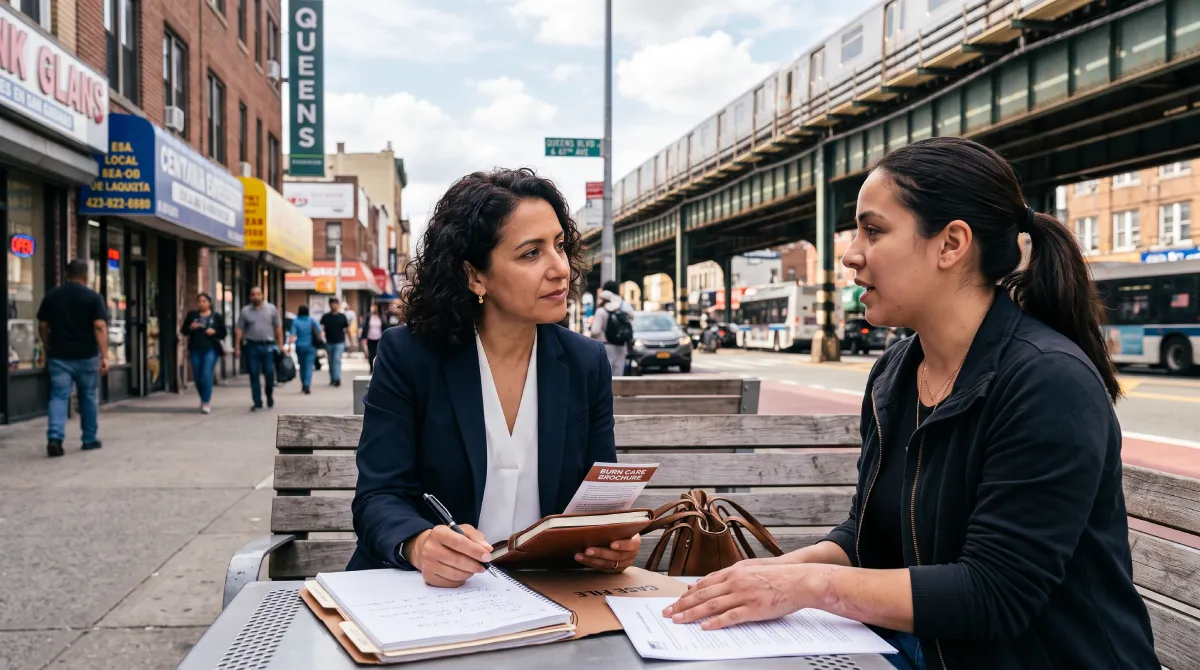
A serious burn puts you in a hospital bed for weeks while the bills climb and an insurance adjuster is already asking for a recorded statement. A Queens burn injury lawyer at Silver Law Group can take that call for you — in English, Spanish, or Russian — and your first consultation is free, any hour of the day or night. When burns or smoke-damaged lungs make travel impossible, the attorney comes to your hospital room or your home instead of asking you to come to the Midtown office. You pay nothing to sit down, walk through what happened, and find out whether you have a case. Call 212-470-4544 to reach someone 24/7.
How Burn and Fire Injuries Happen in Queens
Most Queens burn cases start in the same few places: old buildings, busy kitchens, and the gas and electrical systems that run underneath both. The pre-war apartment stock across Jackson Heights, Elmhurst, Corona, and Woodside was wired decades before anyone ran a microwave, a space heater, and an air conditioner off the same circuit. Overloaded wiring behind a wall can smolder for hours before it breaks through, which is why so many apartment fires start at night while people sleep.
The other common sources fall into a short list:
- Kitchen fires along Flushing’s Main Street corridor, where restaurant grease and gas ranges run hard through every dinner service
- ConEdison gas line failures, where a leak in an aging main can turn a routine repair into an explosion that reaches tenants two floors away
- Vehicle fires after a crash on the Long Island Expressway or Grand Central Parkway, when a fuel line or an electrical fault ignites
- Scalding burns from failed water heaters and broken radiators that push water past safe temperatures
- Chemical burns from industrial cleaners, drain products, and solvents handled on the job
The cause of a fire and the reason it spread are two separate questions, and both decide who is responsible for your injuries. A fire might start with a tenant’s mistake but spread because the landlord never fixed a dead smoke detector or a blocked exit. Each of those failures points back to a decision someone made — a landlord who ignored a wiring complaint, a utility that skipped an inspection — and that decision is what makes them answer for your burns.
Lithium-Ion Battery and E-Bike Fires
Lithium-ion batteries are now one of the fastest-growing fire risks in the city. FDNY recorded 277 lithium-ion battery fires across the five boroughs in 2024, many traced to the e-bikes and scooters that delivery workers park and charge inside apartments overnight. These batteries do not burn like paper. A damaged or counterfeit cell can go from fine to a jet of flame in seconds, often with little warning, and it burns hot enough to trap everyone in the room.
Queens carries more of this risk than most of the city. Thousands of delivery workers across Flushing, Elmhurst, and Corona depend on e-bikes to earn a living, and many charge cheap replacement batteries in crowded apartments with a single exit. The Long Island City barge fire showed how far the danger reaches beyond any one home. If a battery, charger, or bike that failed on you was defective or sold without proper safety testing, the maker and the seller can both answer for the burns that followed.
Do You Have a Queens Burn Injury Case
You have a case when someone else’s carelessness caused the fire or made your burns worse than they had to be. In legal terms that carelessness is negligence: a person or company owed you a duty to keep you reasonably safe, broke that duty, and your injuries are the result. Proving it means showing what they should have done and did not do.
Several parties can carry that responsibility, and sometimes more than one does at the same time:
- Landlords who let wiring, smoke detectors, or sprinklers fall out of line with the NYC fire code
- Employers and site owners, who owe workers safe conditions under Labor Law §200 and heightened duties on construction sites under Labor Law §241
- Manufacturers of a defective heater, battery, or vehicle part, who answer under strict product liability even when they were not careless
- Contractors whose bad electrical or gas work set up the failure
- City agencies and NYCHA, when a public building or worksite created the hazard
Sharing some of the blame does not close the door on your claim. Under CPLR §1411, New York uses pure comparative fault, so you can still recover even if part of the fire was your fault. Your recovery is reduced by your share, not erased. That rule matters most in the first phone call after a fire: an adjuster who tells you the whole thing was your own fault is often trying to end the conversation before you find out that partial blame still leaves you a claim worth pursuing.
Burn Severity and Long-Term Injuries
Burns are graded by how deep they go, and the depth drives everything about your treatment and your claim. A first-degree burn stays in the top layer of skin and heals on its own. A second-degree burn reaches the layer beneath, blisters, and can scar. Third-degree burns destroy the full thickness of the skin, kill the nerve endings, and almost always need surgery. A fourth-degree burn goes past the skin into muscle, tendon, or bone, and it can cost you the use of a hand or a limb.
The deeper burns rarely end when the wound closes. Third- and fourth-degree injuries usually mean skin grafts, where surgeons move healthy skin to cover the burn, and repeated debridement, where dead tissue is cut away over many sessions to stop infection. What follows can last for years:
- Permanent disfigurement and scarring that no later surgery fully erases
- Lung damage from smoke and superheated air, which can leave you short of breath long after the skin heals
- Loss of movement when scar tissue tightens across a joint
- PTSD, flashbacks, and broken sleep, which New York law treats as real, compensable harm
A burn claim that stops at the emergency-room bill misses most of what the injury actually took from you.
What Your Queens Burn Injury Claim Is Worth
No two burn claims are worth the same, because the value tracks your specific injuries, the treatment still ahead of you, and how the burns change your ability to work and live. New York puts no cap on what a jury can award in an injury case, so the ceiling is set by your losses, not by a statute.
Your claim is built from two kinds of damages. Economic damages are the costs with a paper trail:
- Future surgeries, including the grafts and revisions serious burns often need for years
- Lost wages now and lost earning capacity later, if the injury keeps you from the work you did before
- Medical equipment, home care, and rehabilitation
Non-economic damages cover the harm that has no receipt but is just as real:
- Physical pain during treatment and the long recovery after it
- Permanent scarring and disfigurement, especially on the face, hands, or other areas people see
- The mental toll, from anxiety and PTSD to the loss of things you used to do without a second thought
When a landlord’s conduct crosses from careless into reckless — ignoring repeated wiring complaints, stripping out smoke detectors to save money — the law allows punitive damages, meant to punish that choice on top of what covers your losses. And if your burns came from a vehicle fire, permanent disfigurement clears the serious-injury threshold in Insurance Law §5102(d). That lets you step outside the no-fault system and sue the at-fault driver directly for your pain and suffering.
What to Do After a Burn Injury in Queens
The hours and days after a burn shape both your recovery and your claim. Take these steps in order, as soon as you are able.
- Get real burn care, not just an urgent-care visit. Serious burns need a specialized center — NewYork-Presbyterian/Weill Cornell runs the Hearst Burn Center — and getting there early lowers your infection risk and creates the medical record your case will stand on.
- Photograph everything: your injuries as they heal, the room, the appliance or wiring involved, and the scene before anyone cleans it up.
- Keep whatever caused the fire. A burned space heater, charger, battery, or e-bike is the evidence a product case depends on, so do not throw it out or send it back to the seller.
- Report the fire to FDNY and get the incident number. Their marshals investigate causes, and their report can help pin down where the fire started.
- Say no to a recorded statement from any insurer. The adjuster’s job is to get you talking early, while you are on pain medication and before anyone knows the full extent of your injuries.
Do as much of this as your condition allows. If you are in a burn unit and cannot manage any of it, that is exactly when calling a lawyer early matters most, because someone can preserve the evidence and handle the insurer while you heal.
What Hiring a Burn Injury Lawyer Costs
Nothing, unless your case wins. Silver Law Group takes burn cases on a contingency fee, which means you pay no money up front and no hourly bill along the way. The firm’s fee is a set percentage of what you recover, agreed to in writing before any work starts, and it comes out of the recovery only if there is one. If the case does not win, you owe the firm no fee at all.
Burn cases also cost real money to build — fire-cause experts, medical reviews, engineers who take apart a failed battery. Silver Law Group advances those costs, so you are not paying investigators while you are out of work. You get the same caliber of experts an insurance company would hire, without writing a check to bring them in. That is the point of contingency: whether you can fight a case should not depend on the cash in your account the week after a fire.
Deadlines to File a Queens Burn Injury Claim
Every burn claim in New York runs on a clock, and the shortest one can end your case before you feel ready to think about a lawsuit at all. Which deadline applies depends on who caused the fire.
- Three years to sue a private party — a landlord, a manufacturer, a contractor — under CPLR §214. This is the general injury deadline, and it runs from the date of the fire.
- 90 days to file a Notice of Claim if a City agency or NYCHA is involved, under GML §50-e. Let this short window pass and you can lose the right to sue the City at all, no matter how strong your case is.
- Two years to bring a wrongful death claim under EPTL §5-4.1 if the fire killed a family member, measured from the date of death rather than the date of the fire.
- Two years to file for workers’ compensation if you were burned on the job. That is a separate track from suing a negligent third party, and one does not replace the other.
These clocks run at the same time, and the earliest one controls. A fire in a City-owned building can trigger the 90-day notice while the three-year lawsuit deadline is still years away, but let the 90 days slip and the longer deadline stops mattering. The safest move is to get the dates pinned down in the first weeks, while the evidence is fresh and every option is still open.
Why Silver Law Group for Your Queens Burn Case
Insurance companies pay less when they believe a firm will not actually try the case. Silver Law Group prepares every burn case as if it is headed for a Queens jury, building the fire-cause proof, lining up the medical and engineering experts, and readying the file for the Queens County Supreme Court on Sutphin Boulevard in Jamaica. That readiness is what gives your claim weight at the negotiating table, long before any trial date is set.
The office sits at 49 West 37th Street in Midtown Manhattan, a short drive from Queens over the Queensboro Bridge, and the same line answers around the clock. Your first consultation costs nothing and can happen in English, Spanish, or Russian. If your burns keep you in a hospital bed, the attorney comes to you rather than making you travel. Call 212-470-4544 when you are ready to find out what your case involves and what the next step looks like.