

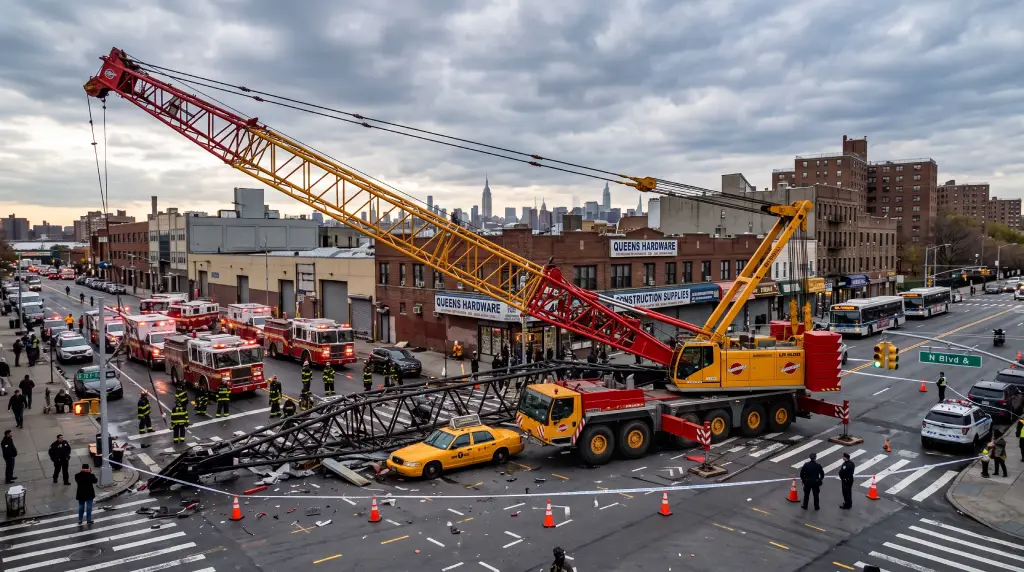
A Queens crane accident attorney at Silver Law Group represents the workers and bystanders hurt when a crane fails on a New York construction site. Whether a load dropped onto a Long Island City sidewalk or a boom collapsed over a job in Astoria, the firm handles Queens crane accident claims from the first hospital visit through trial. The consultation is free, and someone answers 24/7. Intake happens in English, Spanish, and Russian, and no fee is owed unless money is recovered for you. If you cannot leave a hospital bed, the attorney comes to you. Call 212-470-4544.
Do You Have a Crane Accident Claim in Queens
Two different people can sue after the same crane accident, and they sue under different law. If you were working the site, rigging the load, signaling the operator, or framing the floor below, New York’s Labor Law gives you protections that go past ordinary negligence, and they attach to the owner and general contractor whether or not your own employer carried enough insurance. If you were a pedestrian on the sidewalk when a load or a piece of debris came down, you have a direct personal-injury claim against the parties who controlled that site.
Your immigration status does not change any of this. New York’s Labor Law protects every construction worker on the job, and courts have held that a worker’s documentation status does not bar a Labor Law claim or the damages that follow from it. An employer who tells you otherwise is trying to keep you from calling a lawyer. Undocumented workers pursue the same Labor Law claims as anyone else hurt on a Queens site.
The question is rarely whether you have a claim. It is which claims you have, and against whom, and those answers depend on facts an attorney gathers in the days right after the crane comes down.
Types of Queens Crane Accidents We Handle
Cranes fail in a handful of recognizable ways, and each one points to a different set of causes and defendants.
- Tip-overs, when a mobile crane’s load or reach exceeds what its outriggers and the ground can hold. Soft fill and poorly plated setups are common on the fast-moving towers going up around Long Island City.
- Boom collapse from overloading, metal fatigue, or an operator swinging past the machine’s rated capacity.
- Dropped loads, when a hoist line, hook, or clamp lets go and steel or concrete falls onto the workers and the street below.
- Rigging failure in the slings, shackles, and chains that hold the load. A single mis-rated shackle can drop a load over an Astoria job.
- Power-line electrocution, when a boom or line touches overhead high-voltage near sites in Flushing and Jamaica. Contact can injure the operator and everyone touching the load at once.
- Swinging loads that strike workers or pin them against a structure during a lift.
The heavy residential and commercial building across Queens keeps mobile and tower cranes standing over occupied streets, which is why a dropped load here endangers pedestrians as often as workers.
Pedestrian and Bystander Injuries
You do not need to have been working to sue. A pedestrian struck by falling debris, a dropped load, or a swinging beam files an ordinary personal-injury claim, and workers’ compensation, which limits what an injured employee can collect, never touches it. Your case runs directly against the property owner, the general contractor, and any subcontractor whose crew created the hazard.
Because you are outside the comp system, you can pursue the full range of damages: every medical bill, your lost income, future care, and pain and suffering. A construction company on a Queens site owes a duty to the people walking past it, not only to the men on the scaffold. When a load comes down onto a Jamaica or Flushing sidewalk, that duty is the basis of your claim.
New York Labor Law 240, 241, and 200
Three sections of New York’s Labor Law decide most crane cases, and the strongest of them puts the risk on the owner and contractor instead of on you.
Labor Law §240, the section people call the scaffold law, covers elevation-related hazards: loads being hoisted, workers lifted, objects falling from a height because they were not properly secured. When a crane drops a load or a hoisting failure sends a worker down, §240 imposes strict liability on the owner and general contractor. Strict liability means that once the elevation hazard caused your injury, they cannot escape by arguing you were careless; your own conduct is not a defense the way it is in an ordinary negligence case. That single feature is why a Labor Law §240 claim is often worth pursuing even when comp is already paying.
Labor Law §241(6) requires owners and contractors to follow specific safety rules written into the Industrial Code. For crane work, that means 12 NYCRR Subpart 23-8, the mobile-crane provisions, with rules on load charts, outrigger use, ground conditions, and signaling. A documented violation of a concrete Subpart 23-8 rule is evidence of negligence you can build a case around, rather than a general claim that the site felt unsafe.
Labor Law §200 is the general-negligence section. It codifies the duty to provide a safe workplace and reaches parties who controlled the work, or who knew about the danger and did nothing. It carries no strict-liability shortcut, so it turns on proving what each defendant knew and controlled, which is why the maintenance logs and inspection records matter so much.
Who Is Liable for a Queens Crane Accident
A crane accident usually has more than one party at fault, and naming all of them is how you reach enough insurance to cover a catastrophic injury. Depending on how the failure happened, the defendants can include:
- the site or property owner
- the general contractor running the job
- subcontractors whose crew rigged, signaled, or loaded the crane
- the crane rental or leasing company that supplied the machine
- the operator, if the lift itself was mishandled
- the manufacturer of the crane or of a failed component
When a part breaks, whether a shackle, a hydraulic line, a brake, or a boom section, you may have a product-liability claim against the company that made or sold it, and that claim runs alongside your Labor Law case rather than replacing it. Product liability does not require proving the manufacturer was careless; a defect that made the equipment unreasonably dangerous is enough. Sorting out which theory fits which defendant is work an attorney does by pulling the rental contract, the maintenance file, and the inspection history before that paperwork disappears.
DOB Licensing Violations as Evidence
An operator running a crane without the license the city requires hands you a ready piece of evidence. Since November 7, 2024, New York City’s Department of Buildings has required an HMO license to run articulating boom cranes, mini cranes, and rotating telehandlers. These machines used to fall outside the older licensing rules, and the DOB closed that gap.
If the operator on your job lacked the HMO license, that violation is proof the site was not run the way the law demands. It supports a Labor Law §241(6) claim tied to the safety rules and feeds the §200 negligence theory about who let an unqualified operator lift a load. The licensing record is one of the first documents worth pulling after the accident.
Workers’ Compensation vs. a Third-Party Lawsuit
If you were on the clock, you have two separate paths, and the smart move is usually to run both. Workers’ compensation is the no-fault benefit from your employer’s insurer. You get it without proving anyone was at fault, but it comes with hard limits and hard deadlines.
To keep comp, tell your employer about the injury in writing within 30 days, and file your claim with the Workers’ Compensation Board within two years. Comp pays your related medical treatment and about two-thirds of your average weekly wage while you cannot work. What it does not pay is anything for pain and suffering, and it does not fully replace a high earner’s lost income.
A third-party lawsuit fills that gap. Comp bars you from suing your own employer, but it does not stop you from suing the other parties who caused the accident: the owner, the general contractor, the crane company, a manufacturer. Under Labor Law §240 and §241(6), that suit reaches the full range of damages comp leaves out, including pain and suffering and your true lost earning capacity. The two run in parallel, with comp keeping benefits flowing while the lawsuit builds. If the lawsuit recovers, the comp insurer is typically repaid part of what it advanced out of that recovery, which your attorney negotiates.
Compensation Available After a Crane Accident
A serious crane injury creates costs that land now and costs that arrive for years. A full claim under New York’s Labor Law reaches all of them:
- emergency care, from the ambulance and trauma team through your first surgery and hospital stay
- future medical needs: follow-up operations, hardware removal, physical therapy, long-term care
- lost earning capacity, meaning the paychecks already missed and the work you can no longer do
- pain and suffering, for the injury itself and the way it changes daily life
- permanent disability when a crush injury, amputation, or spinal damage ends a career in the trades
- disfigurement, including burns and scarring from power-line contact
When a crane accident kills a worker, the family’s claim changes shape. A wrongful-death action can recover the medical and funeral costs, the income the worker would have brought home, and the value of the support and guidance lost to the people who depended on them. That claim belongs to the estate and runs under its own deadline, which is shorter than the deadline for an injury case.
What to Do After a Crane Accident in Queens
What you do in the first days shapes what your claim is worth. In rough order:
- Get treated. Queens trauma care runs through Jamaica Hospital Medical Center, Elmhurst Hospital Center, and NewYork-Presbyterian Queens in Flushing. Go even if you think you can walk it off, because internal and head injuries hide.
- Photograph everything you safely can: the crane, the load, the rigging, the ground conditions, and your own injuries, before the site is cleaned up.
- Get names. The operator, the signal person, the foreman, and any witness who saw the load come down.
- Say nothing recorded to an insurer. An adjuster may call within days asking for a recorded statement. You are not required to give one, and it will be used to shrink your claim.
- Push to preserve the paperwork. The crane’s inspection reports, maintenance logs, and lift plan are the heart of the case, and they can vanish once a site reopens. A lawyer can send a preservation demand the same day.
Filing Deadlines for Queens Crane Accident Claims
Every crane claim runs on a clock, and the shortest one that applies to you controls. Miss it and the claim is gone no matter how strong it was.
For a personal-injury lawsuit, CPLR §214 gives you three years from the date of the accident to sue. That is the deadline for most injured workers and bystanders. If the accident killed someone, EPTL §5-4.1 gives the estate two years from the date of death to bring a wrongful-death action, a full year shorter than the injury deadline, which is why families should not wait.
A different clock starts the moment a government entity is involved. If the crane was on a city or state project, or a public agency shares the blame, General Municipal Law §50-e requires a Notice of Claim within 90 days of the accident, long before any lawsuit. Blow that 90-day window and you can lose the right to sue the public defendant at all.
A Queens case is filed in Queens County Supreme Court, the civil courthouse on Sutphin Boulevard in Jamaica. Keeping the case in the county where the accident happened puts it in front of a Queens jury, and it keeps the site, the witnesses, and the hospitals local to the court handling it.
Why Injured Queens Workers Choose Silver Law Group
You pay nothing up front, and you pay a legal fee only if the firm recovers money for you. That is what a contingency fee means: the fee is a percentage of the recovery, taken out of it at the end, so if there is no recovery there is no fee, and the risk of the case sits with the firm rather than with a worker who is already out of a paycheck. The initial consultation costs nothing either way.
Someone is reachable 24 hours a day, and the consultation can happen in English, Spanish, or Russian. If you are stuck at Jamaica Hospital or laid up at home, the attorney comes to you instead of making you travel while you are hurt. Every case is worked up as if it will be tried, because crane defendants and their insurers settle seriously only when the file is built for a courtroom.
If a crane accident has hurt you or someone in your family in Queens, call Silver Law Group at 212-470-4544. The office is at 49 West 37th Street, 7th Floor, in Midtown Manhattan, and the first call is free.