

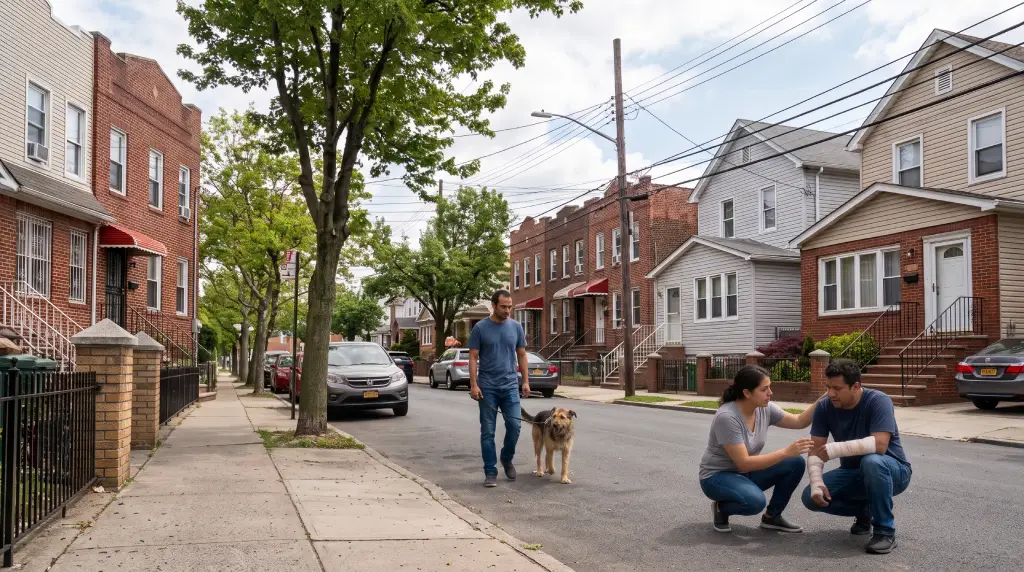
A dog attack in Queens can leave you with hospital bills, a permanent scar, and an insurance adjuster calling before your stitches are out. As a Queens dog bite attorney, Silver Law Group represents people bitten or knocked down by dogs across the borough, and we work to hold the dog’s owner and their insurer accountable for what you’re facing. Your first consultation is free, available 24 hours a day, in English, Spanish, and Russian, and you pay nothing to find out where your case stands. Call 212-470-4544 to reach a lawyer directly, or ask us to come to your home or hospital room if getting to an office is hard right now.
Do You Have a Dog Bite Case in Queens?
Three parties can owe you money after a Queens dog attack: the dog’s owner, the landlord who rented to that owner, and the property owner where the bite happened. Which one pays depends on who knew the dog was dangerous and who had the power to stop it. New York gives you two separate paths to recovery, and a strong case often pleads both. One is strict liability, which turns on whether the dog had shown dangerous tendencies before it bit you. The other is ordinary negligence, which turns on whether someone carelessly let the attack happen. The sections below break down each. Sharing some blame does not end your claim. Under CPLR §1411, New York follows pure comparative negligence, so if a court decides you were partly at fault, say you reached toward a dog that was clearly agitated, your recovery is reduced by your share of fault, not erased. Even a finding that you were mostly responsible still leaves a portion of your damages on the table. Provocation is a factor a jury weighs, not an automatic bar.
Strict Liability and the “One-Bite” Rule
Strict liability in a New York dog bite case rests on one question: did the owner know the dog was dangerous before it hurt you? The standard comes from Bard v. Jahnke, where the state’s highest court held that an owner is liable when the dog had shown a vicious propensity and the owner knew or should have known about it. You do not have to prove the owner was careless, only that the danger was known. Agriculture and Markets Law §123 adds a related route. Once a dog has been formally declared “dangerous” through a court proceeding, its owner is strictly liable for the medical and veterinary costs of a later attack. Evidence that the owner knew builds your case. Records of an earlier bite, neighbors who heard the dog growl or lunge at people through a fence, prior complaints to a landlord or to 311, each one helps show the propensity was there and the owner ignored it.
Negligence Claims After Flanders v. Goodfellow
For almost twenty years, New York was an outlier: you could not sue a dog owner for plain negligence. Under Bard v. Jahnke, strict liability was the only theory available, so if a dog with no bite history ran into the street and knocked you off your bike, you often had no claim at all — the owner’s carelessness didn’t matter without proof the dog was already known to be vicious. That changed on April 17, 2025. In Flanders v. Goodfellow, the New York Court of Appeals held that an injured person can bring an ordinary negligence claim against a dog owner, judged by whether the owner acted as a reasonable person would under the circumstances. You no longer have to prove the animal had a vicious past to recover. For your Queens case, this matters most when there is no prior-bite record. A dog left loose in an unfenced yard near a Jamaica sidewalk, or an owner who dropped the leash in a crowded park, is now a negligence question a jury can hear. The older strict-liability route still exists and still helps when the dog’s history is documented, so many claims now travel both roads at once.
When a Landlord or Property Owner Is Liable
A landlord can be on the hook even though the dog was never theirs. In Strunk v. Zoltanski, New York’s Court of Appeals held a landlord liable for a tenant’s dog attack because the landlord knew the animal was dangerous before renting to the tenant and still allowed it onto the property. Two things have to line up: the landlord knew about the danger, and the landlord had the power to do something about it — refuse to renew the lease, require the dog’s removal, bar it from common areas. This comes up often in Queens, where much of the borough lives in multi-unit buildings and two-family homes. A superintendent who fielded complaints about a dog lunging in a shared hallway, or a landlord who watched a tenant’s dog terrorize the courtyard and renewed the lease anyway, can put the building’s owner and their insurer into your case alongside the dog’s owner.
What Your Queens Dog Bite Claim Is Worth
What your case is worth depends on the wound, the scar it leaves, and how the attack changed your daily life. New York lets you recover both the money you’ve already lost and the harm that has no receipt. The damages that show up most often in Queens dog bite claims:
- Emergency and follow-up medical bills, including the rabies post-exposure shots a bite of unknown vaccination status usually requires, a series of injections over several visits rather than a single shot.
- Reconstructive and plastic surgery, which for deep bites often means more than one operation as the tissue heals and revises.
- Permanent scarring, especially to the face and hands, where a dog’s teeth tend to land and where scars stay visible for life.
- Lost wages while you recover, and lost earning capacity if a hand injury keeps you from the work you did before.
- Psychological injury, including post-traumatic stress and, in children, a lasting fear of dogs that can shape how they move through their own neighborhood. Scarring carries real weight with New York juries, because a permanent mark on a child’s cheek or an adult’s forearm is something jurors can see and understand without an expert explaining it. That visibility is part of why facial and hand injuries drive higher value than the raw medical bills alone would suggest. Photographing the wound early, before surgery and healing change how it looks, preserves that evidence while it is strongest.
Who Pays a Dog Bite Settlement in Queens?
The money in most Queens dog bite claims does not come out of the dog owner’s pocket. It comes from an insurance policy — usually the homeowner’s HO-3 policy on a house, or a renter’s policy in an apartment — which typically covers injuries the household causes, dog bites among them. That is why identifying where the owner lives and how they hold the property matters early. Two wrinkles can complicate the source of payment. Some policies carry breed exclusions, refusing to cover bites from breeds the insurer labels high-risk, which can leave a gap even when a policy exists. And when the injury is severe enough that the base policy limit won’t cover it, an umbrella policy sitting on top of the homeowner’s or renter’s coverage may apply. Sorting out which policies exist, what they exclude, and how they stack is work we do for you before any demand goes out. Pursuing the wrong policy, or missing an umbrella layer, can leave real money uncollected — which is one reason handling this yourself against a trained adjuster rarely goes well.
What to Do After a Dog Bite in Queens
The hours after a bite shape the claim you’ll be able to bring later. Work through these steps as soon as you’re able.
- Get medical care fast. For a serious bite, go to an emergency room; Elmhurst Hospital Center and Jamaica Hospital Medical Center both handle Queens dog attack injuries, and a bite that looks minor can seed a deep infection. The ER record also fixes the date and cause of your injury in writing.
- Find out whether the dog is vaccinated. Rabies status decides whether you need the post-exposure shot series, so ask the owner for proof of vaccination and note who told you what.
- Photograph everything. Shoot the wounds before they’re cleaned and stitched, keep shooting as they heal and scar, and get pictures of the dog and the spot where the attack happened.
- Identify the owner and any witnesses. Get names, a phone number, an address, and the dog’s description, because without this, tracing the right insurance policy becomes far harder.
- Report the bite to NYC Health by calling 311. A reported bite creates an official record, triggers a rabies check on the dog, and gives your claim a document you did not write yourself. Do all of this before you talk to the owner’s insurer, and never give a recorded statement in those first days.
What Hiring a Dog Bite Lawyer Costs
Hiring a dog bite lawyer here costs you nothing up front. Silver Law Group works on a contingency fee, which means we are paid only if we win money for you, and our fee is an agreed percentage of that recovery, taken out of the amount we collect rather than billed to you separately. If your case does not succeed, you owe us no attorney’s fee at all. The financial risk of bringing the case sits with the firm, not with you. That structure matters most for the person who is already behind on medical bills and can’t imagine adding a legal bill on top. You get a lawyer working your case, dealing with the adjuster, and preparing it for court without paying by the hour and without a retainer. The consultation that starts all of it is free.
How Long You Have to File a Queens Dog Bite Lawsuit
You have three years from the date of the bite to file a dog bite lawsuit in New York. That deadline comes from CPLR §214(5), and once it passes, the court will throw the case out no matter how strong it is. A much shorter clock applies when a government entity is involved. If the dog belonged to a city agency, or the attack happened on New York City Housing Authority (NYCHA) property, you generally must file a Notice of Claim within 90 days under General Municipal Law §50-e before you can sue at all. Miss that 90-day window and you can lose the right to bring an otherwise valid claim, years before the three-year deadline would have run. A Queens dog bite suit is filed in Queens County Supreme Court in Jamaica. The gap between a 90-day notice requirement and a three-year filing deadline is why getting the facts in front of a lawyer early protects you — the deadline that controls your case may be far closer than you think.
Why Choose Silver Law Group
Some dog bite cases settle with the insurer, and some have to be tried. Silver Law Group prepares every case as if it will go in front of a Queens jury, because an adjuster tends to offer more when the file is built for trial than when it looks built to settle cheap. If your injuries or your fear of the dog make it hard to travel, the attorney comes to you — at your home or your hospital room in Queens — so hiring a lawyer isn’t one more trip you have to make. Intake runs in English, Spanish, and Russian, so you can explain what happened in the language you actually think in, without a relative translating your medical history. What you get is a lawyer who answers the phone, prepares the case for court, and comes to you, with no fee owed unless you recover. Start with a free consultation, available 24/7, by calling 212-470-4544.