

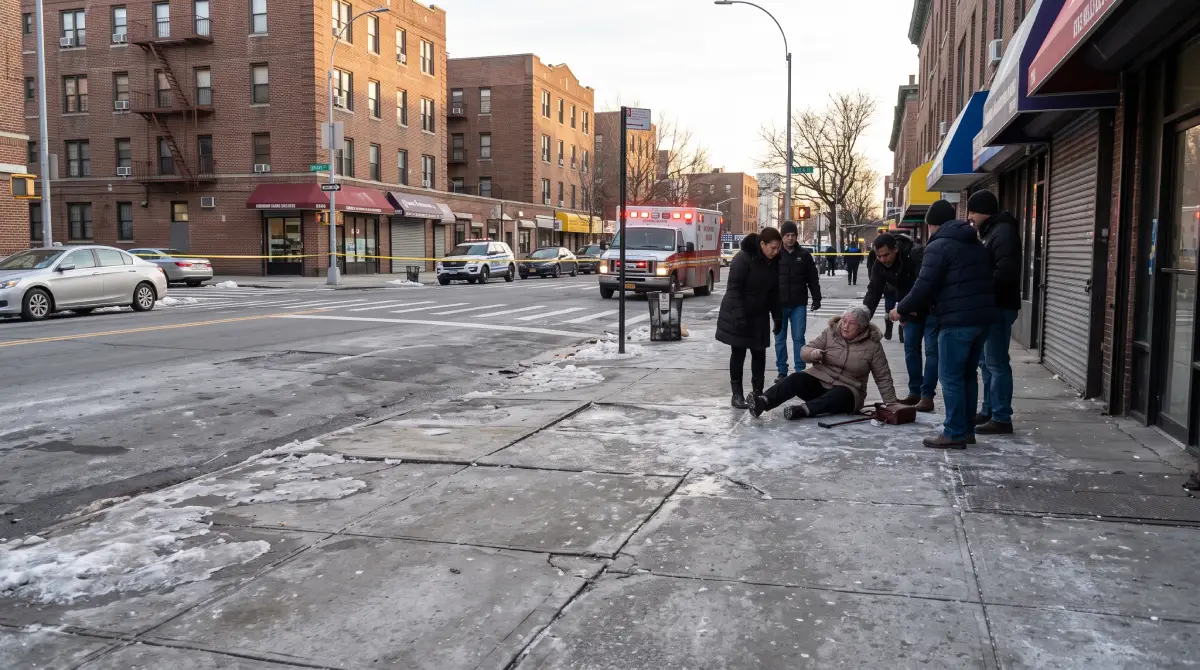
A fall on a wet bodega floor in Astoria, on a slick subway platform at Jamaica Center, or in a dark NYCHA lobby can leave you hurt and out of work in seconds. A Queens slip and fall attorney at Silver Law Group can tell you quickly whether the property owner is on the hook for your injury and what you should do next. The first consultation is free, and we handle it in English, Spanish, or Russian, over the phone or in person, at any hour of the day or night. You pay no fee unless we recover money for you. If your injury keeps you in a hospital bed or stuck at home, the attorney comes to you instead of the other way around. Call 212-470-4544 and you reach someone who handles Queens fall cases.
Do You Have a Slip and Fall Case in Queens?
Getting hurt on someone else’s property is not the same as having a case. New York premises liability turns on three things, and you need all three. First, a dangerous condition, meaning a torn floor mat, a spill left to spread, a broken stair tread, or ice on an untreated walk. Second, notice: the owner either created the hazard, knew about it, or should have known because it sat there long enough that a reasonable owner doing regular inspections would have found it. That second kind is called constructive notice, and it is where most Queens fall cases are won or lost. A puddle that formed two minutes before you slipped usually does not count. A puddle a manager walked past for an hour does.
Third, the owner failed to fix the hazard or warn you about it. A wet-floor sign in the right spot can defeat your claim, and the absence of one can make it.
There is a limit worth knowing early. If a hazard was open and obvious and not inherently dangerous, say a large box sitting in the middle of a dry, well-lit aisle you could plainly see, the owner may owe you nothing, because the law expects you to avoid what any careful person would notice. That defense is narrower than insurers pretend. Poor lighting, a distraction the store itself created, or a hazard you had no room to step around can all pull a case back from open-and-obvious. Whether your fall clears these hurdles is a fact question. Small details decide it: where you were looking, how long the spill sat, and who cleaned that aisle and when.
Who Is Responsible for Your Queens Fall?
The party that pays is the party that controlled the spot where you fell, and in Queens that can be more than one. Figuring out who had a duty to keep that floor, stair, or platform safe is the first real work of your case, because if you sue the wrong entity the clock can run out before you fix the mistake.
Likely defendants include:
- Store and bodega owners, for spills, cluttered aisles, and broken entry tiles on their premises.
- Landlords and their managing agents, for unlit stairwells, loose handrails, and hazards in the common areas of apartment buildings.
- NYCHA, when you fall in a public-housing development like Queensbridge or Ravenswood, a government landlord with its own strict notice rules.
- The MTA and NYCTA, for falls on subway platforms, stairs, and mezzanines in stations across the borough.
- The Port Authority, for hazards inside the JFK and LaGuardia terminals it operates.
More than one may share the blame. A managing agent that hired a careless cleaning contractor, and the property owner that let that contract run, can both be defendants in the same case. Naming every responsible party is what protects the full value of your claim, especially where a government agency’s short deadline sits next to a private owner’s longer one.
Falls on New York City Sidewalks
Where you fall on a Queens sidewalk decides who answers for it. Under NYC Administrative Code 7-210, the owner of the property next to the sidewalk, not the City, has the legal duty to keep that stretch of pavement in reasonably safe repair. A cracked, heaved, or sunken flag outside a Jamaica storefront is the store owner’s problem to fix, and their liability if it drops you.
One exception matters to a lot of Queens homeowners. If the abutting property is an owner-occupied home of one, two, or three families used only as a residence, that owner is exempt, and responsibility for the sidewalk shifts back to the City of New York. That single fact changes who you sue and which deadline governs, because a claim against the City brings a 90-day notice rule that a claim against a commercial owner does not.
Snow and Ice Falls
After it stops snowing, a Queens property owner does not get to leave the walk untouched. Administrative Code 16-123 gives owners four hours to clear snow and ice from the sidewalk once the snow stops falling, with the overnight hours between 9 p.m. and 7 a.m. left out of that count. Miss that window, let the walk turn to ice, and the owner can be liable for the fall that follows.
The timing cuts the other way too. Under the storm-in-progress doctrine, an owner is not expected to clear snow and ice while precipitation is still coming down, and a claim for a fall during an active storm usually fails. This is where insurers push hardest, arguing the storm had not ended when you fell. The weather record for that day and hour, from the nearest Queens reporting station, often settles the fight. If the snow stopped hours before you went down, the four-hour clock controls, not the storm defense.
Common Slip and Fall Injuries
The ground does not forgive a hard fall, and the injuries that follow range from painful to permanent. Some of the most common after a Queens slip and fall:
- Hip fractures, especially in older adults, often needing surgery and months of rehab.
- Wrist and arm fractures from the reflex of throwing a hand out to break the fall.
- Herniated discs, where the impact pushes spinal discs out of place and pinches nerves.
- Spinal cord damage, which can mean lasting weakness, numbness, or loss of function below the injury.
- Traumatic brain injury and concussions from the head striking tile, concrete, or a stair edge.
Not all of this shows up at the scene. A concussion can hide behind adrenaline for a day, and disc and soft-tissue injuries often stiffen and worsen over the following week. Get checked the same day, even if you feel able to walk away. The medical record you create early ties your injury to the fall, and any gap between the fall and your first visit is the first thing the insurer will use to argue you were hurt somewhere else.
What Is Your Queens Slip and Fall Case Worth?
No two Queens falls are worth the same, because the number is built from what the injury actually cost you, not from a chart. Your claim splits into two kinds of losses, and both count.
Economic damages are the ones with receipts. Emergency care, surgery, imaging, physical therapy, medication, and the medical bills still coming as you heal. The wages you lost while you could not work, and the earning power you lose for good if the injury keeps you from your trade. The cost of future care a doctor says you will need, from home help to follow-up procedures to equipment. These are proven with records, pay stubs, and expert testimony, and the stronger the documentation, the harder they are to knock down.
Non-economic damages cover what a receipt cannot capture: the pain itself, the sleep you lose, the hobby or job you can no longer do, the daily life the injury took from you. New York does not cap these in a standard fall case, but their value rests on how credibly your records and your own account show a real change in how you live.
What lowers a claim is not honesty about your limits but gaps in proof. A missed appointment, a downplayed symptom, or a fall you never reported all give the insurer room to argue your injury is smaller than it is. The documented loss is the case.
What to Do After a Fall in Queens
What you do in the first hours after a fall often decides the case months later. Move through these steps if you can:
- Report the fall to the owner, manager, or building super right away, and ask that it be written down.
- Get a copy of that incident report, or at least the name of the person you told and the time you told them.
- Photograph the hazard before anyone cleans it, capturing the puddle, ice, broken step, or missing handrail along with the surrounding light and signage.
- Keep the shoes and clothes you were wearing, unwashed, in case the insurer claims your footwear caused the fall.
- Get medical care the same day. In Queens that can mean the emergency room at Elmhurst Hospital Center or Jamaica Hospital Medical Center, or your own doctor, but do not wait.
Two things quietly sink cases here. Hazards get fixed within hours, so a photo taken before the mop comes out can be the only proof the condition existed. And falls reported days later invite the argument that they happened somewhere else. If you were taken straight to the hospital and could not do any of this, you have not lost your case, because a lawyer can pull the incident record, the store’s own footage, and the 911 and ambulance logs to rebuild what happened.
What If You Were Partly at Fault?
Being partly to blame does not end your Queens fall claim. New York follows pure comparative negligence under CPLR 1411, which means your recovery is reduced by your share of the fault but never wiped out by it. If you were texting when you tripped on a broken step and a jury puts 30 percent of the blame on you, you still recover 70 percent of your damages.
Watch the word an adjuster or a competing site may use. Some call this “contributory negligence,” which is a different, harsher rule from other states that can bar recovery entirely if you were even slightly at fault. New York does not use it. Under the actual rule here, even a plaintiff found mostly responsible still collects the remaining percentage.
This is exactly why insurers push fault onto you early, in the recorded call and in how they frame the incident report. Every point of blame they pin on you comes straight off your recovery, so the story of how the fall happened is worth as much as the medical file. Do not hand them that story before you have talked to a lawyer.
Deadlines to File a Queens Slip and Fall Claim
Every Queens fall runs on a clock, and which clock applies depends entirely on who you are suing. Miss the deadline for your defendant and the case is over before its merits are ever heard.
Against a private property owner, such as a store, a bodega, or a private landlord, you generally have three years from the date of the fall to file suit, under CPLR 214. That is the longest and most forgiving deadline, and even it disappears the day it expires.
If your loved one died from the fall, a wrongful death claim under EPTL 5-4.1 must be brought within two years of the death, a separate and shorter clock than the injury deadline.
Government defendants change everything. If you fell in an NYCHA development, in a subway station run by the NYCTA, or on City-owned property, General Municipal Law 50-e requires a formal Notice of Claim within 90 days of the fall. That notice is not the lawsuit itself; it is a sworn document that must be served correctly and on time, or the claim behind it can be lost for good. The Port Authority, which runs the JFK and LaGuardia terminals, sets its own trap: a notice of claim at least 60 days before you sue, and the suit itself within one year.
These deadlines do not wait for you to feel better or finish treatment. The 90-day and 60-day government clocks in particular can run out while you are still in physical therapy, unaware a public agency was ever involved. The single most useful thing a lawyer does early is identify every defendant and calendar every deadline before one quietly closes.
Why Injured Queens Residents Choose Silver Law Group
Here is how paying us works, in full and only once. You owe nothing up front and nothing out of pocket while your case runs. Our fee is a percentage of what we recover for you, taken only if we recover, which is what a contingency fee means. If we recover nothing, you owe us no attorney’s fee. That arrangement exists so that being hurt and short on money does not keep you from a lawyer, and so our interest and yours point the same way: we get paid when you do.
Around that, a few things matter to Queens clients. The first consultation is free, and you can have it in English, Spanish, or Russian, at any hour, because falls do not keep business hours. If your injury keeps you in a bed at Elmhurst or Jamaica Hospital or at home, the attorney comes to you rather than making you travel hurt.
We prepare every case as if it will be tried. Insurers track which firms fold at the courthouse door and which do not, and a case built for trial from day one is treated differently in settlement talks. If yours does go to court, Queens slip and fall suits are filed at the Queens County Supreme Court, 88-11 Sutphin Boulevard in Jamaica. When you are ready to talk, call 212-470-4544.