

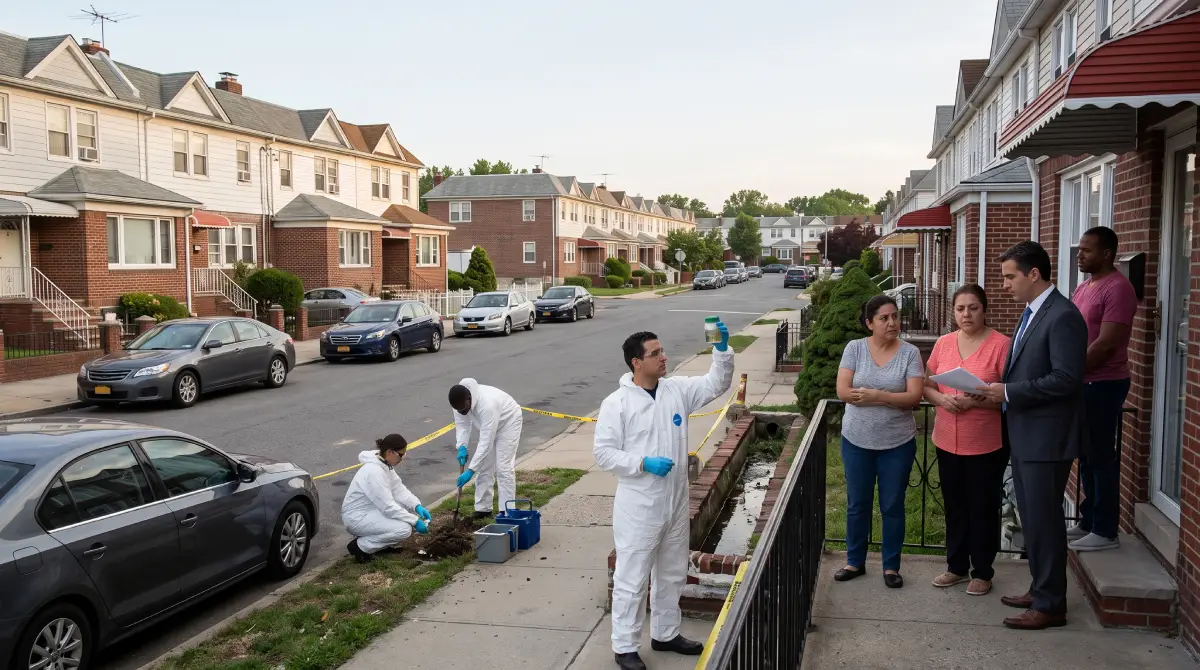
If a chemical or contaminant made you sick in Queens, Silver Law Group represents residents and workers across the borough in toxic-exposure claims. Our Queens toxic tort lawyers work on contingency: no fee unless you recover. Call 212-470-4544 at any hour, because the consultation is free, and it is free in English, Spanish, and Russian. If your illness keeps you in a hospital bed or at home, the attorney comes to you instead of making you travel to Midtown. These cases turn on medical timing and on proof that is hard to rebuild years later, so the sooner a lawyer starts documenting what happened, the stronger your claim stands.
Do You Have a Queens Toxic Exposure Case?
A toxic tort case stands on four things you have to prove, and the middle two are where these cases are won or lost. Duty comes first. The party that exposed you owed you a legal obligation: an employer to keep a worksite safe, a landlord to keep a building free of known hazards, a manufacturer to warn about what its product releases. Breach is the failure to meet that obligation.
Causation is proof that the specific substance caused your specific illness, and in toxic cases it splits in two: that the chemical is capable of causing your disease, and that it did cause it in your body. Harm is the diagnosed injury itself, the cancer or lung disease or neurological damage, along with everything it costs you. Causation is the fight. A defendant will rarely argue it never used benzene; it will argue your leukemia came from something else. That is why the substance and the diagnosis have to be tied together with medical and industrial records, not assumptions. The exposures that support a claim in Queens include:
- Asbestos, still sitting in older buildings, pipe insulation, and demolition debris
- Lead paint in housing built before 1978
- Benzene, a solvent linked to blood cancers
- Silica dust from cutting stone, concrete, and masonry
- Industrial solvents used in manufacturing and auto work
- Pesticides sprayed in commercial and residential settings
- Toxic mold in water-damaged apartments and workplaces
Not every exposure becomes a case. What turns exposure into a claim is a documented substance, a diagnosed harm, and a party that had a duty to prevent it.
Where Toxic Exposure Happens in Queens
Some of the borough’s contamination is mapped and named. In Ridgewood, the former Wolff-Alport Chemical Company site left radiological contamination in the ground from its years of chemical processing, and it is now a federal Superfund cleanup; the streets and buildings around it carry a documented history a claim can be built on. Along the Queens side of Newtown Creek, one of the most polluted waterways in the country, decades of oil, solvent, and industrial discharge soaked into a corridor that a federal Superfund investigation is still working through. The working parts of the borough carry their own risk.
Long Island City and Maspeth hold clusters of manufacturing, warehousing, and auto and metal shops where benzene, solvents, and silica are part of the daily air. People who worked those floors for years, and people who lived next to them, breathed the same exposures. Then there is housing. Any Queens apartment or house built before 1978 may still hold lead paint, and in a borough with this much pre-war and mid-century stock, that is a large share of the homes. Lead does its worst damage to young children, whose growing bodies absorb it fast, and the harm often shows up as developmental and neurological problems long after the exposure. Where you were exposed shapes who is responsible and which records exist. A Superfund designation creates a public paper trail. An industrial employer keeps safety and monitoring logs. A pre-1978 building has an ownership and violation history. Naming the place is the first step toward naming the defendant.
What Your Toxic Tort Claim Is Worth
New York law lets you recover several categories of loss, and toxic cases tend to carry heavy ones because the illnesses are serious and long-running. Here is what you can pursue.
- Past and future medical care. Toxic diseases are treated over years, not weeks. Chemotherapy, surgery, oxygen therapy, monitoring scans, and the care you will still need a decade from now all count, and the future portion is often the largest part of a serious claim.
- Lost earning capacity. If your illness cut your career short or forced you into lighter work, the claim covers the wages and the earning power the exposure took, not just the paychecks you have already missed.
- Pain and suffering. The physical pain, the treatment, and the daily toll of living with a chronic or terminal disease are compensable losses in their own right.
- Wrongful death. When exposure kills, the surviving family can bring a claim for the financial support they lost and, through the estate, for what the person went through before death.
Punitive damages sit apart from all of these. They are not meant to repay a loss; they are meant to punish a company that knew a substance was dangerous and exposed people anyway, and to make that choice expensive enough to deter it. New York sets a high bar for them, but they exist precisely for reckless corporate conduct, like a manufacturer that buried what it knew about its own product. The size of any claim depends on the diagnosis, your age and earnings, and how strong the causation proof is. No lawyer can price your case honestly before those facts are in.
Who Is Liable for Your Exposure
More than one party is usually responsible for a single exposure, and finding all of them is what separates a full recovery from a partial one. Your employer is the obvious starting point, but in New York the employer is also the hardest to sue directly, because workers’ compensation usually blocks a lawsuit against them. The next section explains that trade-off. It makes the other defendants matter more. Product manufacturers are the ones who often pay in toxic cases. The company that made the asbestos insulation, the benzene-based solvent, or the pesticide had a duty to warn users about what its product does to the body. That duty runs to you whether or not you ever had a contract with them, and it does not vanish because your employer is the one who handed you the product.
Landlords carry specific lead-paint duties in New York City. Under Local Law §1, the owner of older housing must find and fix lead-paint hazards in any apartment where a young child lives, and failing to do it is a breach you can build a claim on if a child in that unit is poisoned. Property owners more generally owe a duty to keep their premises reasonably safe from known contamination. On a construction or renovation site, Labor Law §200 puts a duty on owners and general contractors to provide a safe workplace, which can reach the party that controlled the site where you inhaled silica or disturbed asbestos. The point of naming every defendant is practical. Each one carries its own insurance, and a company that has closed its doors can sometimes still be reached through the coverage it held when the exposure happened.
Workers’ Comp vs. a Third-Party Lawsuit
If you were exposed on the job, two separate tracks run at once, and understanding the difference decides how much you can recover. Workers’ compensation is the first track. It pays medical treatment and a portion of your lost wages without you having to prove your employer did anything wrong, which is its advantage when you are sick and need coverage now. The catch is written into the deal: in exchange for that no-fault payment, you generally cannot sue your employer, and workers’ comp pays nothing for pain and suffering.
For a disease that reshapes your life, wage replacement alone leaves most of the loss uncovered. The second track is a third-party lawsuit, and it is where the real recovery in toxic cases usually lives. It targets everyone responsible who is not your employer: the manufacturer that made the toxic product, a subcontractor that controlled the site, a property owner who let the hazard sit. Because these parties are outside the workers’ comp bargain, a claim against them can recover the full range of damages, including the pain and suffering that comp refuses and the future losses that comp underpays. The two tracks are not either-or. You can collect workers’ comp while your third-party case proceeds, though the comp insurer will usually get repaid out of a later recovery. Sorting that overlap correctly is part of what a lawyer does before it costs you money.
Proving Causation in Latent Illness Cases
Toxic diseases arrive late, and that delay is the defense’s best weapon. Mesothelioma can surface 20 to 40 years after the asbestos that caused it. Benzene-linked leukemia and other blood cancers also develop long after exposure ends. By the time you are diagnosed, the job may be gone, the product discontinued, the company sold, and your own memory of which building and which year is fuzzy. Proof gets rebuilt from the outside in.
Medical experts connect your specific diagnosis to the specific substance and rule out other causes. Old employment files, union records, product invoices, and site histories reconstruct where you were and what you breathed. Defendants attack every link, arguing the exposure was too small, too brief, or too long ago to blame. Winning means building the record they cannot pull apart, and the sooner that reconstruction starts, the more of it survives.
How Long You Have to File in Queens
The clock in a toxic case does not start when you were exposed. It starts when you discover the injury, and missing it ends the case no matter how strong the proof. Under CPLR §214-c, you have three years from the date you discovered your injury, or reasonably should have discovered it, to file suit. That discovery rule exists because toxic illnesses hide for decades; a rule tied to the exposure date would bar almost every mesothelioma or benzene case before the victim knew they were sick. CPLR §214-c(4) adds a narrow extension for the hardest cases.
If you knew you were injured but the cause was not yet known and could not have been known through reasonable diligence, you may get one additional year from the date you discover the cause, provided you meet the statute’s proof requirements. CPLR §214-f addresses contamination sites directly. When a substance comes from a federal Superfund site, the law opens a filing window tied to the site’s designation, which can revive claims that the ordinary three-year clock would otherwise have closed. For exposure connected to Newtown Creek or the Ridgewood Superfund site, that provision can matter. These deadlines interact, and the safe date is rarely the obvious one. Have a lawyer calculate your specific clock early, because the one thing no court will forgive is filing after it runs out.
Why Injured Queens Families Choose Silver Law Group
You are choosing a lawyer while you are sick and worried about money, so start with how the fee works. Silver Law Group takes toxic tort cases on contingency. You pay nothing to start and nothing along the way; the firm covers the cost of experts, records, and filing as the case runs. The fee is a percentage of what you recover, and it comes only out of a recovery. If the case brings in nothing, you owe nothing and you are not billed for the work or the expenses. The consultation is free and available 24 hours a day, in English, Spanish, and Russian. If your treatment keeps you in a hospital bed or at home, the attorney comes to you rather than asking you to travel. Call 212-470-4544 to start. The firm’s office is in Midtown Manhattan, and a Queens toxic tort case is filed and heard in Queens Supreme Court in Jamaica. Every case is built to be tried in that courtroom, and cases built that way tend to settle from a position of strength.