

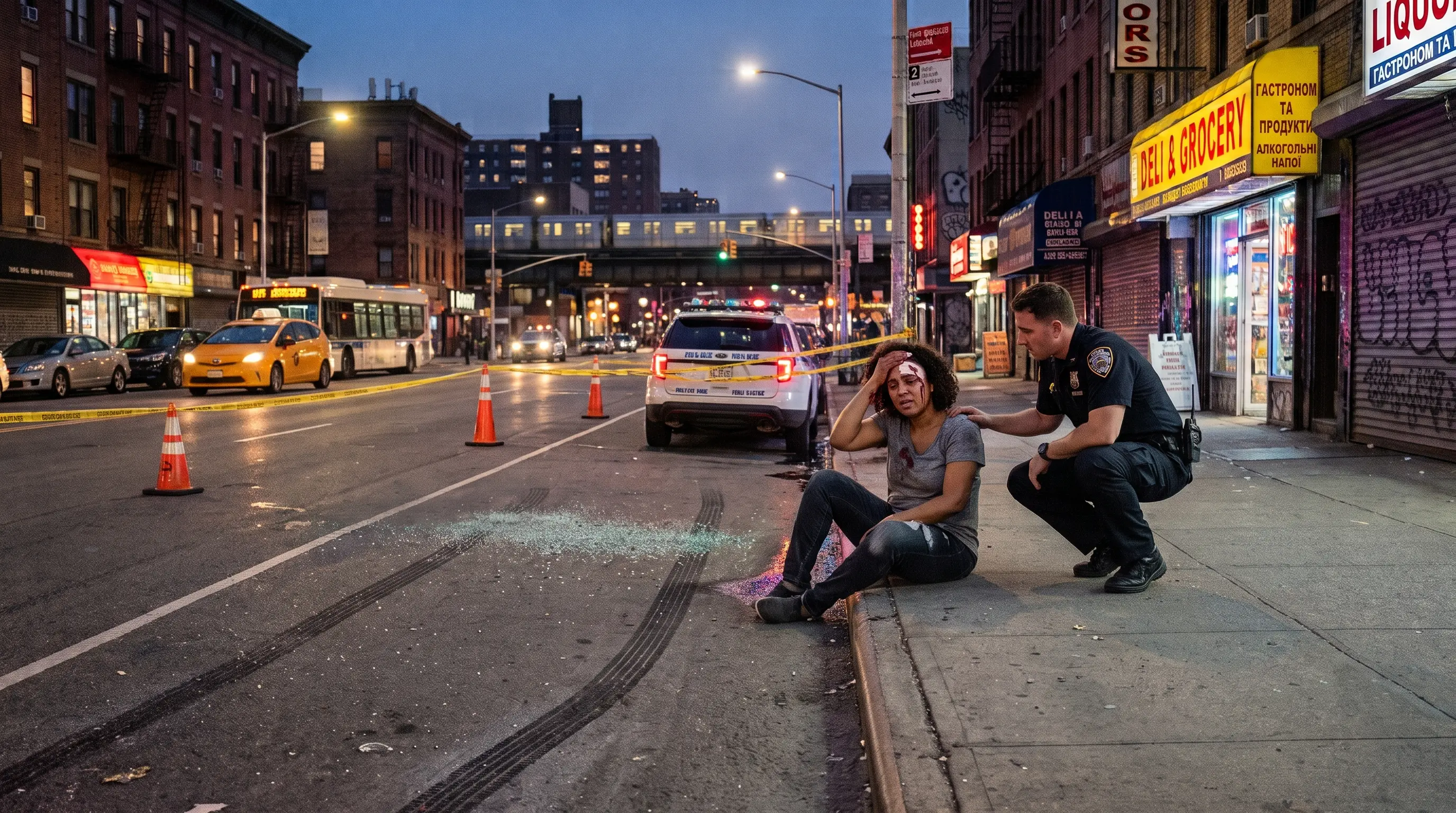
When a driver flees, your case splits into two tracks based on whether law enforcement can locate them:
- Driver is identified: You pursue a standard personal injury claim against their liability insurance — and their personal assets if coverage falls short.
- Driver is never found: You pursue no-fault PIP benefits, your own uninsured motorist (UM) coverage, and potentially a claim through the Motor Vehicle Accident Indemnification Corporation (MVAIC).
- Driver is found later: A case that began as uninsured can shift tracks entirely, which is why preserving evidence from day one matters.
Both tracks can produce substantial compensation. The difference is which insurance pool pays — not whether you have a claim.
Immediate Steps to Take After a Bronx Hit and Run
The actions you take in the first 24 hours directly determine the strength of your claim.
- Call 911 immediately. A police report is required to file a no-fault claim and is critical for any MVAIC or UM filing. Without it, insurers have grounds to deny benefits from the start.
- Stay at the scene until officers arrive. Leaving — even if you're not at fault — can complicate your claim.
- Collect everything you can: the make, model, color, and partial plate of the fleeing vehicle; names and phone numbers of witnesses; photos of your injuries, vehicle damage, and the surrounding area.
- Note any surveillance cameras on nearby businesses, traffic signals, or building entrances. This information is time-sensitive.
- Seek medical care the same day — not the next morning, not after the weekend.
Why You Must See a Doctor the Same Day
Adrenaline masks serious injuries, and delayed treatment gives insurers grounds to deny your claim.
Spinal compression fractures, traumatic brain injuries, and internal bleeding routinely present with minimal immediate pain. By the time symptoms become undeniable, you may be 48 or 72 hours out from the crash. New York no-fault law requires you to seek treatment within 30 days to preserve PIP benefits — but insurance adjusters will challenge any gap, however short. A same-day emergency room visit creates a documented link between the crash and your injuries that is nearly impossible to attack later.
How to Preserve Evidence Before It Disappears
Skid marks fade, surveillance footage overwrites, and witnesses scatter within hours of a crash.
Evidence in a hit and run deteriorates faster than in any other accident type:
- Traffic and bodycam footage at many intersections overwrites on a 24–72 hour loop.
- Physical road evidence — skid marks, debris fields, vehicle paint transfer — is destroyed by weather and traffic within hours.
- Witnesses have no legal obligation to preserve contact information and often cannot be located after 48 hours.
- Business surveillance systems often require a formal legal preservation letter before they will hold footage.
An attorney can send preservation notices the same day you call. Waiting costs you evidence you cannot recreate.
Who Pays Your Medical Bills When the Driver Is Unknown
New York's no-fault PIP system covers your medical costs regardless of who caused the accident.
New York is a no-fault state. Your own auto insurance policy — or the policy on the vehicle you were in — must pay your medical expenses and a portion of your lost wages up to $50,000 per person, regardless of fault. This applies even in a hit and run where the at-fault driver is gone.
Key facts about no-fault in a Bronx hit and run:
- Coverage applies whether you were driving, a passenger, or a pedestrian struck by a vehicle.
- You must file your no-fault application within 30 days of the accident.
- No-fault covers necessary medical treatment, 80% of lost wages (up to $2,000/month), and certain other out-of-pocket costs.
- No-fault does not compensate pain and suffering — that requires a separate personal injury claim.
If you do not have your own auto insurance policy, MVAIC (discussed below) can act as the no-fault insurer of last resort.
How to Recover Compensation Without Identifying the Driver
Uninsured motorist coverage and MVAIC provide financial recovery even when the at-fault driver is never found.
Beyond no-fault, two primary recovery options exist when a hit and run driver is never identified:
Uninsured Motorist (UM) Coverage- Required on all New York auto policies.
- Treats an unidentified hit and run driver as an uninsured motorist.
- Covers pain and suffering, serious injuries, and damages that exceed no-fault limits.
- Requires that physical contact occurred between the fleeing vehicle and your car or body — New York law does not allow UM claims based solely on a forced-swerve with no contact.
- Filing deadlines are typically within 30 days of the crash under most policies.
- A state-established fund for victims with no applicable insurance coverage.
- Pays both no-fault benefits and bodily injury compensation.
- Subject to its own strict claim deadlines.
Filing an MVAIC Claim as a Last Resort
MVAIC covers Bronx residents who have no applicable insurance policy of their own to fall back on.
If you were a pedestrian, cyclist, or uninsured driver struck by an unidentified vehicle, MVAIC is often your primary recovery path. Filing requirements are strict:
- A police report must exist for the crash.
- You must file a Notice of Intention with MVAIC within 90 days of the accident.
- You must demonstrate you are a "qualified person" — generally, a New York resident without access to any applicable auto insurance policy.
- Compensation limits apply, and MVAIC defends claims actively — meaning they will challenge your injuries and liability.
An attorney familiar with MVAIC procedures significantly improves outcomes. These claims are procedurally different from standard insurance negotiations, and errors in the initial filing are difficult to correct.
How Lawyers Investigate and Identify Hit and Run Drivers
Attorneys access NYPD reports, traffic cameras, and surveillance networks that victims cannot reach alone.
A substantial portion of hit and run drivers are eventually identified — often because of evidence collected in the hours after the crash. Here is what a legal investigation looks like:
- NYPD and MTA camera footage: Attorneys can send formal preservation and subpoena requests to agencies that do not respond to individual requests.
- Automated License Plate Reader (ALPR) data: The NYPD operates one of the largest ALPR networks in the world. That data is not publicly available but is accessible through litigation.
- Private business surveillance: Law firms routinely send preservation letters to gas stations, bodegas, banks, and parking garages along the route.
- Witness canvassing: Investigators can return to the scene at the same time of day to find witnesses who follow the same routine.
- Vehicle damage databases: Paint transfer analysis and debris can identify the make and model of the fleeing vehicle, narrowing searches significantly.
- Social media and community network monitoring: Drivers sometimes post about crashes or are reported by others who witnessed the incident.
Even a partial plate or a vehicle description can become a full identification with access to the right databases.
What Your Bronx Hit and Run Claim Is Worth
Compensation covers medical bills, lost wages, pain and suffering, and long-term disability costs.
No two cases produce the same number. Value is determined by the nature of your injuries, how they affect your life, and the available insurance coverage. Recoverable damages include:
- Medical expenses: Emergency room, surgery, imaging, physical therapy, future treatment needs
- Lost wages: Income lost while injured, plus reduced earning capacity if you cannot return to your previous work
- Pain and suffering: Physical pain, emotional distress, anxiety, PTSD, and lost enjoyment of daily activities
- Permanent disability: Disfigurement, loss of mobility, ongoing care costs
- Out-of-pocket expenses: Transportation to treatment, home care assistance, medication
New York's serious injury threshold applies to pain and suffering claims in auto accidents. To recover those damages, your injuries must meet a defined legal standard — fractures, significant disfigurement, permanent limitation of a body organ or member, or substantial disability for 90 of the 180 days following the accident. A lawyer evaluates whether your injuries cross that threshold before filing.
Critical Deadlines That Can End Your Right to Collect
New York imposes strict filing windows for no-fault benefits, uninsured motorist claims, and personal injury lawsuits.
Missing any one of these deadlines can permanently eliminate your right to compensation:
| Claim Type | Deadline |
|---|---|
| No-fault application | 30 days from the accident |
| UM claim notice to your insurer | 30 days (varies by policy — check immediately) |
| MVAIC Notice of Intention | 90 days from the accident |
| Personal injury lawsuit (general) | 3 years from the accident date |
| Wrongful death lawsuit | 2 years from the date of death |
| Claims against a city or public agency | 90-day notice of claim required |
The 3-year statute of limitations sounds generous. It is not. Evidence disappears, witnesses become unreachable, and insurers become less willing to settle as time passes. The first call — which costs nothing — is always better made today than next month.
Why Hit and Run Claims Are Harder Than Standard Car Accident Cases
Insurance companies treat unverified single-vehicle reports with extra skepticism and challenge evidence aggressively.
A standard rear-end crash involves two drivers, two insurance companies, and an exchange of documented information at the scene. A hit and run gives insurers an opening to argue:
- The second vehicle never existed — that your damage was pre-existing or self-inflicted
- Physical contact did not occur, defeating a UM claim under New York law
- Your injuries were caused by an unrelated incident, not the reported crash
- The delay between the crash and medical treatment breaks the causal chain
These arguments are not honest — they are tactics.
But they succeed against unrepresented claimants who do not know how to respond. An attorney's job is to close every one of those gaps with documented evidence before the insurer ever raises them.
What It Costs to Hire a Bronx Hit and Run Lawyer
You owe nothing upfront and pay only if your attorney wins compensation for you.
Silver Law Group works on a contingency fee basis. The mechanism is straightforward: if there is no recovery, there is no fee — period. You will not receive a bill for consultations, case preparation, investigation costs, or court filings if the case does not result in a recovery.
If there is a recovery, the attorney's fee is a percentage of that amount, agreed upon before representation begins. This model means:
- You can hire an experienced attorney regardless of your financial situation.
- Your attorney is financially incentivized to maximize your recovery.
- You are not paying hourly fees while injured and out of work.
Free consultations are available in English, Spanish, and Russian. Every case starts with that call — there is no commitment and no cost to find out what your claim is worth.
How Bronx Hit and Run Statistics Affect Your Case
The Bronx recorded over 1,776 injury-causing hit and run crashes in 2023, influencing local jury expectations.
The Bronx consistently ranks among New York City's highest-volume boroughs for hit and run accidents. That context matters in your case for two reasons:
It shapes how juries see these cases. Bronx jurors know these crashes happen constantly. They are not inclined to dismiss a hit and run claim as implausible — which counters the insurer's core defensive argument.
It puts pressure on NYPD investigation resources. With over 1,776 injury crashes in a single year, not every case receives sustained investigative attention. Private investigation through an attorney often produces results that NYPD follow-up does not. The driver who fled your crash may still be identifiable — but finding them requires resources and access that most victims cannot mobilize on their own.
Silver Law Group has handled hit and run cases across the Bronx and the greater New York area for years. The consultation is free. The case evaluation is honest. Call to find out exactly where your case stands.