

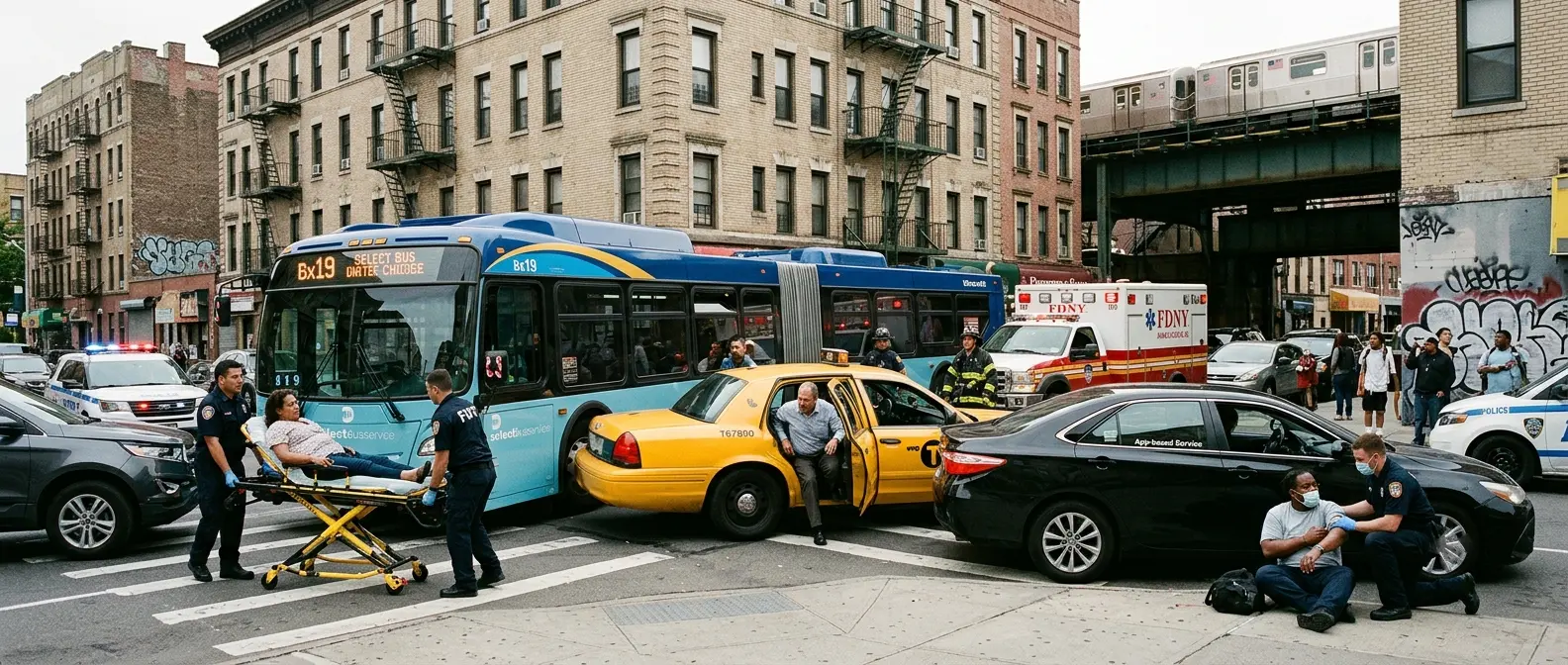
You may have a viable claim if:
- Another driver ran a red light, changed lanes without checking, or was speeding
- The driver of your vehicle was distracted, intoxicated, or driving recklessly
- A bus or commercial carrier failed to operate the vehicle safely
- A government agency failed to maintain a road, signal, or transit vehicle
- A rideshare or taxi driver caused or contributed to a collision
You do not need to prove you were careful. You were a passenger. New York law is built to protect you.
Who Can Be Held Liable for Your Injuries?
Liability may fall on one party — or several at once. That distinction matters because multiple defendants mean multiple insurance policies, which can significantly increase the total recovery available to you.
Potentially liable parties include:
- The driver of the vehicle you were in
- The other driver or drivers involved in the crash
- The owner of the vehicle (different from the driver)
- A trucking or livery company whose employee caused the accident
- Uber, Lyft, or another rideshare platform
- The MTA or another government transit agency
- A municipality responsible for a dangerous road condition
Your attorney's job is to identify every party whose negligence contributed to your injury — not just the most obvious one.
MTA and Government Agency Claims
If a city bus, subway, or government-owned vehicle was involved, a separate legal rule applies. You must file a Notice of Claim within 90 days of the accident. Miss that deadline and your right to sue the MTA or any government agency is permanently lost — regardless of how serious your injuries are.
This 90-day window is far shorter than the general statute of limitations. If a government vehicle was involved in your accident, contact an attorney immediately.
Rideshare and Taxi Company Liability
Uber and Lyft carry up to $1.25 million in liability coverage when a paying passenger is in the vehicle at the time of the crash. That coverage is active from the moment you enter the car until the moment the trip ends.
Yellow cab and black car operators in New York are required by the TLC to carry commercial liability insurance as well. These policies often exceed standard personal auto coverage — which matters when your medical bills are high.
Types of Passenger Accidents We Handle in the Bronx
Our firm represents injured riders across every vehicle type common to Bronx streets.
- Rideshare accidents — Uber, Lyft, and other app-based services
- Yellow cab and black car crashes
- MTA bus accidents — local routes, express buses, and BxM lines
- Private car accidents — as a passenger in a friend's or family member's vehicle
- Livery and for-hire vehicle crashes
- Commuter van and shuttle accidents
- Multi-vehicle collisions where you were a rear-seat passenger
- Hit-and-run accidents involving the vehicle you were riding in
No matter which type of vehicle you were in, the analysis starts the same way: who was negligent, who is liable, and what compensation does New York law entitle you to recover.
Common Injuries Sustained by Bronx Passengers
Spinal fractures, traumatic brain injuries, and soft tissue damage are the most frequent results of passenger accidents — but the full range of harm is wide.
Common injuries include:
- Herniated and bulging discs — often caused by sudden deceleration or impact
- Traumatic brain injuries (TBI) — ranging from concussion to permanent cognitive damage
- Broken bones — arms, legs, ribs, pelvis, and facial fractures
- Spinal cord injuries — with potential for partial or full paralysis
- Internal organ damage — frequently missed in emergency evaluations
- Whiplash and cervical injuries — soft tissue damage that often worsens over weeks
- Shoulder and knee injuries — torn ligaments and rotator cuff tears from impact
- Psychological trauma — PTSD, anxiety, and depression following serious crashes
Some injuries, particularly spinal and neurological damage, do not fully present for days or weeks. This is one of many reasons to see a doctor immediately after any accident — even if you feel "okay" at the scene.
What Compensation Can a Bronx Passenger Injury Claim Include?
You may recover every dollar of documented loss, plus compensation for harms that do not appear on a bill.
Economic damages (documented losses):
- Emergency room, hospital, and surgical costs
- Ongoing physical therapy and rehabilitation
- Future medical expenses for permanent or long-term injuries
- Lost wages while you were unable to work
- Reduced earning capacity if the injury affects your career long-term
- Out-of-pocket costs: medication, medical equipment, transportation to appointments
Non-economic damages (real harm without a receipt):
- Pain and suffering
- Loss of enjoyment of life
- Emotional distress and psychological harm
- Loss of consortium (impact on your relationship with a spouse or partner)
Serious injuries — spinal damage, TBI, disfigurement, permanent disability — typically result in the highest non-economic awards. These categories are where an experienced attorney adds the most value, because insurers routinely undervalue them.
New York No-Fault Insurance and When It Applies to Passengers
No-fault covers up to $50,000 in medical expenses and lost wages, regardless of who caused the crash. As a passenger, you are automatically entitled to no-fault benefits from the vehicle you were riding in — even if the driver of that vehicle caused the accident.
No-fault benefits cover:
- Medical treatment up to the policy limit
- 80% of lost wages, up to $2,000 per month
- Other reasonable expenses related to the accident
You must file a no-fault claim within 30 days of the accident or risk losing these benefits entirely.
When Your Injuries Exceed the No-Fault Threshold
No-fault was designed for minor injuries. When your injuries are serious, New York law allows you to step outside the no-fault system entirely and bring a direct lawsuit against the at-fault party.
New York's serious injury threshold is met if you suffered:
- Significant limitation of use of a body function or system
- Permanent consequential limitation of use of a body organ or member
- A fracture
- Significant disfigurement
- Medically determined injury preventing normal activities for at least 90 of the 180 days following the accident
Most injuries that require surgery, hospitalization, or extended recovery will meet this threshold. Once you cross it, you can pursue pain and suffering damages in full — not just the capped no-fault amounts.
Critical Deadlines That Apply to Your Bronx Passenger Injury Claim
Missing a filing window can permanently bar your right to compensation. These are not extensions or guidelines — they are hard cutoffs.
| Claim Type | Deadline |
|---|---|
| MTA / government agency — Notice of Claim | 90 days from accident |
| Standard personal injury lawsuit | 3 years from accident |
| No-fault benefit application | 30 days from accident |
| Wrongful death claim | 2 years from date of death |
The 90-day Notice of Claim requirement for government defendants catches more victims off guard than any other rule. If an MTA bus, NYPD vehicle, or city-owned car was involved, that deadline begins the day of the accident — not when you decide to pursue a claim.
What to Do Immediately After a Passenger Injury Accident in the Bronx
The steps you take in the first 24–72 hours directly affect what evidence is available and how strong your case becomes.
- Call 911. Get police and EMS to the scene. A police report creates an official record that names all drivers involved.
- Get the driver's information. License, registration, insurance card — for both drivers if there were two vehicles.
- Record the vehicle details. For taxis: the medallion number. For rideshares: take a screenshot of the trip in the app. For buses: the route number and bus number displayed on the exterior.
- Photograph everything. Vehicle positions, damage, road conditions, traffic signals, your visible injuries.
- Get witness contact information. Names and phone numbers of anyone who saw the crash.
- Seek medical care the same day. Even if you feel fine. A gap in treatment gives insurers a reason to argue your injuries were not caused by the accident.
- Do not give a recorded statement to any insurance company. Not the driver's. Not the carrier's. Not even your own. Speak with an attorney first.
- Contact Silver Law Group. The sooner we begin, the more evidence we can preserve.
How Bronx Passenger Injury Settlement Values Are Calculated
No formula produces an exact number — but the factors that drive value are consistent and well-documented.
Factors that increase settlement value:
- Severity of injury — permanent disability, surgical intervention, or long-term impairment produce higher values than soft tissue injuries that resolve
- Clear liability — when fault is undisputed or well-documented, insurers have less leverage to reduce offers
- High policy limits — a $1.25 million rideshare policy allows for a higher recovery than a minimum-limits personal policy
- Strong documentation — medical records, imaging, lost wage verification, and expert testimony all support a higher number
- Impact on daily life — inability to work, care for children, or perform basic tasks strengthens non-economic damages
Factors that reduce offers:
- Delayed medical treatment (the insurer argues the injury wasn't serious)
- Gaps in treatment
- A recorded statement that contradicts your injury claims
- Pre-existing conditions that overlap with your claimed injuries
An attorney's job is to maximize the first list and counter the second. That gap between an initial low offer and a fair settlement is where legal representation earns its value.
Why Passengers Who Do Nothing Still Lose Money to Insurance Tactics
Adjusters routinely contact injured passengers early — sometimes within 24 hours — to obtain statements that reduce payouts.
What an adjuster may do:
- Call you while you are still in pain and before you understand your full injuries
- Ask leading questions designed to minimize how the accident happened
- Offer a fast, low settlement before you know what your medical bills will total
- Ask you to sign a release that permanently closes your claim for less than it is worth
- Record a statement and use your words against you later in the process
Insurance companies are not on your side. Their adjusters are trained claims professionals whose job is to close your file at the lowest possible cost. Every dollar they pay you is a dollar they do not keep.
You are not required to speak with the other driver's insurer. You are not required to accept any offer before consulting an attorney. Once you sign a release, you cannot go back — even if your injuries turn out to be far worse than they appeared.
Do not let insurers close your claim for less than it is worth.
Once you sign a release, you cannot go back. Let Silver Law Group handle your case. Call today at 212-470-4544.
Why Hire a Bronx Passenger Injuries Law Firm?
Local courtroom knowledge and carrier-specific experience consistently produce higher recoveries than general representation.
What Silver Law Group brings to your case:
- Experience with MTA claims — including the 90-day Notice of Claim process and the procedural requirements that trip up out-of-borough firms
- Rideshare carrier experience — understanding how Uber and Lyft structure their insurance layers and when each coverage tier applies
- New York no-fault expertise — knowing when to move beyond no-fault and how to build a serious injury threshold argument
- Access to accident reconstruction specialists, medical experts, and life care planners who support high-value injury claims
- Trial readiness — insurers settle more — and for more — when they know the firm on the other side will go to court
- Free consultations in English, Spanish, and Russian
Silver Law Group has recovered millions of dollars for injured New Yorkers. That track record does not happen by accident — it happens because every case is built to go to trial, even when it settles.
No Fee Unless We Win Your Bronx Passenger Injury Case
You pay nothing upfront. Silver Law Group earns a fee only when compensation is secured for you.
Here is how contingency works:
- You pay $0 to start your case. No retainer. No hourly fees. No upfront costs.
- We advance the costs of investigating, filing, and litigating your claim.
- If we recover money for you, our fee is a percentage of that recovery — agreed upon in writing before we begin.
- If we do not recover, you owe us nothing.
This model means your interests and ours are exactly aligned. We only win when you win.
Your case will not cost you anything to explore. Call Silver Law Group for a free consultation. We will tell you honestly whether you have a claim, what it may be worth, and what happens next — before you decide anything.