

Silver Law Group represents explosion injury victims across New York City, the greater metropolitan area and the entirety of New York state. Our consultations are free, available in English, Spanish, and Russian, and our attorneys are reachable 24 hours a day. We work on contingency: you owe nothing unless we win your case.
Why Hire Our Manhattan Explosion Attorneys
Explosion cases are not standard personal injury matters. They involve federal pipelines, safety regulations, New York State fire codes, utility company internal protocols, and structural engineering questions that most law firms are not equipped to handle. We work with expert cause-and-origin investigators, gas engineering specialists, and accident reconstruction experts — the professionals whose testimony makes the difference between a dismissed claim and a multi-million dollar recovery.
Common Causes of Explosions in Manhattan
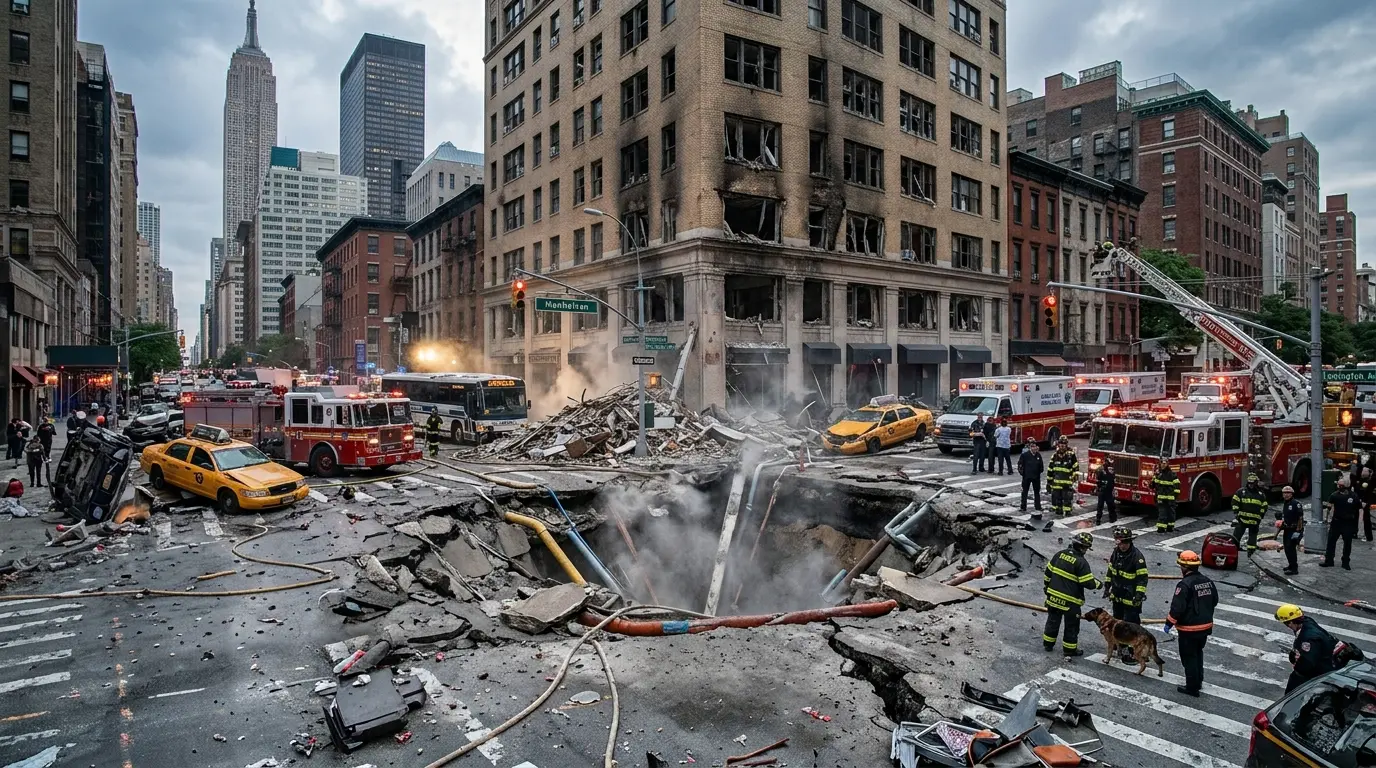
Manhattan's density makes it uniquely vulnerable. Nearly nine million people live and work above one of the most complex underground systems ever built — and large portions of that system are well past their intended lifespan. Explosions here injure tenants inside their apartments, workers on job sites, pedestrians on the sidewalk, and people nowhere near the source of the blast.
The City of New York and Government Agencies
When city-maintained infrastructure contributes to an explosion, the City of New York can be a defendant. But pursuing a government entity requires strict compliance with procedural rules. A Notice of Claim must be filed within 90 days of the explosion — before any lawsuit can be commenced. A lawsuit against the city must then be filed within 15 months of the accident. Missing the 90-day window is usually fatal to the claim and cannot be corrected after the fact. Contact an attorney immediately.
Con Edison and National Grid
Con Edison is responsible for gas distribution in Manhattan, the Bronx, and Northern Queens. National Grid covers Brooklyn, Staten Island, and parts of Queens. Both utilities have legal obligations to inspect, maintain, and repair the infrastructure they operate. When they fail — through deferred maintenance, missed leak detection, or negligent repair work — they are liable for the consequences.
Gas Pipe and Gas Line Explosions
Approximately 60 percent of gas mains beneath Manhattan are made of cast iron or unprotected steel — some installed more than 100 years ago. Con Edison operates the gas distribution network in Manhattan, the Bronx, and Northern Queens. When distribution lines corrode, when service lines fail, or when interior building piping goes unrepaired, gas accumulates and ignites. The results are catastrophic. The 2014 East Harlem explosion killed 8 people and injured 70. The 2015 East Village explosion destroyed three buildings and killed 2. Both traced directly to gas infrastructure failures.
Construction Site Explosions
Excavation work ruptures gas lines. Improper welding ignites flammable vapors. Pressurized equipment fails without warning. These are documented, recurring causes of construction site blasts across New York City. New York Labor Laws — specifically Labor Law 200, 240, and 241 — provide strong legal protections for injured workers, and liability can reach general contractors, subcontractors, and property owners even when the direct cause was the act of a subcontractor's employee.
Manhole and Underground Utility Explosions
Underground electrical fires and pressure buildups in utility vaults can launch manhole covers 50 feet or more into the air, with enough force to kill or permanently injure anyone nearby. Cable insulation fires — a known, recurring problem in New York's aged underground electrical network — are a documented cause. Con Edison and the City of New York are frequent defendants in manhole explosion cases.
Building Boiler and Heating System Explosions
Building owners have a legal obligation to maintain boilers and heating systems in safe operating condition. Improperly maintained equipment, deferred repairs, and failed pressure relief valves cause boiler explosions that can bring down walls, start fires, and injure tenants throughout a building — including in adjoining structures. When a landlord or property management company neglects that duty, they are liable for what follows.
Vehicle and Fuel Tank Explosions
High-speed collisions — particularly those involving commercial trucks or tanker vehicles — can rupture fuel lines and trigger post-impact fires that escalate into explosions. Victims may have claims against the negligent driver, the fleet operator that put an unsafe vehicle on the road, or a vehicle manufacturer whose defective fuel system contributed to ignition. An explosion accident lawyer can identify which parties are responsible and pursue all available defendants.
Building Owners and Landlords
From the meter inward, the gas piping, heating equipment, and appliances in a building are the owner's responsibility. The New York City Administrative Code and Multiple Dwelling Law impose specific maintenance duties on residential landlords. A landlord who ignores tenant complaints about gas odors, defers boiler maintenance, or allows illegal gas connections in the building has failed that legal duty. That failure can make them directly liable for every injury that results.
Employers and Third Parties in Workplace Explosions
Workers injured in an explosion on the job have two potential legal paths. Workers' compensation covers medical bills and a portion of lost wages, but it does not compensate for pain and suffering — and benefits are capped. A separate personal injury lawsuit against a negligent third party — a contractor, equipment manufacturer, or property owner — can recover those non-economic damages. You cannot sue your direct employer in a personal injury action under New York law, but third-party claims remain fully available and are often worth far more than workers' comp alone.
Do not let insurers or the other party push you around.
Let Silver Law Group handle your case and get you the answers you want and the results you deserve. Call today at 212-470-4544.
Proving Negligence in a Manhattan Explosion Case
A successful explosion claim requires proving four elements: the defendant owed a duty of care, they breached that duty, the breach caused the explosion, and you suffered damages as a result. In practice, proving causation in an explosion case demands forensic evidence — gas pressure records, pipeline inspection logs, Department of Buildings violation histories, maintenance contracts, and expert testimony from engineers and fire investigators. Evidence at explosion scenes degrades quickly and is often removed during emergency remediation. Time is a factor the law allows you to use. Do not wait.
Evidence Used to Build an Explosion Claim
Our work explosion law firm assembles and analyzes: FDNY and fire marshal investigation reports; NTSB findings in major incidents; Con Edison and National Grid maintenance, inspection, and repair records; Department of Buildings violations; surveillance footage from neighboring buildings and businesses; eyewitness accounts; expert reports from gas engineers and fire cause-and-origin investigators; emergency room and treating physician records; and life-care planning assessments projecting future medical costs. We manage every element of the investigation while you focus on your medical care.
Economic Damages
Economic damages are the documented financial losses you can prove with bills, pay stubs, and medical records: emergency treatment, surgery, burn and reconstructive care, hospitalization, physical and occupational therapy, mental health treatment, prosthetics and adaptive equipment, home modifications required by disability, lost wages during recovery, and projected loss of future earning capacity if permanent injury prevents you from returning to your prior work.
Non-Economic Damages
Non-economic damages compensate for what cannot be put on a receipt: physical pain, emotional suffering, permanent disfigurement, PTSD, loss of enjoyment of life, and loss of consortium for a spouse or dependent. In catastrophic explosion cases — severe burns, amputation, TBI — non-economic damages frequently represent the largest component of total compensation. These damages have no statutory cap in New York personal injury cases.
Statute of Limitations for Explosion Lawsuits in New York
New York generally allows three years from the date of an explosion to file a personal injury lawsuit. Wrongful death claims carry a two-year statute of limitations. Those deadlines are fixed — courts rarely extend them.
The exceptions are where timing becomes critical in Manhattan explosion cases. If the City of New York, a city agency, or a government entity is a defendant, a Notice of Claim must be filed within 90 days of the injury. A lawsuit against the city must then commence within 15 months of the accident. Miss the 90-day window and you lose the right to pursue the city entirely — it cannot be reinstated after the fact.
Workers injured on the job must report the explosion to their employer within 30 days and file a workers' compensation claim within two years. Third-party personal injury lawsuits remain subject to the three-year general statute. Talk to an explosion injury attorney as soon as possible after any incident. Every day of delay costs something.
What to Do After an Explosion in Manhattan
The steps you take in the hours and days after an explosion directly affect the strength of your legal claim. Here is what matters most:
- Get emergency medical attention immediately — even if you feel fine. Blast wave injuries, carbon monoxide poisoning, and internal injuries often present with delayed symptoms. A gap in medical care creates a gap in your case.
- Do not speak to insurance adjusters, Con Edison representatives, or any agent of a potentially liable party without first consulting an attorney. Recorded statements made in the aftermath of a traumatic event are routinely used to minimize or deny claims.
- Preserve all evidence you can access — photographs of your injuries, your clothing, the scene if safely reachable. Do not discard anything.
- Document everything going forward: every medical appointment, every symptom, every day you cannot work. A written log maintained from the beginning of your recovery is valuable evidence.
- Contact a Manhattan explosion lawyer at Silver Law Group as soon as possible. We can secure evidence, retain experts, and file the notices that protect your right to recover — before deadlines close those options.